Philadelphia Phillies at Kansas City Royals is a mid-summer interleague matchup, the National League Phillies visiting the American League Royals, and the way I read Phillies vs Royals odds has nothing to do with guessing who wins. It has to do with where the market is soft. This page shows you how the OddsShopper +EV board grades every price in the game: the de-vigged fair number, the best takeable price at the book paying the most, and the edge between the two. That gap is the whole point, and it is where the money is actually made.
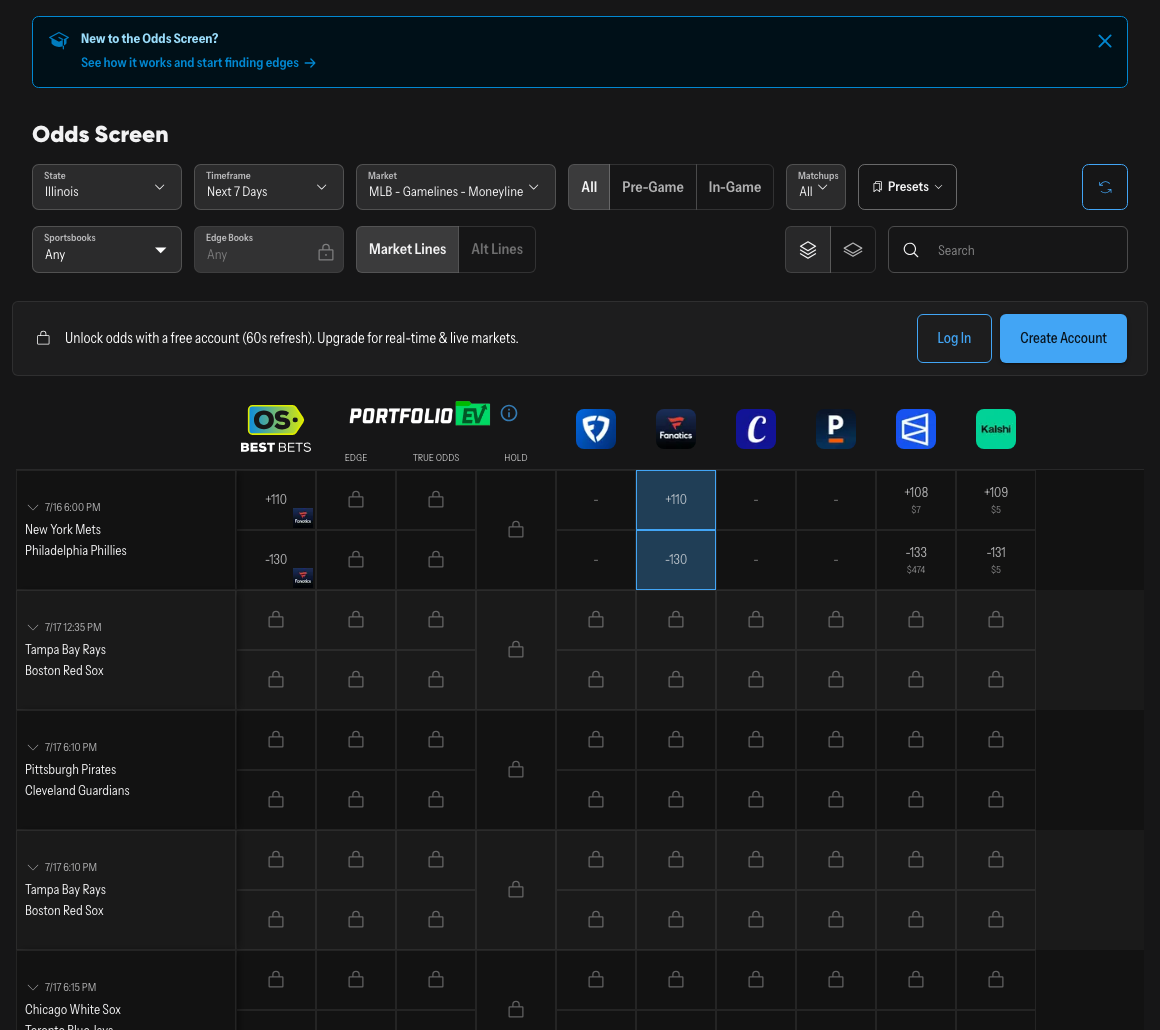 The OddsShopper live odds screen — every book's price on one board, refreshed in real time. Open the live board.
In Summary
- The Read On This Game: the value in Phillies vs Royals odds usually is not on the side you first think of. It lives in the price, not the pick, so the winning habit is line shopping the exact same bet across books.
- The Number I Keep Coming Back To: the de-vigged fair price. When the best available number beats it, you have an edge, and when it does not, you pass. That one comparison drives every decision below.
- The Method, In One Line: find the fair price, find the best posted price, take the play only when the second beats the first.
- Why It Matters: the same bet can be +170 at one book and +155 at another. Fire it at the wrong book and you have handed back the edge before first pitch.
- Tool Surfaces To Use: the OddsShopper +EV top bets screen for live prices, the odds screen for game lines, and the EV calculator to price any number yourself.
I built this page the way I actually bet a Phillies vs Royals game: I ignore the loud narrative, I let the board find the softness, and then I chase the best price on it. Below, I walk that process market by market.
Where The Value Lives In Phillies Vs Royals Odds
Most Phillies vs Royals prediction pages you will find hand you a single winner and a confidence percentage. That is the least useful thing you can know, because the market has already priced the favorite. Philadelphia is usually the road favorite in this matchup and Kansas City the home dog, and the closing line reflects that before you ever log in.
One matchup-specific wrinkle worth pricing in: Kansas City moved Kauffman Stadium's fences in for the 2026 season, pulling the left and right field walls roughly 9 to 10 feet closer and lowering the wall height. A park that spent decades as one of the toughest home-run venues in baseball now projects around 10% homer-friendlier than league average and about 7% above average for run scoring. That reshapes how the total and the hitter props read here, and a reputation that lags the new dimensions is exactly the kind of stale prior the market is slow to fully bake in.
The forward promise of this page is simpler and more durable: I am going to show you where the edge hides instead of who to pick. It hides in three places every card carries, and the same discipline unlocks all three. Read to the worked example below and you will have a repeatable process, not a one-day tip.
Moneyline, Run Line And Total: The Game Markets
Every Phillies vs Royals card carries the three core MLB game markets: the moneyline (who wins outright), the run line (the standard plus or minus 1.5 baseball spread), and the total (the combined runs scored, bet Over or Under). Those three are what the competitor pages lead with.
| Market | What you are betting | How to read it |
|---|---|---|
| Moneyline | Which team wins outright | The favorite pays less than even money; the home dog carries a plus-money premium |
| Run Line | The standard 1.5-run baseball spread | A favorite at -1.5 must win by two or more; a dog at +1.5 cashes even in a one-run loss |
| Total | Combined runs, bet Over or Under | Priced off the starters, the bullpens and the ballpark, and it moves late |
The run line is the row that trips up newer bettors. A Phillies -1.5 is a very different bet from a Phillies moneyline, because a one-run win still loses you the spread even though your team won the game, and that is precisely the kind of pricing nuance the de-vig is built to expose. The total is the one I watch most closely in this matchup: with Kauffman's moved-in 2026 fences pushing it about 7% over league average for run scoring, the reflex "pitcher's park, hammer the Under" read is the exact stale prior that can leave a soft number on the board.
I am deliberately not quoting a live game-line price here, because those numbers move with the posted starting pitchers, the bullpen usage from the night before, and the wind at Kauffman Stadium right up to first pitch. A stale number helps nobody. Instead, pull the live game lines the same way you would read any market: open the OddsShopper +EV top bets screen and let the de-vig do the work. New to the run line specifically? Our MLB run line explained primer walks through why minus 1.5 for a favorite is priced the way it is. The point holds across all three markets: I only take a side when the best available price beats the fair price.
How The +EV Board Prices This Game
Under the hood, the machinery is straightforward. The OddsShopper board pulls the price for each bet from every major book — DraftKings, FanDuel, Bet365 and more — and strips the vig out to compute a de-vigged fair number, the market's honest read with the book's margin removed. Then it compares that fair number to the best price anyone is currently posting.
That comparison is the edge. Because books do not move in lockstep, one will often lag, and line movement at the sharp shops shows up as a soft price left standing at a slower book. Watching that closing line value over time is exactly how you separate a real edge from noise. This is also why odds comparison across books matters more than any single book's number: the board is not telling you the price, it is telling you the best price.
A Worked Example: Turning A Fair Price Into An Edge
The math is easier than it sounds. Say a hitter's Under is posted at +170 at one book while the de-vigged fair price sits at +155. The fair price of +155 says that bet should hit about 39% of the time; +170 pays you as if it were only a 37% shot. Taking +170 on an outcome truly worth +155 is roughly a 6% edge, and a 6% edge means the book is paying you about 6% more than the bet is truly worth.
Run that same bet through the EV calculator and you will see the implied probability behind each number spelled out. Do that across a full season and the difference between routinely taking +170 and settling for +155 on the same play is the difference between a green ledger and a break-even one. That is the entire game in miniature: the outcome does not change, but the price you get paid does.
Line Shopping: Why The Book Matters
Come back to that worked example for a moment. The play and the price are two separate decisions, and you have to win both. Picking the right side of a Phillies vs Royals bet is worth nothing if you fire it at +155 when +170 is sitting one tab over.
Line shopping is the single highest-leverage habit in this entire process, and it is why the board lists the book next to the price on every row. The best book flips card to card and even inning to inning, which is the point: you shop every play, every day. Remember one thing from this page and let it be that.
The Bottom Line
Phillies vs Royals odds do not reward you for picking a winner. They reward you for finding the handful of prices the market is overpaying and taking them at the right book. Let the board find the de-vigged fair number, wait for a posted price that beats it, and then shop that play across every book before you fire. Win the pick and the price, and the ledger takes care of itself. It is the same discipline behind every one of our MLB best bets today. For more MLB reads, our Dodgers vs Phillies odds and Royals vs Mets odds pages run the exact same play. If you are still new to the concept underneath all of it, start with how to read betting odds.
See the whole board, live.Every price the OddsShopper +EV screen grades comes with its de-vigged fair number attached. Start a 7-day OddsShopper Pro free trial and watch it flag edges across every book in real time, or take 20% off your first payment with code ODDS20.
Start your free trial Want a human read instead? Browse free expert picks today.
Odds move constantly and vary by state and sportsbook. Bet only where it is legal and available, only with money you can afford to risk. 21+ where legal.
More on this: Padres Vs Royals Odds: Best Prices And +EV Edges · Royals Vs Mets Odds: Best Prices And +EV Edges · Royals Vs Orioles Odds: Best Prices And +EV Edges · Diamondbacks Vs Dodgers Odds: Best Prices And +EV Edges · Astros Vs Nationals Odds: Best Prices And +EV Edges