Every sharp habit you built at a sportsbook still works on an exchange; it just answers to a different name. The jump from sportsbook to Kalshi is mostly a language problem: the odds become cents, the vig becomes a spread plus a fee, the cash-out button becomes an order book, and "the house" becomes a crowd of other traders. I made every one of those translations the slow way, so this guide is the phrasebook I wish I had, concept by concept, with the arithmetic to back each mapping. Once the vocabulary clicks, you will find the exchange is not a new discipline at all. It is line shopping with one more venue on the screen.
The Sims play Commanders-49ers 10,000 times, from the opening kickoff to the last snap, and keep count of every bet. Ask them how often your bet hits in the box below, for free.
In Summary
- The Cents Are The Odds. A Kalshi contract trades between 1 and 99 cents, the price reads as the implied probability, and 60 cents translates to about -150.
- Vig Becomes Spread Plus Fee. No margin is baked into the posted price; you pay the bid-ask spread and a trading fee capped at $1.75 per 100 contracts on a standard market.
- Cash-Out Becomes Selling. There is no house offer; your exit is the order book's bid, or a limit order at your own price.
- Parlays Become Combos. Where combos are offered, partial resolutions multiply through the payout instead of voiding it.
- Line Shopping Is Still The Whole Job. You de-vig the book's price to a fair probability and hold it against the fee-adjusted cents. The full translation table and a worked de-vig example on next Monday's (Oct. 19) Commanders at 49ers market, priced Oct. 13, 2026, are below. Parlays become combos, and the Kalshi Parlay Simulator prices any combo against the sims before you buy it.
Stay ahead of the markets.
Daily insights and expert picks on Kalshi, Polymarket, and what's moving markets.
Free forever. Unsubscribe anytime.
The Translation Table
Keep this table open next to the order book and half the learning curve disappears. Everything a sportsbook taught you maps onto one exchange concept, and the rest of this guide walks the table row by row.
| Sportsbook Concept | Kalshi Equivalent | What Actually Changes |
|---|---|---|
| American odds (-150) | A cent price (60c) | The price reads directly as a probability |
| Vig baked into the line | Bid-ask spread plus a trading fee | The cost is visible, and it peaks near 50c |
| Cash-out offer | Selling contracts into the order book | Your exit is the bid, not a house quote |
| Parlay | Combo market, where offered | Partial resolutions multiply through the payout |
| Line shopping | De-vigged fair price vs the cents | Same discipline, one more venue to compare |
| Bet slip | An order, market or limit | You can set your own price |
| The house | The order book and counterparties | You trade against other people, not a book |
Soccer carries its own notation quirks, and our explainer on what over 2.5 goals means covers the most common one.
American Odds To Kalshi Cents
The first translation is the one you will use on every single market. A Kalshi contract settles at $1.00 if the outcome happens and $0.00 if it does not, so the price in cents is the implied probability. Converting American odds to Kalshi cents is just the implied-probability math you already know, run in reverse: at a price of p cents, the favorite-style line is -100 x p/(100-p), and the underdog-style line is +100 x (100-p)/p.
| Kalshi Price | Implied Probability | American Odds Equivalent |
|---|---|---|
| 60c | 60% | -150 |
| 55c | 55% | about -122 |
| 50c | 50% | +100 |
| 40c | 40% | +150 |
| 12c | 12% | about +733 |
The habit worth building early: stop asking "what are the odds" and start asking "what is the probability," because the exchange hands it to you directly. Our Kalshi odds guide runs this conversion in full, both directions, with more price points.
Vig Becomes A Spread Plus A Trading Fee
At a sportsbook, the cost of doing business hides inside the line: -110 on both sides of a coin flip is the house margin wearing a price costume. Kalshi has no single posted price to hide a margin in, so the cost splits into two visible pieces. The first is the bid-ask spread, the gap between what buyers are bidding and what sellers are asking, which you pay on the way in and again if you leave early. The second is the trading fee: a standard taker order costs round up(0.07 x C x P x (1-P)), where C is contracts and P is the price in dollars. That formula peaks at a 50-cent price, where 100 contracts cost $1.75 in fees, and decays toward the extremes, down to $0.63 per 100 contracts at 90 cents. Resting limit orders on markets with maker fees used to pay a flat 0.25 cents per contract; since Kalshi's July 1, 2026 schedule, those markets, NFL, NBA and NHL game markets among them (MLB games are not), charge a scaled maker fee on filled resting orders instead (a 0.0175 factor versus the 0.07 taker factor). As of Oct. 13, 2026, Kalshi's own market data still lists the NFL game series under the maker-fee schedule; check the fee schedule for the market you are trading. There is still no settlement fee and no fee on bank deposits or withdrawals.
I am deliberately not re-deriving the whole curve here, because our Kalshi fees guide already runs the full fee table, the maker-order discount, and the funding details, and Kalshi publishes the current schedule at kalshi.com/fee-schedule. The translation that matters: your true break-even is the cents plus the fee, the same way a book's true price is the line plus the juice.
Cash-Out Becomes Selling Into The Kalshi Order Book
This is the translation that trips up the most sportsbook converts, because the words sound the same and the mechanics are opposites. A sportsbook cash-out is a single house-priced offer: one algorithmic number, margin included, take it or leave it. Kalshi has no cash-out button in that sense. Exiting early means selling your contracts into the order book, and your exit price is whatever buyers are currently bidding.
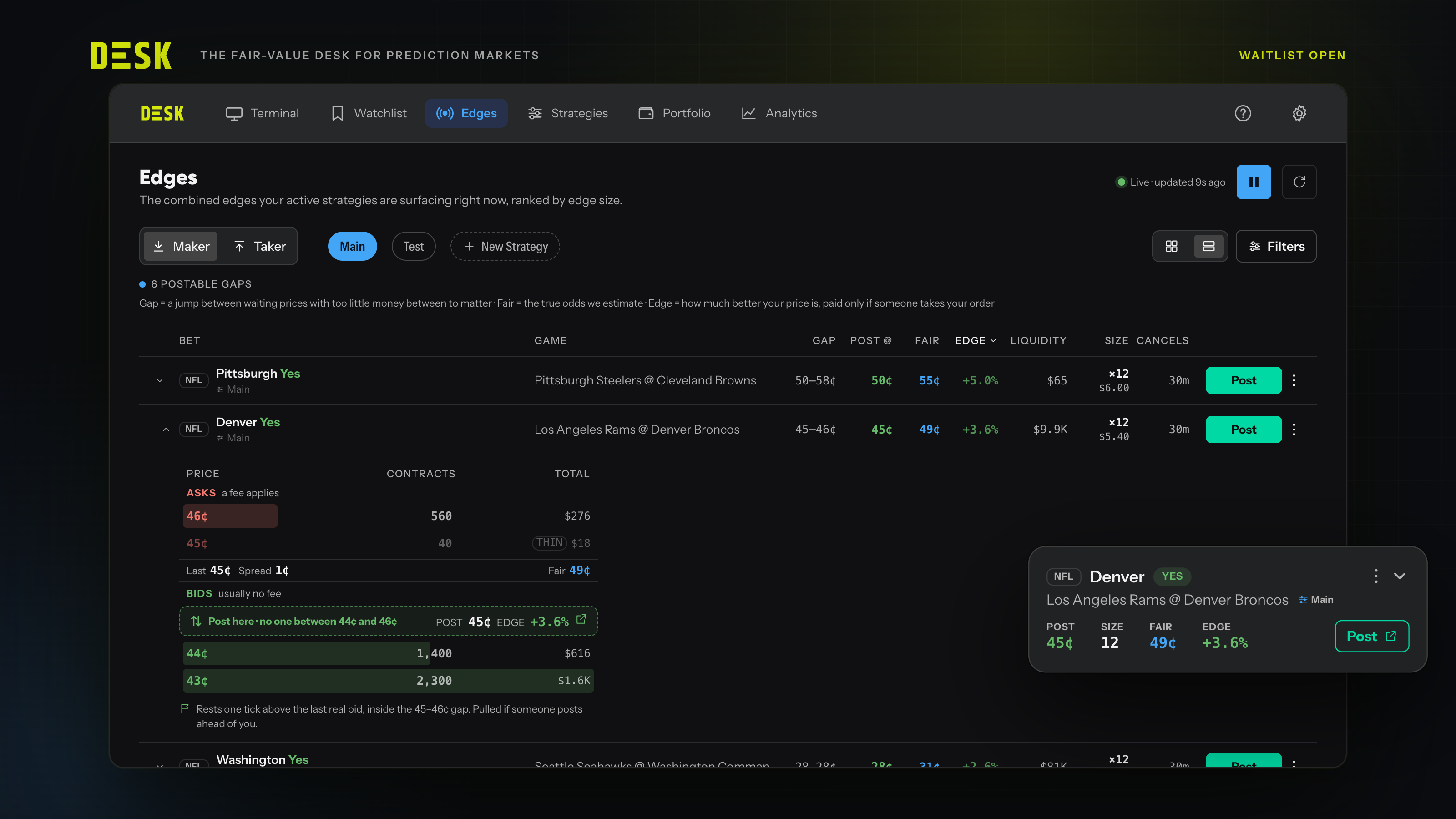
The quick order sale flow makes it feel simple: pick the position, pick a quantity, and Kalshi shows the average price and estimated payout before you submit. But the price you get is the bid, and the bid-ask spread is the true cost of the exit. On the 49ers market priced below, buy at the 78-cent ask and the instant exit is the 77-cent bid: $1.00 of spread, $1.21 in fees on the way in and $1.24 on the way out, about $3.45 per 100 contracts for a round trip with nothing moving. That is the exchange's version of the cash-out haircut, and in a thin market the spread alone can swallow a healthy chunk of your profit. You can also rest a limit order at your own exit price, accepting the risk it never fills. The full mechanics, including a worked exit with real spread math, are in our companion piece on how Kalshi's early cash-out is priced.
Parlays Become Combos, And Settlement Changes
The sportsbook parlay has a partial cousin on the exchange: combo markets, where offered, bundle multiple outcomes into one position. The translation to watch is settlement. A book grades a parlay leg by leg, and one dead leg usually kills the ticket. Kalshi's combo payout with partial resolutions is the product of each position's value, so a leg valued at 0.70 multiplies the combo payout by 0.70 rather than zeroing it. A leg that settles at $0 still zeroes the combo, exactly like a parlay; the multiplication only matters when a leg resolves partially. Availability varies by sport and over time, so treat the combo board as something to check, not something to assume.
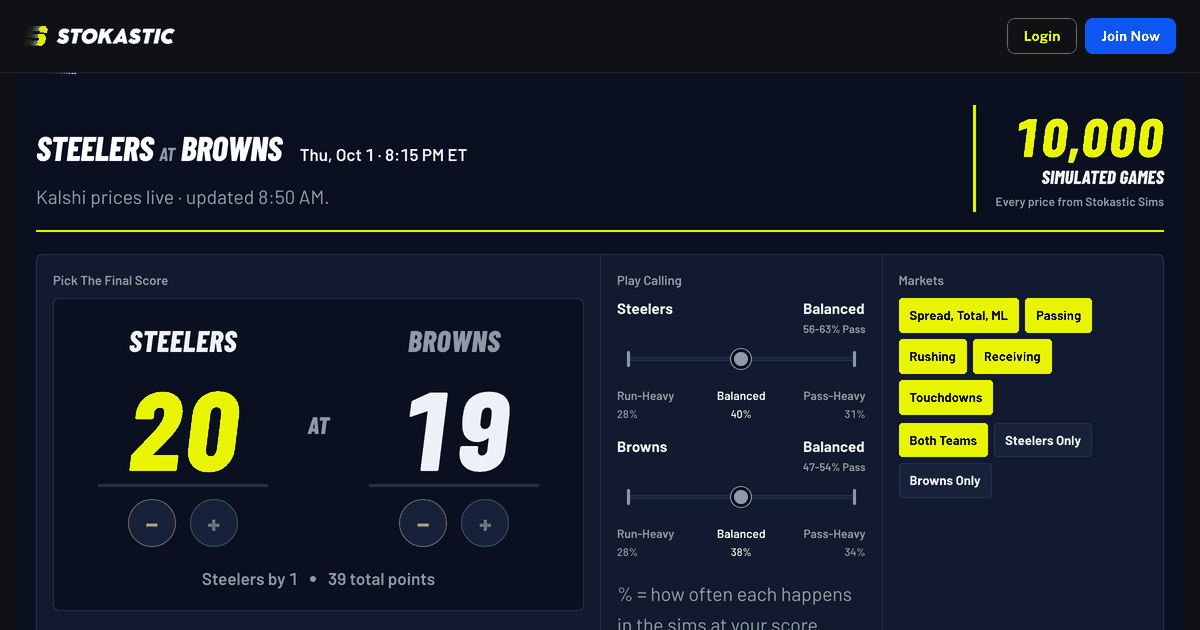 A sportsbook parlay becomes a Kalshi combo. Run the combo through 10,000 sims and the Kalshi Parlay Simulator shows what it is worth next to the exchange's ask.
While you are recalibrating, two settlement facts worth carrying over: winning contracts pay $1.00 each to your cash balance at settlement, and most markets settle within a few hours of the outcome being known, often within about three hours. Market close and settlement are also distinct events, so a market staying open while the result is verified is normal, not a problem with your position.
Worked Example: Translating A -382 Favorite
Here is the entire guide compressed into one decision, on a live market. The prices below were pulled Tuesday, Oct. 13, 2026, at 4:37 a.m. ET for next Monday's Week 6 game, the Washington Commanders at the San Francisco 49ers on Oct. 19 (8:15 p.m. ET kickoff at Levi's Stadium, the 5-0 49ers hosting the 1-3-1 Commanders). They will have moved by the time you read this, so run the same steps on the current quote.
Pinnacle posted the 49ers at -382 with the Commanders at +310. Convert both: -382 implies 79.3%, and +310 implies 24.4%. They sum to 103.6%, and that extra 3.6 points is the vig. Strip it out and the 49ers' fair probability is 79.25 divided by 103.64, which lands at 76.5%. OddsShopper's no-vig read across the whole sportsbook board, which weighs every book rather than one, said 77.9%. The two disagree by more than a point this week, which is its own lesson: one book is one opinion. I price against the board, so call the fair number 78.
Now open the same market on Kalshi. The 49ers contract showed 77 cents bid and 78 cents asked. Buying 100 contracts at the ask costs $78.00 plus a $1.21 trading fee, $79.21 all-in against a $100.00 payout, so your break-even is 79.21%. Hold the two honest numbers side by side: the fair estimate says 78%, and the cost of buying here is 79.21%, fee included. That is about $1.21 of negative expected value per 100 contracts, so paying the ask is a pass. Notice what the big favorite did to the fee, though. At 78 cents it is $1.21 per 100 contracts. The 62-cent price in the Oct. 10 edition cost $1.65, because the formula shrinks as the price moves away from 50, and a book's hold does not shrink with it. DraftKings and Bet365 had the 49ers at -410, which is 80.4%, and FanDuel at -450, which is 81.8%, so on this line the exchange's ask, fee included, was cheaper than DraftKings, FanDuel, BetMGM and Caesars. The best price anywhere on the board was -355 at NoVig (a peer-to-peer exchange that the screen lists as a book, not the de-vig math), 78.0%, sitting right on the fair number.
The order book is still where the exchange earns its keep. Rest a bid at 77 cents instead of paying 78, and if it fills, the fee on a sports game market drops to the maker rate: $0.31 per 100 contracts, $77.31 all-in, a 77.31% break-even that sits under the 78% fair number. That is $1.90 per 100 contracts better than taking the ask, and the one route on either venue that cleared fair. Two catches. About 39,000 contracts were already bid at 77 when I pulled, so yours waits behind them, and the fill is a maybe, not a given. And if you trust Pinnacle alone, at 76.5%, nothing on either venue clears, not even the resting bid, which is exactly why the fair number you choose matters more than any single price.
Flip to the underdog and the book wins outright. The Commanders contract asked 23 cents; the fee at that price is $1.24 per 100 contracts, so the all-in cost is $24.24 and the break-even is 24.24%, against a fair number of 22, the other side of the 78 (the board read 22.1%). The best price on Washington anywhere on the screen, +350 at FanDuel, works out to 22.2%, a hair over fair and two full points cheaper than the exchange's ask, with NoVig next at +344, or 22.5%. Even a resting bid at 22 cents, $22.31 all-in at the maker rate, lands a hair above fair. By Pinnacle alone, Washington's fair number is 23.5%, and on that read both the resting bid and FanDuel's price clear, so the lesson about choosing your fair number cuts the same way from the underdog's side. That is the whole discipline: never compare the sticker prices, compare the fair number against the fee-adjusted cents and the de-vigged book line, and go wherever the gap favors you, or nowhere.
What Moved Since Oct. 10
The Oct. 10 edition of this page priced the Oct. 12 Bills at Rams market. Here is what changed between that pull and this one, checked Tuesday, Oct. 13, 2026.
- The Oct. 10 row settled against the favorite. The Bills beat the Rams 37-34 in overtime. The Rams contract this page priced at 62 cents, and called a pass at the ask, traded as high as 95 cents around 11:35 p.m. ET and was a penny by 11:48 p.m. The Bills contract at 39 cents, which the page also called a pass, paid $1.00: right on the price, wrong on the result, and both can be true. The resting 61-cent Rams bid the page favored would have lost if it filled. The method prices the number, not the game.
- The big favorite moves the exchange ahead of the retail books. On Oct. 10's -175 line, the best sportsbook price sat closer to fair than the exchange's ask. On next Monday's -382 line, the exchange's ask after the fee beats DraftKings, FanDuel, BetMGM and Caesars, though NoVig, Betcris and ProphetX at -355 to -362 still edge it, because the taker fee shrinks on a lopsided price and a book's hold does not. The section above has the arithmetic; the resting bid is still the only route that cleared fair.
- The rules did not move. Kalshi's market data still lists the NFL game series under the maker-fee schedule, and the help-center funding lines in the section below (free bank deposits with a $10 minimum, the 2% debit line, the settlement-based hold) read the same as they did Oct. 10.
Skip the hand math.The live odds screen runs line shopping across every major book, and the tool surfaces each book's no-vig fair price on the market you are shopping, so you hold one honest number against Kalshi's cents instead of de-vigging by hand. When the book and the exchange drift far enough apart to play both sides, the arbitrage finder flags the gap.
The Bet Slip Becomes An Order
The last translation is the one that should change how you trade, not just what you call things. A bet slip is an acceptance: the book posted a number and your only choice is yes or no. An order is a negotiation. A market order takes the best price available in the book, and a large one can fill across several price levels. A limit order names your price and waits, and cancelling a resting order costs nothing. The single biggest upgrade in Kalshi for sports bettors is exactly that: when the fair number says the 49ers are worth 78 cents and the order book shows 78 asked with about 92,000 contracts offered there, you do not have to pass or pay: you can bid 77, behind the 39,000 already resting at that price, and let the market decide. "The house" stops being an opponent with a margin and becomes an order book of counterparties, some of whom may eventually want your price.
That flexibility is also a responsibility. A resting order left up through news is a free option for everyone else, so treat limit orders the way a bookmaker treats a stale line: pull them when the picture changes. If you want the fuller playbook on order types and market selection, start with our Kalshi sports guide.
Tools for thisthe Kalshi combo builder prices every combo against 10,000 simulated games; the live odds screen shops the single legs across every book.
What Does Not Translate
A few sportsbook reflexes have no exchange equivalent, and knowing that up front saves the support ticket.
- The promo reflex has nothing to grab. Sportsbook-style boosts and bonus bets are not the draw here; the exchange's pitch is the price itself.
- Payouts follow settlement, not the final whistle. Most markets settle within a few hours; rules can specify a later determination time, and verification against the settlement source happens before you are paid.
- Funding has its own rhythm. Bank (ACH) deposits are free with a $10 minimum, part of a deposit may be credited for trading right away, and deposited funds become withdrawable once the deposit settles, or up to two days after settlement if you withdraw by a different method than you deposited (that hold applies to bank and card deposits). Debit card deposits may carry a 2% processing fee, and a credit card can be coded by your issuer as a cash advance with its own bank fee, so ACH is the no-fee path.
- The legal map is its own map. Confirm what is offered where you are before you fund anything, and meet Kalshi's own minimum age (18+).
For the structural view behind these translations, our exchange vs sportsbook comparison explains why the two models price risk so differently.
FAQ
What is the Kalshi equivalent of American odds? The cent price. A Kalshi contract trades between 1 and 99 cents, and the cents read directly as the implied probability. A 60-cent contract is roughly a -150 favorite, 50 cents is +100, and 40 cents is about +150.
Does Kalshi have vig? Not in the sportsbook sense. There is no margin baked into a single posted price. Instead you pay the bid-ask spread and a trading fee that is largest near 50 cents and capped at $1.75 per 100 contracts on a standard market.
Can you cash out on Kalshi like a sportsbook? There is no house cash-out offer. Exiting early means selling your contracts into the order book at whatever buyers are bidding, or resting a limit order at your own price and waiting to see whether it fills.
Can you parlay on Kalshi? Kalshi's combo markets, where offered, are markets in their own right with their own pricing rather than a sportsbook parlay slip, and settlement works differently. With partial resolutions, the payout is the product of each position's value, so a leg valued at 0.70 multiplies the combo payout by 0.70 instead of killing the ticket.
Is trading on Kalshi legal? Availability varies by state and changes over time as the legal picture moves. Confirm what is offered where you are, meet Kalshi's own minimum age (18+), and trade responsibly.
Bring Your Book Habits To The Exchange
You do not need to become a trader to use Kalshi well. You need the habits you already have, renamed: read the cents as a probability, treat the fee and spread as the juice, de-vig the book before comparing anything, and use limit orders the way you always wished you could argue with a posted line. The bettors who struggle on the exchange are the ones who abandon their sportsbook discipline at the door. Keep it, and Kalshi becomes what it should be for a sharp shopper: one more set of prices to beat.
Put the book's fair number next to the cents before you commit. The odds screen's no-vig prices do the de-vig step across every major book, and the betting calculators turn any price into a probability in one step.
The fair numbers and edges on this page are estimates. Event contracts involve risk and are not appropriate for everyone. Availability varies by state. Trade responsibly.
Prices on this page are Kalshi's book. If you also trade on Polymarket, code OS4 gets new users a $50 trading bonus on a $10 deposit — affiliate link; terms as stated by Polymarket; 18+, availability varies by state.
More on this: Kalshi Vs A Sportsbook: Where The Money Actually Goes · Prediction Market Vs Sportsbook: An Exchange Is Not A Book · Kalshi Fees Vs. Sportsbook Vig: Which Costs You More? · Polymarket Vs A Sportsbook: Exchange Or House? · Kalshi Vs A Sportsbook: Where The Money Actually Goes