If you already know the MLB run line, you are most of the way to understanding the NHL puck line: it is the hockey cousin of that bet, a standard 1.5-goal spread that sits on almost every game. What trips up new hockey bettors is not the spread itself but everything hockey does around it. Overtime, the shootout, and the mad scramble of an empty net late in a one-goal game all bend the puck line in ways no football or basketball spread ever will. Learn those quirks and the rest of the NHL vocabulary that lives around them, and hockey goes from one of the more confusing markets to one of the more approachable ones. There is one puck-line wrinkle in particular that matters more than most beginners realize, and we will get to it right after the basics.
New to spreads entirely? Our MLB run line explainer walks through the same 1.5 concept in baseball, and the MLB betting terms glossary covers the wider vocabulary in plain English.
TL;DR: NHL Puck Line Betting In 30 Seconds
- The Puck Line Is Hockey's 1.5-Goal Spread. Favorite -1.5 must win by 2 or more; underdog +1.5 cashes on a win or a one-goal loss.
- Overtime Is The Whole Game. Any game that reaches OT or a shootout settles as a one-goal margin, so +1.5 always covers and -1.5 never can — the single most important rule below.
- The Moneyline Is Hockey's Most Popular Bet, because one goal decides so many NHL games and there's no margin to sweat.
- Totals Usually Sit 5.5 To 6.5, and the grand salami is one over/under on every goal across the day's whole board.
- Empty-Net Goals Swing Everything Late — a goal into a pulled net turns a 2-1 game into 3-1, flipping a -1.5 cover and tipping close totals over.
- Line-Shop Every Number. The OddsShopper NHL odds screen compares the puck line and total across every major book so you take the best price, not the first one you see.
What Is The NHL Puck Line?
Think of the puck line as the point spread for hockey. Because NHL games are so low-scoring, with most finishing somewhere around five or six total goals, a blowout is the exception rather than the rule. So instead of sliding the spread around game to game the way an NFL point spread moves from -3 to -10, sportsbooks set it at 1.5 goals almost every night and let the price do the talking. That gives you two sides:
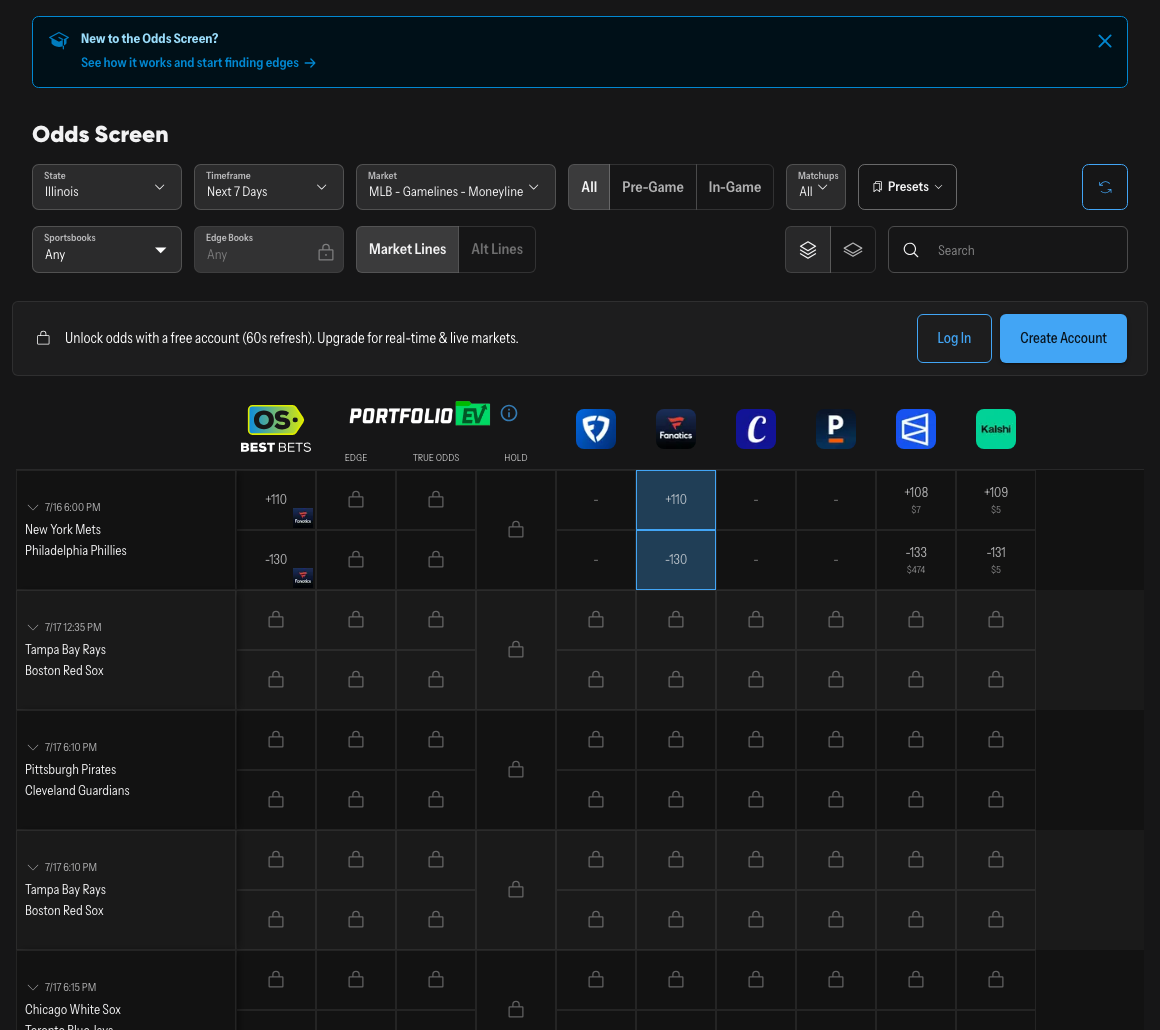
The OddsShopper Odds Screen.
- Favorite -1.5: the favored team must win by two or more goals for the bet to cash. A one-goal win does not cover.
- Underdog +1.5: the underdog wins the bet if it wins outright or loses by exactly one goal. A two-goal loss does not cover.
Laying -1.5 with a favorite usually gets you a better price than the moneyline, because hockey favorites so often win by a single goal, and taking +1.5 with an underdog is popular insurance, since a team can lose the game and still win your bet. That single half-goal is the whole appeal here: you are betting the margin, not just the winner. And in hockey, that margin is razor thin more often than in any other major sport.
The Puck Line Quirk Nobody Warns You About: Overtime
Here is the wrinkle promised up top, and it is the single most important thing to understand about the puck line. It is the first thing I check before I ever think about laying -1.5. NHL overtime is sudden death, and so is the shootout that decides regular-season games. The moment one team scores in overtime, the game is over. That means any game that reaches overtime ends with a one-goal margin in the final score, because only one goal can be scored in the extra period.
Follow that to its conclusion. If a game goes to overtime, the winning team wins by exactly one, every single time. So a -1.5 favorite cannot cover an overtime game, and a +1.5 underdog is already covered before the puck even drops in the extra period. The shootout works the same way: the winner is credited with a single deciding goal, so a shootout result is a one-goal game too.
The one rule that outranks the restif a game reaches overtime or a shootout, it settles as a one-goal margin no matter who wins. The +1.5 underdog always covers it and the -1.5 favorite never can. Price every puck line with that in mind.
This is why so many sharp hockey bettors treat +1.5 and the moneyline as close relatives, and why laying -1.5 asks you to bet on regulation being decided cleanly. A meaningful share of failed -1.5 covers are not blown games at all, they are one-goal wins that slipped into overtime and finished as a one-goal margin by rule. Keep this in your back pocket for the worked example below.
How The Puck Line Pays Compared To The Moneyline
The moneyline is a straight bet on who wins, with no margin attached. Bolt the 1.5-goal requirement onto that same game and the price shifts on both sides:
- Laying a heavy favorite at -1.5 turns a steep moneyline price into a much friendlier number, often plus money, because you now need that favorite to win by two.
- Taking an underdog at +1.5 turns a long moneyline price into a short one, because the cushion makes the bet far more likely to cash.
The trade is always the same. Backing the favorite at -1.5 buys a better price in exchange for a tougher condition, while backing the underdog at +1.5 buys a safer bet in exchange for a worse price. Neither side is a gift, and plenty of nights the number is priced so tightly that both sides are negative value and the correct move is no bet at all.
How The NHL Puck Line Pays: A Worked Example
Picture a night when the Colorado Avalanche host the Chicago Blackhawks, and the Avalanche are a clear favorite. There are three realistic ways this plays out on the puck line:
- Avalanche win 3-1. A two-goal margin, so Avalanche -1.5 covers and Blackhawks +1.5 loses.
- Avalanche win 2-1. A one-goal win. Now Avalanche -1.5 loses even though the favorite won the game, and Blackhawks +1.5 cashes despite losing.
- The game goes to overtime and Colorado wins in the extra period. The final is a one-goal game by rule, so Avalanche -1.5 loses and Blackhawks +1.5 cashes, exactly like the 2-1 result.
The four ways any puck line can settle line up like this:
| Final Result | Favorite -1.5 | Underdog +1.5 |
|---|---|---|
| Favorite Wins By 2+ (E.g. 3-1) | Covers | Loses |
| Favorite Wins By 1 (E.g. 2-1) | Loses | Covers |
| Winner Decided In OT Or Shootout | Loses | Covers |
| Favorite Loses Outright | Loses | Covers |
Read down that favorite column and the lesson jumps out: the -1.5 side covers in only one of these four outcomes, when the favorite wins by two or more, and loses even when its team wins the game by a single goal or in overtime. Those outcomes are not equally likely, so treat this as a map of what covers, not a 25 percent cover rate. That is why laying the puck line demands a real edge on the margin, not just a hunch on the winner. Now add the twist that decides more of these than anything else: the empty net, which we will unpack in a moment.
Shop before you fire.New to OddsShopper? It scans the major sportsbooks and flags the puck lines and totals priced in your favor, doing automatically the exact comparison this guide is teaching you to do by hand. Code PUCKLINE20 takes 20% off OS Pro or OS Core, the tools that run this comparison for you automatically: Get OS Pro.
The Moneyline: Hockey's Most Popular Bet
Because one goal decides so many NHL games, the moneyline is the go-to hockey bet for most bettors. Betting simply on who wins, with no spread to worry about, is the cleanest way to express a read, and it works exactly like the NFL moneyline football bettors already know. If the plus and minus prices still trip you up, our guide to reading betting odds breaks them down. A lot of value on the puck line only makes sense once you have compared it to the moneyline on the same game, so the two are best studied together rather than in isolation. Whenever a favorite at -1.5 looks appealing to me, the first thing I do is check what that team costs straight up.
NHL Totals: Betting The Over And Under On Goals
A total is an over/under on the combined goals both teams score, and in the NHL it usually sits in the 5.5 to 6.5 range. It is the same market you would read on NFL totals, just scaled down to a low-scoring sport. You are not betting on who wins, only on how many goals get scored. Goaltending, pace, and how much each team leans on defense all push a total up or down, and a night with two backup goalies in net looks very different from a night with two Vezina candidates. Totals are also where a late empty-net goal does its quiet damage, since a goal into an unguarded cage can flip an under into an over in the final minute.
The Grand Salami: One Bet On The Whole Board
The grand salami is one of hockey betting's most fun markets. Instead of a total on a single game, it is an over/under on the combined goals scored across all the NHL games on that sportsbook's posted board. You add up all the goals from all the games, then bet whether that grand total lands over or under the posted number. On a 10-game night, a single wager rides on dozens of goals, and it stays live right up until the final horn of the last game. Same over/under logic as a single-game total, just scaled to the whole board.
Empty-Net Goals: The Late Swing On Totals And Spreads
Remember the puck line quirk about one-goal games? The empty net is the other side of that coin, and it is why late-game hockey is so volatile for bettors. When a team trails by a goal in the final minute or two, it pulls its goalie for an extra skater to press for the tying goal. If that gamble fails and the leading team scores into the open net, a one-goal game instantly becomes a two-goal game.
That single empty-net goal is enormous for your ticket. It can turn an Avalanche 2-1 win into a 3-1 final, which flips the -1.5 favorite from a loss to a cover. That same extra goal counts toward the total too, so when the number is sitting right on the edge, an empty-netter can tip an under into an over in the final seconds. Empty-net goals are the reason a favorite backer is never truly dead in a one-goal game and an under backer is never truly safe with a close total. Any serious hockey bettor watches the final two minutes with the puck line and total in mind, not just the outcome.
NHL Betting Terms At A Glance
Before the last wrinkle, here is the whole hockey vocabulary in one place. Every one of these markets ties back to the fact you started with: NHL games are low-scoring and usually close.
| Term | What you are betting | The number to remember |
|---|---|---|
| Puck Line | The goal margin, hockey's spread | Favorite -1.5, underdog +1.5 |
| Moneyline | Who wins outright, no margin | The most common NHL bet |
| Total (Over/Under) | Combined goals by both teams | Usually 5.5 to 6.5 |
| Grand Salami | Combined goals across every game on the board | One number for the whole day |
| Alternate Puck Line | A moved spread bought for a different price | -2.5 or +2.5 |
| Empty-Net Goal | A late goal into a pulled-goalie net | Swings totals and one-goal spreads |
The row that catches new bettors off guard is the last one. An empty-net goal is not a footnote in hockey, it is a live market-mover that can flip a total and a puck line in the final minute, which is exactly why it earned its own section above. The alternate puck line, next, is the one term on this list you reach for on purpose when your read is specifically about the margin.
Alternate Puck Lines
If the standard 1.5 does not fit your read, sportsbooks offer alternate puck lines that move the number. You can lay a favorite at -2.5 (they must now win by three or more) for a longer price, or buy an underdog +2.5 (they can lose by two and still cash) for a shorter one. Alternate lines are useful when your read is specifically about the margin. Just like the standard puck line, an alternate number is only worth taking when its price beats the true chance of that exact margin, which is where comparing books and fair prices earns its keep.
Why Line Shopping Wins NHL Bets
Here is the part that quietly decides whether you come out ahead over a full season: the number you take matters as much as the side you pick. The same Avalanche -1.5 or over 5.5 can pay meaningfully more at one book than another, and DraftKings 🎁, FanDuel 🎁, and BetMGM 🎁 will not always agree on the price, because each one bakes in its own built-in cut, or vig. Taking the better number every time, on bets you were going to make anyway, quietly improves your expected value over hundreds of tickets, even if no amount of shopping can promise a profit. I never fire a puck line at the first price I see for exactly this reason.
Handling that comparison is exactly the job of the OddsShopper NHL odds screen: the tool scans every book's puck line, moneyline, and total side by side and surfaces the best available price, so you are line shopping instead of guessing (our walkthrough of the odds screen shows how). From there, OddsShopper compares that price against the de-vig, no-vig fair odds — the true implied probability of each side — and surfaces the plus expected value bets through Portfolio EV, so you are not just taking the best number, you are confirming it is actually a good bet. Master the terms in this guide, then let the tools handle the shopping.
The Bottom Line On NHL Puck Line Betting
The puck line looked intimidating at the start of this guide, but it comes down to a low-scoring sport that decides too many games by a single goal, which is why the spread sits at a fixed 1.5, why the moneyline is king, and why overtime and the empty net swing so many tickets. Once those pieces click, the rest of the NHL vocabulary, from totals to the grand salami, falls into place around them. Hockey rewards bettors who understand why a one-goal game is the default and who shop for the best number on every side. Get comfortable with that, and the NHL turns from the sport you skipped into one of the more approachable boards on the app.
Ready to put it to work?OddsShopper scans the major sportsbooks and flags the NHL puck lines, moneylines, and totals priced in your favor, then checks them against the fair no-vig price so you can focus on the bets it estimates as plus expected value. Code PUCKLINE20 gets you 20% off OS Pro or OS Core when you subscribe: Get OS Pro.
More on this: How To Bet NHL On Kalshi: Markets, Odds, Settlement · NHL Hart Trophy Odds 2026-27: McDavid, MacKinnon And A Board Full Of Traps · Reverse Line Movement Betting: How To Spot Sharp Money · Line Movement Explained: Steam & Reverse Line Moves · MLB Run Line Explained
Frequently Asked Questions
What is the puck line in NHL betting? The puck line is hockey's version of a point spread, set at 1.5 goals in nearly every game. The favorite is laid at -1.5 and must win by two or more goals to cover, while the underdog is taken at +1.5 and cashes if it wins outright or loses by exactly one goal.
Why is the NHL puck line almost always 1.5? Hockey is low-scoring and a huge share of games are decided by a single goal, so books standardize the spread at 1.5 goals and adjust the price instead of moving the number. That keeps one consistent line across the board while still letting the odds reflect each matchup.
What happens to the puck line in overtime? Overtime and the shootout are sudden death, so any game that reaches the extra period ends with a one-goal margin in the final score. That means the +1.5 underdog covers and the -1.5 favorite cannot, no matter which team wins.
What is a grand salami bet in hockey? The grand salami is a single over/under on the combined total goals scored across every game on the day's NHL board. You add up all the goals from all the games and bet whether that number lands over or under the posted line.
How do I find the best NHL puck line odds? Compare books before every bet, because the same puck line or total can pay more at one sportsbook than another. The OddsShopper NHL odds screen aggregates prices across the major books so you can take the best available number, then judge it against the fair, no-vig price to confirm it is actually plus expected value.
Sports betting is legal in many regulated U.S. states, but availability and rules vary by state. Bet only where it is offered, play 21 and up, and stay within your means.