The Louisville Cardinals 2026 college football win total is a bet on a paradox. At most ACC programs the coach is the variable and the roster is the constant; in Louisville it is the exact opposite. Jeff Brohm has not finished a season with fewer than nine wins since he took the job, yet he has not started the same quarterback in back-to-back seasons the entire time. In 2026 that pattern holds again: a fourth straight portal quarterback takes over, this time behind an offensive line returning just one starter. So the whole futures ticket comes down to one question, and it is the trenches question, not the star-power one. Hold on to that rebuilt line, because it is the hinge the over and the under both swing on. This page walks the number the way our college football win totals hub teaches, and the way our Betting U crew has read ACC totals for years: sort the schedule into wins, losses, and the toss-ups that actually decide the bet, weigh what came back against what left, then build the case both ways before you fire.
Quick Summary: The Louisville Win Total At A Glance
- The Bet: the season-long over/under on how many regular-season games Louisville wins in 2026, graded when the Cardinals' 12-game regular season ends in late November. It ties your money up for months, so treat it like a futures position, not a Saturday side.
- The Setup: head coach Jeff Brohm returns for his fourth season off a 9-4 campaign, a third straight nine-win year, and a 27-22 Boca Raton Bowl win. His CFB resume in Louisville is 28-12. The catch: Ohio State transfer Lincoln Kienholz is the fourth new starting quarterback in four years.
- What Decides It: whether a rebuilt offensive line protects a first-year starter well enough to bank the winnable ACC games, because Louisville returns only one starter up front and a defense replacing seven starters cannot always cover for a slow-starting offense.
- The Odds: as of mid-July, FanDuel posts Louisville at 7.5 wins. Shop that number across books before you bet it, and never bet a number you have not shopped first.
Where The Louisville Win Total Sits For 2026
A win total is a futures market. The book posts a number for Louisville's full 12-game regular season, non-conference games included, as a half-win line so there is no push, and you bet the over or the under. As of mid-July, FanDuel posts that number at 7.5 wins. Shop it across books before you bet it, because a win total you half-remember from earlier in the summer is worthless once the price has moved. If you want the mechanics of how a posted price converts to a real probability, the how to read betting odds guide walks the math.
What is knowable now is the shape of the market, and Louisville sits in a specific and unusual spot on it: an upper-middle ACC number built almost entirely on the coach. This is a program that has won at least nine games three years running and beat a No. 2-ranked Miami team 24-21 last season, but is also breaking in an unproven quarterback behind a line it had to reassemble. Brohm is exactly the kind of proven, Louisville-native operator the market trusts, so the number lands higher than a team with this much roster turnover would normally draw, and the market leans on his name more than the roster alone has earned. The edge on a total like this has nothing to do with whether Louisville is "good," it clearly is. It comes down to whether Brohm's floor is worth what the market is charging for it, given how much of the offense he has to rebuild before the season-defining games arrive.
Reading Louisville's 2026 Schedule
The schedule is the knowable half of this bet, and for Louisville it explains why the number sits high but not sky-high. The 2026 card is a nine-game ACC schedule plus three non-conference games. Sort the 12 into three buckets and the path comes into focus.
| Tier | Games | What it means for the number |
|---|---|---|
| Likely Wins | Villanova at home | The floor, and a thin one at a single near-certain win. It is the only game you can pencil in before a snap. |
| Toughest Tests | Ole Miss (neutral-site opener in Nashville), Florida State at home, at Georgia Tech, at North Carolina | The ceiling limiter. An SEC opponent in Week 1 before the new quarterback has taken a live snap, then two of the hardest road environments on the card. |
| Toss-Ups | Pitt, SMU, Stanford, Wake Forest (all home), at NC State, at Syracuse, at Kentucky (the rivalry finale) | Where the number is decided. Louisville has to win the clear majority of these to clear the over, and the road ones are the trap doors. |
The single most important row in that table is not the floor and it is not the toughest tests, it is the seven-deep toss-up tier, because that is where a win total lives or dies. Louisville's schedule is unusually top-loaded on difficulty: it opens against SEC opposition on a neutral field in Nashville, so the very first result asks a brand-new quarterback to win a big game before he has settled in at all. From there October turns home-heavy: it hosts the marquee Florida State test, but around it the home dates get friendlier, Stanford among them, which gives a rebuilt offense room to find itself between the hard games. Then the season ends on the road at Kentucky in the Governor's Cup. Bank the home toss-ups and steal one road game and the over is comfortably live; drop two of the toss-ups a young line "should" win and the math is already leaning under before the finale. Remember that Week 1 Ole Miss test, because it comes back when we get to the thresholds.
Returning Production And The Coaching Picture
If the schedule is the knowable half, the roster is where the number gets its edge and its risk, and here is where the promise from the top pays off. Start with the edge, because it is real. In a conference where continuity is the rarest currency, Louisville has the most valuable version of it at the one spot that never changes hands: head coach. Jeff Brohm is a Louisville native and former Cardinals quarterback in his fourth year, running his own offense, with a 28-12 record and three straight nine-win seasons that were built with three different starting quarterbacks. That is not a coach hoping a system works; that is a coach who has already proven the system travels across passers. Returning star running back Isaac Brown is the centerpiece of that offense, one of the more dangerous backs in the sport, which gives a first-year quarterback the exact security blanket a new starter wants.
Now the other half of the promise, the reason to hold the over at arm's length. In college football the quarterback is the line, and Louisville is starting a new one for the fourth year in a row, this time Ohio State transfer Lincoln Kienholz, who flashed arm strength and mobility in the spring without locking down the job cleanly. A transfer quarterback can absolutely hit here, Brohm's track record says as much, but "can hit" is not "has hit," and the line in front of him is the deeper worry. Louisville returns just one starting offensive lineman, so a first-year quarterback is learning the offense behind a first-year front. That is the trench mismatch this whole ticket turns on.
The one we keep circling back tothis number is not a referendum on Brohm and it is not a referendum on Isaac Brown, it is a referendum on the offensive line. A veteran coach and a star back raise the floor, but a rebuilt front that cannot protect gives up the pressures and negative plays that stall drives in one-score games, and one-score games are exactly what decide a total in this range.
The defense adds to the rebuild rather than offsetting it. Louisville has to replace roughly seven starters on that side of the ball, leaning on building blocks like defensive lineman Clev Lubin and cornerback Tayon Holloway to hold serve while a lot of new pieces settle in. Where our read stays qualitative rather than quoting a returning-production percentage the public coverage does not support, that is deliberate: college football roster facts move by the week in the portal era, and a depth chart that is true in April can be stale by August. Re-check the two-deep at publish. The bottom line is that Louisville returns the two hardest things to keep, an elite coach and an elite back, and has to rebuild almost everything around them, and the win total is the market's guess at that trade.
The Case For The Over
The over is the bet that a proven coach and a proven back paper over a rebuilt line and a new quarterback, the same way they have every year Brohm has been here. Every lever for it points the same direction:
- The Floor Is The Highest In This Tier Of The ACC. Three straight nine-win seasons, a 28-12 record, and a coach who has cleared nine wins with three different quarterbacks is about as bankable a floor as a season-long number offers. Programs like that rarely crater; they land near their usual range, and their usual range clears most totals in this window.
- Brohm Has Already Done The Hard Part Three Times. The knock on the over is the new quarterback, but this is the fourth straight portal starter Brohm has plugged in, and the previous three all produced nine-win seasons. Betting against a system that has repeatedly turned transfer quarterbacks into winners is betting against the one variable most likely to hold.
- Isaac Brown Lowers The Degree Of Difficulty On Offense. A genuine star at running back lets a new quarterback lean on the run, control tempo, and stay out of obvious passing downs while the receivers and the line grow up. That is the ideal environment for a first-year starter, and it is exactly the kind of edge a season-long number underrates.
- The Home Schedule Buys Time. The toughest road games are spread out and the October card is home-heavy, which gives a rebuilt front a runway before the season's defining stretch. A team with this floor only needs the offense to be functional, not finished, to bank the winnable games.
The through-line is simple. This side does not need Louisville's quarterback to be a star. It needs Brohm and Isaac Brown to matter more than a rebuilt line, which is a bet the last three seasons keep cashing.
The Case For The Under
The under is the bet that you cannot rebuild your line and your quarterback at the same time and stay a nine-win team, no matter who the coach is. It starts with the exact hole the over is trying to talk its way around:
- A New Quarterback Behind A New Line Is The Classic Stall Spot. One returning offensive lineman plus a first-year starter is a lot to ask to gel by September, and the trenches are where CFB games are decided at a wider talent margin than the NFL. Pressure and negative plays turn makeable third downs into punts, and those points left on the field show up as losses in one-score games.
- The Week 1 Test Is Unforgiving. Opening against an SEC opponent on a neutral field, before the offense has taken a live snap together, is a live loss and a rough way to find out how far along the rebuild is. A slow start there sets the tone the market may not have priced.
- Nine Wins Already Banked Some Good Fortune. A team that keeps landing on nine and then loses this much of its offensive infrastructure is a classic sell-high on the futures board. The market anchors to the recent win count, and the honest question is whether this specific roster is as complete as the record suggests, not whether the program is good.
- The Road Toss-Ups Are Where It Breaks. Trips to NC State, Syracuse, Georgia Tech, and the rivalry finale at Kentucky are all live losses for an offense still finding itself, and a rebuilt line is at its most exposed in hostile road environments late in the year. At a number that already respects the nine-win floor, the under only needs a couple of those to tip.
The fair version of the under is not that Louisville is a bad team. It is that a proven-floor program is being asked to match a win count it posted with a more complete roster, while it reassembles both a line and a quarterback, and the price is charging full freight for the coach.
Key Thresholds: Which Half-Win Lines Change The Calculus
Where the number lands matters as much as which side you like, because a single half-win moves the bet across a real line. How much you trust the rebuilt line to protect a new quarterback is what decides which threshold is in play. Walk them as a set of setups and reveals.
- 7.5: the friendliest over for a program with this floor. It asks for only eight wins, effectively baking in a small step back from three straight nine-win seasons. For a Brohm team, eight wins is a low bar, so if a book hangs this, the over is buying the coach and the running back at a discount, and the price will usually be shaded to reflect that.
- 8.5: the true pivot for a team of this profile, and the number a proven-floor ACC riser like this tends to draw. Here the over needs nine wins, a repeat of the recent norm, which means banking nearly every toss-up and stealing at least one tough game. That is the line where the line-and-quarterback rebuild decides the bet, and where the under's case is strongest.
- 9.5: the optimist's number, a bet that Louisville is not just steady but a clear step better than a nine-win team. The over now needs ten wins, which almost certainly requires winning that Week 1 SEC test we flagged and running the road toss-ups, a tall order for a first-year quarterback behind a first-year line.
The practical takeaway: the exact posted line tells you how much of Brohm's floor the market has already paid for. A number at 7.5 rewards the over's continuity case; a number at 8.5 or above leans the rebuild concern of the under into the better price. Shop for the friendliest version of the side you have chosen before you commit, the same discipline our how to find +EV bets guide lays out.
How This Class Of Team Gets Priced
A proven-floor ACC program with a beloved coach and a new quarterback is a specific profile on the futures board, and knowing how books treat it is part of the edge:
- The Juice Gets Shaded To The Over. Brohm's name-brand floor, a Louisville native running his own offense off three straight nine-win seasons with Isaac Brown headlining, is exactly the profile the public piles on, so the book prices that in with a stiffer number on the over. It shows up in the shape of the market: a proven-floor program like this tends to draw a total in the 7.5 to 8.5 range with the popular side shaded, and that shading is the tell. You may be paying up for a floor the market already agrees on, which is exactly when the under can become the value.
- The Limits Stay Small. A season-win future is a long-dated wager the shop defends with a low maximum bet rather than a razor price, which means the number is not fully battle-tested and can be beaten with timing.
- The Line Drifts All Summer, And Louisville's Swing Factor Is Obvious. This number should move on one specific storyline: how the new quarterback and the rebuilt line look in camp. A strong report that Kienholz has grabbed the job and the front is gelling nudges this total up; a shaky August pulls it back. That is why the same number can be a better price at FanDuel than at DraftKings, BetMGM, or Caesars on any given afternoon. Track the quarterback-and-line news and you are tracking the line.
That price spread across books is not noise. It is real expected value, a bet priced in your favor over the long run, when you take the best version of a side you have already decided to play. The same line-shopping habit that wins on Saturday game lines wins here: check the win-total price at several books before you commit, and take the best one. If you like the under, the early number, set before camp firms up the offense, may be the better price; if you like the over on the coach, there is a case to grab the number before August buzz shades it higher. Getting the friendliest number on a futures ticket is the same discipline as chasing closing line value, just applied months in advance. The OddsShopper college football odds screen and its live odds board are built for exactly that once the weekly board opens: the tool scans every major sportsbook and flags the +EV bets tilted in your favor, so you are never the bettor who locked a number one tab away from a better one.
New to OddsShopper?It scans every major sportsbook and flags the bets priced in your favor, so you can compare the Louisville number across books and grab the best price instead of guessing which shop is generous. Start with a free 7-day OddsShopper Pro trial, and if you subscribe, code CARDS20 takes 20% off your first OS Pro or OS Core payment.
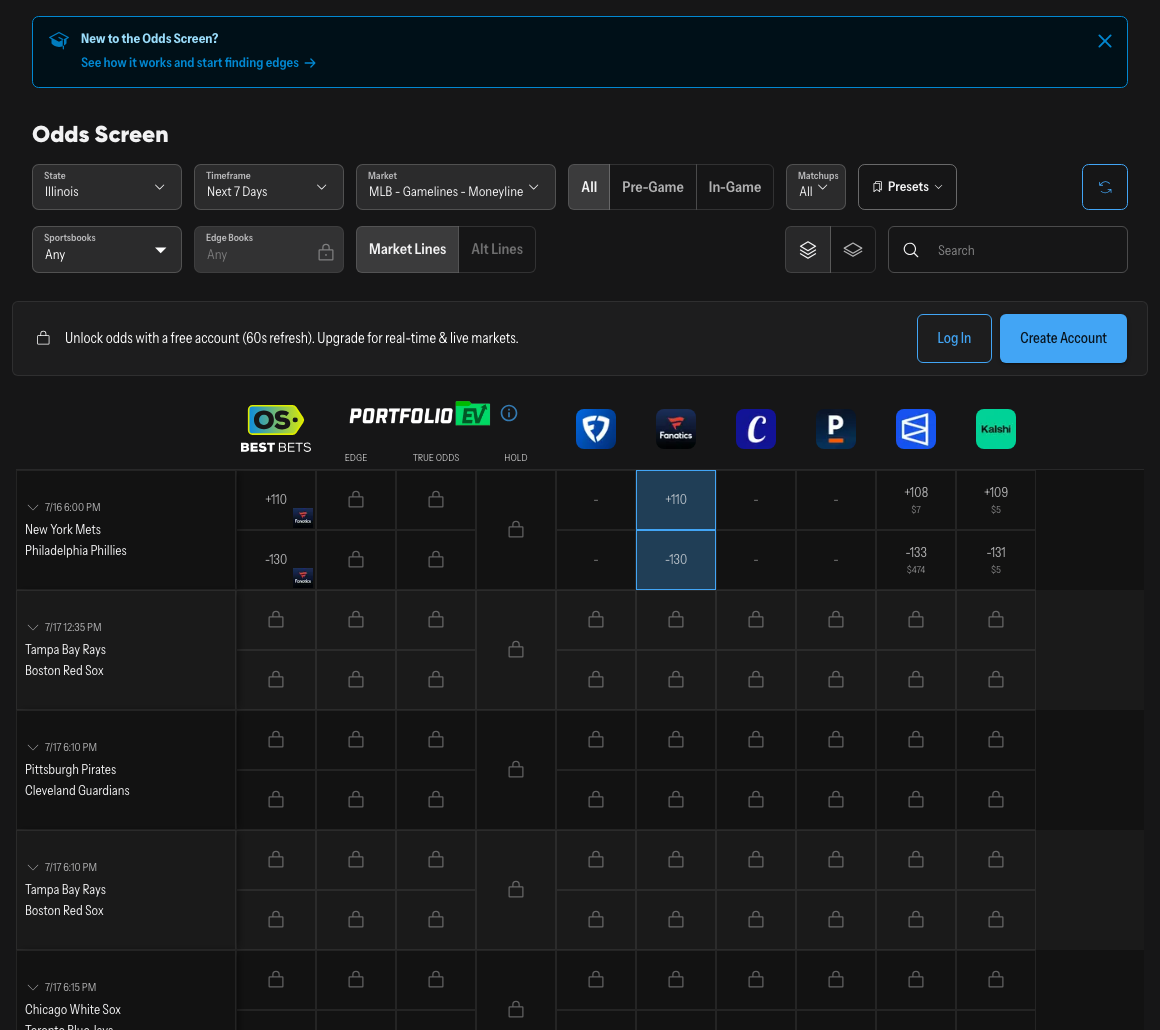 The OddsShopper live odds screen — every book's price on one board, refreshed in real time. Open the live board.
How To Bet The Louisville Win Total The Smart Way
A season-win future is a long hold, so bet it like one.
- Let The Offense Clarify, Or Buy The Coach Early. More than most teams, Louisville's number should move as the quarterback and line questions resolve in camp. If you like the under, the earlier number, set before the new pieces prove anything, may be the better price. If you like the over on Brohm's floor, there is a case to secure the number before August reports firm the offense up.
- Let The Quarterback Battle Be Your Timing Signal. If August reports have Kienholz clearly winning the job and the rebuilt front settling in, that is the cue to take the over number before it climbs; if the offense looks shaky in camp, the under number will only get friendlier as the summer runs. Whichever side that news pushes you to, take the best available price across books on it. The OddsShopper college football odds screen is the same line-shopping tool for Louisville's weekly game lines once the season starts, and OddsShopper's Tails marketplace is where its experts post their weekly college football cards once the games matter more than the futures.
- Size It As A Future, Not A Game. This bet does not settle until late November and you cannot hedge it cheaply, so stake it small and once. Our bankroll management guide covers sizing a long-dated position.
Bottom Line
Strip it down and the Louisville win total is a wager on whether Jeff Brohm's floor survives its most demanding rebuild yet. The coach is the best in this tier of the ACC, Isaac Brown is a star, and three straight nine-win seasons with three different quarterbacks are the entire case for the over. The catch is that a fourth new portal quarterback is learning the offense behind a line that returns one starter, while the defense replaces roughly seven, and the schedule opens against an SEC opponent before any of it has been tested. The over is the Brohm-always-wins-nine bet; the under is the you-cannot-rebuild-the-line-and-the-quarterback-at-once bet. The line itself, once it posts, tells you how much of that floor the market has already priced. Work through the toss-up games, decide whether you trust the front to protect in time, then shop the friendliest price on the side you have chosen. That is the whole bet.
Ready to shop the number?OddsShopper compares the Louisville win total across every major sportsbook and flags where the price is in your favor. Try it free for 7 days, then code CARDS20 takes 20% off OS Pro or OS Core if you subscribe.
More on this: Kalshi Steelers Over 8.5 Settlement: Refunded, Not Paid · TCU Win Total 2026: Over/Under 6.5 Wins Odds · Texas Tech Win Total 2026: Over/Under 11.5 Wins Odds · Utah Win Total 2026: Over/Under 8.5 Wins Odds · Ole Miss Win Total 2026: Over/Under Wins Odds