The Philadelphia Eagles win total 2026 line is one of the first numbers NFC bettors circle every summer, and this year it arrives with a genuine argument attached. The sportsbooks have hung the Eagles at 10.5 wins and, unlike most contenders, priced the under up instead of the over. That is the market telling you something specific: it trusts the roster's ceiling but doubts the offense that has to reach it. Philadelphia gets one of the easiest schedules in football, yet the books still made you pay to back the number, because the group that produced those wins looks different now. This piece does not hand you a lean. A win total is a two-way market, so what follows is the framework: why the number sits at 10.5, the schedule that shapes it, the honest case for the over, the honest case for the under, and the exact thresholds where the bet changes.
The Quick Read (TL;DR)
- The Market: the Philadelphia Eagles 2026 season win total is 10.5 wins, with the vig shaded to the under (the under has sat around -140, the over is the plus-money side near +115), a futures bet on how many regular-season games Philadelphia wins. The under is the favored side of this number.
- Why 10.5: an elite core (Jalen Hurts, Saquon Barkley, DeVonta Smith), a defense that carried the team in 2025, and one of the softest schedules in the league — but a bar that still asks for 11 wins.
- The Over Case: the plus-money side. A top-shelf roster with a returning quarterback and running back, a defense that traveled, and the seventh-easiest schedule in football against a division that went a combined losing record last year.
- The Under Case: the side the market is paying up for. A.J. Brown is gone, the offense is on its fifth coordinator in six seasons installing a scheme that reworks how Hurts plays, and 11 wins in a 17-game season leaves almost no margin.
- The Swing Factor: the offense and the price you pay. Confirm the Week 1 depth chart before you bet, and remember a win total ties your money up for months: the receiver room you back in July is not guaranteed to be the one that takes the field.
Where The Number Sits And Why It Is 10.5
Start with the number itself, because a win total is really the market's combined read on the schedule and roster rolled into one line, and where the books set that line decides how you play it. Philadelphia sits at 10.5 wins with the juice tilted to the under. That detail matters as much as the number. The Eagles are one of the few genuine contenders whose under, not its over, carries the premium, which is the market's own soft vote of doubt about the offense even as it respects the overall roster. You are not getting a bargain on the under here. You are paying up for it.
The reason the number is 10.5 and not higher is a tug-of-war between two honest forces. On one side, the talent and the schedule argue up: an elite quarterback-running back pairing, a defense that ranked among the league's best in yards allowed per play, and one of the softest schedules in the sport. On the other, the offense argues down: the loss of the team's top target and a brand-new system pulling the ceiling back toward the field. The books split the difference at 10.5 and then shaded the vig under, which tells you where their uncertainty actually points.
Here is what the number asks of each side:
| Posted Total | The over needs | The under needs |
|---|---|---|
| 10.5 Wins | 11+ wins | 10 or fewer wins |
Eleven wins in a 17-game season means going 11-6 or better, and doing it while an offense reinvents itself on the fly. That is the entire bet in one sentence, and it is the sentence to keep in mind while every other section fills in the receipts behind it. (New to season-long markets? Our futures bet explainer covers how these prices are built and settled.)
The Schedule Read: Sort The Games First
Before you weigh talent, count the schedule, because a win total starts with the schedule and the roster only decides the toss-ups. And here the schedule is doing real work for the over. By projected win totals, the Eagles drew the seventh-easiest schedule in the NFL and the easiest road in the NFC East, a soft draw that comes with winning the division the year before.
The engine of that easy number is the division itself. Philadelphia plays the NFC East twice, and last season the Giants finished 4-13 and the Commanders 5-12. Six games against that neighborhood is the single biggest reason the schedule grades out so light, and it is the cleanest path to double digits on the board. Bank a strong record inside the division, add the home games a contender is supposed to hold, and 10 wins is within reach before you ever survive the marquee dates.
That is exactly why the under carries the juice despite the soft draw: the schedule was never the doubt. Run the sort honestly and the shape of the bet snaps into focus. An easy schedule raises the floor, but the over asks for a ceiling, and a ceiling is a question about the offense, not the opponents. The teams that bust an over on a soft schedule are the ones that trip in games they were favored in, not the ones that fall short against the tough dates, and that distinction is the whole discipline of win-total betting. For the full picture of how Philadelphia's schedule stacks up against the field, our NFL strength of schedule breakdown ranks all 32.
Returning Production And Coaching: The Receipts
Three facts carry the most weight on the Eagles number, and the order they matter in is not up for debate.
The offensive overhaul first, by a mile. The offense is the question the whole line is built around. Philadelphia traded A.J. Brown, its most physically dominant receiver, and handed the play sheet to Sean Mannion, a first-time coordinator and the fifth man to run this offense in Nick Sirianni's six seasons. Mannion's background is in the McVay and Kubiak coaching trees, which means more under-center snaps, wide-zone runs, and play-action than Jalen Hurts has been asked to operate week to week in an offense that has lived in the shotgun. That is a meaningful adjustment for a quarterback, and adjustments take time. The receiver room was rebuilt rather than replaced one-for-one, with additions like Hollywood Brown and Elijah Moore joining DeVonta Smith and a group of younger pieces. Whether that room gels early or midseason is the difference between the over and the under.
The stars who anchor the floor, second. This is what keeps the Eagles a contender no matter the scheme. Jalen Hurts is back under center, Saquon Barkley returns behind one of the league's best offensive lines, and DeVonta Smith is still a No. 1-caliber target. A run game that can carry an offense through its passing-game growing pains is the quiet over-supporting factor a raw talent grade never captures, because a healthy Barkley behind that line shortens the distance between a shaky pass attack and a winning score.
The defense, third and steadiest. Philadelphia's defense was the reason the team stayed a contender through last season's second-half slide, ranking near the top of the league in yards allowed per play. A defense that travels is what lets a retooling offense win ugly, and ugly wins still count on the win-total ledger. The one caveat that showed up in the record: the Eagles lived in one-score games and won most of them, and coin-flip win rates like that tend to regress. Bank on the defense, but do not bank on last year's one-score luck repeating.
The Case For The Over
Start with the foundation the schedule is already handing you: the seventh-easiest schedule in football, six games against a division that finished a combined losing record last season, and a first-place schedule that still grades out soft. Layer on a roster most teams would trade for — a returning quarterback in Jalen Hurts, Saquon Barkley behind an elite line, DeVonta Smith outside, and a defense that ranked among the league's best — and the path to 11 wins is real. The Eagles have also cleared their win total in each of the last four seasons, and a franchise that reloads at the top of the roster rather than rebuilds is exactly the profile that keeps clearing that bar.
The over is fundamentally a bet that talent and schedule outrun the scheme change. If Mannion's offense clicks even by midseason, this roster is good enough to run away with a soft division, and the callback to that easy schedule matters here: an offense does not have to be elite in September to beat the Giants and Commanders, it just has to be functional, and a functional Eagles team with this defense wins a lot of games. The catch is the price. Because the over is the plus-money side, you are actually getting paid to back the ceiling, which makes it the value angle if you believe the offense sorts itself out. And if any book drifts the Eagles to 9.5, where the over needs just 10 wins — and assuming that move is not tied to a Hurts injury or a camp disaster that would explain it — that side gets stronger in a hurry.
The Case For The Under
Now the honest other side, and here is where the market is planting its flag. Unlike the over, the under is the side the books shaded the vig toward, which means the sharper read priced 11 wins as the harder outcome. The under's thesis rests on three forces.
First, the offensive reset. Trading A.J. Brown removed the receiver defenses had to account for on every snap, and asking Jalen Hurts to adapt to his fifth coordinator in six years — one whose offense leans on under-center, play-action concepts Hurts has not lived in — is a real bet on early-season friction. New offenses stumble in September more often than they hum, and a slow start against even a soft schedule can cost the games that decide a coin-flip win total. Second, the margin is thin. To cash the under, Philadelphia only has to go 10-7 or worse, and one bad month from a retooling offense gets you there without any disaster. Third, the finish is a warning. Last year the Eagles jumped to 8-2, then dropped three straight and limped to an 11-6 regular season before a 23-19 wild-card loss to the 49ers — the defending champs bounced in the first round. A team that already showed it could stall for a month, now asking a new offense to avoid a repeat, is exactly the profile the under is built on.
Add it up and the under is clean: you are not betting against Philadelphia being talented. You are betting, at the price the market itself is leaning, that 11 wins is a lot to ask from an offense learning a new language while its best receiver plays somewhere else.
The Key Thresholds That Flip The Bet
This is where line shopping stops being generic advice and becomes real money. On an Eagles-class win total, small differences swing the whole bet, and the direction of the juice makes the shopping target different on each side.
- 10.5 Is The Live Number. If a book posts the Eagles at 9.5, the over needs only 10 wins and the whole calculation changes — re-price it from scratch rather than assuming this same case applies. That makes the price, not just the number, your main lever.
- If You Want The Over, You Are On The Plus-Money Side — Hunt The Fattest Price. BetMGM has hung the over near +110 while other books have posted +120, and that gap is a materially better payout on the same opinion, so line the over up across DraftKings, FanDuel and BetMGM and take the best number.
- If You Want The Under, Hunt The Cheapest Juice. The under is the taxed side here, so the difference between a book charging -130 and one charging -145 is real money over the life of the bet. Take the least-expensive under you can find.
The practical takeaway is the one our seasonal handicapping repeats every summer: never bet a win total off the first line you see. The gap between the best and worst price on the same side is not a rounding error on a bet like this. It is the edge. Compare every book before you lock anything in, and use a tool like Portfolio EV to check whether the price is actually in your favor rather than just the side you like.
The Market Read: How This Class Of Number Behaves
A few things are predictable about how the books treat a popular contender's win total, and knowing them keeps you from paying the tourist price. Marquee franchises like the Eagles draw heavy public money every summer, usually to the over, and when books from BetMGM to FanDuel shade the vig to the under instead, that is a tell worth reading. It says the sharper side of the market sees the offensive overhaul as a bigger drag than the casual bettor betting the helmet does. Read the hold on your side against the true price, not the two-way average, because on a lopsided market the two-way number hides where the juice actually sits.
The specific tell on this number is the mismatch: the Eagles drew one of the softest schedules in football, the input that normally drags a win total up, yet the books still shaded the under. That gap between an easy schedule and a juiced-down number is the market pricing the Brown trade and the coordinator change louder than the soft set of opponents — read it as the books telling you where the real risk sits. Futures limits are lower than main-line game limits, which is why sharp season-long bettors often buy better by waiting for a dip. If the offense stumbles early and books post adjusted win totals in-season, a slow Eagles start can open a friendlier entry point on the over later in the year, though treat that as a separate market from any preseason ticket you hold. Finally, treat the whole thing as the long-dated bet it is. Your money is tied up for months, the depth chart can change under you, and that opportunity cost is part of the bet's real price. For the general mechanics of how these season-long markets move, our NFL win totals guide walks through the same structure across the league.
How To Actually Shop The Eagles Win Total
We do not hand you a side on this one, and that is by design: a claimed lean on the Eagles is a named analyst's call, not a house verdict. What OddsShopper gives you is the two things that actually move your bottom line on a bet like this. First, the best price: the tool surfaces every book's number and juice in one place, so you can shop the number across every major book on the live odds screen and take the plus-money over at the book paying the most, or the under at the book charging the least tax. Second, an honest read on that price: Portfolio EV and our de-vig tools flag when a win-total number is actually positive expected value rather than just the side you like. Pair that with the framework above and the Eagles over/under stops being a guess and starts being a priced decision.
New to OddsShopper?It scans every major sportsbook and shows you, in one place, which book offers the best price on a bet like the Eagles win total, so you are less likely to leave value on the table when the under is shaded. You can try it free for 7 days, and code EAGLES20 takes 20% off OS Pro or OS Core if you subscribe. Start your free trial
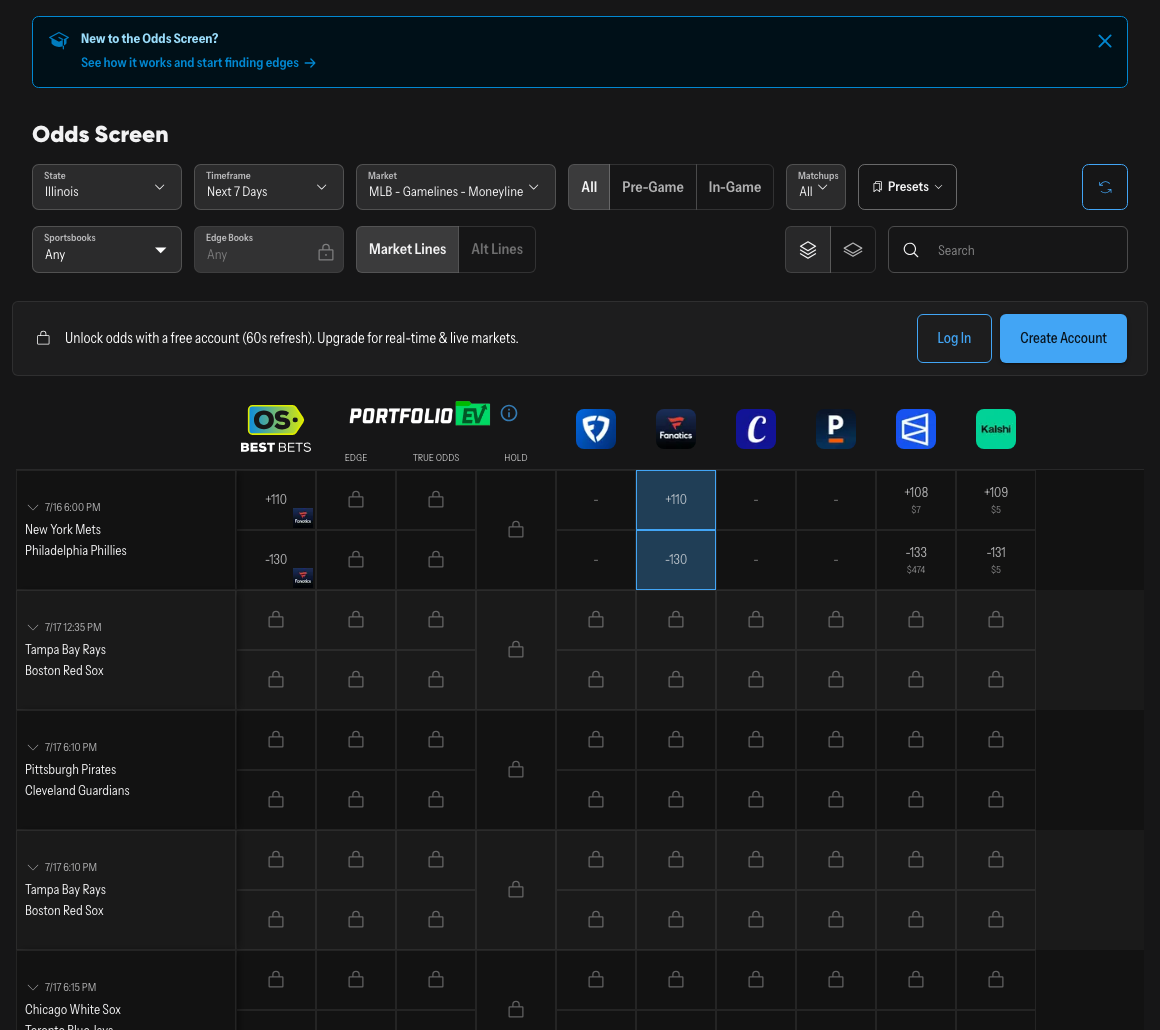 The OddsShopper live odds screen — every book's price on one board, refreshed in real time. Open the live board.
The Bottom Line
The Eagles at 10.5 is a number two honest forces built. The over is a bet that an elite roster and the seventh-easiest schedule in football outrun a new offense finding its footing, and you get paid plus money to back that ceiling. The under, the side the market itself is shading, is a bet that trading A.J. Brown and installing a fifth coordinator in six years costs Philadelphia a game or two while the offense learns to walk. Which side is right depends on the price you can find and how much you trust that offense in September. Shop the number and the juice across every sportsbook, confirm the depth chart before you commit, and let the offense, not the crest on the helmet, decide the bet.
New to OddsShopper? It scans every major sportsbook at once and flags the bets priced in your favor, so you can find the best price on a play like this one. Try it free for 7 days, and code EAGLES20 takes 20% off OS Pro or OS Core.
More on this: Cowboys Win Total 2026: Last In Defense, Priced To Contend · Giants Win Total 2026: A 4-13 Team Priced For 7.5 Wins · Patriots Win Total: The Books Agree On The Number. The Machines Don't · Chiefs Win Total Odds: Lindy Vs. The Machine On 11+ Wins · Shaedon Sharpe Injury: Blazers Win Total Odds On Kalshi