You watched a prediction market price jump from 40¢ to 55¢ and nothing was on the news. So what moved it? Nearly every move in a prediction market price traces back to one of four forces: new information arriving, a large participant taking a position, time running out as resolution approaches, or a thin order book amplifying a small trade. That is the working list worth memorizing. The skill is telling them apart: whether a move reflects new information, time removing scenarios, or nothing more than the market's own plumbing. By the end of this piece you will watch a constructed summer afternoon carry one contract from 30¢ to 97¢, and you will be able to name which force moved it at every step.
The Quick Answer
Prediction market prices move for four reasons: information arrives (the main driver), big orders push through the book, uncertainty collapses as the resolution date gets close, and thin markets exaggerate all of the above because a few contracts can move the last-traded price. A price is a live probability estimate, so anything that changes the probability, or changes who is willing to trade at what number, changes the price. The cleanest place to see all four forces working in the open is a weather market, and the hour-by-hour worked example is below.
Stay ahead of the markets.
Daily insights and expert picks on Kalshi, Polymarket, and what's moving markets.
Free forever. Unsubscribe anytime.
These are market prices and model estimates, not predictions of fact and not financial advice.
A Price Is An Estimate, SO Ask What Changed The Estimate
Start with what the number is. A prediction market contract settles at $1 if the event happens and $0 if it does not, so a 40¢ price is the market's working estimate of a 40% chance. Our guide to how prediction markets work covers the mechanics, and Kalshi odds explained shows how to translate cents into the American odds you already know. The point that matters here is that the price is not set by the house. On an exchange there is no house; the price is just the last level where a buyer and a seller agreed. A sportsbook line works differently: a bookmaker publishes it and defends it, which is why an exchange is not a sportsbook when you are trying to read a move.
So when the number changes, one of two things happened: the crowd's estimate of the probability changed, or the set of people willing to trade at the old number changed. The four forces below are the four ways that happens in practice. Keep the 40-to-55 jump from the opening in mind; we will come back to it.
Force One: New Information, The Main Driver
Information arrival is the main driver of prediction market price movement, and in a liquid market over any meaningful stretch of time it is the force doing most of the work. A poll drops, a jobs report prints, an injury report leaks, a storm system stalls. Traders who see the news update their estimate, their orders land on the book, and the price walks to the new consensus. This is the mechanism behind the claim that these markets aggregate information, and it is why the accuracy question is worth taking seriously; we looked at the evidence in are prediction markets actually accurate. It also means an efficiently priced market offers you nothing: if the price already reflects everything knowable, watching is the correct trade.
Two properties of an information move are worth locking in, because they are how you recognize one:
- It Sticks. A price that jumps on real news tends to hold rather than drift back, because the market now has a new consensus to trade around.
- It Arrives With Volume On Both Sides, as holders of the old estimate get out and holders of the new one pile in.
A move that reverses quietly on a handful of contracts was probably not information at all. That distinction is the working heart of how prediction market prices work in practice, and the weather example below makes it concrete.
Force Two: A Large Participant Takes A Position
Sometimes the news is the order itself. When someone buys 5,000 contracts of YES in a market that normally trades a few hundred a day, the price moves whether or not that buyer knows anything. The book absorbs the order by filling it at worse and worse prices, so the last trade prints higher, and everyone watching has to decide what it means. Maybe the buyer has real information the market has not digested. Maybe it is one conviction trader, or a fund hedging exposure somewhere else, or someone who mis-clicked a zero. From the outside, a single print cannot tell you which.
What the market does next usually can. If the big order carried information, other traders confirm it and the price holds its new level. If it did not, sellers treat the elevated price as an invitation, fade it, and the market bleeds back toward the old number.
Price impact without information decays; price impact with information gets ratified. The order itself cannot tell you which kind it was. The hour after it can.
Watching resting orders rather than headlines is a different way to read a market entirely, and it is the idea behind the OddsShopper Liquidity Tool, which tracks where real money is sitting on prediction exchanges rather than what anyone is saying.
Force Three: Resolution Approaches And Uncertainty Collapses
A prediction market has a clock built into it, because every contract names a date on which it becomes a fact. Far from resolution, almost any price can be defended; there is time for the world to change. Close to resolution, there is not, and the price is pulled toward $1 or $0 as the remaining ways to be wrong disappear. Uncertainty collapses as resolution nears, and the price movement that collapse produces needs no news at all. An election market drifting from 70¢ to 90¢ over the final week is often reacting less to fresh events than to the absence of them, each quiet day removing scenarios where the trailing side comes back.
This is also why a market that resolves gradually, a weather contract being the cleanest case, has nothing like a sportsbook's closing line. A game has a kickoff, a single moment that freezes the market's final opinion before any of the outcome is revealed, and a Kalshi contract on that game has the same moment: its pre-game price is a real closing line, even though the contract keeps trading once the ball is in the air. A continuously-resolving market has no such moment; the price drifts toward the answer as evidence accumulates, so a late price is largely the outcome in disguise, not a forecast you can grade yourself against. It is one of the deeper structural differences between prediction markets and sports betting, and it changes how you should judge any late-market price you see quoted.
Force Four: Thin Books Move On Small Size
The first and third forces are mostly about the estimate changing. The fourth, like the second, is about the printed price moving more than the estimate did. Order books in these markets are often thin: outside the few contracts everyone is watching, there may be only a handful of resting orders within a few cents of the last trade. In a book like that, small size moves the price. A 200-contract market order can walk through every offer between 50¢ and 58¢, print 58¢, and make the market look eight points more confident, when the truth is that one modest order met very little resistance.
Thin books have two other habits worth knowing. Spreads are wide, so the cost of trading immediately is real; in a market where the whole question is worth a few cents, paying the spread can eat the entire edge you think you have, which is why patient traders rest orders and wait. And thinness varies by venue, which is one reason the same contract can trade at different prices on different exchanges at the same moment. When you see a violent move in a small market, check the size behind it before you check the news. Often there is no news, just an order that was large relative to the book, and the price quietly walks back once deeper liquidity shows up. Which resolves the 40-to-55 jump from the opening: nothing was on the news, so it was size or thinness, and the next hour tells you which. If the price holds on real volume, somebody knew something. If it round-trips on 12 contracts, it was plumbing.
The four forces, side by side:
| Force | What it looks like on screen | The tell |
|---|---|---|
| New Information | A sharp move with volume on both sides | It sticks; the new level becomes the new consensus |
| A Large Order | One print walking through the book | Holds if others ratify it, decays if they fade it |
| Approaching Resolution | A steady drift toward $1 or $0 | No headline needed; quiet days do the pushing |
| A Thin Book | An outsized move on tiny volume | Wide spread, few resting orders, quick reversion |
Notice what the table splits: the first row means new information changed the estimate, the third means time removed scenarios without any news at all, and the second and fourth are where the print can move more than the probability did. The afternoon below runs all four on a single board.
The Worked Example: One Afternoon In A Weather Market
Weather markets are the ideal place to watch all four forces, because the information arriving is literally observable. Nobody has a feed the rest of the market can't buy. The inputs that matter are public or built from public data: the forecast, the hourly station readings, and the settlement source each contract's rules name. A new observation lands every hour, on schedule. Weather markets on Kalshi settle on whatever source the contract's rules specify, typically the official climate report for one named station, and the daily-high temperature ladder splits the outcome into bands that together form a probability distribution you can see.
The example, a constructed one, built from how these ladders actually behave rather than one logged session: a dry desert city in midsummer, forecast high near 99°F, and one contract on the ladder, the band that pays if the day's high lands at 99° or 100°. Here is that band across one afternoon:
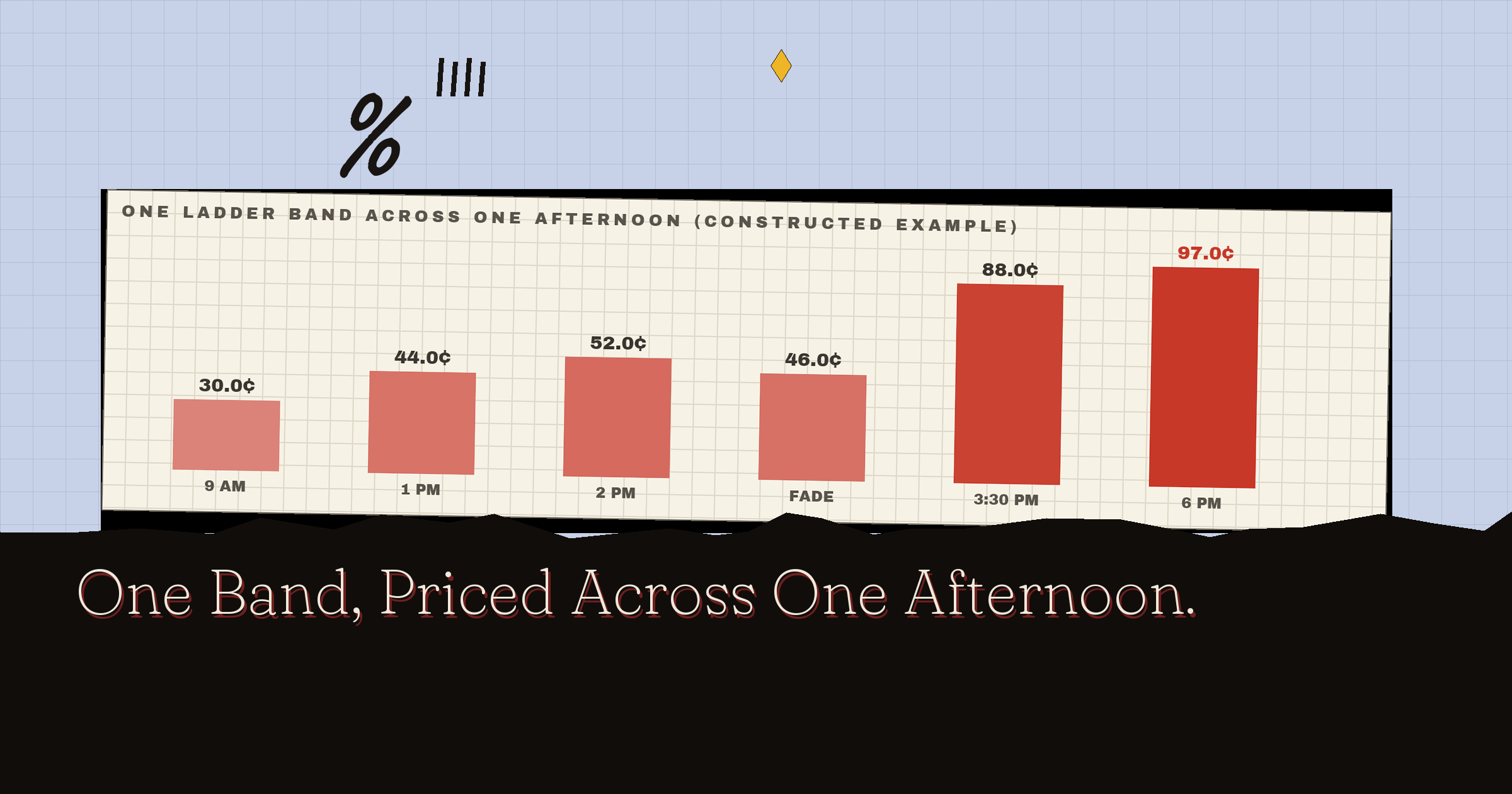
| Time | Observed so far | Band price | Which force moved it |
|---|---|---|---|
| 9 AM | 84° and climbing | 30¢ | None yet: the forecast consensus, with several bands still alive |
| 1 PM | high so far 95° | 44¢ | Information: each hourly reading narrows where the high can land |
| 2 PM | reading holds at 95° | 52¢, fades to 46¢ | A large order in a thin book: the print moved, the estimate did not |
| 3:30 PM | high so far 99° | 88¢ | Collapse: every band below 99° is now mechanically dead |
| 6 PM | cooling, high stands at 99° | 97¢ | Collapse without news: each quiet hour buries the late-spike scenario deeper |
The row that repays the most study is 3:30 PM. A daily high is a running maximum, and a running maximum can only rise, so the moment the station touches 99°, every band below it is not unlikely but impossible, and the money that was spread across those bands has nowhere to live except the survivors. Uncertainty collapse rarely comes purer: no interpretation, no spin, a price pinned by arithmetic, with one honest asterisk: the contract settles on the source its rules name, not on the feed you happened to watch, and that gap is its own small risk. Overnight-low markets run the same logic mirrored, a running minimum that can only fall, which is why highs and lows are two different games. And the 2 PM row is the fourth force caught in the act: the temperature did not change, one order did, and the fade that followed is how you tell.
Every market you will ever trade runs this same afternoon in slow motion. An election runs it over months, a Fed meeting over weeks, a game over three hours. Weather just compresses the whole cycle into a day and shows you the gears.
What A Moving Price Means For Your Risk
Reading moves correctly matters most at the edges of the ladder, because that is where the arithmetic gets unforgiving. By 6 PM that 97¢ band looks like the safest thing on the board, and its mirror image, selling the 3¢ tail, looks like collecting rent on an impossibility. But selling an unlikely outcome collects a small premium and risks most of a dollar, so one loss erases the premiums from something like 30 or 40 wins. That asymmetry, not the hit rate, is what makes position sizing the whole game, and a late-day heat spike that lands once in a blue moon is exactly the kind of event that produces it. The full math lives in when you sell a long shot, one loss costs many wins, and the trading fee makes every margin thinner than the raw prices suggest; how Kalshi's fees work shows the standard fee formula peaks at 50¢, right where a contract spends its most uncertain hours.
A late price is not a safe price. Near resolution, prices sit close to $1 or $0 because most uncertainty is gone, not because the remaining uncertainty is free to ignore. The rare miss at 97¢ is priced small precisely because it is expensive.
More on this: Prediction Market Prices: Kalshi's Probability In Shoes · The Forecast Is Not The Price On A Kalshi Weather Market · Kalshi Rules: How Contracts Are Written, Settled And Changed · 2026 Governor Races: Every Kalshi Board We Track · Prediction Market Liquidity: Why It Decides If You Can Trade
The Same Habit, Pointed At Any Market
Strip the weather out and the habit travels. A Fed-meeting market grinding from 70¢ to 85¢ across a quiet week, no speech, no data print, is the 6 PM row on a slower clock: time removing scenarios while nobody says a word. A futures market that spikes six points on a sleepy Tuesday and gives half of it back by dinner, on a few hundred contracts, is the 2 PM row. Same afternoon, slower clock. Treat every price as an estimate, and every move as a question about which force produced it. Did information arrive, or did an order? Will this move hold, or decay? Sportsbook prices reward exactly the same reading, with one twist: a bookmaker's margin is baked into every line, so the posted number is not the market's honest estimate until you strip that margin out. Stripping it out is the job of OddsShopper's +EV top bets screen, a live odds screen that shops each market across 100+ books and de-vigs it into a no-vig consensus estimate so you can compare any posted number against the broader market, and the tool surfaces the books sitting on the wrong side of it. The Liquidity Tool applies force number two directly, showing where size is resting on the exchanges themselves. And if you would rather watch probability-first reasoning applied to games before touching any of it, our free expert picks are open to read, no account needed, and the full toolkit behind them starts with a free week trial whenever you are ready to run the reading yourself.