Winning MLB bets over a full season has almost nothing to do with picking more winners than the guy next to you. Baseball is a 162-game grind with a coin-flip feel most nights, and the bettors who come out ahead do it at the margins: a few cents of price here, a weather read there, a bad bullpen exposed at the right moment. None of it is flashy. All of it compounds. Below are five sports betting tips for baseball, counted down the way we do it at OddsShopper, with the single most important habit saved for last. Master that one and the other four get a lot easier.
In Summary
- You Win MLB Bets At The Margins, Not With Hot Takes. Small, repeatable edges piled up over a long season beat any single "lock."
- The Order Matters. Underdog value, weather and parks, and pitching matchups all feed into two habits that decide your season: betting early and shopping the number.
- The Best Price Is The Whole Game. Getting the best available odds on every bet you make is the highest-leverage thing you can do, which is exactly why it is tip number one.
Watch: Sports Betting 101 — How To Win MLB Bets
Below is the short video version of these five tips before we break each one down.
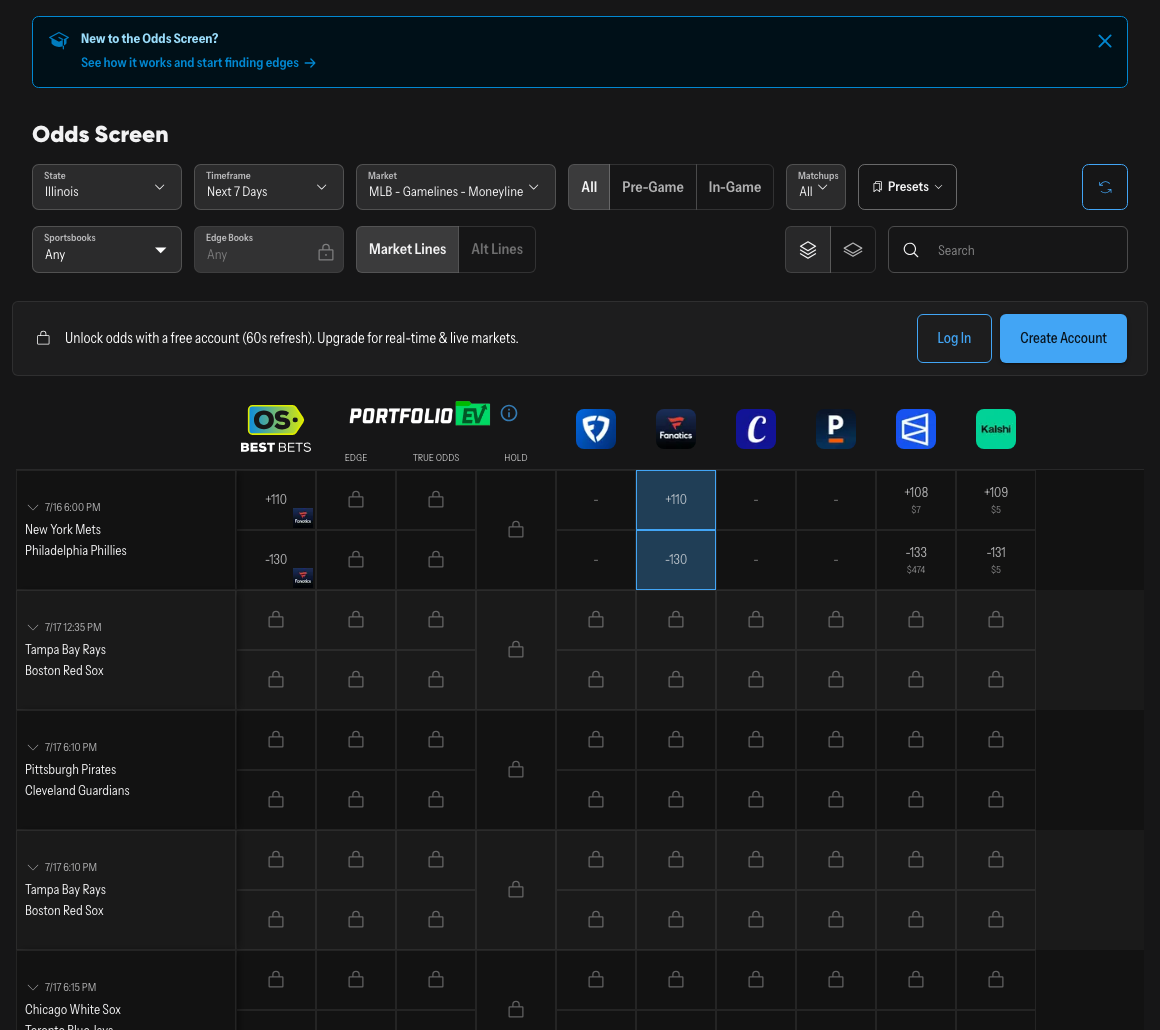
The OddsShopper Odds Screen.
Tip 5: Do Not Be Afraid To Bet MLB Underdogs
Public bettors love baseball favorites, and that habit quietly bleeds money. A heavy MLB favorite might sit at -180 or worse, which means you are risking $180 to win $100 in a sport where the "worse" team wins roughly four times out of ten on any given night. Underdogs let you flip that math: you bet less to win more, and you only need to be right a fraction of the time to profit.
The point is not to blindly hammer every plus-money team. It is to stay open to them. When a book prices a solid road team at +140, the payout does a lot of the work for you over a full season. If the concept of why +140 pays more than a -140 favorite is fuzzy, our guide to how to read betting odds walks through the plus/minus math in plain terms. And if you want to cut your risk while still backing a dog, the MLB run line is the tool for it.
Tip 4: Know The Weather And The Ballparks
Baseball is the most environment-dependent sport on the board, and the books cannot fully price every gust of wind. Before you bet a total or a home run prop, you want to know how the wind is blowing that day, the chance of precipitation, how hot or cold it is, the time of year, and how a given park plays for hitters and pitchers. Wind blowing out at a hitter's park is a real, namable edge; a cold, damp night at a pitcher-friendly stadium is the opposite.
The extra layer most casual bettors skip is fit: how equipped are tonight's pitchers and hitters to handle those conditions? A fly-ball pitcher in a bandbox with the wind out is a very different bet than a ground-ball arm in the same spot. Match the arm to the air, not just the park to the total, and you are already ahead of the crowd betting the weather at face value.
Tip 3: Understand The Pitching Matchups
This is the one I keep coming back to, because it is where the books are most beatable. No matter how sharp a sportsbook is, there is simply too much going on under the hood of a baseball game for them to perfectly price every starter, every bullpen, and every prop across a 15-game card. That is a feature of the sport, not a flaw in the book. There are only so many hours in a day.
So dig into the matchup. How does the starter fare against left-handed versus right-handed bats? Is he pitching for the third time through a lineup that already saw him twice? What happens when the opposing starter gets knocked out early and a shaky bullpen has to cover six innings? Those questions are where mispriced numbers hide. Our MLB betting research process lays out a repeatable checklist, and if you only trust the two starters and not the relief corps, the first-five-innings market lets you bet the part of the game you actually have a read on.
Tip 2: Jump On MLB Lines Early
Now the first three tips start paying off. Once you have a read on the underdog value, the weather, and the matchup, you want to get your money down before the market catches up. If you know your stuff, or you are using a market-based tool that flags mispriced odds, you can bet a soft number the night before, well ahead of the sharp money that will shape it by first pitch.
That early price is usually the best price you will see. As the game approaches and more money pours in, the line drifts toward its true value, and the edge you spotted evaporates. Beating the closing number is the single cleanest sign that you are betting well over time, which is why sharps obsess over it. If that idea is new to you, closing line value explained is the piece to read next.
Tip 1: Shop The Odds On Every Bet You Make
This is the most important one, not just in baseball but in all of sports betting. Every book prices the same game a little differently, and by simply taking the best available number on every bet, you pay the sportsbooks less and keep more money in your pocket, even on the bets that lose. Few habits do more for less effort, and this one takes no handicapping skill at all.
The gap is bigger than most people think. To make it concrete, here is a real sample of a few MLB player-hit markets pulled from one recent day of games. The exact names and prices rotate every day, but the pattern never does. Each row shows the de-vigged fair price against the best number actually available across books at that moment:
| MLB Hit Market (One-Day Sample) | Fair (no-vig) price | Best available price | Edge |
|---|---|---|---|
| Petey Halpin Under 0.5 Hits | -111 | +110 (Bet365) | +10.5% |
| Brandon Nimmo Under 0.5 Hits | +155 | +180 (Bet365) | +9.8% |
| George Springer Under 0.5 Hits | +158 | +175 (Bet365) | +6.6% |
Look at that top row. The fair, no-vig price on Petey Halpin's under makes it a slight favorite at -111, yet the best book on the board had the same outcome at +110, plus money on a bet the math says should cost you. A clean 10.5% edge, created by nothing more than knowing where to look. Take the -111 version at the wrong book and you have handed the house the entire margin. Tomorrow the names change; the day you stop shopping is the day that edge starts leaking back to the book.
Doing that comparison by hand across a dozen books is a chore, which is exactly what the OddsShopper live odds screen — shop the number across every major book automates. It pulls every book's price into one view and marks the best available number and the fair, de-vigged value on each MLB line, so the plus-money version above is the one you see first instead of the one you stumble into.
New to OddsShopper?It scans every major sportsbook and flags the exact best-priced, best-value bets the way this article just did by hand. Try OS Pro free for 7 days, and code WINMLB20 takes 20% off OS Pro or OS Core if you subscribe: Start your free trial.
Putting The Five Tips Together
Read the list back and you will notice it collapses into one idea. Betting underdogs, reading the weather, and digging into the matchup are all ways to find a number the book got slightly wrong. Betting early and shopping the odds are how you capture that number before it moves and at the best possible price. Find the edge, then protect the price. That is the whole discipline, and it is why tip one is tip one: even a perfect read on Petey Halpin is worthless if you take -111 at the wrong book instead of +110 at the right one.
None of these habits locks in a winning season, and anyone who tells you otherwise is selling something. What they do is tilt a long, noisy 162-game schedule a few percentage points in your favor, over and over, which is exactly where baseball profits come from. If you want the broader, all-sport version of this same discipline, we cover it in how to win sports bets, and you can pressure-test your own reads against our free expert picks today.
Frequently Asked Questions
How do you win MLB bets consistently? By compounding small, repeatable edges rather than chasing "locks." Bet underdogs when the price is right, factor in weather and park effects, dig into the pitching matchup, get your money down early, and always take the best available number. No single bet wins your season, but those habits compound across 162 games.
Is it smart to bet MLB underdogs? It can be, because favorites are often overpriced by public money. A plus-money dog lets you bet less to win more and only needs to hit part of the time to profit. The key is selectivity: back dogs when the payout outweighs the risk, not blindly.
Why does shopping for the best odds matter so much? Because you pay the sportsbook less on every bet, win or lose. The same MLB outcome can be priced as a favorite at one book and plus money at another, and taking the better number is a free edge that requires no handicapping. Over a full season, those saved cents are often the difference between red and green.
When should you bet MLB lines? As early as you reasonably can, often the night before. Early numbers are usually softer, and the line hardens toward its true value as sharp money arrives. Betting early and beating the closing number is one of the clearest signs you are betting well.
The Bottom Line
Winning MLB bets is less about genius picks and more about a handful of disciplined habits: stay open to underdogs, respect the weather and the ballpark, understand the arms, bet early, and above all, shop for the best price every single time. Do the first four to find the edge, and let the fifth make sure you never give it back at the window. OddsShopper's Odds Screen exists to do the last and hardest part for you, pulling every book's number and the fair value into one screen so the best MLB bet on the board is the first one you see.
Bet smarter this season.OddsShopper shows you the best-priced, best-value MLB bets across every major book, so you stop leaving money on the table. Start free for 7 days, then use code WINMLB20 for 20% off OS Pro or OS Core: Start your free trial.
More on this: MLB Hit Props Today · MLB Home Run Picks Today (8/19): Shohei Ohtani & More · MLB Picks Hub: Today's Live Boards and Series · MLB Strikeout Props Today · MLB Total Bases Props Today