Super Bowl 2027 odds moved on Thursday night while the game that moved them was still being played. The Los Angeles Rams, the preseason favorite to win Super Bowl LXI, lost 27-7 to the San Francisco 49ers at the Melbourne Cricket Ground, and their Kalshi championship contract went from 16 bid, 17 offered at kickoff to 13 bid, 14 offered, with the whole drop printing in the 20 minutes around a fourth-quarter touchdown, 40 minutes before the final whistle. The 49ers' contract went from 5 cents to 8 in the same window. The question after a night like that is not whether the Rams are still good. It is whether the price they now carry is one you want to pay.
Two things get settled below: how much one game in September is worth to a February favorite, and whether the team that won it, now third on the Kalshi board, earned a seat at the top or got chased there. The answer comes from the trading, not the box score, and the trading was lopsided in a way you can see down to the minute.
The Quick Answer
The Rams are still the Super Bowl 2027 favorite after the loss, but a smaller one: their Kalshi championship contract fell from 16 bid, 17 offered at kickoff (17 on Wednesday night) to 13 bid, 14 offered, and DraftKings, the one book still at +500 before the game, moved to +600, where bet365, BetMGM, Caesars and FanDuel already were. The 49ers went from 5 cents to a 9-cent print, 8 on the ask now, and from +1900 to +1400 at DraftKings, climbing past Seattle, Baltimore, Denver and Kansas City into third on Kalshi behind Buffalo, and fifth on DraftKings' list. The full 32-team board, the 20 minutes of trading that did most of it, and where I would and would not be after Melbourne are below.
Super Bowl 2027 Odds: The Board After Melbourne
Below is the Super Bowl LXI board as of just after midnight ET on Friday, September 11, 2026, late Thursday night Central, priced off Kalshi's KXSB-27 market, where every team trades as its own yes/no contract in cents (a 13-cent contract pays $1 if that team wins the title). The middle column is each contract's bid and ask in the last full hour before kickoff, from Kalshi's hourly candles. DraftKings prices come from ESPN's odds feed after the game for the seven teams it lists. Odds move on every game and every injury, so treat this as the current shape of the board rather than a frozen number, and before you bet anything, check your price against the live odds screen and shop the number across every major book.
| Team | Kalshi bid / ask now | Before kickoff (bid / ask) | DraftKings after |
|---|---|---|---|
| Los Angeles Rams | 13¢ / 14¢ | 16¢ / 17¢ | +600 |
| Buffalo Bills | 8¢ / 9¢ | 8¢ / 9¢ | +1000 |
| San Francisco 49ers | 7¢ / 8¢ | 4¢ / 5¢ | +1400 |
| Seattle Seahawks (Defending Champs) | 6¢ / 7¢ | 6¢ / 7¢ | +1050 |
| Baltimore Ravens | 6¢ / 7¢ | 6¢ / 7¢ | +1000 |
| Kansas City Chiefs | 5¢ / 6¢ | 5¢ / 6¢ | +1600 |
| Denver Broncos | 5¢ / 6¢ | 5¢ / 6¢ | +2000 |
| Cincinnati Bengals | 4¢ / 5¢ | 4¢ / 5¢ | |
| Houston Texans | 4¢ / 5¢ | 4¢ / 5¢ | |
| Philadelphia Eagles | 4¢ / 5¢ | 4¢ / 5¢ | |
| Los Angeles Chargers | 4¢ / 5¢ | 4¢ / 5¢ | |
| Dallas Cowboys | 4¢ / 5¢ | 4¢ / 5¢ | |
| Green Bay Packers | 3¢ / 4¢ | 3¢ / 4¢ | |
| Detroit Lions | 3¢ / 4¢ | 3¢ / 4¢ | |
| New England Patriots | 3¢ / 4¢ | 3¢ / 4¢ | |
| Chicago Bears | 3¢ / 4¢ | 3¢ / 4¢ | |
| Minnesota Vikings | 2¢ / 3¢ | 2¢ / 3¢ | |
| Jacksonville Jaguars | 2¢ / 3¢ | 2¢ / 3¢ |
The other 14 teams are bid at a penny or less, and ten of them carry no bid at all: the Saints, Raiders, Cardinals, Panthers, Titans, Browns, Steelers, Falcons, Jets and Dolphins. Buy every team once at the ask and the board costs about $1.22 for a payout of exactly $1, and that 22 cents is the overround you are fighting on any futures market.
The row I keep coming back to is not the Rams. It is the 49ers, because of when the move happened. Their championship contract traded 1.52 million contracts in the 24 hours ending at my pull, five times the Rams' 303,570 and by a mile the most on the board, and the price history says most of it, roughly 60%, printed in one hour while the game was still going. Stafford was stopped at the 1 at 10:30 p.m. ET. Purdy's 15-yarder to Deebo Samuel Sr. landed at 10:44. In the ten minutes around that touchdown, about 600,000 49ers contracts changed hands in only 132 trades, roughly 4,500 contracts apiece, and the block opened and closed at 5 cents, which means sellers absorbed all of it at the old price. Then the price gapped to 9. The next 167,000 contracts traded it back down to 6, and it settled at 8 by the final whistle. The Rams' contract gapped from 16 to 13 in the same ten minutes and traded 56,000 contracts between 13 and 16. The final whistle did not come until 11:24. By then the repricing was 40 minutes old, and the last hour of the game added little to it. One team was sold. The other was bought in size, by a few large orders, and they were buying the drive as it happened.
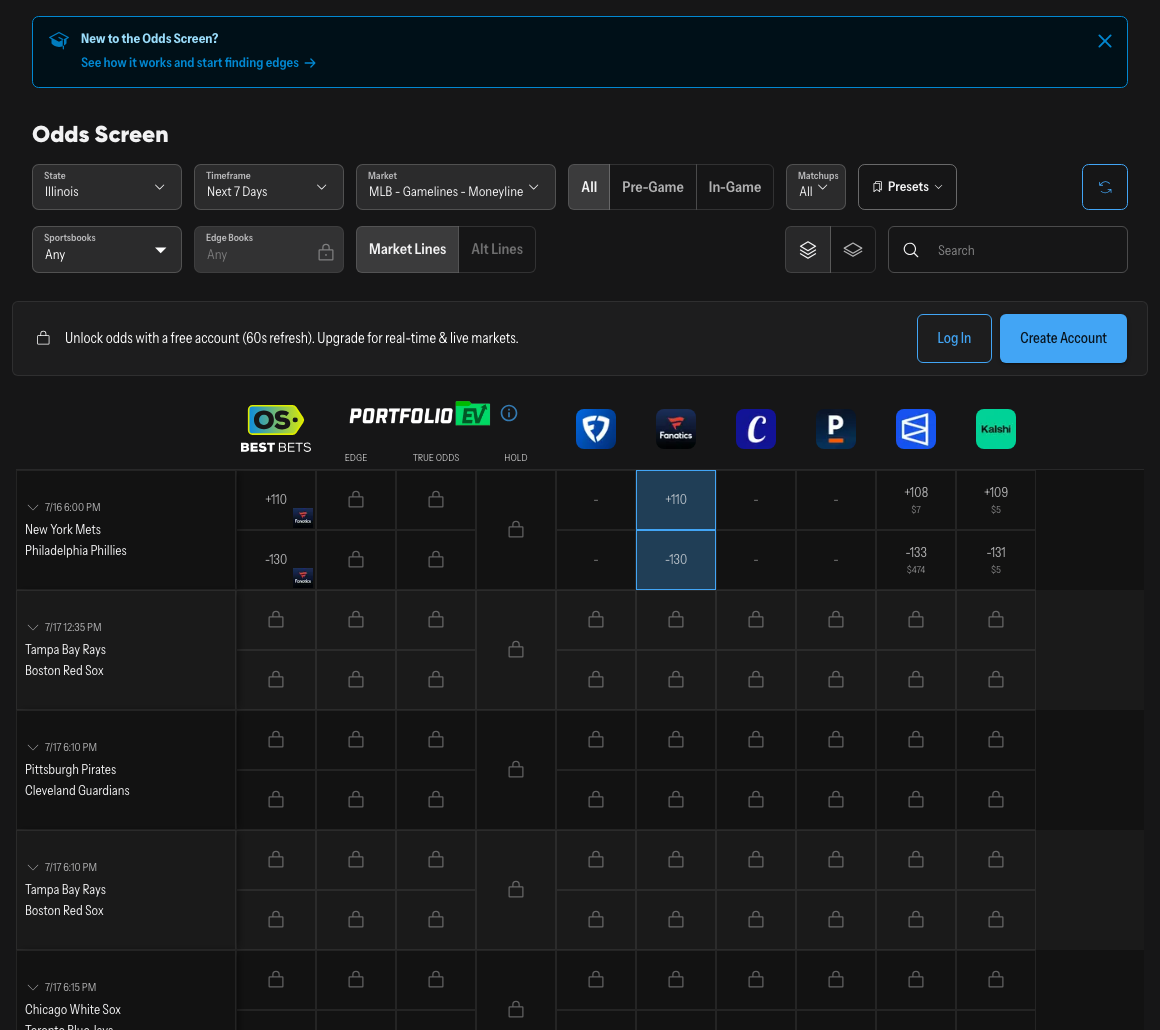 The OddsShopper live odds screen — every book's price on one board, refreshed in real time. Open the live NFL board.
What Happened At The MCG
The price moved because of one drive, so it is worth being precise about the game. In front of 100,021 at the Melbourne Cricket Ground, the Rams trailed 10-7 at halftime and 17-7 early in the third quarter after Brock Purdy's second touchdown pass, a 2-yard throw from the goal line. Los Angeles then put together the drive that should have made it a game: 12 plays, 72 yards, 7 minutes and 22 seconds, down to the goal line. On fourth-and-goal at the 1, with 3:46 on the clock, Sean McVay passed on the field goal and ran Matthew Stafford on a sneak. He was stopped short, the ruling held up on review, and the 49ers took over at their own 1 with 3:41 left in the quarter.
What followed is the part the market was pricing. San Francisco went 99 yards in 11 plays, Purdy hit Deebo Samuel Sr. from 15 out early in the fourth quarter, and a 10-point game became 24-7 without the Rams touching the ball. Eddy Pineiro added a 56-yard field goal for the final margin. Stafford finished 15 of 25 for 155 yards, no touchdowns and an interception. Purdy went 25 of 34 for 205 yards and three scores with a pick of his own, and the 49ers' two backs, Christian McCaffrey and Kaelon Black, combined for 133 rushing yards on 24 carries. Los Angeles' only points came on a 5-yard Kyren Williams run in the second quarter.
What Three Cents Means For One Loss
Sixteen cents to 13 is a bigger cut than it looks. The Rams were 17 on Wednesday night, 16 bid and 17 offered at kickoff, and 13 bid, 14 offered after the game, so the loss itself took three cents off both sides of the market, about a fifth of the Rams' implied championship probability, from roughly one in six to somewhere between one in seven and one in eight. DraftKings' move from +500 to +600 says the same thing in American odds, 16.7% down to 14.3%, with one qualifier: the other four books were already at +600 before kickoff, so across sportsbooks the consensus number barely moved and DraftKings simply stopped being the outlier. So is one loss in September worth three cents to a February favorite?
Partly, yes, and the reason is that this was not a random loss. The Rams lost to a division rival that now sits level with them in the NFC West market, in a game that counts as a division loss and hands San Francisco a 1-0 lead in the season series. You can see that in the sibling market. In the last hour before kickoff the Rams' Kalshi NFC West contract was 50 bid, 52 offered, and its last print before the game was 52. It now trades 36 bid, 38 offered, a 16-cent drop on the last price, while San Francisco's went from 20 bid, 21 offered to 34 bid, 37 offered and Seattle's edged from 29 bid, 30 offered to 32 bid, 34 offered. The championship contract only fell 3 because a Super Bowl does not require a division title, but the seeding and the bye that come with one are real, and Thursday turned the Rams' path to them from a cushion into a three-way race. The market took the division seriously and the title less so, which is the right order.
Partly, no, and the callback to July belongs here. When this page first went up, the Rams had just shortened from +950 to the +500s on the Myles Garrett trade, and the read was that a favorite the public is piling onto gets no shorter and often drifts back when the hype cools. It did not drift back on cooling hype. It drifted back on a 20-point loss, and the drop landed on the same crowd that bought the top. Buying a favorite at its peak of enthusiasm means a single game can hand back a quarter of your position, and there are 16 more of them. At 13 cents the Rams are the same roster that was 17 on Wednesday, with one more thing to prove and one less game to prove it in.
Did The 49ers Earn A Seat At The Top?
The 49ers earned a seat in the division race and got chased into a seat on the title board. Those are different things. Five cents to 8 is a 60% increase in implied probability off one game, it printed 9 on the way, and it arrived on the heaviest ten minutes of buying this contract saw all night. It is exactly the kind of move I fade on instinct, and instinct is not an argument, so here is the actual case on both sides.
The case for the price: the 49ers won on the road, on a neutral continent, against the preseason favorite, with a 99-yard drive after a goal-line stand as the swing. They are 1-0 with a series lead on the division favorite, and their NFC West contract, at 34 to 37 cents, now sits within a few pennies of the Rams'. At +1400 you are being asked to believe they win the title about 6.7% of the time. A team that just did that to that opponent is not an outlandish 6.7%.
The case against: it was one game, and it was 10-7 at halftime. The second half turned on a fourth-and-goal from the 1 that goes the other way often enough that nobody should price a season off it. Before kickoff the 49ers were +1900 at DraftKings and as short as +1200 at Caesars, which means part of Thursday's move was DraftKings catching up to a board that already had them shorter. If you liked San Francisco at 5 cents on Wednesday, the roster you liked is unchanged; the price is 60% worse. Buying 8 cents tonight is paying for the game you just watched, and the game has already happened.
Where that leaves me: the division contract is the better-shaped expression of what Thursday actually proved, and not because it moved less. It moved more, from 21 cents to the mid-30s, on a thin book (about 8,600 contracts in 24 hours, with a 3-cent spread), so nobody should call it cheap. The difference is structural. Winning the NFC West only asks the 49ers to be the best of four teams over 17 games, and Thursday changed that question directly: a division win, a series lead, and the favorite knocked off its cushion. The championship contract staples three or four single-elimination games onto the same opinion, and Thursday changed none of those. Whenever you like a team's news, check whether the division or conference market pays you for the opinion without the bracket. Tonight the division market is at least pricing the thing the game actually decided.
The Field Trade After The Loss
If the Rams at 13 cents are a one-in-seven proposition, the interesting question is what the market charges you for the other six in seven, and prediction markets let you see it directly. "No" on the Rams' championship contract trades at 86 cents bid, 87 offered. Pay 87 cents, collect $1 if any of the other 31 teams wins Super Bowl LXI. That is the field priced as a single number. Be clear about the shape, though: you risk 87 to make 13, a return of about 15% if anyone else wins. Thursday made that trade less attractive, not more, because the market already sold the Rams for you; the field trade was better business at 17 cents than it is at 13. If what you actually believe is that Thursday exposed the Rams, the 87-cent field is the bluntest way to say it, and the 49ers' NFC West contract at 34 to 37 cents is the sharper one, because the division is the market the game actually decided.
Sportsbooks do not hang a field ticket against one team, so the equivalent there is a portfolio: pass on the favorite and take prices on the two or three contenders you actually rate. The structure of the board after Melbourne favors that discipline more than it did in July. The second tier is now four teams inside two cents of each other, Buffalo at 8 to 9, the 49ers at 7 to 8, Seattle and Baltimore at 6 to 7, then Kansas City and Denver a step down at 5 to 6, then a five-team shelf at 4 to 5 cents. The market is saying it cannot separate 11 teams, while it still prices one team above all of them. One of those two claims is much easier to be wrong about, and Thursday was a reminder of which, even if the size of the Rams' cut was defensible.
The rule Thursday taughtthe loss moved the Rams' division contract 16 cents and their title contract 3. Price the market the result actually decided, and be slow to pay up in the one it did not.
If you want the framework for building your own number first, our NFL win totals guide walks through constructing a projection you can bet against the board, and there is real money in backing the right underdog before the market catches up, which is the whole idea behind betting NFL underdog moneyline value. The operative word is right, not long: the penny tier of this board is cheap because it should be.
The Number You Accept: A Line-Shopping Worked Example
Everything above is about which price to study. This section is about which price to take, because a night like Thursday is when the same ticket is furthest from being one number. The last pre-game board I could see, VegasInsider's five-book table stamped 11:51 a.m. Thursday, had the Rams at +500 at DraftKings and +600 at bet365, BetMGM, Caesars and FanDuel. The 49ers ran from +1200 at Caesars to +1400 at bet365, +1500 at BetMGM, +1600 at FanDuel and +1900 at DraftKings. Read that 49ers row again: before a snap was played, bet365 had San Francisco at +1400, where DraftKings only got to after the game, and Caesars was shorter still at +1200. A winning $100 ticket on the 49ers at +1200 returns $1,200 in profit; at +1900 it returns $1,900. Seven hundred dollars of difference on the identical outcome was sitting on the board Thursday afternoon for anyone who compared five columns.
After the game, ESPN's DraftKings feed showed the Rams at +600 and the 49ers at +1400. That is DraftKings catching up to the +600 the other four books were already hanging on Los Angeles, and closing most of its 49ers gap. What I cannot tell you from my desk is which of the other four had moved by midnight, and that is the point: on a repricing night the edge is the book that has not moved yet, and it is never the same book twice. The OddsShopper live NFL odds screen lines up the futures price at DraftKings, FanDuel, BetMGM, Caesars, bet365 and 20-plus other books side by side, the same way you would compare real-time NFL odds on a game line, so the slow book is obvious instead of buried. If reading those plus-and-minus prices is still fuzzy, our plus and minus odds explainer breaks down exactly what +600 pays versus +500. And if you would rather start with what our experts are playing this week, the free expert picks today hub is the no-cost entry point.
Bet the best number, not the first one. New OS Pro members get 20% off their first month with code SBFUTURES20, plus a free trial to shop every futures price before the rest of the board catches up.
Hedging A Rams Ticket After Thursday
Early futures come with one feature no game bet has: time. Bet a team now and, if it reaches Super Bowl LXI, you can place a hedge at the game that converts the ticket into a fixed return once both bets are placed, regardless of which team wins. Hedges depend on the game price and the limits available to you, so this is an option the ticket creates, not a promise it makes, and a hedge always gives back some expected value in exchange for certainty.
Take the reader who followed this page in July and bought the Rams at +550 for $100. That ticket pays $550 in profit if Los Angeles wins it all, and Thursday did not change that number by a cent. Suppose the Rams get to SoFi Stadium as a -150 favorite, which makes their opponent roughly +130. Bet about $283 on the opponent at +130 and the two outcomes balance: a Rams win collects the $550 minus the $283 hedge, about $267, and an opponent win pays $368 on the hedge minus the $100 futures stake, about $268. The ticket that spent September looking worse just converted into a fixed $267, before price movement and limits. Whether to take that deal instead of letting the ticket ride is the actual decision, and it is a decision about your own risk tolerance, not about the Rams.
The same opinion in a Kalshi wrapper behaves differently, and Thursday showed how. The Rams' contract is a live two-sided market: anyone holding it at 17 cents watched it mark to 13 early in the fourth quarter and could have sold at any point on the way down, at whatever the bid was in that minute. A sportsbook ticket at +500 sits in your account at +500, and the cash-out button the big books offer on futures is a take-it-or-leave-it price with the book's margin built in, not a market you can work. The book gave the slightly better number (+550 implies 15.4%, against a 17-cent ask on Kalshi at kickoff Thursday); the contract gave you the door. Which wrapper you want depends on whether you plan to hold to the final whistle.
Where I Would Be After Melbourne
None of this is advice to force a bet, but if you are in this market this week, here is how I frame the four lanes, chalk to longshot, with the read on each.
- The Chalk (Rams, 13 To 14 Cents, +600): In July I wrote the Rams were defensible at +550 or better. Four books were already at +600 before kickoff; Thursday's change is that DraftKings finally matched them and Kalshi's 14-cent ask (about +614) fell in line, so +600 is now the consensus rather than the outlier. That clears the July bar, and it clears it on a loss that changed the division picture more than the roster. If you believe in this team, this is the cleanest entry the market has offered on it since the Garrett trade. If you do not, be clear that the field trade got more expensive on Thursday, not cheaper, because the market already sold the Rams for you.
- The Mid-Board (Bills, Seahawks, Ravens, +1000 To +1050): Still where I would concentrate, three teams deep before you get to the question of the 49ers. This is the tier the market treats as interchangeable even though these rosters are not, and it is the tier the field math argues for. Shop hardest here: Baltimore is +1000 at DraftKings and was +1300 at Caesars and FanDuel before kickoff, a $300 difference on a winning $100 ticket.
- The 49ers Specifically (7 To 8 Cents, +1400): Not at this price, not tonight. The division contract at 34 to 37 cents is the version of this opinion I would own. If the championship price comes back to 6 cents on a quiet week, the conversation reopens.
- The Longshot Lottery (The 2-Cent-And-Under Tier, +4900 And Longer): Fun, and hedge-able if it hits, but the hold at the bottom of the board is the worst on it. Size it like the lottery ticket it is.
Whatever lane you pick, the number you accept decides the bet more than the team does. That was this page's thesis in July, and Melbourne did not weaken it. It produced the sharpest example of the season so far: the same 49ers ticket was +1200 at one book and +1900 at another on Thursday afternoon, and DraftKings had closed most of that gap by midnight.
The Takeaway
One bad night overseas cost the favorite four cents and most of its division cushion, and it bought the team that beat them three cents and a series lead. Neither move is wrong, and neither is finished: the Rams will be repriced again on Sunday's results and every Sunday after, and the 49ers' 8 cents will be tested the first time Purdy plays a half like Stafford just did. Read the board for who is good, bet the price for what is worth it, and notice that the market did its repricing in the 20 minutes around Samuel's fourth-quarter touchdown, with the game still on. Pull up the live futures market, find the book that has not caught up, and let the board come to you.
More on this: Super Bowl 2027 Odds: Kalshi's Rams Are AI's Biggest Fade · Bills Super Bowl Odds: What An 8-Cent Share Really Pays · NFC West Odds: The Division Market After Melbourne