The Kentucky win total for 2026 is a bet on the fastest kind of rebuild there is: a new coach, a new scheme on both sides, and a first-year quarterback, dropped into one of the SEC's hardest schedules. Mark Stoops, the winningest coach in program history at 82-80, was fired on December 1, 2025 after the Wildcats went 5-7 and missed a bowl for the second straight year, and Kentucky handed the program to Will Stein, the young Oregon offensive coordinator, who then lost incumbent quarterback Cutter Boley to Arizona State and rebuilt the roster through 29 transfer-portal additions. Hold on to that word, rebuild, because the whole number swings on how fast it takes: a torn-down-and-reloaded team meeting Alabama, LSU, and Florida at home and Texas A&M, Oklahoma, and Tennessee on the road. This page walks the Kentucky win total the way our college football win totals hub teaches it: sort the schedule, weigh what is actually coming back, then build the case both ways before you fire.
The Quick Read
- The Bet: the season-long over/under on how many regular-season games Kentucky wins in 2026, graded when the Wildcats' 12-game regular season ends in late November. It ties your money up for months, so treat it like a futures position, not a Saturday side.
- The Setup: Kentucky went 5-7 in 2025 (2-6 in SEC play), closing with a 45-17 loss to Vanderbilt and a 41-0 loss at Louisville, then changed coaches and quarterbacks. Win totals grade on the regular season, so a 5-7 baseline under an entirely new staff is the number the market has to price.
- What Decides It: how quickly Stein's rebuilt roster gels behind a first-year starter, against a schedule with almost no soft SEC dates. The floor is two non-conference wins; the rest of the number is fought for in a handful of swing games.
- The Odds: BetMGM 🎁 posts Kentucky at 4.5 wins (as of mid-July 2026). Juice moves book to book and week to week, so never bet a number you have not shopped first.
Where The Kentucky Win Total Sits For 2026
A win total is a futures market. The book posts a number for Kentucky's full 12-game regular season, non-conference games included, as a half-win line so there is no push, and you bet the over or the under. Kentucky's posted number is 4.5 at BetMGM (as of mid-July 2026), among the lowest in the SEC alongside Arkansas and Mississippi State. Prices move, so confirm the live number before betting, because a win total you half-remember from July is worthless by August. If you want the mechanics of how a posted price converts to a real probability, the how to read betting odds guide walks the math.
What is knowable now is the shape of this market, and Kentucky sits at a specific spot on it: a rebuilding team with a brand-name new coach. That combination pulls the number in two directions. The market respects the offensive upside Stein brings from Oregon, where he was the coordinator, which props the number up on hope. But it cannot ignore a 5-7 team that just lost its last two games by a combined 86-17, changed everything, and returns very little proven offense, which drags the number back down toward the floor. That tension is the whole ticket. The edge on a total like this is not the coaching change and it is not the ugly November finish. It is whether a first-year staff and a first-year quarterback can win enough of a thin group of catchable games to clear a number the market has set by weighing Stein's Oregon pedigree against the program's recent struggles.
Reading Kentucky's 2026 Schedule
The schedule is the knowable half of this bet, and Kentucky's is shaped like a season with a tiny margin for error. 2026 is the first year the SEC plays nine conference games, and the Wildcats drew four of them at home, hosting Alabama, LSU, Vanderbilt, and Florida while traveling to Texas A&M, South Carolina, Oklahoma, Tennessee, and Missouri. The non-conference card is soft: Youngstown State (an FCS opponent) and South Alabama at Kroger Field, plus the season-closing Governor's Cup against rival Louisville at home. Sort the 12 games into three buckets and the path comes into focus.
| Tier | Games | What it means for the number |
|---|---|---|
| Likely Wins | Youngstown State (home, FCS) and South Alabama (home) | The floor. Two non-conference home games Kentucky should be favored in before the SEC schedule turns hard. |
| The Swing Tier | at South Carolina, home vs Vanderbilt, at Missouri, home vs Louisville | Where the number is decided. The only games on the card a rebuilding Kentucky can realistically target, and it must win a chunk of them to move off the floor. |
| Toughest Tests | home vs Alabama, home vs LSU, at Texas A&M, at Oklahoma, at Tennessee, home vs Florida | The ceiling limiter. Six of the toughest opponents on the schedule, half on the road, and the reason this number starts low. |
The single most important row in that table is the swing tier, because that is where the total is actually won or lost, and for Kentucky it is unusually thin. A rebuilding team gets no free SEC wins on this card, so the two non-conference gimmes plus that four-game swing group is essentially the entire realistic win pool. Worse for the over, two of those four are the exact opponents that ended 2025 in a heap: Vanderbilt, which won 45-17, and Louisville, which won 41-0. A team can beat Youngstown State and South Alabama by 50 combined and still land on a low number if it cannot flip results like those, and that is precisely the question the swing tier asks. Which runs straight back to the quarterback question we flagged at the top, because in college football the passer is the difference between stealing a swing game and losing it late.
The Reset: New Staff, New Quarterback, And What Comes Back
If the schedule is the knowable half, the roster is where the number gets its risk, and in college football the quarterback is the line, exactly as the open promised. Kentucky opens 2026 with a new starter under center, because 2025 starter Cutter Boley transferred to Arizona State rather than stay for the coaching change. To fill the void, Stein went to the portal for Kenny Minchey, a redshirt sophomore who backed up at Notre Dame and arrives with two years of eligibility and the inside track on the job, with sophomore Brennan Ward also in the room. Minchey has practiced in a winning program, but he has never carried a starting job across a full season, and a first-time full-season starter is always the biggest single variable on a win total. As with any portal-era roster fact, the depth chart is worth re-checking right up to kickoff, because it is the piece that spoils fastest.
The one I keep coming back tothis number is not a referendum on the Stein hire and its offensive upside, it is a referendum on how fast a made-over roster can play winning football. Kentucky brought in 29 transfers for a class ranked around ninth nationally, which is a real haul, but a haul of newcomers still has to learn to play as one team, and whether they gel by October is the question the whole total pivots on.
The rest of the roster explains why the under is even a conversation, and it starts in the trenches. Kentucky sent two offensive linemen to the NFL, guard Jalen Farmer (fourth round) and center Jager Burton (fifth round), lost its top receiver in fifth-round pick Kendrick Law, and lost lead back Seth McGowan (seventh round), so the offense is rebuilding at the exact spots that decide college games fastest, protection and skill. The way we approach SEC win totals, a portal-rebuild offensive line is a fade signal until it proves it can protect, and this one has to protect a first-year quarterback. What comes back is mostly on defense: safety Ty Bryant, who led the team with 76 tackles and four interceptions, corner Terhyon Nichols, and a pass-rush pair in Mi'Quise Humphrey-Grace and Tavion Gadson who combined for six sacks and 11 tackles for loss, with tight end Willie Rodriguez the notable returning starter on offense. The reset runs to that side of the ball too: new coordinator Jay Bateman arrives from Texas A&M to install a 3-4, so even the veteran defenders are learning a new scheme. The reality is that Kentucky's talent influx is real and its coaching upgrade is the story of the offseason, but its actual on-field experience, at quarterback and up front, is as thin as it has been in years.
The Case For The Over
The over is the bet that a real coaching upgrade and a top-ten transfer class turn 2025's disappointing finish into a quick bounce, and that the number is set low enough to make even a modest rebuild profitable. Every lever for it points the same way:
- The Coaching Change Points To An Offensive Jump. Stein arrives from Oregon, where he was the offensive coordinator, and a scheme change is one of the fastest ways for a college roster to add points without adding talent. A well-coached new attack can outrun the market's low expectations.
- The Number Should Open Low. If the market opens Kentucky in the lower range, it is pricing in the 5-7 finish, the coaching change, and the quarterback turnover, and a low total is easier to clear. The over does not need Kentucky to be good; it needs the Wildcats to be a little better than a team the market has written down.
- The Portal Class Is Volume, Not Scraps. Twenty-nine additions ranked around ninth nationally is a serious reload, and if even a handful hit right away, Kentucky has more usable bodies than a typical rebuild. New talent plus a new scheme is exactly the mix that can beat a cautious number.
- The Winnable Games Are At Home. Vanderbilt and Louisville both come to Kroger Field, and home field carries outsized weight in college football, so the over does not need Kentucky to steal a game at Oklahoma or Tennessee; it needs the Wildcats to hold serve in the non-conference games and flip a couple of the swing games they lost a year ago.
The through-line is simple. It does not need Minchey to be a star. It needs a sharp new staff to make a deep portal class competent by October, and a low posted number to turn two or three winnable home games into a cash ticket.
The Case For The Under
The under is the bet that a total roster and staff overhaul takes a full year to gel, and that a schedule this hard punishes a first-year quarterback before the rebuild ever finds its footing. It starts with the position that decides the number:
- A First-Year Starter Is The Biggest Risk On The Board. Minchey has never held a starting job for a full season, and new quarterbacks are volatile week to week, especially in the SEC. He is also learning a new scheme behind a rebuilt line and throwing to a made-over receiver room, so the whole offense is new at once.
- The Trenches Got Gutted. Losing two drafted offensive linemen, the top receiver, and the lead back is a lot of production to replace at the spots that swing games, and a portal-rebuild line protecting a first-year passer is the classic profile that struggles early.
- The Schedule Offers No Relief. Alabama, LSU, and Florida visit, and the road games include Texas A&M, Oklahoma, and Tennessee. Even the "home" SEC dates are against heavyweights, so there is no soft conference stretch to bank wins while the offense finds itself.
- The Recent Evidence Is Ugly. Kentucky closed 2025 losing to Vanderbilt by 28 and at Louisville by 41, and two of the four swing games on this card are rematches with those exact teams. A rebuilding roster has to reverse those results, not just hang closer.
The honest version of the under is not that the Stein hire was wrong. It is that a brand-new staff, scheme, and quarterback are being asked to win a thin set of games right away, against a schedule whose soft dates are non-conference and whose SEC games offer nowhere to hide.
A Worked Example: Turning The Schedule Into A Number
Here is how the read becomes a bet, without leaning on a side. Start from the floor: pencil in Youngstown State and South Alabama at home and Kentucky is at two wins before the schedule means anything. From there the swing tier does the work. Say the posted number lands at 5.5. The over needs six wins, which means holding the two expected wins, then finding four more from a group of four swing games (at South Carolina, Vanderbilt, at Missouri, Louisville) and six heavyweights (Alabama, LSU, at Texas A&M, at Oklahoma, at Tennessee, Florida). In one sentence: after the two gimmes, the over is a bet that Kentucky effectively runs its entire swing tier or steals a game it is not supposed to win.
Now move the line half a win in each direction and watch the bet change. At 4.5, that same math needs only five wins, so the two-win floor plus three of the four swing games gets there without beating a single ranked opponent, which is why a lower number rewards the "Stein banks the winnable games" case. At 6.5, the required haul jumps to seven, which forces Kentucky to sweep the swing tier clean and beat one of Alabama, LSU, Florida, or a road heavyweight, a heavy ask for a first-year starter no matter how deep the portal class was. Same team, same schedule; the half-win is what turns a plausible rebuild into a reach.
Key Thresholds: Which Half-Win Lines Change The Calculus
Where the number lands matters as much as which side you like, because for a team in this range a single half-win moves the bet across a real line, and the most meaningful landing spot here is six. Six wins is bowl eligibility, the season's dividing line between a successful first year and a losing one, and win totals for a rebuilding team cluster around that psychological number the way game spreads cluster around field goals and touchdowns. That makes the gap between a 5.5 and a 6.5 bigger than the half-point looks.
- 4.5: the deep-rebuild number. It asks for five wins, which the two-win non-conference floor plus three of the four swing games reaches without beating a single ranked opponent. If a book hangs this, the over is buying the coaching upgrade at a discount to the roster turnover.
- 5.5: the likely pivot for this class of team, and the number the "does the rebuild gel" question decides. Here the over needs six wins and a bowl bid, which means sweeping nearly all of the swing games or splitting them and stealing one it should not. That is the line where the new-coach optimism and the new-everything caution collide.
- 6.5 And Up: the optimist's number, a bet that Stein's offense is not just improved but immediate and the portal class is a top-half SEC unit right away. The over now needs seven wins, which requires running the swing tier clean and beating a heavyweight, a stretch for a first-year quarterback and a made-over line.
The practical takeaway: the exact posted line tells you how much of Kentucky's rebuild the market has already priced. A number at the low end rewards the over's coaching-upgrade case; a number near or above bowl eligibility leans the first-year-quarterback and gutted-trenches concerns of the under into the better price. Shop for the friendliest version of the side you have chosen before you commit, the same discipline our how to find +EV bets guide lays out.
The number in one linetwo non-conference wins are the floor, the four swing games are the whole realistic ceiling, and everything else on the card is an SEC heavyweight. Whatever the book posts, that is the math you are betting on.
How This Class Of Team Gets Priced
A rebuilding program with a splashy new coach is a specific profile on the futures board, and knowing how books treat it is part of the edge:
- The Juice Can Lean To The Over. A high-profile hire generates optimism, and if the public bets the Stein story, the book can shade the total and the price to match that demand rather than the roster's actual experience. The name on the sideline pulls money a first-year quarterback and a rebuilt line do not justify.
- The Limits Tend To Stay Small. A season-win future is a long-dated wager the shop defends with a low maximum bet rather than a razor price, a tell that the number is not fully battle-tested, and a program this far from the sport's blue-bloods gets less line-sharpening attention than an Alabama or a Texas.
- The Line Can Still Move Through Camp. The offense will not truly settle until fall camp shows how Minchey and the portal additions fit Stein's scheme, and the number moves as the market digests it, which is why, once the market is posted, the same total can be a better price at one book than at another.
That price spread across books is not noise. It is where the value hides, a bet priced more in your favor over the long run, when you take the best version of a side you have already decided to play. And the same rebuild uncertainty that fuels the case for the under is why patience can pay: Kentucky's number should move once camp reveals how fast the new pieces are fitting, and a good price today can look very different after the depth chart settles. The same line-shopping habit that wins on Saturday game lines wins here: check the win-total price at several books before you commit, and take the best one. Getting the friendliest number on a futures ticket is the same discipline as chasing closing line value, just applied months in advance. The OddsShopper college football odds screen and its live odds board are built for exactly that once the weekly card opens: the tool scans every major sportsbook and flags the +EV bets tilted in your favor, so you are never the bettor who locked a number one tab away from a better one.
Shopping this number?A free 7-day OddsShopper Pro trial lets you compare Kentucky's win total across every major sportsbook and take the best price before it moves. If you subscribe, code KENTUCKY20 takes 20% off your first OS Pro or OS Core payment.
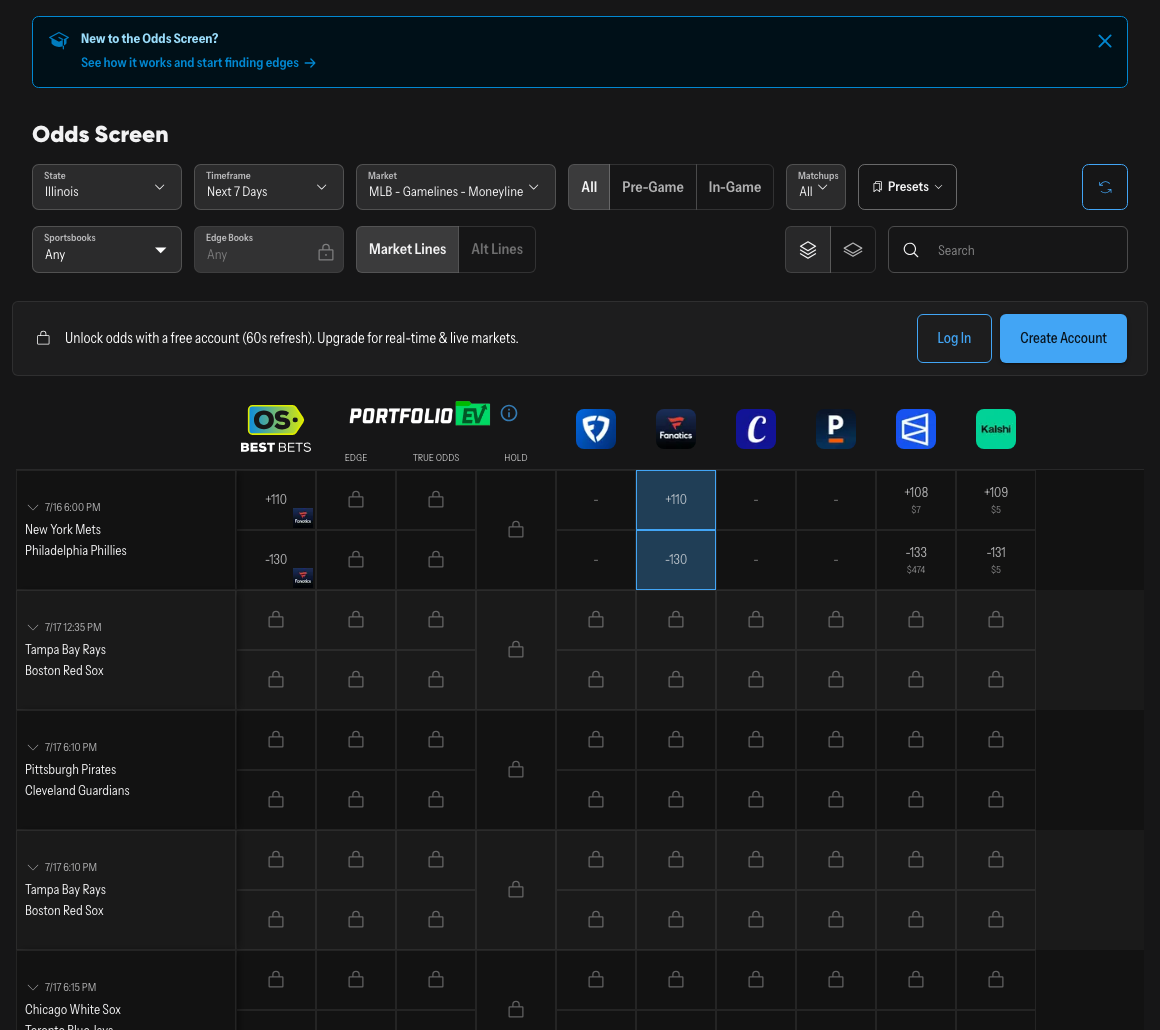 The OddsShopper live odds screen — every book's price on one board, refreshed in real time. Open the live board.
How To Bet The Kentucky Win Total The Smart Way
A season-win future is a long hold, so bet it like one.
- Wait For The Camp Read, Or Buy The Story Early. Kentucky's number should move once fall camp shows how the new quarterback and portal additions look in Stein's scheme. If you like the under, the earlier number, before the market sees the rebuild take shape, may be the better price. If you like the over, there is a case to wait for camp signals before paying up.
- Shop Every Book Before You Fire. Check the win-total price at FanDuel, DraftKings, BetMGM, and Caesars and take the best available number on the side you like. On a total shaded by the excitement around a new coach, the gap between two books is meaningful over a full position. The OddsShopper college football odds screen is the same line-shopping tool for Kentucky's weekly game lines once the season starts, and OddsShopper's Tails marketplace is where its experts post their weekly college football cards once the games matter more than the futures.
- Size It As A Future, Not A Game. This bet does not settle until late November and you cannot hedge it cheaply, so stake it small and once, and track the open position in OddsShopper's Portfolio EV so a summer futures ticket does not get lost behind your Saturday card. Our bankroll management guide covers sizing a long-dated position.
Bottom Line
Strip it down and the Kentucky win total is a wager on how fast a rebuilt program can play winning football. The over is the upgrade bet: a highly regarded offensive coach, a top-ten transfer class, a number set low by a 5-7 finish, and a couple of winnable home games to flip. The under is the turnover bet: a first-year quarterback, two drafted linemen and the top skill players gone, a new scheme on both sides, and a schedule whose only soft dates are non-conference. The line itself, once it posts, tells you how much of that rebuild the market has already priced. Work through the swing games, decide whether you trust Stein to make it competent by October, then shop the friendliest price on the side you have chosen. That is the whole bet.
Ready to shop the number?OddsShopper compares the Kentucky win total across every major sportsbook and flags where the price is in your favor. Try it free for 7 days, then code KENTUCKY20 takes 20% off OS Pro or OS Core if you subscribe.
More on this: Kalshi Steelers Over 8.5 Settlement: Refunded, Not Paid · Why Charles Booker (D) Will Win The Kentucky Senate Race · TCU Win Total 2026: Over/Under 6.5 Wins Odds · Texas Tech Win Total 2026: Over/Under 11.5 Wins Odds · Utah Win Total 2026: Over/Under 8.5 Wins Odds