The first bet on a Saturday pop-up stream that was not supposed to happen cashed on the first swing of the first game the show broke down, and then the player kept going. Live With Lindy signed off as a daily live show earlier this month, and August 15 brought it back for one afternoon after viewers asked and Lindquist needed carved-out time to work the slate anyway. The day's whole thesis showed up in the first ten minutes. This was a slate about paying for the unknown. The day's defining bet was on a hitter nobody in the market had a season of data on, and the discipline that let that bet get made is the same discipline that kept a money line the show badly wanted off the card entirely. There is also one number on this card the host told the chat to stop obsessing over, and the arithmetic behind that is worth more than any single play below.
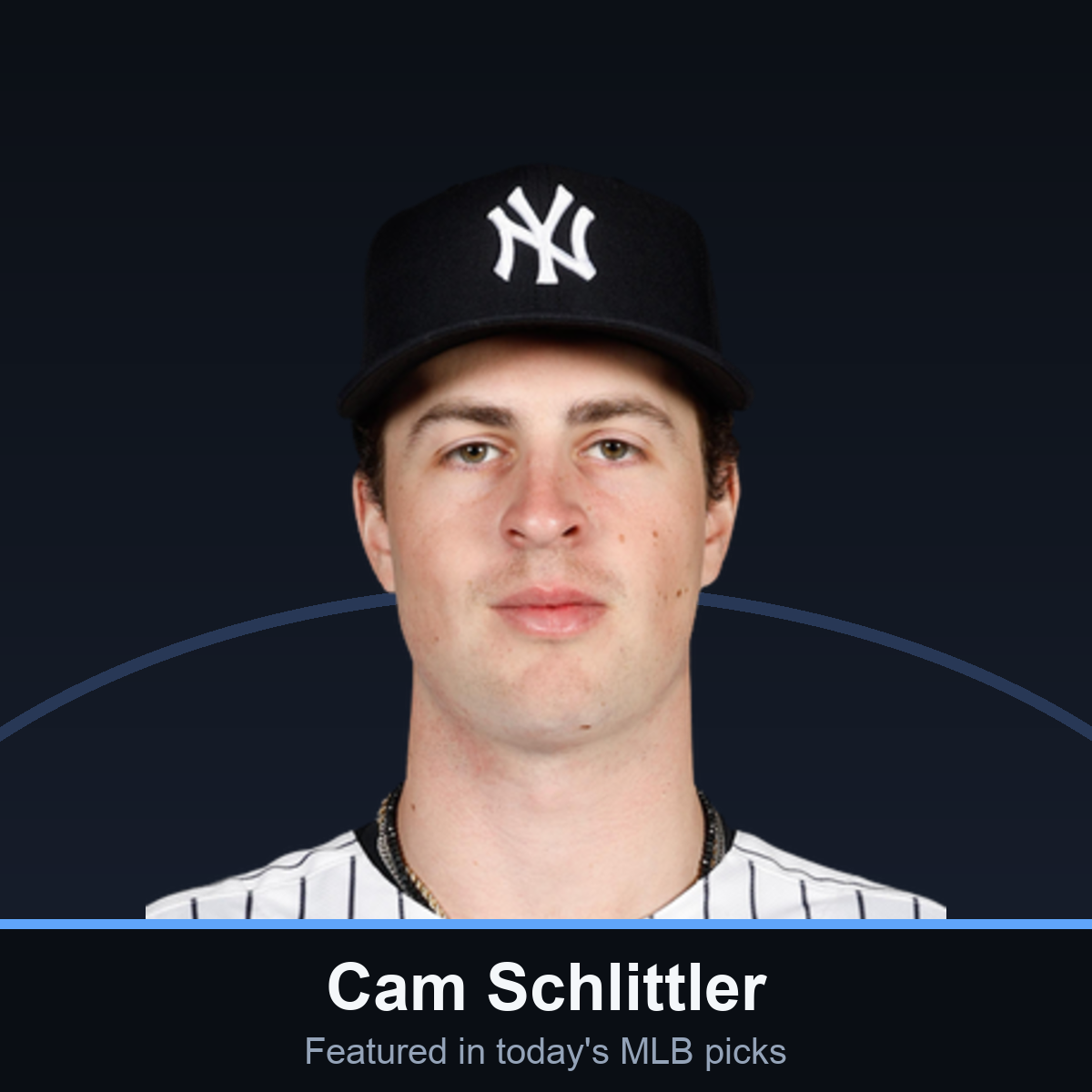
Cam Schlittler — one of the featured players on today's slate.
The Quick Answer
The Saturday, August 15 Live With Lindy card: Joshua Báez (STL) to homer in his major league debut, Cam Schlittler (NYY) over 6.5 strikeouts at a half unit, Logan Webb (SF) over his outs number, Michael Busch (CHC) over his total bases number, and a Griffin Conine (MIA) homer paired with his two-strikeout number. Báez did not just homer. As of the live box-score check, he had three home runs and 12 total bases. The full card, the leans that stayed leans, and where the de-vigged +EV board found Saturday's biggest edges are all below.
In Summary
- The Headliner: Joshua Báez (STL) to go deep against Matthew Boyd (CHC) with the wind blowing out at Wrigley. He homered three times in his first big league game.
- The Strikeout Play: Cam Schlittler (NYY) over 6.5 strikeouts against a Toronto lineup missing its best bats, sized at a half unit, the largest stake on the card.
- The Outs Prop: Logan Webb (SF) over his outs number against a Colorado lineup with Hunter Goodman (COL) on the bench.
- The Two-Way Swing: Griffin Conine (MIA) to homer at Great American Ball Park, supplemented with his two-strikeout number, because he is either crushing it or missing it.
- The Quarter-Unit Side Bet: Michael Busch (CHC) over his total bases number against Michael McGreevy (STL).
- The Lean He Refused To Fire: the Cleveland Guardians money line against a San Diego bullpen game. "I want to. I'm not going to."
Watch The Video
The full two-hour research session is below: the board walkthrough, the live reaction to the debut homer, and the end-of-show card recap. This article pulls out the fired plays and the read behind each.
Results below come from a live MLB box-score check at roughly 4:40 p.m. ET on Saturday, August 15. The afternoon games were still in progress and the night slate had not started, so treat every result as a running line rather than a final one.
Saturday's Fired Card At A Glance
These are the official plays, not the leans. On this show a lean is a number the host likes but has not bet; an official play is money down. Prices move all afternoon, so confirm the current number on the OddsShopper MLB odds screen before following anything here.
| Play | Game / Spot | The read |
|---|---|---|
| Joshua Báez (STL) Home Run | at Matthew Boyd (CHC) | A 34-homer Triple-A season, wind out at Wrigley, and a lefty starter whose swing-and-miss against right-handed bats has evaporated |
| Cam Schlittler (NYY) Over 6.5 Strikeouts (0.5U) | at Toronto | Stuff fully recovered from a June dip, against a Blue Jays lineup gutted by absences |
| Logan Webb (SF) Over Outs (0.25U) | vs. Colorado | An efficient ace against a Rockies lineup without Hunter Goodman, with the show's workload sim well above the market's outs number |
| Griffin Conine (MIA) Home Run (0.25U) | at Brady Singer (CIN) | Great American Ball Park grades far better for homers than for hits, and Conine is a pure damage-or-whiff bat |
| Conine 2+ Strikeouts (0.15U) | at Brady Singer (CIN) | The same profile from the other side, a huge miss rate against Singer's slider-sweeper look |
| Ian Seymour (TB) 7 Strikeouts (0.1U, Pick'em) | vs. Baltimore | Strikeouts available up and down the Orioles lineup, taken as a pick'em leg rather than a straight bet |
| Michael Busch (CHC) Over Total Bases (0.25U) | vs. Michael McGreevy (STL) | McGreevy's changeup to lefties gets ground balls, but the ones in the air get blistered |
The row that decided the day is the first one, and it decided it fast. The rest of the card is still running.
The Headliner: Buying A Player The Market Could Not Price
Joshua Báez (STL) is 23, right-handed, and arrived at Wrigley Field on Saturday with a Triple-A Memphis season of 34 home runs and 21 stolen bases behind him and a .317 isolated power mark to go with it. He also arrived with no major league track record at all, which is exactly why the price existed.
The setup was the sport profile in miniature. Wrigley had the wind blowing out with heavy August humidity, a stadium that turns into a launching pad in precisely those conditions. Matthew Boyd (CHC), the left-hander on the mound, has seen his strikeout rate come down since returning from the injured list earlier in the year and has been surrendering more and more power, with essentially no swing-and-miss against right-handed bats over his recent stretch. A right-handed power bat with real extra-base ability, facing a fading lefty, in a hitter's park with the wind out — that is the outlier the whole exercise is looking for.
The honest counterweight got aired too. The projection systems were miles apart on Báez, with the bearish one carrying a materially lower power forecast, and every one of them had him striking out at a well-above-average clip. There was real pinch-hit risk in the profile, with Nathan Church (STL) and Everson Pereira (STL) both available if St. Louis decided to protect a debut late. The read was that a club calling up a bat like this intends to give it leash, and the price paid for the uncertainty anyway.
He homered early, then homered again on stream to a chat that lost its mind, and the show signed off with two on the board. The box score has since gone further. Batting fifth and playing left field, Báez had three home runs and 12 total bases through his first four at-bats in his first career major league game. That third one landed after the stream ended, so it is a box-score fact rather than something you can watch him call live. The line the host kept repeating on air is the one worth keeping anyway: you will never see a number like that on him again.
The bet itself is worth describing precisely, because it is where the show's process is least imitable. This was not a sportsbook ticket. The home run price got compared across three venues before a dollar moved:
- A Sportsbook Number, the one most bettors would have taken by default.
- A Prediction-Market Exchange carrying the best price of the three, which the show could not access.
- A Second Exchange, where the bet actually went down at the next-best number.
That last step matters more on an exchange than at a book. Exchange contracts carry a trading fee, so the price on the ticket is not the price you are actually getting, and a number that looks better before fees can be worse after them. The OddsShopper odds screen runs that fee adjustment for you and puts exchange prices on the same footing as book prices, which is the only thing that makes a cross-venue comparison like that one mean anything.
The transferable idea, not the result.A debut bat has no major league sample, so the market prices it off scouting reports and projection systems that disagree with each other. That disagreement is the edge. The bet was not "this guy is going to homer"; it was "the price implies a lower chance than the park, the weather, the platoon edge and the minor league power say it should be." Three home runs is noise. The reason for the ticket is not.
Fittingly, Blaze Jordan (STL), the seven-hole bat Lindquist spent a stretch of the stream defending against a chat insisting he had been scratched, homered as well on the same box-score check. For the full-board version of this exercise run every single day, the MLB home run picks hub applies the same park, weather and platoon screen across every slate.
The Number Nobody Should Be Losing Sleep Over
Here is the promise from the top of the page, and it is the most transferable thing in the two hours.
Bettors torch themselves over failing to get the very best price on a long shot. Run the arithmetic and the panic mostly evaporates. A 6-to-1 price implies about a 14.3% chance; a 7-to-1 price implies 12.5%. (If converting American odds into a percentage is not automatic yet, start with implied probability.) That is a gap of under two percentage points. But a 4-to-1 price implies 20% and a 5-to-1 price implies 16.7% — a gap of more than three points, on numbers that look closer together. The shorter the price, the more each increment of odds is actually worth, and the more expensive a missed shop becomes.
That does not make shopping optional; it makes it targeted. Rule one is still shopping every number, and the discipline underneath it is a hard floor: no click without a projected edge of more than one percentage point, ever, in any market. A break-even home run number is not a bet. That is the same standard +EV betting runs on, and it is what let a debut bat get backed with conviction while a money line the show liked got left alone entirely.
The Half Unit: Schlittler Into A Hollowed-Out Toronto Lineup
The largest stake on the card went on Cam Schlittler (NYY) over 6.5 strikeouts, and it was a stuff read before it was a matchup read. Schlittler went through a rough patch in June where this show was actively betting against him; his velocity and shape have since returned to where they were, and the last two weeks have been the best version of him all season.
Toronto is where the number comes from. Vladimir Guerrero Jr. (TOR) is on the injured list and George Springer (TOR) was out of the lineup, which strips the two bats that make the Blue Jays hard to strike out. What is left is a middle and bottom of the order full of targets: Kazuma Okamoto (TOR), Brandon Valenzuela (TOR) and Charles McAdoo (TOR) all profile as strikeouts. The one bat the show openly wished were somewhere else was Alejandro Kirk (TOR), in there as the designated hitter.
The same conviction got expressed a second way. Schlittler was paired on a pick'em card with Ryan Kreidler (MIN) to strike out, a small ten-dollar ticket stacking two independent strikeout reads. It worked. Schlittler had four strikeouts through three innings when the stream signed off, with the show's only complaint being that Okamoto, the whole point of the spot, had not been one of them. By the sixth he was at seven strikeouts through five innings, clearing the number with an inning still in front of him.
Two Quarter Units And A Split Ticket
Logan Webb (SF) got a quarter unit on his outs number in the afternoon game against Colorado. The Rockies lineup that showed up had Hunter Goodman (COL) on the bench and Brett Sullivan (COL) catching, and the show's own simulation of Webb's workload came back far more bullish than the market's number on how deep he would go. Michael Lorenzen (COL) on the other side is a starter this show reads as vulnerable to left-handed power. Worth noting on the environment: the afternoon slot is the warmer version of San Francisco, not the mid-50s long-sleeve evening the park is known for, so this is a workload bet rather than a weather bet.
Michael Busch (CHC) over his total bases number was the other quarter unit, and the case was uncomfortable by design. Busch has been dreadful, hitting in the .170s for August with an on-base mark barely above .260 — and the entire bet is that the price had overcorrected for a hitter with real power. If the phrasing on that market is new to you, the MLB betting terms glossary covers total bases and the rest of the prop vocabulary. McGreevy's changeup to left-handed bats generates ground balls, but the fly balls he does surrender to lefties get hit hard. Busch struck out in his first at-bat and has not cooperated since. That is what a quarter unit is for.
The most interesting construction on the card is Griffin Conine (MIA) against Brady Singer (CIN). Conine hits the ball extremely hard and misses it a lot. Against slider and sweeper looks specifically, the profile is enormous power paired with an enormous miss rate. The park read sharpened the play rather than blessing it: grouped by outcome, Great American Ball Park is excellent for home runs and poor for singles and doubles, so the extra-base path is the homer path, not the total-bases path. So the ticket got split: a quarter unit on Conine to go deep, and 0.15 units on him striking out twice. He is live for both, and the show said plainly that it is more skewed to the home run side. Keeping stakes that small on a correlated pair is a bankroll decision before it is a handicapping one.
The Leans That Stayed Leans
Five spots got long looks and no money, and the reasons are the education.
The Cleveland Guardians money line against San Diego is the one that hurt. San Diego was running a bullpen game, with Wandy Peralta (SD) opening, Randy Vásquez (SD) taking the bulk and Griffin Canning (SD) available in long relief, and Vásquez is a pitcher this show likes to target on principle. The market number was cheap and available almost everywhere. It got passed anyway, purely because Lindquist calls Cleveland his lowest-ROI team of the year, and because on Friday the Tigers recorded zero strikeouts and still shut the Guardians out. "I want it. I don't know if I can do it." That is a bettor refusing to relitigate a spot he has already lost money on six different ways, which is more useful than pretending the tilt is not there.
The White Sox–Tigers over 7.5 was, by the show's own math, the single best play on the board and got passed on price alone, because the juice was too heavy at the number available. Sean Manaea (NYM) under 5.5 strikeouts got a long look against Washington and was not deployed. The stated reason was the arm, not the number: Manaea is throwing almost nothing but fastball and sweeper right now, the stuff is not where the show wants it, and 5.5 is a big number to attack in either direction on a pitcher he cannot read cleanly. Jesús Luzardo (PHI) over 6.5 strikeouts was liked without being loved. And Steven Kwan (CLE) to homer got flagged as a pick'em placeholder rather than a straight bet, because an opener changes the at-bat math for the top of a lineup in a way that makes the projection unstable.
One clean pass, too: Jacob Misiorowski (MIL) at Los Angeles. This show is usually well above the market on his strikeout number and was not on Saturday, and with pitch-tipping concerns floating around, the spot got left alone rather than forced. Not forcing a bet on your favorite arm is the same muscle as not chasing Cleveland.
Where The +EV Board Found Saturday's Edges
Everything above is one sharp process run by hand across a fifteen-game slate. The +EV board runs the same comparison across every market at once: de-vig each book, compute the fair price, rank the gaps. At Saturday afternoon's capture, the board clustered hard on hitless unders in two games, Boston at Pittsburgh and Kansas City at the Angels, with one Texas row hanging off the bottom.
| Market | Best takeable | Fair | Edge |
|---|---|---|---|
| Denzer Guzman (LAA) Under 0.5 Hits | +182 (Bet365) | +143 | +16.1% |
| Moisés Ballesteros (LAA) Under 0.5 Hits | +175 (Bet365) | +147 | +11.3% |
| Zach Neto (LAA) Under 0.5 Hits | +182 (Bet365) | +155 | +10.6% |
| Vaughn Grissom (LAA) Under 0.5 Hits | +195 (Bet365) | +167 | +10.5% |
| Andruw Monasterio (BOS) Under 0.5 Hits | +130 (Bet365) | +110 | +9.5% |
| Salvador Perez (KC) Under 0.5 Hits | +160 (Bet365) | +138 | +9.2% |
| Nick Sogard (BOS) Under 0.5 Hits | +182 (Bet365) | +159 | +8.9% |
| Jake Mangum (PIT) Under 0.5 Hits | +185 (Fanatics) | +164 | +8.0% |
| Ronny Simon (PIT) Under 0.5 Hits | +165 (Bet365) | +146 | +7.7% |
| Sonny Gray (BOS) Under 5.5 Strikeouts | -106 (DraftKings) | -124 | +7.6% |
| Caleb Durbin (BOS) Under 0.5 Total Bases | +145 (Fanatics) | +130 | +6.5% |
| Jake Burger (TEX) Under 0.5 Hits | +180 (Fanatics) | +164 | +6.1% |
The row worth sitting with is the only pitcher on it: Sonny Gray (BOS) under 5.5 strikeouts at -106 against a -124 fair price. It is the one laid-price row in the table, and it is a reminder that a minus number can be the best bet available. Price and probability, not the size of the payout. That is the same principle that made the Báez homer defensible at a long number and made the White Sox–Tigers over indefensible at a short one.
The Guzman row is the biggest single edge in the table, and it belongs to the same family of bet as the headline. Denzer Guzman is a young Angels infielder without much of a major league sample, which is exactly the condition that produced a long price on Báez a few hours earlier. Thin samples make markets nervous, nervousness widens prices, and wide prices are wrong in both directions. The de-vig math is the only thing that tells you which direction you are standing in on any given one.
Nearly every one of those prices sits at Bet365, with Fanatics and DraftKings holding the rest, and a board edge only pays if you can actually take the number, which means more than one funded account. The Sonny Gray row is a DraftKings number, so if you are building that rotation out, the book's current offer and how to claim it is the place to start, and any bonus bets you collect along the way can be turned into withdrawable cash with the free bet converter. Free plays post daily at the expert picks hub, and Lindquist's own card tracks publicly on Tails.
A Worked Example: Pricing The Guzman Under
Take the board's top row and run the math yourself. At +182, the implied break-even probability is 100 / 282, or 35.5%. The de-vigged fair price of +143 implies 100 / 243, or 41.2%. That gap is the whole bet: the market's own no-vig consensus says the under wins about 41 times in 100, and Bet365 is paying as though it wins 35.5. On a $10 wager returning $18.20 of profit, expected value is (0.412 x $18.20) minus (0.588 x $10), roughly +$1.60 per $10 risked, which is where the +16.1% grade comes from.
The honesty note the show would insist on: that is implied break-even math on posted prices, not a promise about tonight. A 41% bet loses more often than it wins, which is why closing-line value across hundreds of tickets, not any single afternoon, is the scoreboard that matters. Saturday is the perfect illustration in reverse. The debut ticket cashed on the first swing, and the two extra homers that followed added nothing to the payout. It was the right bet at the price either way, and it would still have been the right bet if he had struck out three times instead.
Every price in that table came off the OddsShopper screen.OS Pro runs line shopping across the major books, shows the de-vigged fair price next to the best takeable number, and ranks the entire board by edge. There is a 7-day free trial, and code LINDY25 takes 25% off your first week or month.
Try OS Pro free for 7 days, with code LINDY25 pre-loaded at checkout.
What The Pop-Up Actually Proved
Zoom back out and the card has a shape. One aggressive bet on a player with no major league sample, sized properly. One half unit on the day's cleanest stuff-versus-lineup mismatch. Three quarter units, a 0.15-unit strikeout supplement on Conine, and two dime-sized pick'em legs. And a money line the show wanted, could have justified, and refused to touch because the ledger said stop.
That refusal is the part worth copying. The Báez homer will get the clip and the screenshots, and it should, because three home runs in a debut is not something a model predicted. But it was a bet available to anyone willing to price an unknown honestly and then act on the number instead of the narrative, which is the same skill that leaves Cleveland alone on a day it looks cheap. The board in the table above does that arithmetic on every market at once, all afternoon, whether the show is streaming or not.
Get OS Pro with a 7-day free trial and 25% off your first week or month with code LINDY25.