Most NFL win totals ask you to pick a side. The New England Patriots win total 2026 market asks you something stranger first: which number are you even betting? BetMGM lists this team at 9.5 wins and makes you lay juice on the over. DraftKings lists it at 10.5 and makes you lay juice on the under. A full win apart, at two of the biggest books in the country, in the same month. The tempting read is that the market is confused. It is not, and that is the more useful story: strip the vig out of both two-way prices and the two books land in almost the same place, on a team worth about ten wins. They agree. They simply drew the line on opposite sides of ten and charged you accordingly. That hands you something better than a disagreement to exploit: a choice of which number to buy. This guide walks the total the way our NFL win totals hub teaches it, reading what changed, weighing the schedule, and building the case both ways, before doing the de-vig math that shows what each book actually thinks.
TL;DR: Patriots Win Total 2026
- The Bet: the season-long over/under on how many of its 17 regular-season games New England wins in 2026, graded when the National Football League regular season ends in January. Playoffs never count, so the Super Bowl run that ended last season is worth nothing to this ticket.
- The Setup: the Patriots went 14-3 in 2025 and won their first AFC East title since 2019, a jump from back-to-back 4-13 seasons. Mike Vrabel won Coach of the Year in his first season in charge, Drake Maye finished MVP runner-up, and New England reached Super Bowl LX before losing to the Seattle Seahawks 29-13.
- What Decides It: whether Maye's quarterback play is good enough to carry a team whose 2025 schedule was the softest in football into a much harder 2026 schedule.
- The Odds: as of mid-July 2026 there is no single posted number. BetMGM lists 9.5 wins (over -145 / under +120); DraftKings lists 10.5 (over +115 / under -140) and an alternate over 9.5 at -150. De-vigged, BetMGM implies a 56.6% chance of ten-plus wins and DraftKings a 44.4% chance of eleven-plus. Same team, same read, different line placement.
Each of these gets its own section below, ending on the threshold that actually decides the bet. If you only want the short version of any Patriots season win total debate this summer: the market thinks this is a ten-win team, and your job is to decide whether ten is too many or too few.
Where The Patriots Win Total Sits For 2026
A win total is a futures market: the book posts a number for New England's full 17-game regular season, always as a half-win line so there is no push, and you take the over or the under. Usually the interesting question is which side. Here, the books have not even settled on the line.
| Book | Line | Over price | Under price |
|---|---|---|---|
| BetMGM | 9.5 | -145 | +120 |
| DraftKings | 10.5 | +115 | -140 |
| DraftKings (Alternate) | 9.5 | -150 | — |
The row that settles the argument is the DraftKings alternate. The same book that hangs 10.5 will also sell you the 9.5 over at -150, five cents worse than BetMGM's -145 on the identical bet. If DraftKings actually thought New England was a weaker team than BetMGM did, it would sell that over cheaper, not dearer. It doesn't, because it isn't. Notice what happens across the two main numbers: at 9.5, the market makes you pay to back the over; at 10.5, it makes you pay to back the under. Those are not contradictory reads. They are the same read, expressed at two different starting points, and both say New England's true win expectation sits at about ten.
That is still worth real money to you, just not for the reason it first appears. When every book posts the same number, shopping earns you a few cents of price. When the two numbers sit a full win apart, shopping earns you a different bet: BetMGM will sell you the under at 9.5, which needs nine wins or fewer, while DraftKings will sell you the under at 10.5, which also cashes on ten. That extra win of room is real, and you pay for it in juice, +120 at BetMGM against -140 at DraftKings. So the question was never which book is right. It is which combination of number and price your own projection prefers, and you cannot answer that until you strip the vig out of both. We do that below.
Hold onto that ten-win read. Everything below is an argument about whether the real Patriots live above it or below it.
Reading The Patriots' 2026 Schedule
A number that slid from 14 actual wins down to 9.5 or 10.5 is the market making one claim above all others: last year's schedule lied to you. So start there, because it is the most concrete fact on this page.
New England played the softest schedule in football in 2025. Its opponents finished with a combined .391 winning percentage. That is the context for 14-3, and it is the single most important number on this page after the line itself. For 2026, those opponents combine for a .531 winning percentage, the sixth-toughest schedule in the league. The defense that looked dominant is about to be asked a harder question, and the swing from .391 to .531 is the largest single input behind a number that fell from 14 actual wins to the 9-or-10 range.
One honest caveat belongs here, because strength of schedule is measured more than one way. The .531 figure rates New England's 2026 opponents by their prior-year records, which is the standard method and the one that produces the sixth-toughest ranking. Rate the same opponents by their 2026 projected win totals instead and the number moves, because the method is really a bet on which of last year's bad teams are about to be good. Both are defensible. The reason to trust the harder read here is that it does not depend on projections at all: seven of the nine games New England plays away from Foxborough, including the neutral-site Munich game, come against teams projecting 9.5 or more wins. Our NFL strength of schedule breakdown walks how those methods differ and why the answer changes.
What is not in dispute is the shape of the road card. The specific games are the specific games, regardless of whose model you trust:
| Tier | What it holds | What it means for the number |
|---|---|---|
| Marquee Tests | Week 1 at Seattle (a Super Bowl LX rematch), Week 15 at Kansas City on Monday night, plus Detroit at a neutral site in Munich in Week 10 | The ceiling limiter. These are the games a 9.5 number assumes New England does not sweep. |
| Division Swing | Buffalo twice, including Week 4 in Buffalo | The hinge. The AFC East title ran through here in 2025 and does again. |
| Away From Foxborough | Seven of the nine games outside New England, including the neutral-site Munich trip, come against teams projecting 9.5 or more wins | The whole case for the under, in one line. |
That last row is the one we keep coming back to. A team can be good and still go 4-5 on a road schedule that stacked, and 4-5 on the road is how a 14-win team becomes a 10-win team without anything actually going wrong. Note the callback to those soft 2025 opponents: the Patriots went a perfect 8-0 on the road last season, a spotless record earned against the league's weakest schedule. The 2026 road map is where the softness gets repriced.
The Roster: Maye's Rise, Vrabel's Encore
If the schedule is the market's case, the quarterback is the rebuttal, and it is a strong one. Drake Maye's 2025 was not a fluke propped up by opponents. He threw for 4,394 yards with 31 touchdowns and eight interceptions, completed an NFL-best 72% of his passes, and led the league in passer rating (113.5), completion percentage over expected, and EPA, including the best EPA per play among all qualified quarterbacks. He finished MVP runner-up behind Matthew Stafford. None of that is soft-schedule production; these are the efficiency metrics that travel.
Here is where we have to be honest against our own argument, though, because that .391 schedule cuts both ways. Maye's numbers were posted against the same weak opponents that inflated the record, and a 72% completion rate against the league's softest schedule is not automatically a 72% completion rate against a .531 one. The strongest version of the over case is not that his 2025 line repeats exactly. The claim is narrower than that: efficiency metrics like completion percentage over expected and EPA per play are built to adjust for what a quarterback was actually asked to do, and they rated him first in the league, not merely very good on easy work. A quarterback grading out that far ahead of the field has room to lose some ground to a harder schedule and still be the best player in most games he plays.
Mike Vrabel matters here too, and for a specific reason rather than a general one. The 2025 leap was not a one-year sugar high bought with veterans on expiring deals; it was a first-year coach installing a system around a second-year quarterback. What carries into 2026 is the part that took the longest to build: Maye, Vrabel, and the offensive structure they ran, now in Year 2 together. Continuity of that kind is the quiet input the market tends to underprice.
The number that runs this betten. That is where both books' prices quietly agree the Patriots really are, and every argument below is about whether Maye drags them above it or the schedule pulls them under it.
The catch is that two of 2025's biggest inputs are the kind that historically do not repeat.
The Case For The Over
The over is the bet that Maye is the real thing and the market over-corrected, and it has receipts:
- The Efficiency Was Elite, Not Lucky. A 72% completion rate, a 113.5 passer rating, and the league lead in EPA per play among qualified quarterbacks are stability metrics. Quarterbacks who post them tend to post them again, and quarterback play is the single most predictive input in any win total.
- The Number Fell Four Wins From The Actual Result. New England won 14 games. The market asks for about 10. Even a substantial regression of four full wins off last season still cashes the over at 9.5. The over does not need a repeat; it needs the Patriots to be a good-not-great team.
- The Coach And The Trend Both Return. Vrabel's Coach of the Year turnaround was a 10-win improvement, and Year 2 under a proven staff, with a rising 2025 MVP runner-up at quarterback, is usually where a young team consolidates rather than collapses.
- The Line Itself Is Available At 9.5. At the lower of the two posted numbers, the over needs just ten wins from a team that won 14 and reached the Super Bowl. If you believe in Maye at all, that is a modest ask.
The through-line: the over is the Drake Maye bet. If the quarterback who led the league in EPA per play is the quarterback who shows up, a four-win regression still leaves the over alive at the lower number.
The Case For The Under
The under is the bet that 2025's 14 wins were built on inputs that do not carry over. It starts where the over does not want to look:
- The Schedule Really Was The Softest In Football. A .391 opponent winning percentage, and just three games all season against teams that finished with winning records, are not framing. They are the conditions that produced the 14-3 record. A .531 schedule is a different season.
- A 7-3 Record In One-Score Games Is A Regression Flag. One-score games sit close to coin flips over time, and New England won seven of ten of them. Nudge that to a 5-5 split, which is what the base rate expects, and two wins come straight off the record before anyone plays worse.
- They Were The Healthiest Team In The League. New England finished first in adjusted games lost, the standard measure of how much a roster's injuries actually cost it. Health regresses toward the mean for everyone, and a team starting from first place has only one direction to move.
- The Road Card Is Brutal. Seven of the nine games away from Foxborough, counting the neutral-site Munich game, come against teams projecting 9.5-plus wins, and that run opens with a Super Bowl rematch in Seattle and includes a Monday nighter in Kansas City. That is where an 8-0 road record goes to die.
- The Rest Of The Futures Board Leans The Same Way. New England is priced around +184 to miss the playoffs entirely, roughly a one-in-three shot for a team that just went 14-3. A market that gives a reigning conference champion that big a chance of missing January is not a market expecting 11 wins.
Stacked side by side, the regression case is easier to see than to argue with:
| 2025 Input | What it was | Why 2026 is different |
|---|---|---|
| Opponent Strength | Softest schedule in football: .391 opponent win percentage, only three games against teams with winning records | Opponents combine for a .531 win percentage, sixth-toughest in the league |
| Close Games | 7-3 in one-score games | One-score results sit near coin flips and regress toward .500 |
| Health | First in the league in adjusted games lost | Only one direction to move from first |
| Road Results | A perfect 8-0 | Seven of nine games away from Foxborough come against projected winners |
The row that does the most damage is the last one. An 8-0 road record is the single most impressive line in that table and the least likely to survive contact with 2026, since it was earned against the weakest schedule in the league and now gets re-run against seven projected winners away from home. The honest version of the under is not that the Patriots are bad. It is that a 10-7 season, a very good year and an AFC East contender, still cashes the under at 10.5, and the underlying 2025 inputs argue the true number is lower than the banner record suggests.
Key Thresholds: The One-Win Gap That Decides It
Because the market posted two numbers, this bet has two different hinges, and knowing which one you are on is the entire exercise.
- At 9.5 (BetMGM): the over needs ten wins; the under cashes at nine or fewer. You are laying -145 on the over at BetMGM, or -150 for the same bet on DraftKings' alternate. This asks: can a 14-win Super Bowl team, with an MVP-runner-up quarterback, avoid falling more than four wins? Most of the time, the answer is yes.
- At 10.5 (DraftKings): the over needs 11 wins; the under cashes at ten or fewer. You are laying -140 on the under. This asks: is a good-but-regressed Patriots season enough to reach 11? That is a much harder yes.
- And No, You Cannot Just Bet Both. Ten wins is a winner on the BetMGM 9.5 over and on the DraftKings 10.5 under, which makes the middle obvious enough that it needs pricing rather than admiring. Fire 100 units on each: exactly ten wins pays +140.4, and every other outcome loses about 31. That needs New England to land on precisely ten about 18% of the time to break even. The books' own de-vigged prices imply roughly 12%. The middle is real, it is visible, and it is priced through by about six points. Skip it.
So the practical move inverts the usual advice. Do not pick a side and then hunt a price. Decide your projection first: if you land at 11 or more wins, the 9.5 over is your ticket and the number is doing you a favor. If you land at nine or fewer, the 10.5 under is your ticket, and that extra win of room is worth the steeper price. And if you land on ten, like both books quietly do, then you are not making a judgment call about the Patriots at all. You are making one about which line you can get, which is the friendliest problem in betting. Take the friendlier number now, and if it is still the right side when the market closes in Week 1, that is closing line value, the strongest evidence your read beat the market rather than got lucky.
New to OddsShopper?It scans the major sportsbooks and flags the bets priced in your favor, doing the de-vig math above automatically so you can see the fair number next to the best posted one. Start with a free 7-day OddsShopper Pro trial, and if you subscribe, code PATS20 takes 20% off your first OS Pro or OS Core payment.
De-Vigging Both Books: What The Market Actually Thinks
Everything above has taken "the market says about ten" on faith. Here is the arithmetic, because it is the one thing on this page you cannot get from a competitor's win-total table, and it is what turns two posted lines into a single opinion.
A two-way price always adds up to more than 100%. That surplus is the book's cut, and removing it is how you get the market's honest implied probability. Take BetMGM's 9.5: the over at -145 implies 59.2%, the under at +120 implies 45.5%, and they sum to 104.6%. Divide out that 4.6% of vig and BetMGM's real read is a 56.6% chance New England wins ten or more. Run DraftKings' 10.5 the same way: the over at +115 implies 46.5%, the under at -140 implies 58.3%, summing to 104.8%, which de-vigs to a 44.4% chance of 11 or more.
| Book | The bet | Raw two-way | The market's honest read |
|---|---|---|---|
| BetMGM | 10 or more wins | 104.6% | 56.6% |
| DraftKings | 11 or more wins | 104.8% | 44.4% |
Now read those two rows as one sentence, because that is what they are. The market gives New England a 56.6% chance of reaching ten and a 44.4% chance of reaching 11. Subtract, and the gap between them, 12.2%, is the market's implied chance the Patriots land on exactly ten wins. Nothing about those numbers is in conflict. They are two points on one distribution, and that distribution is centered a shade above ten. The 9.5 and the 10.5 were never rival opinions; they were two places to stand on the same curve.
That 12.2% is also the number that quietly kills the cleverest-looking play on the board, which is why the Key Thresholds section could tell you to skip the middle before it showed its work. And it is why the "which side" argument matters less than it looks: at these prices the market is charging you roughly a coin flip either way, so the edge has to come from your projection actually differing from ten, not from spotting a disagreement that was never there.
How This Class Of Team Gets Priced
A young team coming off a coach-of-the-year leap into a Super Bowl is a specific futures profile, and the books treat it a specific way. Expect the number to land well below last season's win count, because the market prices the inputs (schedule, close-game luck, health) rather than the record, hence 14 wins becoming a 9.5-to-10.5 ask. And expect movement: a Super Bowl runner-up with a rising quarterback attracts public over money all summer, so if the number drifts, it more often drifts up, which is an argument for taking the 9.5 over sooner rather than later if that is your read.
The comparison worth making is the mirror image. Our Baltimore Ravens win total breakdown covers a team the market handed a high number and a juiced under, with reputation priced up and the model priced down. New England is the same trick run backwards: a banner record priced down to the underlying inputs. The Los Angeles Rams win total piece walks a third version, where an MVP season pushed the line up. Same market logic, three different directions, which is why the posted number never tells you the story on its own.
How To Bet The Patriots Win Total The Smart Way
A season-win future is a long hold, so bet it like one.
- Grade The Number Before You Grade The Take. We would not price a Patriots opinion at all until both columns are open: the best available 9.5 over, the best available 10.5 under, and the no-vig number on each. That is the whole job here, and it is what the tool scans for across every major sportsbook, surfacing the fair price next to the best posted one. The edge is not "Patriots over" or "Patriots under." It is whether your projection actually beats the best available side of ten.
- Shop The Number, Not Just The Juice. Before you think about odds, check the posted number everywhere you have an account: DraftKings, FanDuel, BetMGM, Caesars, and ESPN BET all hang season win totals, and they do not move in lockstep in July. A full win of line is usually worth more than a few cents of juice, but not always, which is exactly why the de-vig above comes first.
- Maye's Development Is The Thing That Moves This Number. Camp reports are the specific risk on a total this tied to one quarterback's Year 3, and unlike most futures, the market here is already centered on ten. That means a single practice report can push the 9.5 out of reach before the narrative even reaches the public.
- Size It As A Future, Not A Game. This does not settle until January and you cannot hedge it cheaply, so stake it small and once. Our bankroll management guide covers sizing a long-dated position. Once the season starts, the OddsShopper NFL odds screen runs the same comparison on the weekly game board.
Bottom Line
The New England Patriots win total is the cleanest illustration in this year's futures market of why the number beats the take. The quarterback says over: Drake Maye led the NFL in EPA per play, completed 72% of his passes, and finished MVP runner-up, and even a four-win regression off 14-3 clears 9.5. The inputs say under: the softest schedule in football at a .391 opponent win percentage, a 7-3 record in one-score games, the league's best injury luck, and a jump to a .531 schedule. Both are true at once, which is why the de-vig lands where it does: a 56.6% chance of ten wins, a 44.4% chance of 11, one distribution sitting just above ten, with BetMGM's line below it and DraftKings' above. There is no disagreement here to arbitrage, and the middle that looks like a loophole is six points short of break-even. What is left is the honest bet, and it is a good one: decide whether Maye's efficiency outruns a .531 schedule or the 2025 inputs drag him back to it, then buy whichever number your projection likes. The market has told you it thinks this is a ten-win team. It has not told you it is right.
Ready to shop the number?OddsShopper compares the Patriots win total across the major sportsbooks and flags where the price beats the no-vig fair value. Try it free for 7 days, then code PATS20 takes 20% off OS Pro or OS Core if you subscribe.
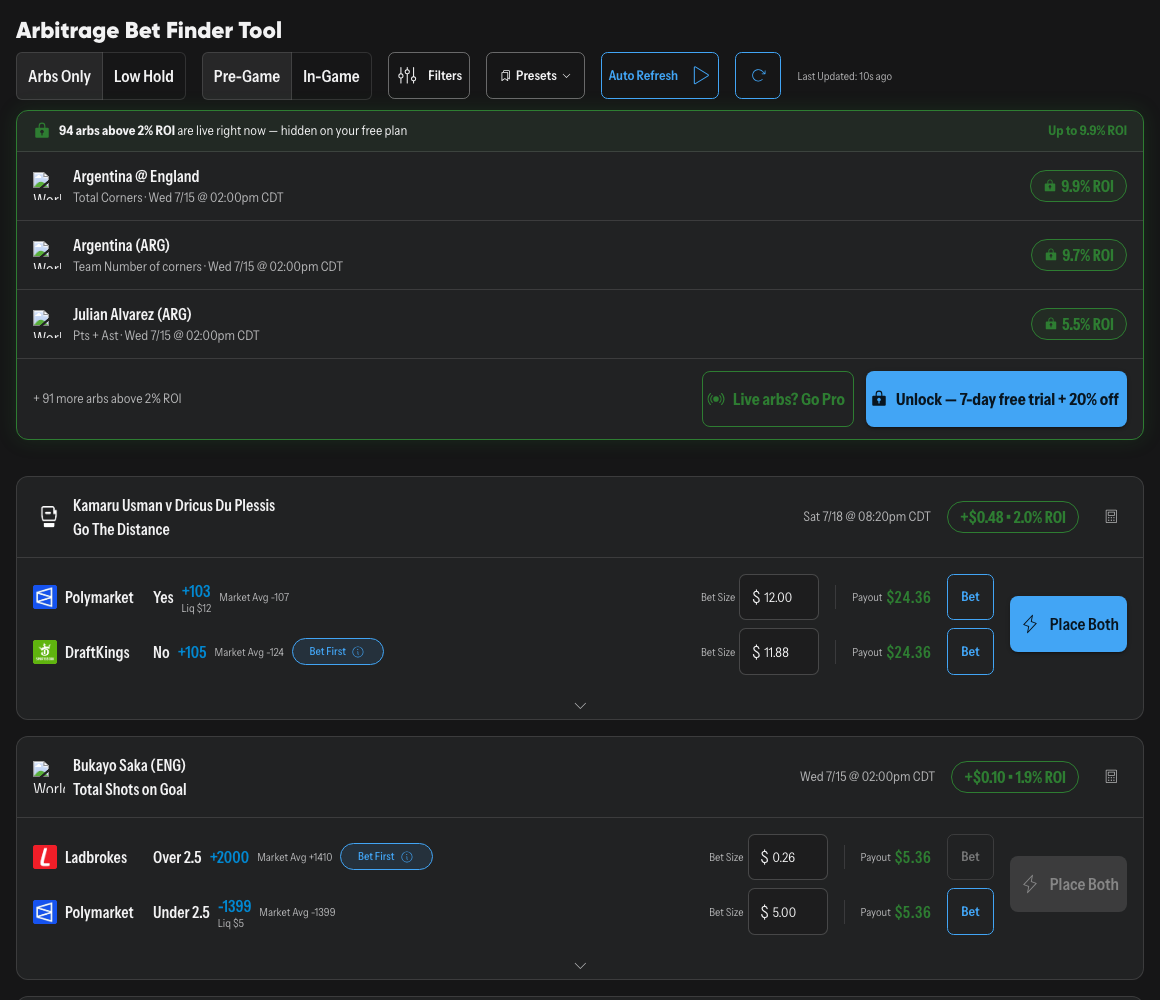 The OddsShopper Arbitrage Finder — live risk-free gaps across 20+ books. Open the live board.
More on this: Patriots Win Total: The Books Agree On The Number. The Machines Don't · Saints Win Total 2026: The 7.5 Line, Kalshi Priced · Chiefs Win Total Odds: Lindy Vs. The Machine On 11+ Wins · Why Cory Booker (D) Will Win the New Jersey Senate Race · Why Justin Murphy (R) Will Win the New Jersey Senate Race