Yes, you can bet NBA on Kalshi, and the 2026-27 basketball board is already open. Six weeks before opening night, the exchange is pricing the title, both conferences, MVP, Rookie of the Year, every team's win total and the first three games of the season. Every price on this page comes from Kalshi's public market feed as of September 9, 2026, pulled that morning.
The Quick Answer
A Kalshi NBA price is a probability in cents. San Antonio to win the 2027 title costs 23 cents, which means the market gives the Spurs about a 23% chance and pays $1 per contract if they do it. You trade against other people, not the house, so the exchange takes a fee instead of hiding a margin in the line. Below: which NBA markets exist right now, how to read one against a sportsbook, what settles a contract, and where to go once the basics are down.
Stay ahead of the markets.
Daily insights and expert picks on Kalshi, Polymarket, and what's moving markets.
Free forever. Unsubscribe anytime.
Which NBA Markets Kalshi Lists Right Now
Kalshi is a CFTC-regulated exchange, so every basketball market is a Yes or No contract that pays $1 or nothing. The board grows through the season: playoff series contracts, one per matchup, post in April, and game props post day by day once there are games. Here is the board as of September 9, favorites first. Bid is the most anyone will pay right now, ask is the least anyone will sell for.
| 2027 NBA champion | Bid | Ask | Money traded |
|---|---|---|---|
| San Antonio Spurs | 22¢ | 23¢ | $677,000 |
| Oklahoma City Thunder | 21¢ | 22¢ | $514,000 |
| Philadelphia 76ers | 9¢ | 10¢ | $7,672,000 |
| New York Knicks | 8¢ | 9¢ | $991,000 |
| Minnesota Timberwolves | 4¢ | 5¢ | $1,793,000 |
Philadelphia has drawn more than seven million dollars of trading at 9 to 10 cents. That is the LeBron James effect: the money that chased his July signing stayed in the building.
- Conference winners. Philadelphia leads the East at 23¢ ask, New York sits at 21¢, Boston at 13¢. San Antonio leads the West at 37¢ with Oklahoma City at 35¢, and nobody else is above 9¢.
- MVP. Victor Wembanyama is the favorite at 32¢ ask, with Luka Doncic at 18¢ and Shai Gilgeous-Alexander at 17¢. Fifty-three players have a contract. The ones priced at a penny are the lottery tickets.
- Rookie of the Year. Caleb Wilson at 25¢, Cameron Boozer at 21¢, AJ Dybantsa at 20¢, Darryn Peterson at 19¢. A tie contract trades at 2¢.
- Win totals. Every team has a ladder of contracts, one per threshold: 40 or more wins, 45 or more, and so on. Each rung is its own Yes or No, so you can buy the exact line you believe in. The bottom rungs trade above 90¢ and cost almost nothing to be wrong about, which is why almost nobody trades them.
- Game and series markets. Opening night is already listed. The Knicks are 64¢ to beat the 76ers on October 20, Detroit is 53¢ against Boston, and San Antonio is 55¢ against Oklahoma City. In season there is a winner contract for every game, plus spread and total questions on the bigger ones, and in the playoffs a contract on each series winner.
- Player props and news markets. Props are covered in their own section below. News markets are the exchange's own category: where a star signs, whether a player retires, whether a city gets a franchise. Kalshi currently lists retirement contracts on Stephen Curry, Kevin Durant, Kawhi Leonard, Kyrie Irving and Draymond Green.
Kalshi is 18 and over and availability depends on where you live. Regulators and courts are still contesting how sports contracts should be treated, which our state-by-state guide to prediction-market legality tracks.
How To Read A Kalshi NBA Price
The cents are the market's implied probability before fees. New York at 64¢ to beat Philadelphia on opening night is a 64% chance in the market's eyes. Buy 100 contracts, pay $64, collect $100 if the Knicks win. Miss and the $64 is gone.
Now add the two asks in that game together. New York at 64¢ and Philadelphia at 39¢ sum to 103¢, not 100. Those three cents are the spread, the exchange's version of a sportsbook's juice, and it is wider here than on the NFL board because opening night is six weeks out and few people are trading yet. The gap between bid and ask on each side, 60 to 64 for the Knicks, says the same thing. A market order takes the 64 right now. A limit order, your own price left sitting on the book, at 61 or 62 might fill later or never.
Placing the trade is four taps: open the NBA tab, pick the game, choose Yes on the team you want, and type either a dollar amount or a contract count. The app shows the price and the fee before you confirm. How to bet sports on Kalshi walks the signup and deposit steps that come before that.
To compare a Kalshi price with a sportsbook line, both need to be in the same currency. A sportsbook's odds carry its margin, the vig; the OddsShopper odds screen removes it from every book and shows the fair probability, which you set beside the cent price. How Kalshi odds convert to American odds walks the math if you want it by hand.
How To Bet On Players On Kalshi
NBA player props on Kalshi are Yes or No contracts on a single stat line, such as whether a player scores more than a set number of points, and they appear game by game once the season starts and the order book can support them. They are the least efficient corner of any market, which cuts both ways: the price can be wrong in your favor, and it can be so thin that your order never fills. How Kalshi player props work covers where they post, how they settle on official stats, and why a stat correction after the game can change the result.
How An NBA Contract Settles
Every contract resolves to $1 or $0 by its written rule, with no push and no partial credit. Three clauses do the work on the NBA board.
- The game winner includes overtime. A game contract pays on the final score after any overtime. If a game is postponed past the contract's close date, the rule text says what happens; read it, because a postponement can turn a live position into a refund.
- Futures settle on the official result and carry a far-off close date. The 2027 title contracts close in July 2029, which means the market keeps trading through the playoffs and settles when the trophy is awarded. A win-total rung settles on the final regular-season record.
- News markets name a source of truth. A next-team or retirement contract pays only when the designated source confirms the event. A rumor does not count, and neither does a deleted post.
The summer's LeBron James market is the standing lesson on that last clause. Miami was the 44¢ favorite the day before he signed, partly because of a leaked, deleted video; Philadelphia was a 9¢ long shot and paid in full. How the LeBron Kalshi market worked keeps the full anatomy of that board, and the next-team odds hub scores every star's landing-spot market that has traded since.
Fees, And When Kalshi Beats The Book
Kalshi's trading fee is a formula, 0.07 times your contract count times the price times one minus the price, rounded up to the next cent. It peaks on coin-flip contracts and shrinks toward either end of the board. The Kalshi fees breakdown has the full schedule; here it is on four live NBA prices.
| 100 contracts at | Fee on the trade | Chance needed to break even, after the fee |
|---|---|---|
| 23¢ (Spurs to win the title) | $1.24 | about 24.2% |
| 32¢ (Wembanyama for MVP) | $1.53 | about 33.5% |
| 53¢ (Detroit over Boston, Oct. 20) | $1.75 | about 54.8% |
| 64¢ (New York over Philadelphia, Oct. 20) | $1.62 | about 65.6% |
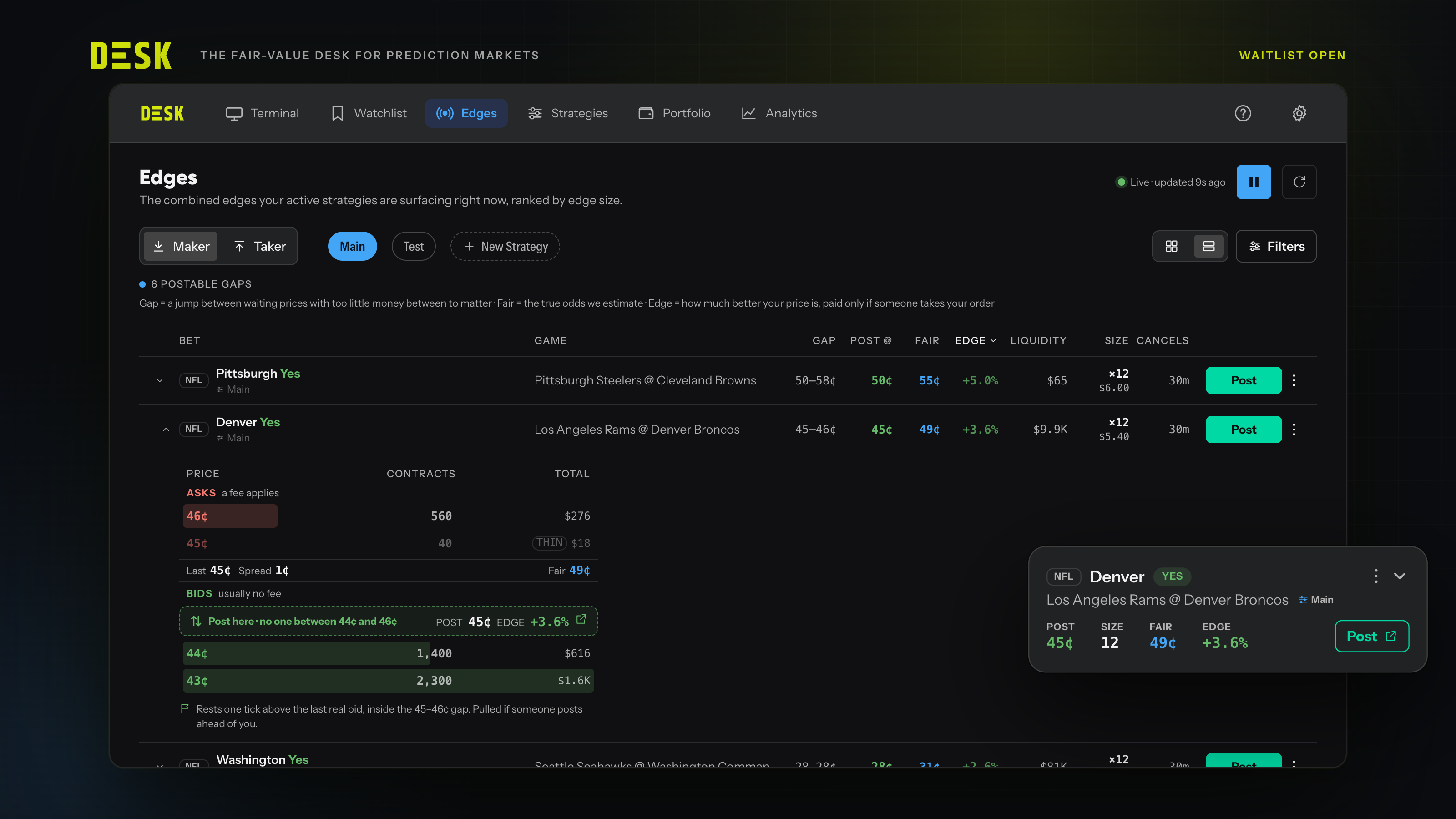
The third column decides trades. Detroit at 53¢ is not a bet that needs to hit 53% of the time; after the fee it needs about 54.8%, and that is before the three-cent spread. So the rule for any NBA game: read the Kalshi price, add the fee, and compare it with the no-vig book number off the odds screen. If the contract is not a few cents below that number, the edge will not survive, so pass. If it clears, rest a limit order rather than crossing the spread, and only where the order book is deep enough to fill you without moving the price. Some nights the book is sharper and a thin Kalshi contract lags, so the habit is to take whichever side is priced below its true probability. When a book and the exchange drift far enough apart, the same screen feeds the arbitrage tool.
Where To Go Next
Everything after the mechanics is strategy. These are the pages we would read, in this order.
- Kalshi trading strategy: five moves sharps use covers resting limit orders, trading where the liquidity lives and selling before settlement instead of hedging.
- How to win on Kalshi is the version of the question everyone asks: an edge that survives the fee, a fill you actually get, and a size that survives a losing streak.
- Kalshi order types and making a price instead of paying one explain why the patient trader pays less on the same contract.
- Cash out or let it ride is the decision every futures holder faces when the Spurs go on a run in January.
- Why liquidity decides whether you can trade at all and Kalshi's position limits cover how big a market will let you get.
- For the boards themselves, the 2027 NBA championship odds page and the East 1-seed board are refreshed through the season.
Other Sports On Kalshi
The same reading applies across the exchange, and each sport has its own quirks. How to bet NFL on Kalshi covers the deepest sports board on the exchange, how to bet NHL on Kalshi explains the Stanley Cup and game markets, the MLB guide and the college football guide round out the fall, and how to bet sports on Kalshi is the account-setup walkthrough for all of them. Still choosing a venue? Kalshi vs. Polymarket lines up the two exchanges.
More on this: Who Wins The 2027 NBA Title? Kalshi Championship Odds · NBA East 1 Seed Odds: Kalshi Doubts The 60-Win Pistons · NBA Next Team Odds: Every Star's Landing-Spot Market, Scored
Line up your Kalshi contract against every book first. The OddsShopper odds screen puts every sportsbook's NBA price on one screen and strips the vig from each one, the baseline you measure a Kalshi cent price against. New users get a free week trial of OS Pro, and 20% off their first OS Pro payment after it with code NBAKALSHI20.
; contracts can lose their full value. Every price here is as of September 9, 2026, and will have moved by the time you read it. We have no commercial relationship with Kalshi.*