If you searched how to win on Kalshi, you want a straight answer. Here it is, in this order: how the exchange works, what a price means, what the fee costs, the three things every winning trade needs, and whether it pays. Updated September 9, 2026, with NFL prices pulled that morning.
The Quick Answer
You win on Kalshi by buying a contract for less than the real chance it pays out, after the fee and at the price you actually get filled. A 40-cent contract pays $1 if it settles yes, so it needs to hit more than 40% of the time plus about two cents of fee to make money. Nobody wins every trade; the traders who come out ahead price events better than the crowd and keep every position small enough that one loss does not erase 15 wins. The rest of this page shows each piece with real prices.
Stay ahead of the markets.
Daily insights and expert picks on Kalshi, Polymarket, and what's moving markets.
Free forever. Unsubscribe anytime.
How Does Kalshi Work?
Kalshi is a federally regulated exchange, overseen by the Commodity Futures Trading Commission, where you trade yes-or-no contracts on real events: who wins a game, where a temperature lands, what the Fed does. Every contract pays $1 if the event happens and nothing if it does not. The price you pay, quoted in cents from 1 to 99, is what the market thinks the chance is. Buy Detroit to beat New Orleans at 75 cents and you are paying $75 for 100 contracts that return $100 if the Lions win, a $25 profit, or return nothing if they lose.
The other side of your trade is another trader or a trading firm, never the house; Kalshi makes its money on a fee. You can place a market order, which fills right now at the best price on the screen, or a limit order, which sits in the order book at your price until someone takes it. The full walkthrough of how Kalshi works covers signup, deposits and settlement. Kalshi is 18 and over, and availability depends on where you live.
Kalshi Odds: What A Price Means And How To Read It
Kalshi odds do not look like sportsbook odds. There is no -110 and no +260, just one number in cents, and that number is the chance the market is charging you for. A 75-cent contract is a 75% chance in the market's eyes. A 26-cent contract is a 26% chance.
Here is the board for three Week 2 NFL games as of September 9, 2026, pulled at 9:36 AM CT from Kalshi's public market feed. Each team is its own contract, and each shows a bid, the most anyone will pay right now, and an ask, the least anyone will sell for.
| Team to win (Week 2, Sept. 13) | Bid | Ask | What $100 at the ask returns if it hits |
|---|---|---|---|
| Detroit Lions vs. New Orleans | 74¢ | 75¢ | $133 |
| New Orleans Saints vs. Detroit | 25¢ | 26¢ | $385 |
| Buffalo Bills vs. Houston | 51¢ | 52¢ | $192 |
| Green Bay Packers vs. Minnesota | 46¢ | 47¢ | $213 |
Read the Detroit row like this: sellers want 75 cents and buyers offer 73. A market order costs you the 75; a limit order placed at 74 might fill later or never. Now add the two asks in that game together. Detroit and New Orleans sum to 101 cents, not 100, and that extra cent is the spread, the exchange version of a sportsbook's juice. Prices move all day, so run this arithmetic at the price you are actually offered, not the one printed here.
If you are used to sportsbook prices, we keep a conversion chart from Kalshi cents to American odds and a note on how Kalshi's price already includes the probability. This page stays in cents, because cents are what the exchange charges you.
How Does Kalshi Make Money? The Fee Formula
Kalshi charges a trading fee, and the fee is a formula rather than a flat rate. On its published schedule, a standard trade costs 0.07 times your contract count times the price times one minus the price, rounded up to the next cent. The fee is highest at 50 cents and shrinks toward either end of the board. There is no fee to settle a winner and no fee to withdraw.
| You buy 100 contracts at | Fee on the trade | Chance needed to break even, after the fee |
|---|---|---|
| 26 cents | $1.35 | about 27.4% |
| 39 cents | $1.67 | about 40.7% |
| 63 cents | $1.64 | about 64.6% |
| 75 cents | $1.32 | about 76.3% |
The third column is the one that decides trades. A 39-cent contract is not a bet that needs to hit 39% of the time; after the fee it needs about 40.7%, and that is before the spread. Orders that rest in the book pay a reduced maker rate on the markets that carry one, which is why patient traders leave limit orders instead of crossing the spread. The full schedule, including when a Kalshi price beats a -110 sportsbook line, is on our Kalshi fees page.
How To Win On Kalshi: The Three Things Every Winning Trade Needs
Every trade that makes money over time has the same three parts.
1. An edge that survives the fee. Your edge is the gap between the chance you believe in and the chance the price implies, after the fee. Say you make Detroit a 78% team against that 75-cent ask. Your edge is about 3 cents per contract before the fee, and about 1.7 cents after it. Make them a 76% team instead and there is no trade. Our guide to reading a Kalshi price against a devigged sportsbook line shows the comparison step by step.
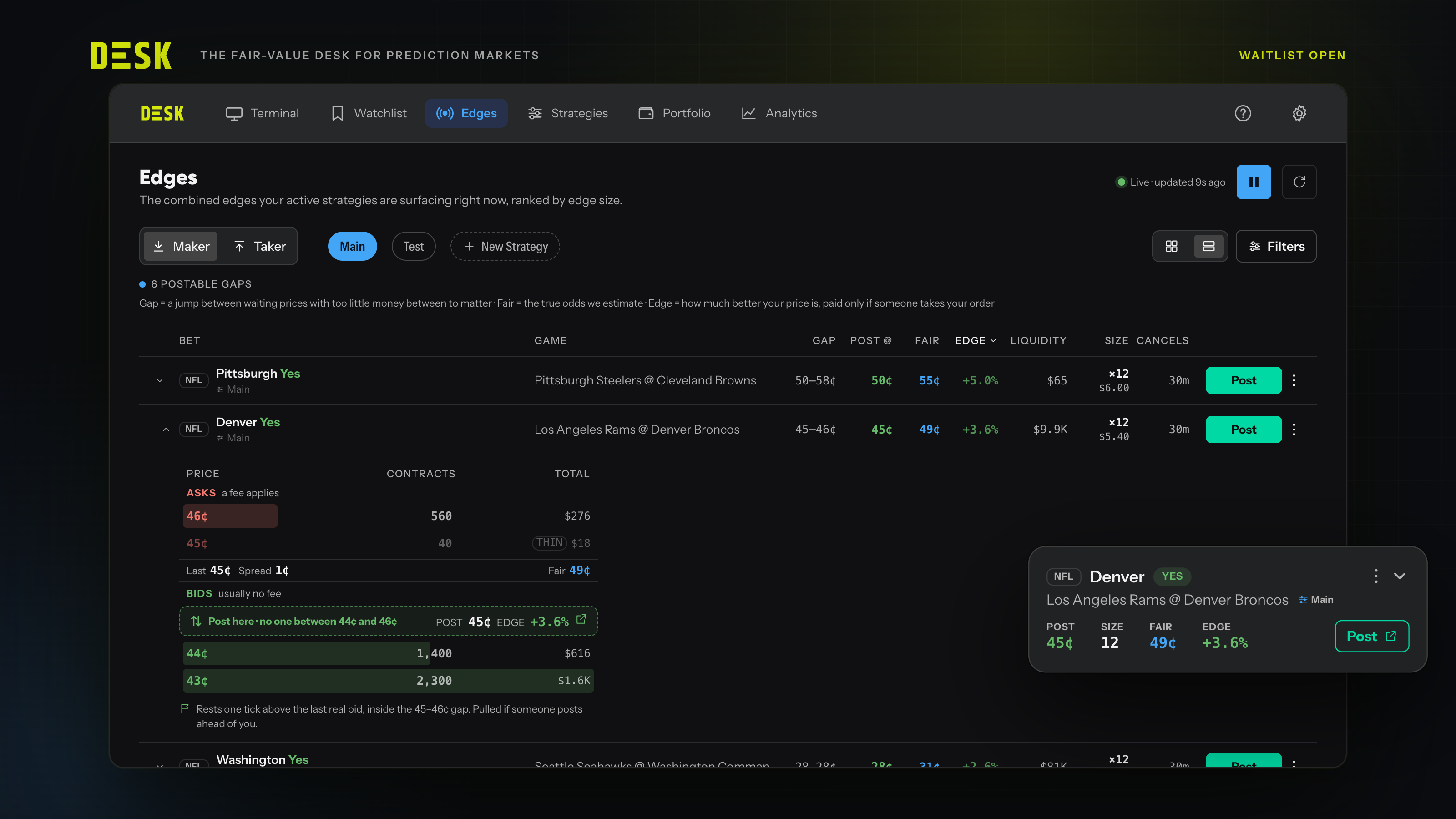
2. A fill you actually get. A backtest assumes you traded at the printed price. Real markets do not. A limit order at 74 cents fills only if someone crosses down to you, and when it does fill, it is often because news moved the price through your order. The maker and taker distinction is the mechanical side of this.
3. A size that survives a losing streak. Selling an unlikely outcome collects a small premium and risks most of a dollar, so one loss erases the premiums from roughly 15 wins. That arithmetic, not the hit rate, is what makes sizing the whole game. The standard sizing rule, the Kelly fraction, is your edge divided by the odds you are getting. Take a 40-cent contract you believe hits 45% of the time.
- The payout is 60 cents of profit on 40 cents risked, so the odds are 1.5 to 1.
- Full Kelly is the win chance times the odds, minus the loss chance, divided by the odds: 0.45 times 1.5, minus 0.55, over 1.5. That is about 8% of your bankroll.
- Most disciplined traders use a quarter of that, about 2%, because the 45% was a guess.
- With $1,000 set aside for Kalshi, that is a $20 position.
The number is the arithmetic, not a recommendation. The Kelly criterion for prediction markets walks through the formula with more examples.
Can You Actually Make Money On Kalshi?
Some traders do, and none of them are running a secret system. The costs are the part anyone can measure: the fee is published, the spread is on the screen, and a resting order fills only when someone else wants to trade at your price. The part you cannot see on the screen is what separates them: they price events better than the crowd, they get filled at the prices their math assumed, and they size so a losing week is survivable. Our own trading on Kalshi is a short log and, as of this update, a negative one, far too small a sample to prove or disprove anything. Is Kalshi profitable? For the disciplined few, yes. For a bettor who treats a 75-cent favorite as already won, the fee and the spread do the losing slowly and the settlement does it all at once.
A Kalshi Trading Strategy Test You Can Run Yourself
Before you trust any Kalshi trading strategy, run it through four checks that take minutes.
- Subtract the fee before you believe a number. A result quoted before the fee is overstated, and on a mid-priced contract the fee is about a fifth of a typical edge.
- Ask whether the fill rate was measured jointly. If a strategy needs three orders to fill, the rate that matters is how often all three fill together, not the average of each.
- Haircut any backtest built from quotes. A quote says where the market stood; it cannot say whether anyone would have traded with you at that moment. Take a couple of cents off.
- Rank ideas by how far the result sits from zero, not by the result. A best week is the noisiest week, and the noisiest idea always posts the best week.
For the moves that come next, our Kalshi trading strategy guide covers resting limit orders, trading where the liquidity lives, and selling before settlement instead of hedging, and the position limits explain how big a market will let you get.
More on this: Kalshi Fees Explained · Kalshi Odds: Cents To American Odds · Kalshi Trading Strategy: Five Moves · Kalshi Maker Vs. Taker · How Much Money Should You Put On Kalshi?
; contracts can lose their full value. We have no commercial relationship with Kalshi.*
Prices on this page are Kalshi's book. If you also trade on Polymarket, code OS4 gets new users a $50 trading bonus on a $10 deposit — affiliate link; terms as stated by Polymarket; 18+, availability varies by state.