I get the same three questions every time I mention trading on Kalshi instead of betting at a sportsbook: how do I open an account, what are these maker and taker fees everyone argues about, and what does a price like 25 cents actually mean in the odds language I already speak? Fair questions. Kalshi looks like a sportsbook if you squint, and that resemblance is exactly what costs new traders money, because underneath the jersey it is an exchange, and almost every expensive rookie mistake I see comes from treating the posted price as the whole price.
So this is my FAQ, the one I wish someone had handed me on day one. We will open the account, learn what the cents mean, split the maker fee from the taker fee, and then convert five real contract prices into the sportsbook odds you already understand. Keep an eye on the 50-cent example when we get there. It looks like the most boring price on the board, and it is quietly the most expensive one on the exchange.
The Quick Answer
Kalshi is a federally regulated exchange where you buy Yes or No contracts on real-world outcomes, priced from 1 cent to 99 cents, and every contract pays exactly $1 if you are right. The cent price is the market's implied probability, and your real cost depends on whether you take a resting price or make your own, because the trading fee differs. The full five-row conversion table, from 1 cent all the way to 99 cents with true after-fee odds at each stop, is below.
Stay ahead of the markets.
Daily insights and expert picks on Kalshi, Polymarket, and what's moving markets.
Free forever. Unsubscribe anytime.
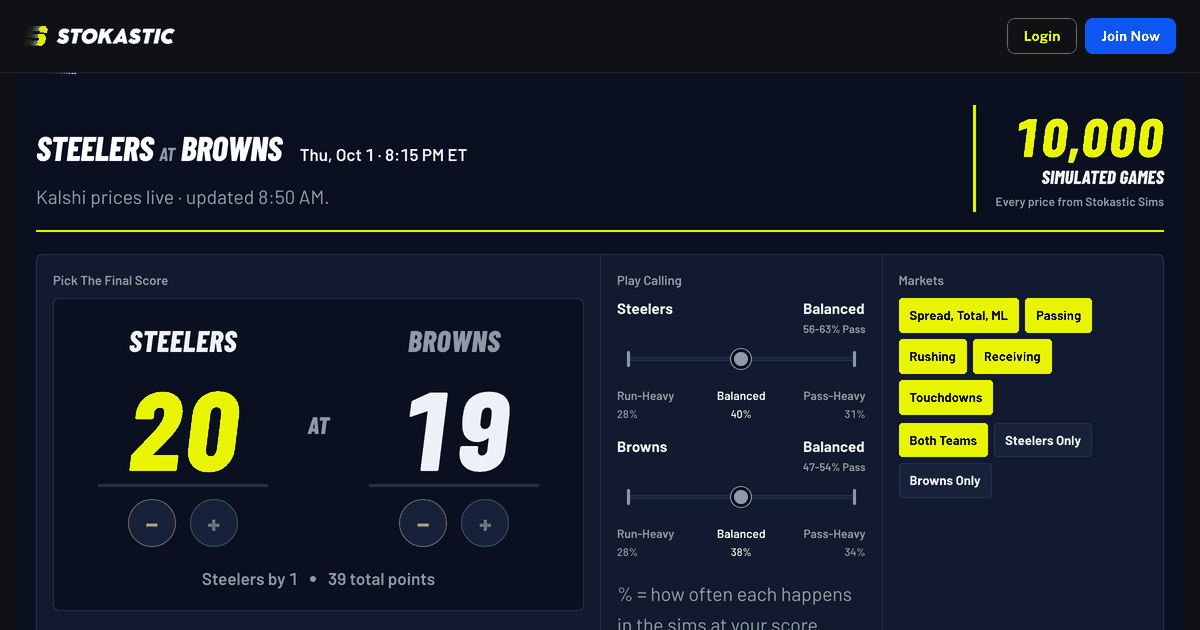 Price the combo before you buy it: the Kalshi Parlay Simulator runs 10,000 simulated games of this week's game and prints the fair price of any combo next to the price on Kalshi.
How To Open A Kalshi Account
Opening the account is the easy part, and it works like any regulated financial platform rather than like a sportsbook signup. How prediction markets work as a category is its own topic, but the mechanics of getting on the platform are four steps:
- Sign up with an email address on the Kalshi site or app.
- Verify your identity. Kalshi is a designated contract market regulated by the Commodity Futures Trading Commission (CFTC), so it runs the same know-your-customer checks a brokerage does: legal name, date of birth, and Social Security details, sometimes a photo ID. You must be 18 or older.
- Fund the account. Standard bank transfers are free. Debit card deposits can carry a processing fee of up to 2%, which matters more than it sounds: a 2% haircut on the way in is real money to a price-driven trader, so I fund by bank transfer and wait.
- Check what you can trade. Availability of some markets, sports especially, differs by state and is actively moving through the courts. I am not going to print a state list that will be stale in a month; check the eligibility screens inside your own account before you plan a strategy around any one market type.
One habit from my own desk: treat that first deposit as a bankroll. Decide what a unit is before you ever click a price, because the exchange will happily let you size every trade emotionally.
If your endgame is specifically sports, our step-by-step guide to betting sports on Kalshi walks the order screen itself. This article stays on the layer underneath: what the prices are, and what they cost.
What The Cents Mean: Every Price Is A Probability
Every Kalshi contract settles at $1.00 if your side happens and $0.00 if it does not. That single fact does all the work. If Yes costs 60 cents, the market is pricing a 60% chance, because paying 60 cents for a shot at $1.00 only breaks even if the thing happens 60% of the time. A 25-cent contract is a 25% proposition. A 99-cent contract is priced as a 99% favorite.
This is the first mental shift for a sportsbook bettor. A book shows you -150 and makes you do algebra to find the implied probability. Kalshi shows you the probability and makes you do algebra to find the odds. Neither number is more honest by nature; they are the same statement in two languages. The trouble starts when you read cents like prices in a store, where 25 cents feels cheap and 99 cents feels expensive. On an exchange there is only accurate and inaccurate, and the fee you pay to find out.
Which brings us to the part Kalshi actually charges you for.
Maker Vs Taker: The Two Prices You Can Pay
On an exchange you are always trading against another person, not the house, and there are two ways to get into a position. You can take a price that is already resting on the order book, and get filled instantly. Or you can make a price by resting your own order at the number you want, and wait for someone to come to you.
Kalshi charges for the two differently, and the difference is the closest thing this platform has to vig:
- Taker Fee: roughly 7% of your expected profit on the trade, calculated as 0.07 × contracts × price × (1 − price), rounded up to the next cent. In this formula the price is written as a fraction of a dollar, so a 50-cent contract goes in as 0.50. The important word is the shape. Because it keys off price × (1 − price), the fee peaks at 50 cents and shrinks toward both ends. On a 100-contract order at 50 cents, the taker fee is $1.75. The same size order at 99 cents costs about 7 cents in fees.
- Maker Fee: on most markets, zero. A filled resting order pays nothing, and canceling an unfilled order costs nothing. On certain designated markets Kalshi does charge makers, at a quarter of the taker rate (a 0.0175 multiplier in the same formula), which is $0.4375 on that same 100-contract order at 50 cents.
A few series carry their own schedules, so treat 7% as the standard rate rather than a law of physics, and glance at the fee readout on the order ticket before you confirm. The full curve, with the withdrawal and deposit details, is in our Kalshi fees breakdown, and the craft of trading the maker side is worth its own read once the basics settle.
Here is the framing I actually use: the taker fee is what impatience costs. The maker fee is what patience costs. On most markets patience is literally free, and that asymmetry is the single most useful thing a sportsbook bettor can learn about this platform, because at a book there is no patient side of the counter. Hold that thought, because the fee curve peaking at 50 cents is about to show up in the odds table as a visible dent.
Kalshi Cents To Sportsbook Odds: 5 Worked Examples
Now the translation layer. I pulled five prices across the whole board, from a 1-cent longshot to a 99-cent heavy favorite, and converted each three ways: the posted price with no fees, the true odds if you take, and the true odds if you make on a market that charges the 1.75% maker rate. Every example is a 100-contract order, and every fee follows the formulas above.
| Contract Price | Implied probability | Posted odds | True taker odds (fee per 100) | True maker odds (fee per 100) |
|---|---|---|---|---|
| 1¢ | 1% | +9900 | +9252 ($0.0693) | +9729 ($0.0174) |
| 25¢ | 25% | +300 | +280 ($1.3125) | +295 ($0.3282) |
| 50¢ | 50% | +100 | -107 ($1.75) | -102 ($0.4375) |
| 75¢ | 75% | -300 | -322 ($1.3125) | -305 ($0.3282) |
| 99¢ | 99% | -9900 | -10645 ($0.0693) | -10077 ($0.0174) |
Fees shown are the exact formula values; on a real order Kalshi rounds the charged fee up to the next cent.
The row I keep coming back to is 50 cents. The posted price says +100, an even-money coin flip. But take that price and your all-in cost is $51.75 to clear a net $48.25, which is -107, with a break-even of 51.75% instead of 50%. The market called it a coin flip and the fee quietly made you lay odds on it. The dent is the fee curve from the last section landing exactly where it hurts most, on the mid-range prices where sports markets live. Rest a maker order on a designated market instead and you are at -102; on a market with no maker fee you keep the true +100.
The ends of the table tell the same story at a whisper. At 99 cents the posted -9900 worsens to -10645 as a taker, and at 1 cent the posted +9900 shrinks to +9252. The dollar fees out there are tiny, pennies per hundred contracts, but the odds still move visibly because your expected profit is tiny too. There is no price on the board the taker fee does not touch; there are only prices where it hides better.
The rule I trade bya posted Kalshi price is a fee-free fantasy. Your true odds are the posted price plus your side of the fee, and until you know which side of the order book you are on, you do not know what you are being paid.
The conversion math itself is two lines:
- Price At 50 Cents Or Above: odds = -(price ÷ (100 − price)) × 100, so 75¢ is -300.
- Price Below 50 Cents: odds = +((100 − price) ÷ price) × 100, so 25¢ is +300.
- Going The Other Way: a book's -150 is 150 ÷ 250 = 60 cents, and +150 is 100 ÷ 250 = 40 cents.
When I want the whole ladder instead of five stops, our cent-by-cent Kalshi odds chart has every price converted, and our odds calculator flips any format into any other, implied probability included, faster than mental math.
That table is the whole toolkit. Now let me show you the five ways I watch people misuse it.
The 5 Most Common Prediction Market Mistakes (And How I Avoid Them)
Everything above is mechanics. What follows is judgment, which is where the money actually changes hands. These are the five mistakes I see most from bettors crossing over, roughly in the order they get made.
1. Reading the price like a price tag. New traders buy 25-cent contracts because they feel affordable and skip 75-cent contracts because they feel expensive. Read the table again: 25¢ is just +300 wearing different clothes. The question is never whether the price is low; it is whether the true chance is higher than the number on the screen. My rule from years of betting home run props at plus money applies here unchanged: bet the price, not the team. If I think a 25-cent contract should be 30 cents, I have a trade. If I just like the story, I have a lottery ticket.
2. Paying the taker fee out of pure impatience. The order book will fill you instantly if you cross the spread, and instantly is a drug. But you saw what taking costs at mid-range prices: an even coin flip becomes -107. On most markets, resting your own order one cent better costs nothing and pays you the spread instead of charging it. I take when a number is about to move and I want it now. I make when nothing is urgent, which is most of the time. Deciding which situation you are in before you click is the whole skill.
3. Comparing Kalshi's posted price to a sportsbook's line without converting both to true cost. The posted +100 on Kalshi is not better than a book's -105 until you know your side of the fee; as a taker it is -107, which is worse. The comparison only means something after every number is all-in. This is the same line-shopping discipline you should already run across sportsbooks, and it is exactly what our live odds screen is for on the book side: pull the best available number across every major sportsbook, convert the Kalshi price with the two-line math, then put your money wherever the true cost is lowest. Some days the exchange wins, some days a book does, and the trader who checks both is the only one who consistently gets the right answer.
4. Living at the extremes of the board. The tails of that table are where bankrolls go to die, in both directions. Penny-contract buyers rack up +9252 shots that almost never hit, telling themselves the losses are small; my discipline from longshot props applies exactly, in that anything in lottery territory gets a tenth of a normal unit at most. The 99-cent crowd runs the opposite disaster, risking $99.07 per hundred contracts to clear 93 cents. Win a hundred of those in a row and a single wrong settlement erases the year. The middle of the board is where prices are actually argued about, and thick, active books mean tighter spreads and cleaner exits. Our guide to where Kalshi's liquidity actually lives shows which markets clear that bar.
5. Never reading the settlement rules. Every contract settles against a specific written source on a specific schedule, and the rules page decides what Yes means before your instinct gets a vote. A sports market may settle on a data provider's final; an economic market settles on one named government print. Close calls can also sit in a review window before payout, which surprises people expecting sportsbook-speed grading; the 24-hour settlement review rule covers how that works. Two minutes on the rules tab before entry has saved me from more bad trades than any model I have ever built.
Look at those five again and notice they are one mistake in five costumes: trusting the surface of the screen instead of the true number underneath. The account setup was ten minutes. Learning to see through the posted price is the actual onboarding.
Kalshi FAQ
Is Kalshi legit?
Yes, in the specific sense that it is a designated contract market regulated by the CFTC, the same federal agency that oversees futures exchanges. Whether individual market types are available where you live is a separate, evolving question. Several states are contesting sports contracts in court, so check the eligibility screens in your account rather than trusting any static list.
Does Kalshi have an app?
Kalshi runs native iOS and Android apps alongside the browser version. The order book, maker orders, and the fee readout on the ticket all work in the app, so nothing in this guide requires a desktop.
Can I get out of a position before the event settles?
You can sell contracts you own, or buy out of a short, at the current market price any time the book is open, and this is a real edge over a sportsbook. If your 40-cent position runs to 70 cents, you can bank the move without sweating the finish; there is no cash-out haircut, just the price, the spread, and any taker fee on the exit.
What is the smallest trade I can make?
One contract, so your risk floor is whatever that contract costs, anywhere from 1 cent to 99 cents. That makes the platform cheap to learn on: you can run 20 single-contract experiments for less than the price of one bad parlay while you get comfortable with maker orders.
Do I owe taxes on Kalshi profits?
Trading profits are taxable income; the specifics of event-contract taxation are between you and a tax professional. I treat the tax bill as part of the true cost of winning, same as the fees, and budget for it the day a big position settles rather than in April.
More on this: How Does Novig Work? Sports-Only Prediction Market · How Does Polymarket Work? Markets, Funding And Settlement · Does Kalshi Have An App? Platforms, And What Works Where · What Does Over 2.5 Goals Mean? Soccer Totals, Explained · How Does Kalshi Make Money? The Charge You Can't See
The Bottom Line From My Desk
Back to where we started: Kalshi wears a sportsbook's clothes over an exchange's skeleton. Open the account like a brokerage, fund it like a bankroll, and then internalize the one table that matters, because a posted price is not a true price until you know which side of the order book you are standing on. The 50-cent coin flip that is really -107 for the impatient and free-to-improve for the patient is the entire platform in a single row.
And keep the habit that makes any of this pay: never trade the first number you see, on the exchange or off it. If you want the same discipline applied to the sportsbook side of your card, our free expert picks publish daily with the reasoning shown, so you can see how our handicappers argue a price before a dollar moves. The traders who lose on prediction markets are almost never bad at predicting. They are bad at pricing, still paying -107 for coin flips they could have rested at even money. You now know better.> Tools for this: Kalshi Parlay Simulator against the sims, or the Polymarket Combo Simulator for Polymarket's book.