Cash out or let it ride is the most-asked question in every prediction market community I read, and almost every answer people give is vibes. I have sold winners I should have held and held losers I should have sold, and what finally fixed it was replacing the feeling with three questions I can answer with numbers: what is my honest probability, what does the exit actually pay after costs, and can my bankroll carry the swing either way. This is that framework, with the arithmetic worked all the way through, a breakeven table you can keep open next to the app, and a checklist that turns a stressful decision into a fifteen-second one.
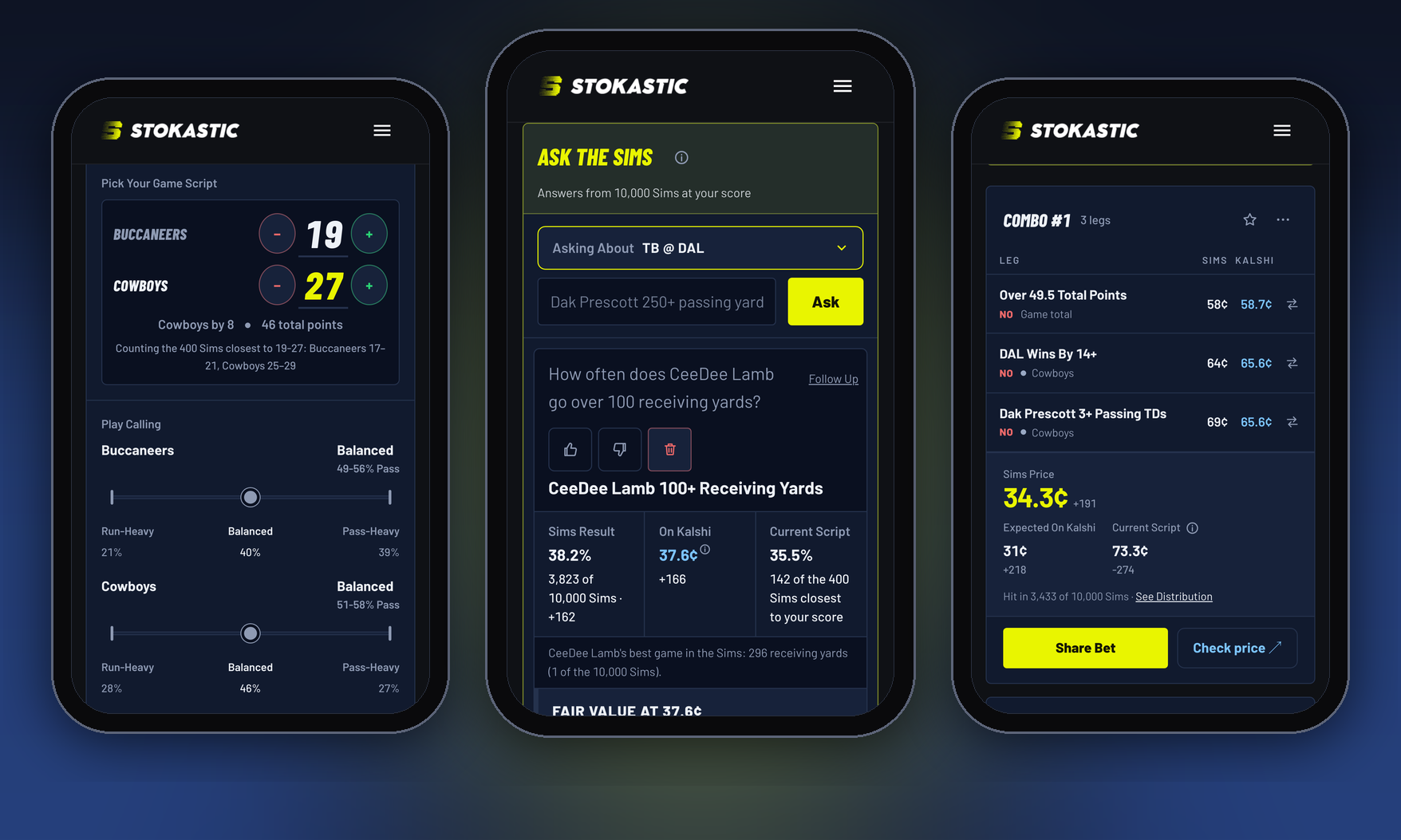 Price the combo before you buy it. The Kalshi Combo Simulator plays this week's game 10,000 times and prices any combo you build next to the price on Kalshi, on your phone, free, no login.
Our Sims play Bears at Falcons 10,000 times, snap by snap, and count how often any bet hits. Ask them anything about this game below, for free.
In Summary
- One Comparison Decides It. Sell when the net proceeds of hitting the bid exceed the position's value at your own win probability. Hold when your number is higher. Everything else is noise.
- The Breakeven Is The Net Bid. Selling 100 contracts at an 80-cent bid nets $78.88 after the trading fee, so the sale is correct only if your honest probability is below about 79%.
- Your Entry Price Is Irrelevant. What you paid is sunk. The decision is about the money in front of you now, not the money you spent then.
- The Spread Is Part Of The Answer. You exit at the bid, and in a thin market the bid can sit several cents below fair value. A bad book can turn a correct sale into a bad price.
- Too Big To Hold Means Too Big, Period. If variance is forcing the sale, the real fix is position sizing, not the sell button.
Stay ahead of the markets.
Daily insights and expert picks on Kalshi, Polymarket, and what's moving markets.
Free forever. Unsubscribe anytime.
The Only Number That Matters: Your Probability Vs. The Net Bid
Every Kalshi position is a stack of Yes or No contracts that settle at $1.00 each if you are right and $0.00 if you are wrong, traded on a CFTC-regulated event-contract exchange. That structure makes the cash-out decision unusually clean, because both sides of the comparison live in the same units.
Hold, and each contract is worth your win probability in dollars. If you make the outcome 85% to happen, 100 contracts carry an expected value of $85.00 at settlement. Sell, and each contract is worth the bid, minus the trading fee on the sale. Those are the two numbers. Whichever is bigger wins.
Notice what is not in that comparison: the price you paid. Your entry cost is identical under both choices, spent and gone, so it cancels out of the math entirely. The trader who says "I just want to get my money back before I sell" is pricing a contract off their own history instead of the market's future, and the order book does not know or care what anyone paid. I think of every position I hold as if I had been handed it this morning: would I keep it at this price, at my probability? That framing removes the single biggest source of bad exits I see, and I include my own.
The honest part, and the hard part, is the probability itself. Your q has to be your real number, built from something, not a number reverse-engineered to justify the decision you already wanted. When the market disagrees with you by a lot, the market is usually the one with better information. Our guide to finding edges on Kalshi covers where a defensible probability comes from in the first place.
The flip side of exiting early is buying the fade — our piece on trading live comebacks on Kalshi covers entering when the market has written a team off.
Worked Example: Bought At 35 Cents, Bid Now 80
Here is the framework on a position that moved the right way. You bought 100 Yes contracts at 35 cents. Your total entry cost was $36.60: the $35.00 for the contracts plus the $1.60 taker fee under Kalshi's standard formula, round up of 0.07 x 100 x 0.35 x 0.65. The event has gone your way and the market now quotes 80 bid, 83 ask.
The sell side. A quick order sale hits the bid. Gross proceeds: $80.00. The sale is a taker trade, so the fee is 0.07 x 100 x 0.80 x 0.20, which is $1.12. Net proceeds: $78.88, locked in, no further variance.
The hold side. Each contract pays $1.00 at settlement if the outcome holds, $0.00 if it does not, and Kalshi charges no settlement fee. At a win probability q, holding is worth 100 x q dollars in expectation.
The comparison. Selling beats holding whenever $78.88 is greater than 100 x q, which means the breakeven probability is 78.88%. Three honest readings of the same position:
| Your Honest q | Value Of Holding | Sell Nets | Correct Call |
|---|---|---|---|
| 72% | $72.00 | $78.88 | Sell, the bid pays you more than your number says the position is worth |
| 79% | $79.00 | $78.88 | Hold by $0.12 of EV, close enough that spread and sizing decide |
| 85% | $85.00 | $78.88 | Hold, selling gives up $6.12 of expected value |
The market's midpoint of 81.5 cents implies the crowd makes it roughly 81.5%. If your number and the market's number are close, the trade is near a wash and the tiebreakers below decide. If they are far apart, one of you is wrong, and it is worth a beat of humility before you assume it is them.
What The Exit Actually Costs
The second question is the toll. On Kalshi there is no house cash-out offer: exiting early means selling contracts into the order book, your exit price is the bid, and the bid-ask spread plus the taker fee is the full cost of leaving. The mechanics deserve their own article and have one, our breakdown of how Kalshi cash out works, but the decision-level summary fits in a table. Net proceeds and the breakeven q for selling 100 contracts at each bid:
| Bid | Fee On 100 Contracts | Net Proceeds | Breakeven q |
|---|---|---|---|
| 50c | $1.75 | $48.25 | 48.3% |
| 60c | $1.68 | $58.32 | 58.3% |
| 70c | $1.47 | $68.53 | 68.5% |
| 80c | $1.12 | $78.88 | 78.9% |
| 90c | $0.63 | $89.37 | 89.4% |
| 95c | $0.34 | $94.66 | 94.7% |
Read the last column as the honest hurdle: sell at that bid only if your probability is below it. Two structural notes. The fee follows the P x (1-P) curve, largest near 50 cents and shrinking toward the extremes, with the full schedule covered in our Kalshi fees breakdown. And the spread matters more than the fee in thin markets. If a market quotes 74 bid, 84 ask, hitting the bid means selling five cents under the midpoint, a cost that dwarfs the $1.35 fee on the sale. In books like that, a resting limit order near the midpoint is usually the better exit, and patience is worth real cents.
The framework needs an honest q, and that is where most of us are weakest. On sports markets, the live odds screen builds one for you: the tool surfaces the de-vigged, no-vig fair probability across DraftKings, FanDuel, and every other major book, a market-grade number to hold against the bid on your Kalshi screen. When your q is the consensus of the sharpest prices in the world, the sell-or-hold comparison stops being a guess.
What Moved Since Oct. 11
Chicago to beat Atlanta in Week 6 (Sunday, Oct. 18, 1 p.m. ET at Atlanta) traded at 53 cents bid, 55 ask on Kalshi at noon ET on Sunday, Oct. 11, and at 63 bid, 64 ask by 7:42 p.m. ET on Monday. The Bears did not earn that move on the field. They lost 31-7 at Green Bay with Caleb Williams missing a third straight game with a hamstring injury and Tyson Bagent starting in his place, and the offense turned the ball over five times, per the AP game story. After the game coach Ben Johnson said Williams is "close" to returning, possibly for Atlanta. The bid barely moved on that, 52 to 54 through Sunday evening, and was 56 by 10 p.m. ET with the Falcons' Sunday night game under way. The rest of the move came from the other sideline. Michael Penix Jr. hurt his ribs late in the fourth quarter of the Falcons' Sunday night game, Tua Tagovailoa played the overtime of the 30-23 loss to Baltimore, and the Chicago bid was 61 by midnight and 62 by 1 a.m. Monday. A Monday report that the injury is not considered serious did not bring the price back; the bid was 62 at 4 p.m., ten minutes before that report posted, and 63 by 5 p.m. As of Monday, Oct. 12 at 7:42 p.m. ET, the book is 63 bid, 64 ask, with 1,214 contracts resting at the bid, so a 100-contract sale fills at 63.
A trader who bought 100 contracts at the 55-cent ask on Oct. 11 paid $56.74 with the fee. The framework sets that number aside and prices the exit:
| Chicago Yes, 100 Contracts | Number |
|---|---|
| Bid to sell into, Monday, Oct. 12, 7:42 p.m. ET | 63c |
| Fee to sell 100 at the 63-cent bid | $1.64 |
| Net proceeds | $61.36 |
| Breakeven q | 61.4% |
The last row is the whole decision. Hold if your honest number on Chicago is above 61.4%, and sell if it is below. The no-vig consensus of 23 sportsbooks had the Bears at 61.6% at the same hour, below the 63.5-cent midpoint of the Kalshi book and two tenths of a point above the breakeven. If the books' 61.6% is your number, holding is worth $61.60 against the $61.36 the sale nets, 24 cents on 100 contracts. That is arithmetic, not a pick, and this week the arithmetic says the exit is priced about right. When the two numbers sit that close, expected value has nothing to say and size makes the call. The input most likely to pull your q away from the market's is the pair of quarterbacks. Johnson was noncommittal on Monday about who starts if Williams cannot go, Penix predicted he will return for the game, and your read of both goes into your number before you look at the bid.
The same book holds the mirror case, and this week it also holds the thin bid. Atlanta Yes traded at 45 bid, 47 ask at noon on Oct. 11 and is 37 bid, 38 ask now. Selling 100 at the 37-cent bid would net $35.36 after a $1.64 fee, a 35.4% hurdle. But only 79 contracts rest at 37; the depth, 42,039 contracts, sits at 36, so a quick sale of 100 fills the last 21 a cent lower, $36.79 instead of $37.00 before the fee, and nets $35.16 after a $1.63 fee. The real hurdle is 35.2%, and the screen price alone would have told you 35.4%. The Atlanta buyer is down since Sunday and the Chicago buyer is up, and neither fact enters the decision. The net bid against your number is the whole comparison.
Of the 28 team markets on the 14 Week 6 games listed on Kalshi, 26 are one cent wide. The two exceptions are the Carolina side of Panthers-Eagles, 47 bid, 49 ask, and the Dallas side of Cowboys-Packers, 48 bid, 50 ask. No Week 6 side is three cents wide. On a one-cent book, selling at the bid gives up half a cent to the midpoint, $0.50 on 100 contracts against the $1.64 fee on the Bears sale, so in these books this week the fee is the larger cost. A thin bid is a cost the spread never shows, and the Atlanta book is this week's reminder.
Can Your Bankroll Hold The Swing?
The third question is the one the first two politely ignore: variance. Holding is the higher expected value whenever your q clears the breakeven, but expected value is an average over futures, and you only live one of them. Hold 100 contracts at an 85% probability and 15 times in a hundred the position goes to zero.
Whether that matters depends entirely on size. If those 100 contracts are 2% of your bankroll, the answer is easy: take the EV, hold, and let the long run do its work. If they are 40% of your bankroll, a 15% chance of losing $80 of value is a different kind of decision, and paying a small EV haircut to lock $78.88 is not weakness, it is solvency. The uncomfortable diagnosis underneath: a position you cannot afford to hold at your own probability is a position you oversized. Selling fixes tonight. Sizing fixes the pattern. If you find yourself in this spot every week, the cash-out button is treating the symptom.
There is also a middle path the all-or-nothing framing hides. Sell 60 of the 100 contracts at the 80-cent bid and you bank $47.32 after the $0.68 fee, more than the $36.60 the whole position cost, while 40 contracts stay live to settlement. Your remaining exposure is money the market gave you, the nightly stress drops with it, and you keep meaningful upside if your 85% read is right. A partial sale gives up some expected value in exchange for a hold you can actually sit through, and that trade is often the most honest one on the board.
The Decision Checklist
This is the whole framework compressed to what I actually run before touching the sell tab. It takes 15 seconds once the habit forms.
- Write down your q first, before looking at the bid, so the market cannot anchor the number you are about to compare it against.
- Compute the net bid: bid times contracts, minus the taker fee. That figure divided by contracts is your breakeven probability from the table above.
- Sell if your q is below the breakeven, hold if it is above. Entry price stays out of the conversation.
- Check the spread before using a quick sale. If the book is thin and the bid sits well under the midpoint, quote a limit order instead and let the market come to you.
- If variance is making the decision for you, act on size, not on this exit. Then cut your standard position size before the next trade, and read up on how cent prices map to probabilities if you want the q side of the comparison sharper.
Ride Or Sell, Decide It With Numbers
The next time the question comes up, and it will come up tonight if you hold anything live, run the three questions in order. Probability against net bid decides the direction. The spread decides the route out. Size decides whether you were ever positioned to let the right answer be the one you take. None of it requires more math than one multiplication and one subtraction, and all of it beats the alternative, which is asking a group chat what they would do with your money.
Build the q side of the comparison before you need it. The odds comparison turns any price into an implied probability in one step, and the live odds screen shows the no-vig fair number on every sports market, so the bid on your screen always has something honest to be measured against.
Event contracts involve risk and are not appropriate for everyone. Availability varies by state. Trade responsibly.
Trade prediction markets on Polymarket too.Most readers here already have Kalshi — Polymarket is the other major venue, and code OS4 adds a $50 trading bonus on a $10 deposit: Get the Polymarket bonus →
Affiliate disclosure: OddsShopper earns a commission on signups through this link. Terms as stated by Polymarket; 18+, availability varies by state.
More on this: How To Cash Out On Kalshi Before The Game Ends · Raiders Vs Dolphins Props: Bowers Is Out, Kalshi Prices Him Like He Plays · Hegseth Out Odds: Tillis Said Fire Him. The Market Cut Its December Price · Cash Out Betting Explained: The Margin You Pay for Certainty