A prediction market looks a lot like a sportsbook if you squint. There are two sides, a price, and a payout when you are right. But a prediction market rewards one skill that a sportsbook never pays you for directly: being honest and accurate about probability. The prediction market strategies that actually hold up over time all start there. Every contract on Kalshi or Polymarket is priced somewhere between 0 and 100 cents, and that price is really a percentage, the crowd's best guess at how likely something is to happen. The people who do well over time are not the ones with the hottest takes. They are the ones who can look at a 65-cent contract, decide whether 65% is too high or too low, and only act when their own number is far enough away from the crowd's to be worth the cost. That is the whole game, and this guide walks a beginner through how to play it.
First, one thing that is not optional. Prediction markets are regulated federally by the CFTC as event contracts, and the exchanges argue that makes them something other than state-licensed sports betting. That claim is exactly what 21 states are now fighting over, and three federal appeals courts have split two to one against the exchanges. That legal difference matters for where you can use them and how they are taxed, and we cover it near the end, with the state map as it stood on October 20, 2026. Nothing here is a promise of profit. Fees, spreads, and thin liquidity are real costs that can quietly turn a good idea into a losing one, so we treat them as part of the strategy, not a footnote.
In Summary
- A Price Is A Probability. A contract trading at 30 cents means the market thinks the event is about 30% likely. Your job is to form your own honest estimate and compare it, not to guess a winner.
- Calibration Beats Conviction. The edge comes from being right about how likely something is, over many trades, not from being loud about one. Track your own predictions so you know whether your 70% calls actually happen about 70% of the time.
- The Soft Prices Hide In The Corners. Thinly traded markets and longshot contracts are where the crowd's price is most likely to be lazy or biased. That is the opportunity, and also the trap, because those same corners are the hardest to get out of.
- Fees And Spread Set Your Real Breakeven. You do not need your estimate to just beat the price. It has to beat the price plus the round-trip cost of getting in and out. Size to the edge that is left after those costs.
- Bankroll Discipline Is The Whole Ballgame. Event contracts can settle at zero. Bet in small, consistent units you can afford to lose, and never chase a bad settle with a bigger one.
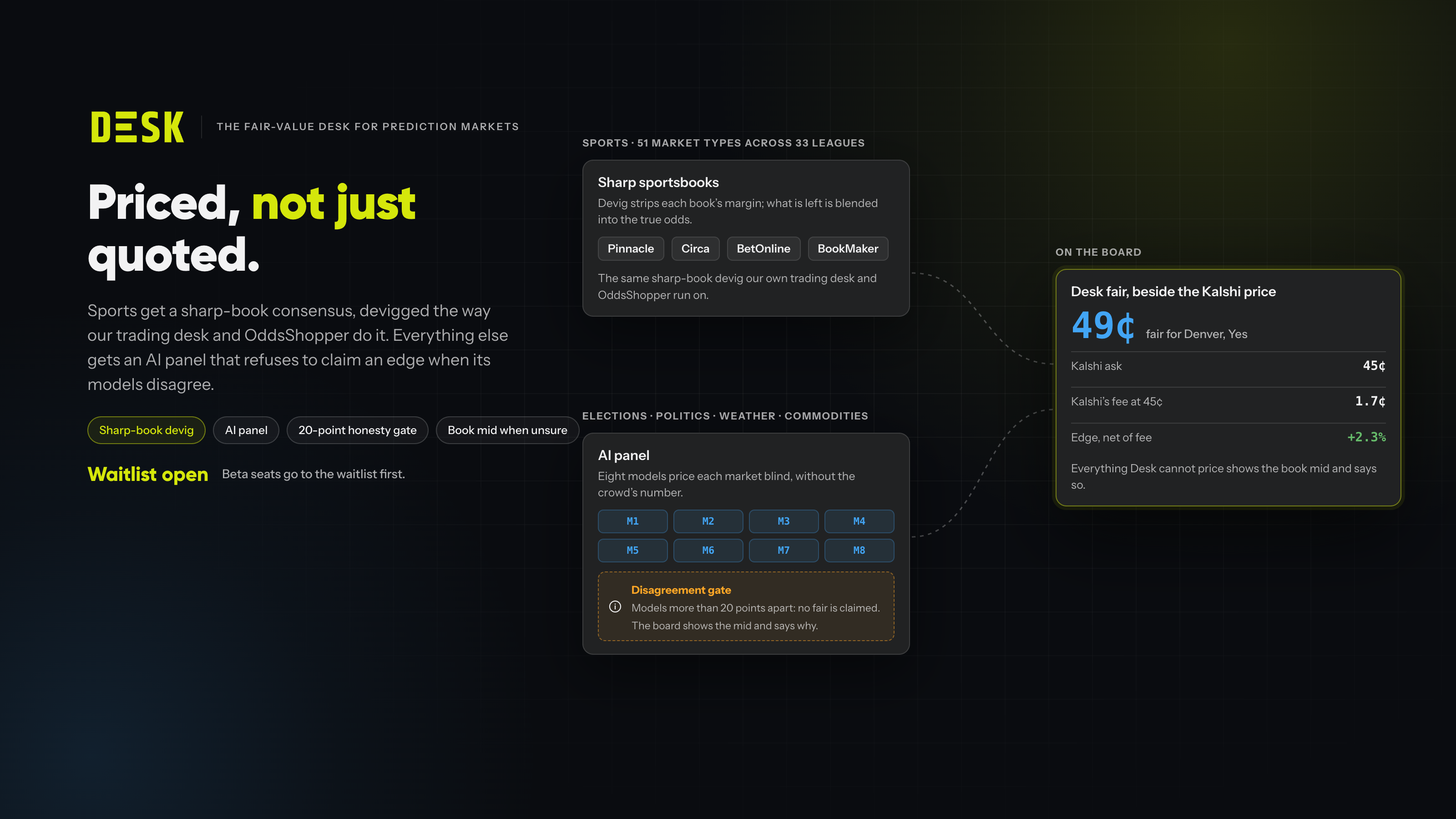
- Where OddsShopper Fits: for any sports event, OddsShopper's no-vig fair-odds pricing gives you a second, independent read on the true probability, so you can sanity-check a Kalshi or Polymarket price before you commit.
One promise to carry through the guide: the most reliably mispriced contracts on the board are the longshots, the cheap contracts that feel like lottery tickets, and they are mispriced high. We will get to exactly why the crowd keeps overpaying for them, and why the beginner edge sits on the boring side of them.
Stay ahead of the markets.
Daily insights and expert picks on Kalshi, Polymarket, and what's moving markets.
Free forever. Unsubscribe anytime.
Start Here: What A Prediction Market Price Actually Means
Before any strategy, you have to read the price correctly, because everything else is built on this. On a prediction market, a contract that pays out $1 if an event happens will trade for some price between 0 and 100 cents. If a contract is trading at 40 cents, the market is collectively saying the event is about 40% likely. Buy it, and you risk 40 cents to make 60 if you are right.
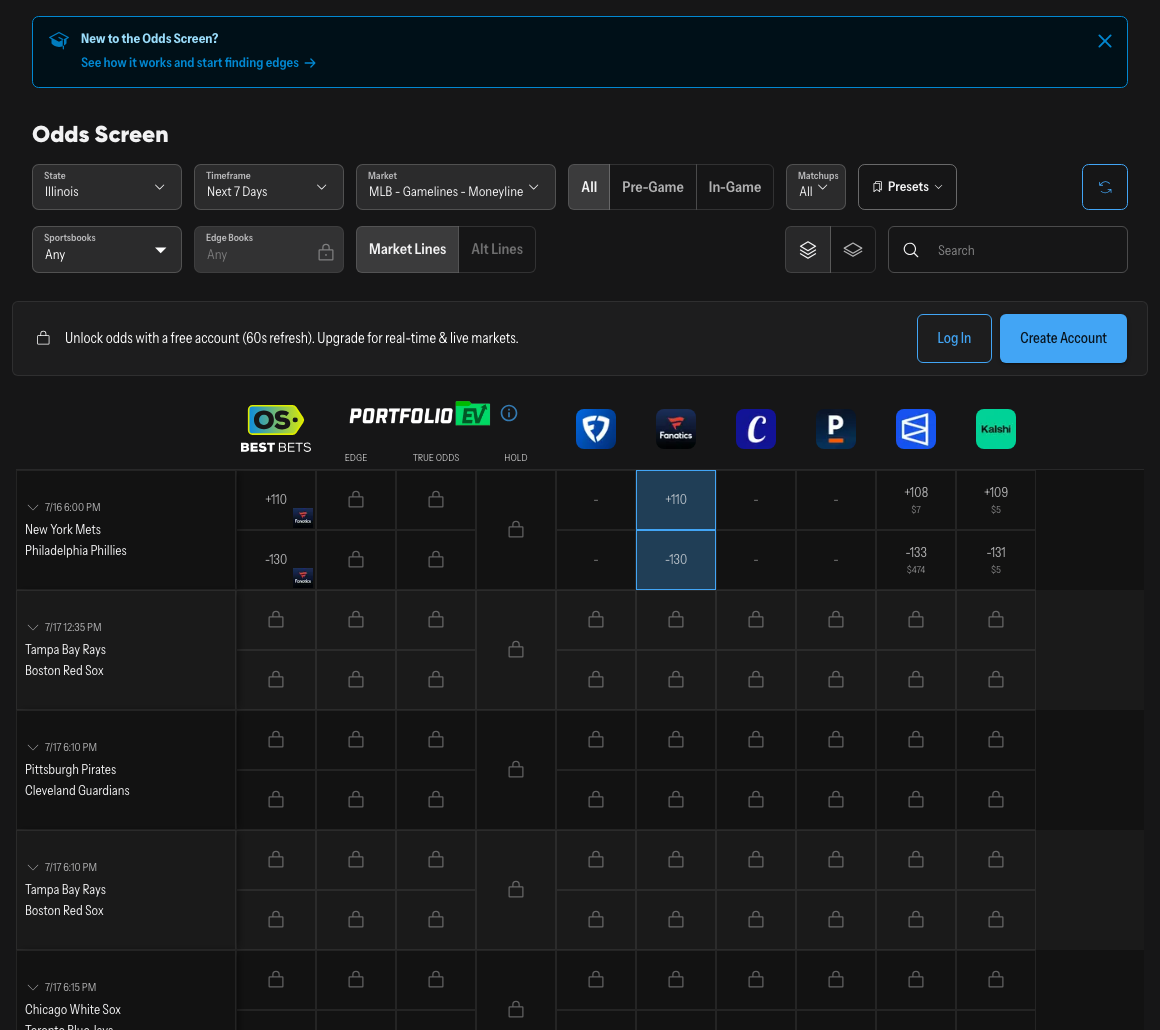
The OddsShopper Odds Screen.
That reframing is the single most useful habit you can build. A sportsbook shows you odds like +150 or -200 and hopes you never do the mental math to turn them into a percentage. A prediction market hands you the percentage directly. The beginner's first move, then, is not to ask "will this happen?" It is to ask "is 40% too high or too low?" Believe the true chance is 55%, and 40 cents is a price worth taking. Think it is 25%, and the crowd is overpaying, so there may be a case to sell or fade it instead.
| Contract Price | What the crowd is saying | Buy it, and you... |
|---|---|---|
| 20 Cents (Illustrative) | about 20% likely | risk 20 to make 80 |
| 40 Cents (Illustrative) | about 40% likely | risk 40 to make 60 |
| 65 Cents (Illustrative) | about 65% likely | risk 65 to make 35 |
| 85 Cents (Illustrative) | about 85% likely | risk 85 to make 15 |
| 60 Cents, Live: Bears To Beat The Patriots On Kalshi (Pulled Tuesday, Oct 20, 2026, 4:11 A.m. ET, About 64 Hours Ahead Of Thursday's 8:15 P.m. ET Kickoff At Soldier Field) | about 60% likely; OddsShopper's de-vigged read paired with the Kalshi price said 59.8% | risk 60 to make 40 |
The 85-cent row is the one worth pausing on. It looks safe, and usually it is, but you are risking 85 to make 15, which means you have to be right roughly 85% of the time just to break even before fees. Favorites are not free money, and reading that row correctly is the beginner's first defense against overpaying for one.
The live row is that lesson with a real price on it, and this week it lands at the other end of the table from the 85-cent row: a modest home favorite, closer to a coin flip than to a near-certainty. At 4:11 a.m. ET on Tuesday, October 20, the Kalshi book on the Chicago Bears to beat the New England Patriots in Thursday night's Week 7 game at Soldier Field showed 59 cents bid and 60 cents offered. Read it the way this guide teaches: the crowd says about 60%, on a 4-2 Bears team at home, a day and a half removed from a 31-23 win in Atlanta, against a 4-2 Patriots team that beat the Jets 26-19 on Sunday and is 1-2 on the road.
Now separate the one fair read from the two prices, and read the verdict first. Pass: every way to buy the Bears costs more than the fair read. Fair read: 59.8%, OddsShopper's no-vig number on the row the screen pairs with the Kalshi price, built from the sharp books that price both sides of the game, the market's honest estimate of how often Chicago wins. Kalshi, all in: 61.7%, because the odds screen folds the trading fee into the line it lists, -161. Most widely posted sportsbook price: 61.4%, which is -159 at BetRivers, Bally, Unibet, WynnBET and SugarHouse, among others; the best licensed U.S. sportsbook price, FanDuel at -154, is 60.6%. The widely posted book price misses by 1.6 points, the exchange by 1.9, so this week the exchange is the dearer door, not the cheaper one. The exchange's 60-cent sticker sits only about two tenths over the read; it is the fee at this price, about 1.7 cents, that carries the all-in cost past FanDuel and the widely posted -159 cluster, though Fanatics, Fliff and Bet365 still run dearer. Knowing that in under a minute is what reading a price as a probability buys you.
The rest of the board is detail, not decision. No price on the U.S. board gets under the read: NoVig, the peer-to-peer exchange, is the cheapest door at -153, which is 60.5%, about seven tenths of a point over it; FanDuel at -154 and ProphetX at -157 sit between that and the -159 cluster; Polymarket US, the prediction exchange the screen lists beside Kalshi, at -164 is 62.1%, dearer than Kalshi all in; and the mainstream U.S. sportsbooks ran from -154 at FanDuel, about eight tenths over the read, to -165 at Fanatics and Fliff, about two and a half points over.
If turning odds into probabilities is new to you, our guide to reading betting odds covers the conversion in full. Everything below assumes you can look at a price and hear a percentage.
What Moved Since October 17
The last full pass on this page was October 17, 2026, and its live row and state map carried that date. The game it priced has been played, so the row has turned over: the 78-cent favorite paid, the new row is a 60-cent home favorite, and the regulator's rules finally reached print.
- The 78-Cent Favorite Paid, On A Ticket That Was Nearly Dead Twice. The 49ers beat the Commanders 23-17 on Monday night, and Kalshi settled the contract at 100 cents at 11:27 p.m. ET. The offer went from 78 to 79 cents around midnight ET on Saturday night, held at 79 through Monday's 6 p.m. ET hourly close, then came in to 77 over the last two hours before kickoff, when about 1.6 million contracts changed hands; the last trades before the 8:15 p.m. kickoff printed at 77. Open interest on the 49ers contract went from about 150,000 contracts at Saturday's pull to about 3.7 million at kickoff and 13.6 million by the final whistle, on roughly 27.7 million contracts of total volume. In the game itself the contract traded as high as 98 cents before 10 p.m. ET and touched 99 in the hour after, then fell to 59 inside that same hour and as low as 57 in the final hour of play, before the result sent it back to 99. A 78-cent price that paid is still a 78-cent price: the pass verdict on it was about the gap to the read, not about the result, and one settle does not grade a read.
- The New Row Sits Near The Coin Flip, And It Repriced On Sunday. The Bears contract was listed a week ago Tuesday and sat at 53 bid, 55 offered for most of the week. Between the noon ET hourly close on Sunday, 52 bid and 53 offered, and the 8 p.m. ET close, 59 bid and 60 offered, the window in which both teams played and won, it repriced by about seven cents. It ticked to 60 and 61 on Monday and was 59 bid and 60 offered at midnight ET, with about 30,000 contracts changing hands in the final hour of Monday night and open interest climbing from about 87,000 at the 8 p.m. ET close to about 124,000 by midnight; at this page's 4:11 a.m. ET pull it stood at about 150,000 contracts. OddsShopper's de-vigged read on the Bears was 59.8% at the pull, and with Kalshi all in at 61.7% the exchange misses by 1.9 points, more than the 1.6 the 49ers row carried on Saturday, and this week the exchange is dearer than the widely posted sportsbook price instead of cheaper. On the Patriots side the read was 40.2% against a 41-cent ask; the live-row section above and the worked example below carry the math.
- The Regulator's Rules Are In Print, And The Comment Clock Is Running. The CFTC's two swap-definition documents reached the Federal Register on October 19: an interim final rule, effective that day, codifying that casino-style gambling products, including sportsbook wagers and casino games, are excluded from the "swap" definition, and a proposed rule that would explicitly include event contracts, including those based on sports, politics, cultural and weather events, inside it. Comments on both are due November 18. Nothing in either document settles the state cases by itself; it hands the exchanges and the states a fresh federal text to argue over, and the Supreme Court file in Flaherty v. KalshiEX, No. 26-299, still shows nothing since the October 8 friend-of-the-court briefs, with Kalshi's response due November 9.
- Missouri's Clock Ran Out, And Two Operators Sued; Kalshi Did Not. On Friday, October 16, after the attorney general's 30-day deadline passed, Crypto.com's exchange, North American Derivatives Exchange, sued Missouri officials in the Western District of Missouri seeking a declaration that federal law governs its contracts and a permanent injunction, and Novig, through Ludlow Exchange, sued in the Eastern District seeking preliminary and permanent injunctions. Kalshi, Polymarket, Robinhood and Underdog had not sued in either district as of October 18, and the attorney general's office last described its talks with Kalshi as ongoing on October 2. Ohio's October 16 deadline for the ten operators it wrote to has also passed with no enforcement filing reported as of October 20, and neither the Sixth Circuit nor the Ninth has acted on Kalshi's rehearing requests, so Tennessee's injunction and Montana's pause both hold. The table below carries each state: the Supreme Court, Federal Register, Ohio and Missouri lines were re-checked October 20, and the rest stands as re-verified on October 12 and October 15.
What did not move is the method. Every strategy below was written to survive exactly this kind of week, and the live row is the first place to see it work.
Strategy 1: Calibrate Your Own Probability First
Whether you are building a Kalshi strategy or a Polymarket strategy, the starting point is the same, and it has an unglamorous name: calibration. The two platforms price events on the same 0-to-100 scale, so there is no separate secret system for either one. A well-calibrated trader is someone whose 70% predictions come true about 70% of the time, whose 30% predictions come true about 30% of the time, and so on. Notice that this has nothing to do with winning every trade. You are supposed to lose your 30% bets 70% of the time. Being calibrated just means you were right about the odds.
So the discipline I will not skip is keeping a record. Before you trade, write down your own estimate of the probability, in your own words, based on whatever you actually know. Then trade only when your number is meaningfully different from the market's. Over a few dozen settled markets, look back: when you said 60%, did those things happen roughly 6 times out of 10? If your 60% calls only hit 40% of the time, you are overconfident, and the fix is to pull your estimates toward the middle. If they hit 80%, you are being too timid and leaving money on the table.
The live row at the top of the page is the exercise on one real price. Before you look at the screen, write your own Bears number. If you had written 60%, the de-vigged 59.8% would tell you your read was within a point of the market, and the trade would still be a pass, because the two prices this guide compared, 61.7% all in on Kalshi and 61.4% at the widely posted books, both sit above the 59.8% read. Being right about the number is not the same as being paid for it. That gap between calibrated and paid is what the next two strategies are about.
This is slow, boring, and exactly why most people skip it, which is precisely why it is an edge. You do not need a model or a spreadsheet full of numbers to start. You need the humility to write down a probability before the screen shows you 60 cents, the patience to check it later, and the honesty to adjust. A trader who is even slightly better calibrated than the crowd, and who only acts on the gaps, has the foundation that every other strategy here is built on.
Strategy 2: Hunt Where The Crowd's Price Is Soft
A market price is only as smart as the money behind it. In the biggest, most-traded markets, the price is sharp, because plenty of informed money has already pushed it toward the true probability. Those are the hard mode. The soft prices, the ones a beginner can actually beat, live in two specific corners.
The first is low-liquidity markets. When only a handful of people are trading a contract, the price can drift, go stale, or reflect one loud opinion rather than the wisdom of a crowd. If you happen to know something real about that specific event, a thin market is where your information is worth the most. There is a real counter-argument, though: thin markets are also the hardest to exit. The gap between the buy price and the sell price, the spread, is usually wide, and if you need to get out before the event settles, you may have to give a chunk of your edge back. So the rule is to treat a thin market as a hold-to-settlement position, not something you plan to flip. The live row is not soft, even this far from kickoff: on Tuesday morning, October 20, about 64 hours before kickoff, the Patriots-Bears market was 59 bid and 60 offered, one cent wide, with about 73,000 contracts bid at 59 and roughly 266,000 offered at 60; the New England side, 40 bid and 41 offered, carried about 59,000 contracts on the bid against roughly 969,000 on the offer, orders that would, if filled, be bets against New England. The wider the gap, the more of your edge the exit eats, and the more the soft price has to be worth to justify it. Where the depth actually lives on Kalshi, and which boards can absorb real size, is the question our Kalshi liquidity breakdown answers market by market.
The second corner is the one I promised at the top: longshot bias. In betting and prediction markets alike, the same pattern shows up over and over. The crowd systematically overpays for longshots, the cheap contracts priced at a nickel or a dime, because a small bet on a big, exciting payoff feels good. That demand props the price up above the true probability. The flip side of an overpriced longshot is an underpriced favorite. So for a beginner, one of the cleanest structural edges is simple: be very skeptical of buying cheap lottery-ticket contracts, and look instead at whether the heavy favorite on the other side is being given away a touch too cheap. You are not chasing the exciting payout. You are quietly taking the boring side the crowd is underpricing. This week's row is not where the bias lives, and it is worth saying so: New England's 41 cents sits about eight tenths of a point over its fair read while Chicago's 60 sits about two tenths over, but a 41-cent underdog is no lottery ticket, and that split is the one-cent spread straddling the read, not the crowd overpaying for a longshot. The bias lives further down the board, in the nickel and dime contracts, and even so this week's favorite is not cheap enough to buy once the fee is on it. This page's own row is the caution the other way: five straight favorites priced here settled at zero from September into October, then the sixth, the 78-cent 49ers, paid on Monday night, and six tickets prove nothing either way. That is Strategy 1 again, because you judge a 60% call over dozens of settles, never over a streak.
Both corners share a theme. The soft price is never in the market everyone is watching. It is in the one they are ignoring, or the one their emotions are pricing for them. On the many-band boards where those ignored corners cluster, learning how to read a Kalshi ladder turns a wall of prices into one probability curve you can actually reason about.
Beginner rule of thumbthe more exciting a contract feels to buy, the more likely the crowd has already bid it above its true probability. The boring side is usually the underpriced one.
Strategy 3: Size For Fees, Not For Feelings
Remember that 30-cent contract we said meant a 30% probability? That was the price, not your cost. Prediction markets charge a trading fee, and on Kalshi the fee is largest on the coin-flip contracts near 50 cents and smaller out toward the longshots and heavy favorites. There can also be a spread between what you pay to buy and what you receive to sell. Add it up, and the price you see is not your real breakeven. Your real breakeven is the price plus the round-trip cost of getting in and, if you ever sell early, back out.
The practical rule follows directly: your estimated edge has to clear the fees before the trade is worth making. Think a contract priced at 30 cents is really worth 33, and that three-cent edge can be entirely eaten by fees and spread, leaving you with a trade that only feels smart. Run every trade through a quick three-step check:
- Read the platform's current fee schedule for the price you are trading.
- Subtract the round-trip cost, the fee to buy plus any cost to sell early, from the gap between your probability and the price.
- Size only on the edge that survives. If nothing survives, pass.
When the edge is thin, size down or skip it entirely. This is the discipline that separates a trader who understands the math from one who is just paying the house for the privilege of being right.
The live row sits close to the fee's fattest point this week, where the October 17 row did not. At 60 cents the taker fee on a Bears contract works out to about 1.7 cents on any real-size order (Kalshi rounds each order's fee up to the next cent, so a single contract pays 2), which is why the odds screen's fee-inclusive line reads about 61.7% against a 60-cent ask; the same trade at 78 cents, where the October 17 49ers ticket sat, carried about 1.2 cents. That 1.7 cents comes from today's schedule; the figure can change, the habit does not: read the fee schedule as it stands today, and never let the excitement of a good read talk you past the cost of acting on it. If you want a deeper grounding in why the gap between your price and the fair price is the entire point, our positive EV betting guide explains it for any market.
The formal version of this sizing rule is Kelly, and our Kelly criterion for prediction markets walkthrough covers it.
Strategy 4: Bankroll Discipline For Event Contracts
Everything above can be right and you can still go broke, because being well-calibrated does not stop you from losing eight of your good 40% bets in a row. Variance is not a bug. It is the water you swim in, and the only defense is how you size.
Treat your prediction-market money as a fixed, separate bankroll, an amount you have decided in advance you can afford to lose entirely. Then bet in small, consistent units, on the order of a few percent of that bankroll per position, so no single settle can knock you out. Event contracts settle to either 100 cents or zero, with nothing in between bar a rare tie or void, so even a heavy favorite that settles the wrong way is a total loss on that position, not a small dip. That is exactly why the unit stays small and consistent no matter how good a read feels. The live row above makes the point: a 60-cent Bears ticket and a 41-cent Patriots ticket both settle to zero when they are wrong (a tie, the one middle outcome this market allows, pays 50 cents a side), and the favorite's zero costs you 19 cents more per contract, so the unit is set by the bankroll, never by which side felt safer. The 78-cent 49ers ticket that sat in this row on October 17 settled at 100 on Monday night, 23-17, the first favorite priced here to pay after five in a row settled at zero, the 55-cent Rams, 58-cent Steelers, 54-cent Saints, 80-cent Cowboys and 62-cent Rams tickets before it; and that ticket traded as low as 57 cents in the final hour of the game, a 23% underdog at kickoff getting itself to a live 43%. The trap that ends most beginners is not a bad prediction. It is chasing a bad settle with a bigger position to win it back, which is how one wrong read becomes five. If you are new to sizing entirely, the same principles that govern a betting bankroll apply here, and our bankroll management guide is a good starting point.
A quiet responsible note belongs right here, because it is part of the discipline and not separate from it: trade only with money you can afford to lose, keep it walled off from money you need, and step away when the process stops feeling like a process. The traders who last are the ones who are still solvent to make next month's well-calibrated bet.
A Worked Example: When 40 Cents Is A Buy
Let me put the four strategies together on one clearly-illustrative trade. Say a contract on a team to reach a final is trading at 40 cents. Step one is calibration: before I look at the price, I write down my own honest estimate, and say I land on 50%. Step two is the gap: the market says 40%, I say 50%, so on paper there is a 10-point edge. Step three is the fee check, the discipline I keep coming back to. If the round-trip cost on this contract is worth a couple of cents, my real edge is not 10 points, it is closer to 8, still healthy but smaller than it looked. Step four is sizing: at a few percent of my prediction-market bankroll, a single wrong settle cannot hurt me, so I take it.
Now flip one number. If my honest estimate had been 42% instead of 50%, the two-cent gap would have been swallowed whole by fees, and the right move is to pass, not to talk myself into it. Same price, same event, opposite decision, and the only thing that changed was whether the edge survived the costs. That is the entire method in one trade.
Now run the same four steps on the live row from the top of the page, from the underdog's side. On October 20 at 4:11 a.m. ET the Patriots were 41 cents offered on Kalshi. Step one, my own number: I would need to believe New England wins that game more than 41% of the time, on the road on a Thursday night, at 1-2 away from home this season, against a 4-2 Bears team that has just won in Atlanta. Step two, the gap: OddsShopper's de-vigged read said 40.2%, about eight tenths of a point under the price, so the market's own fair number does not clear the ask. Step three, the fee: the odds screen's fee-inclusive Kalshi line was +134, 42.7% all in, so an honest estimate would have to clear roughly 43% before a single cent of edge survives, and the best licensed U.S. sportsbook price on New England, +140 at Circa, is a cheaper way to own the same outcome at 41.7%, but cheaper is not the same as worth buying, because it still sits about a point and a half over the 40.2% read; NoVig, the peer-to-peer exchange, had +150, which is 40.0%, two tenths of a point under the read, and two tenths against a read averaged from three sharp books is rounding, not an edge. Step four never arrives, because I do not have a 43% Patriots number and neither did any read on the board. On real prices, that is a pass, and passes outnumber buys whenever the method is run honestly.
Where OddsShopper Fits (For Sports Event Contracts)
Start with the honest scope. A prediction market covers all kinds of events, from elections to the weather, and OddsShopper does not help you price those. Where it does help is the large and growing overlap between prediction markets and sports, and that overlap is exactly where a beginner most needs a second opinion.
For any sports event, the OddsShopper odds screen uses no-vig fair-odds pricing to strip the built-in margin out of every major sportsbook's two-sided lines and hand you a clean, de-vigged probability, the market's true read on how likely something is. That is a second, independent number to check a Kalshi or Polymarket price against, and its line shopping across every major sportsbook makes sure that number is not built on one book's rogue price. This week's row is that check in miniature: the Kalshi Bears offer at 60 cents, the de-vigged read at 59.8%, the fee-inclusive price at 61.7%, and the answer was pass; when the gap runs the other way, you have found something worth a closer look, and you did not have to build a model to see it. When two venues disagree by enough, that same comparison becomes prediction market arbitrage, which has its own mechanics and its own costs.
The Liquidity Tool goes a step further, and it is built for exactly these markets: the tool surfaces the real-money orders sitting on prediction exchanges like Kalshi and Polymarket, flips each one to the sharp side, and shows you the dollars behind the signal next to the arbitrage margin against the sportsbook price. When the informed money is loading up on a contract the crowd has not repriced yet, that disagreement is exactly what you want to see before you trade.
Run this week's underdog through the EV calculator yourself, a 40.2% read against a 41-cent ask, and it tells you what step two of the worked example did: the gap does not clear the price. That is what the tool is for; it turns "I have a hunch" into "here is the gap, and here is what it is worth." And if you want to see how sharp bettors are approaching the same sports events before you form your own number, OddsShopper's free expert picks today are a useful gut-check. That is the whole reason to use a tool: not to be told what to think, but to have an honest second read before you risk anything.
Trade with a second read on the true probability.OS Pro gives you no-vig fair-odds pricing and the Liquidity Tool on every sports market, so you can check a prediction-market price against a de-vigged number before you commit. Take 20% off your first payment with code EVENTEDGE20.
Is It Legal? Kalshi And Polymarket Availability (As Of October 2026)
This is where the "not sports betting" argument becomes practical. Because prediction markets are regulated federally as event contracts, and the states are contesting that one court at a time, their availability does not line up with sportsbook maps. They are open in some states where sportsbooks are not, and closed in some where sportsbooks are live. Always confirm your own eligibility on the platform itself before you fund an account, because these rules change.
| Platform (As Of October 20, 2026) | Status | Restricted or limited states |
|---|---|---|
| Kalshi | CFTC-designated contract market; non-sports boards largely untouched by the state fights outside Washington, where an Aug 13 court order also covers elections, politics and most other categories; sports contracts restricted or contested in 21 states | Sports boards dark or enforceable orders: MI, NV, WA (all categories, not just sports), UT, IA, CT (Kalshi's injunction denied Aug 10, on appeal, state suit pending); the Sixth Circuit ruled against Kalshi for OH and TN on Sept 25, but TN's injunction holds until the court rules on Kalshi's Oct 9 rehearing petition, while OH, with no injunction to hold, may enforce now, and the Oct 16 deadline in its cease-and-desist letters to ten other operators has passed with no enforcement filing reported as of Oct 20; MO cease-and-desist clock ran out about Oct 16, Crypto.com's exchange and Novig sued the state Oct 16, Kalshi had not sued as of Oct 18 and the attorney general last called its talks with Kalshi ongoing on Oct 2, with no enforcement filing against Kalshi reported as of Oct 20; IL: partial preliminary injunction for Kalshi on Oct 2, proposed terms due Oct 29, state fee question still open; cases pending: AZ, KY, MA, MD, MN, NJ, NM, NY, RI, WI; MT suit dismissed by stipulation, regulators not enforcing until the Ninth Circuit rules on rehearing; separately, and not among the 21, California tribal lands under a Sept 16 ruling |
| Polymarket US | US exchange live via its QCEX acquisition and a CFTC amended order; iOS waitlist removed May 2026; Android still rolling out by waitlist as of late September | Most consistently reported walled off: AZ, IL, MA, MD, MI, MT, NV, OH; named in Missouri's Sept 18 letters, where it had not sued as of Oct 18, and in Ohio's Oct 2 cease-and-desist letters, whose Oct 16 deadline has passed with no filing reported as of Oct 20; confirm in the app |
The row that matters most is not in the table. Minnesota passed a law (SF 4760, signed May 18, 2026) that makes operating, hosting, or advertising these markets a felony, aimed at platform operators and promoters rather than individual traders. It was due to take effect August 1, but a federal judge preliminarily enjoined it on July 27, and it remains on hold while the challenge proceeds. The markets are live in Minnesota today because of that injunction, not because the law went away, so the safe move for anyone there is still to confirm the current rule and your access status on the platform before doing anything.
The lists above are not exhaustive. More states are contesting these contracts in court every few weeks, so treat every line as a snapshot, the Supreme Court, Federal Register, Ohio and Missouri lines re-checked October 20, 2026 and the rest re-verified October 12 and October 15, and use each platform's own eligibility check as the real source of truth for your state before you fund anything. We keep the case-by-case record on where is Kalshi legal and is Polymarket legal in the US. The status lines are our reading of the public dockets on those dates: estimates, not predictions of fact and not financial advice. Trade responsibly.
More on this: How To Use Prediction Markets As A Sharp Bettor · Commanders vs 49ers TD Props: My Top Two Kalshi MNF Plays · Best Kalshi Anytime Touchdown Props for Week 6: Three Plays in the 1 PM Window · Monday Night Football Picks: What A 7.5-Point Spread Hides · C.J. Stroud Pass Attempts in London: 31 Is The Floor