You have probably watched Polymarket pop up next to sportsbook odds and wondered whether Americans can actually use it. The short answer is yes, with an asterisk that matters. Right now, in July 2026, Polymarket runs a real, federally regulated U.S. app, and most of the country can trade on it. But "is Polymarket legal in the US" is really two questions stacked on top of each other: a federal one, which has a clean answer, and a state one, which is still being fought out in courts and moves faster than any list can keep up with. By the end of this guide you will know exactly how to get a definitive answer for your own state, without trusting a list that may already be out of date. None of this is legal advice; it is a plain-language snapshot dated to July 2026.
In Summary
- Federally, Yes. Polymarket's U.S. app operates under CFTC regulation as an event-contract exchange, which is a financial-market framework, not a sportsbook license.
- Available In Most States, Restricted In A Specific Set. As of July 2026 it reports availability in 40-plus states and is walled off in a named group of states that keeps shifting with litigation.
- The State Map Moves Fast, SO Check The App, Not A List. Availability is volatile and platform-specific; confirm Polymarket operates where you live on its own eligibility screen before you sign up.
- One Hard Line: Minnesota's law makes prediction markets a felony matter in the state on August 1, 2026. If you are in Minnesota, do not trade event contracts.
Signing up for Polymarket?Our link carries offer code OS3, a new-user sign-up offer: claim it here. Confirm the current terms in Polymarket before depositing — 18+ only, eligibility varies by state, and trading involves risk. The full walkthrough lives in our Polymarket sign-up bonus guide.
OddsShopper is a Polymarket partner and may earn a commission if you sign up through our links. 18+ Only. Restrictions and eligibility requirements apply. Not available in all jurisdictions. Trading is risky. 100% loss can occur. See polymarket.com/tos for more information. The Polymarket US App serves as an independent software provider and affiliate of Polymarket US and Polymarket Clearing, the CFTC-regulated exchange and clearing organization.
Stay ahead of the markets.
Daily insights and expert picks on Kalshi, Polymarket, and what's moving markets.
Free forever. Unsubscribe anytime.
The Short Answer: Federally Legal, Contested By State
At the federal level the answer is yes: Polymarket operates through a CFTC-regulated exchange, which surprises people who remember it as an offshore, crypto-only site and is why its U.S. app can offer real-money markets today. The catch is that federal approval is the floor, not the whole building: individual states sit on top of it, and several are actively contesting whether these markets belong to them or to Washington. So the real answer to "can I use Polymarket" is federal-yes, state-depends, and the state answer is the one that decides whether the app will let you place a trade.
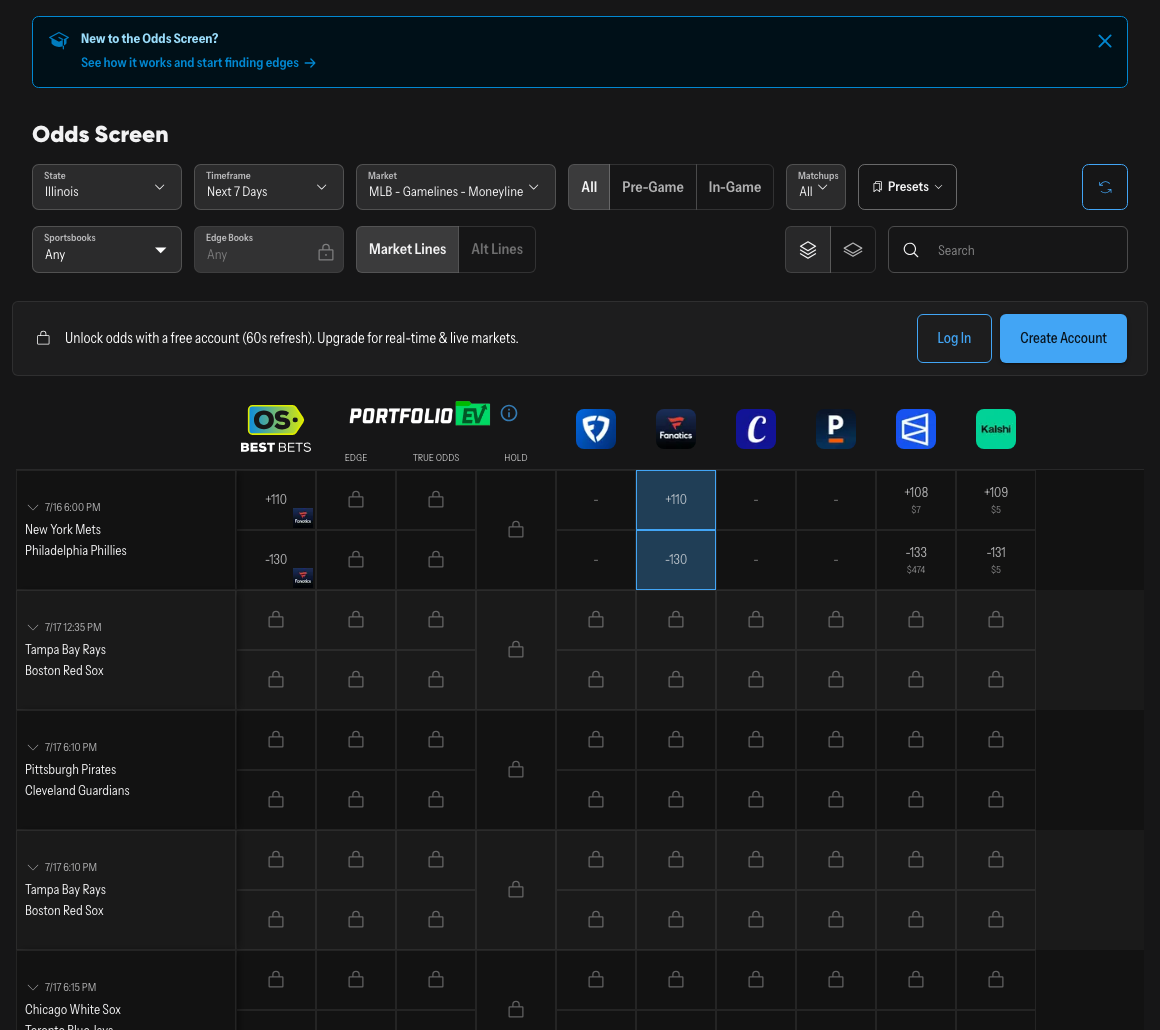
The OddsShopper Odds Screen.
That federal-versus-state split is the reason a Polymarket answer never looks like a sportsbook answer, and it runs through everything below.
What "CFTC-Regulated" Actually Means For Polymarket
This is the phrase every explanation leans on, so it is worth unpacking rather than nodding past. The Commodity Futures Trading Commission is the federal agency that oversees commodity and futures trading, and it treats an event contract as a financial instrument rather than a sports wager. Polymarket reaches U.S. users through an entity that holds Designated Contract Market (DCM) status, the same regulatory tier that governs conventional futures exchanges. In plain terms, a DCM is held to federal rules on segregated customer funds, market-manipulation safeguards, and ongoing CFTC oversight.
That legal label is doing heavy lifting. It is why Polymarket is not "sports betting" as a legal category even when the question on the screen is about a game, and it is why its availability map does not follow the state-by-state sportsbook map at all. A sportsbook lives or dies by a state gaming commission's license. Polymarket answers to a federal regulator, so its baseline is national, and the state restrictions you will read about next are exceptions carved out by ongoing legal challenges rather than a licensing regime. If you want the deeper mechanics of how the contracts themselves work, our what is Polymarket explainer walks through the price-as-probability idea from the ground up.
Polymarket's Road Back To The US
The reason Polymarket's U.S. status feels newer and shakier than Kalshi's is that it is. Polymarket spent years as a crypto-native platform that was off-limits to American traders. Its return ran through a 2025 acquisition of a CFTC-regulated exchange (QCEX) and a subsequent CFTC Amended Order of Designation in November 2025, which is the paperwork that let a compliant U.S. product come online. The app went live to Americans in December 2025 and removed its sign-up waitlist in May 2026. It rolled out on iOS first, and platform coverage has been expanding since, so check the App Store or Google Play for current support rather than assuming it is on your device.
That timeline is the payoff on the promise from the intro: the whole U.S. product is roughly half a year old, which is exactly why the ground under it is still shifting. A legal category this new gets its availability list redrawn every few months, and that is the single most useful thing to internalize before you go looking for a state answer.
The takeawayPolymarket's U.S. product is only about half a year old, so its state map is still being actively redrawn. That is the whole case for checking the app instead of memorizing a list.
Which States Is Polymarket Blocked In? (As Of July 2026)
Here is where the check-the-app discipline earns its place. As of its July 2026 relaunch coverage, Polymarket reported availability in 40-plus states. The states most consistently reported as walled off are Arizona, Illinois, Massachusetts, Maryland, Michigan, Montana, Nevada, and Ohio, and a handful of others — Tennessee among them — have issued cease-and-desist actions that are being contested in court. That set is a snapshot, not a permanent fact, and it can change on the timeline of a court order rather than a calendar year.
Two things are worth saying plainly. First, these restrictions track each platform separately, and Polymarket's reported set does not match Kalshi's, so you cannot assume that because one prediction market is walled off in your state the other is too; our Kalshi vs. Polymarket comparison lays the two side by side. Second, a state's absence from the list is a prompt to confirm your own eligibility, not a personal green light. Because these statuses move with live litigation and can differ from promo eligibility, the honest instruction is not to memorize a list of states, it is to open the app and let it tell you, the same way you would confirm any product is offered where you live.
Check your state on the source, not a screenshot.Availability is volatile and platform-specific. Before you fund an account, confirm Polymarket operates where you live on its own in-app eligibility check, and treat every list, including this one, as a July 2026 snapshot.
For the full both-platforms picture, including where Kalshi's map diverges from Polymarket's, our are prediction markets legal state-by-state guide covers both together, and our best prediction market platforms rundown widens the field past the two of them, because the category is fragmenting well beyond a duopoly.
The Federal-vs-State Fight, In One Paragraph
The reason the blocked-state list keeps moving is a real jurisdictional tug-of-war, and you do not need to be a lawyer to track the shape of it. States argue that sports event contracts are unlicensed gambling and should answer to state law; the CFTC argues that its federal designation preempts them. That standoff has gotten concrete in 2026, with the federal side asserting preemption over state restrictions and individual states pushing back through cease-and-desist orders and court challenges — a fight that has reached the platforms directly and is escalating rather than settling. Courts have reached conflicting conclusions on whether federal approval trumps state gambling law, and legal commentators expect a higher court will ultimately have to settle it. The federal baseline holds through all of it, but the churn is why your state's status is the part that can flip.
The federal answer has stayed put; the state answer is the one being litigated, which is exactly why a live app check beats any static list you will find, including the ones on this site.
If you want this legality map drawn for the whole category rather than one platform, our overview of whether prediction markets are legal in the US covers Kalshi, Polymarket, and the sportsbook prediction products side by side.
Minnesota: A Felony Line, Not A Blocked Market
Everything above is about access. Minnesota is about criminal law, and it deserves its own flat warning. Minnesota passed SF4760, signed May 18, 2026 and effective August 1, 2026, which makes operating, facilitating, servicing, or advertising these markets a felony in the state. That statute is aimed at the businesses behind the markets, but it puts Minnesota participants in real legal uncertainty, and it is being challenged by the CFTC, which does not make it safe to ignore while the challenge plays out. Minnesota residents should not assume access is safe.
Minnesota residents: do not trade.Treat August 1, 2026 as a hard stop and confirm current state law before doing anything at all. No bonus, contract, or edge is worth felony exposure.
What Being Legal Does Not Protect You From
Legal is not the same as free of risk, and the honest version of this guide has to say so before it points you at any tool. Being allowed to trade in your state says nothing about what a trade costs or how it can go wrong.
- Fees And Spreads. A prediction market's real cost is a mix of trading fees and the bid-ask spread, the gap between what buyers will pay and what sellers will accept. It is a real cost even when a contract looks like a clean cents price.
- Liquidity. Thin markets carry wider spreads, and in a low-volume contract your order may fill at a worse price than you wanted, or not fill at all. That risk is separate from any legal question.
- Losing Money. No outcome here is certain, prices move, and you can lose what you put in, so only ever risk what you can afford to lose. These products are for legal-age adults only, so confirm the minimum age where you live before you trade.
Trade responsibly.Put up only money you can afford to lose, and never chase a loss with a bigger position. If it stops being fun, step away. Most platforms offer deposit limits and self-exclusion tools, and the National Problem Gambling Helpline (1-800-522-4700) is there if you need it.
Not one of those costs shows up in a "legal or not" answer, yet every one of them shows up in your results — which is where the price you actually trade at starts to matter.
A Worked Example: Pricing A Polymarket Contract Against The Book
Once you can legally use Polymarket where you live, the most valuable thing it hands you is a clean, real-money probability, and the sharpest way to use it is to hold that number up against what the sportsbooks are quoting for the same event. Numbers make it concrete. The figures below are illustrative, not a live quote, but the math is real and it is the same translation you would run for any market.
Say a Polymarket contract on a team to win its next game trades at 45 cents. That reads straight off as a 45% implied probability. Now look at the same team on a sportsbook: one book has it at +120, and the opponent at -145. To turn a moneyline into a probability, a positive price like +120 is 100 ÷ (120 + 100), and a negative price like -145 is 145 ÷ (145 + 100):
| Source | Price | Raw implied probability |
|---|---|---|
| Polymarket Contract | 45¢ | 45.0% |
| Sportsbook, Team To Win | +120 | 45.5% |
| Sportsbook, Opponent | -145 | 59.2% |
Add the sportsbook's two sides and you get 45.5% + 59.2% = 104.7%. That sum sitting above a clean 100% is the vig, the book's built-in margin. Strip it out and the team's fair, no-vig probability is about 43.5% (45.5 ÷ 104.7) — the book's honest estimate of the real chance once its margin is removed. That fair number does one job: it tells you where the market thinks the truth sits, so you can spot when a price looks off. Deciding who pays you more for backing the team is a separate step, and there you compare the raw prices head to head: Polymarket's 45-cent contract breaks even at 45%, while the sportsbook's +120 breaks even at 45.5%. The lower breakeven is the better deal for the backer, so here Polymarket's price edges it — you risk a hair less for the same payout. Before you act on any gap, weigh Polymarket's own fees and spread against it and confirm the contract settles on exactly the outcome the sportsbook is pricing. Doing that by hand across every book for every game is exactly the chore the next section hands off.
How OddsShopper Fits Alongside Polymarket
You do not need a prediction-market account to get value out of what one shows you, and if a prediction market is restricted in your state, this is where you are not stuck on the sidelines. OddsShopper does not run a sportsbook or a prediction market; it sits on top of the whole market and does the de-vig math for you.
Start with the live odds screen — shop the number across every major book and see the fair, no-vig probability behind each line. Set that fair number next to a Polymarket contract price for the same outcome and you can tell at a glance which side offers the better read, the exact translation the worked example just walked through. In practice the workflow is tight: pick one event both venues price, confirm they settle on the same result, hold Polymarket's price after fees against OddsShopper's no-vig number, and act only when the gap clears a threshold you set in advance — skipping the thin markets where a wide spread eats the edge before you do. If you would rather have the work done for you, our free expert picks today show what our cappers are actually playing across the board, and for the difference between an event contract and a sportsbook wager in the first place, our prediction markets vs. sports betting guide breaks it down.
See both numbers side by side.OddsShopper scans every major U.S. sportsbook and strips the vig out of every line, so you can compare a book's true probability against a prediction market's price in seconds instead of doing it by hand. Try OddsShopper Pro free for 7 days, and code POLYUS20 takes 20% off your first payment of OS Pro or OS Core if you subscribe.
The Bottom Line
Is Polymarket legal in the US? Federally, yes: it runs a CFTC-regulated U.S. app, and most of the country can trade on it as of July 2026. But the answer you actually need lives in your state, where a specific handful block it, Minnesota criminalizes it on August 1, 2026, and the whole map is being redrawn by a live federal-versus-state fight. So do not memorize a list that may be stale by the time you read it; confirm your state on Polymarket's own eligibility check, treat everything here as a July 2026 snapshot, and whichever venue you end up in, price every outcome against its true no-vig number before you commit.
More on this: Polymarket Review 2026: Fees, Legality & How It Works · Polymarket's 5-Minute Crypto Markets: What 'Time-Weighted' Actually Means · Are Prediction Markets Legal? A State-by-State Guide · Is It Legal To Bet On Elections In Michigan? The 2026 Rules · Is Kalshi Legal In All States? Two Courts, Two Answers (2026)