The Quick Answer
Frances Tiafoe beat Alex Michelsen 5-7, 3-6, 7-5, 6-3, 7-6(10-6) in Tuesday's all-American US Open men's quarterfinal, from two sets down and from 0-3 down in the fifth, in 4 hours and 38 minutes at Arthur Ashe Stadium. Kalshi's match market, which had Tiafoe at 57¢ bid / 58¢ ask on Monday morning, settled his contract at $1.00 and Michelsen's at zero at 7:11 p.m. ET on Sept. 8. The 3 a.m. buyer who took about 33,000 Michelsen contracts at 40¢ and 41¢ saw that contract print 98¢ at 4:51 p.m. Tuesday, in the window in which Michelsen served for the match, and anyone still holding it at 7:11 p.m. collected nothing. How every set-spread and games contract graded, and what happened to Tiafoe in Friday's semifinal against Ben Shelton, is below.
Stay ahead of the markets.
Daily insights and expert picks on Kalshi, Polymarket, and what's moving markets.
Free forever. Unsubscribe anytime.
The Match: Two Sets Down, 0-3 In The Fifth, A 135 Mph Ace
On Monday morning this page asked one question about a 57-43 market: whether the buyer who swept 33,000 Michelsen contracts at 3:25 a.m. knew something, or was simply a market maker doing its job. Tuesday answered it in two halves. For the first two hours and 19 minutes the buyer looked like the smartest account on the exchange, and over the last two hours and 19 minutes the position went to zero. What those contracts were worth at the peak, to the cent, is the number I will get to; the tennis comes first because the tennis is what set the price.
Michelsen, 22 and unseeded, took the first two sets 7-5 and 6-3 and served for the match at 5-4 in the third. ESPN's match report has him hitting two consecutive double faults in that game; Tiafoe broke, took the set 7-5 and the fourth 6-3, then went down 0-3 in the fifth. He recovered again, led the 10-point match tiebreak 7-4, gave two points back, and closed it 10-6 on a forehand winner up the line, with a 135 mph ace along the way that ESPN singled out. CBS counts Tiafoe as 2-17 at Grand Slams when trailing two sets to none before Tuesday, and 0-4 in that spot at the US Open, with a first-serve percentage under 40 percent through the first three sets. ESPN calls it the first two-set comeback in a US Open men's quarterfinal since Roger Federer against Gael Monfils in 2014, and it puts Tiafoe in his third semifinal here, after 2022 and 2024. Michelsen, who came into the round as the only man left without dropping a set, fell to 0-6 in five-set matches by ESPN's count, 0-3 by CBS's, and has still never won one.
"It wasn't good, let's put it that way. It wasn't good," Tiafoe told ESPN afterward. "Three out of five is a blessing, because you have time to get it together." Michelsen's version: "I feel the first three sets I was on top of him. Then I kind of let him back in at 5-4. After that, he was playing like Frances does on Ashe."
Fifty-five games, five sets, and a one-game margin, 28 games to 27. Hold on to that margin; it is what graded every spread contract on this match.
How The Match Contract Settled
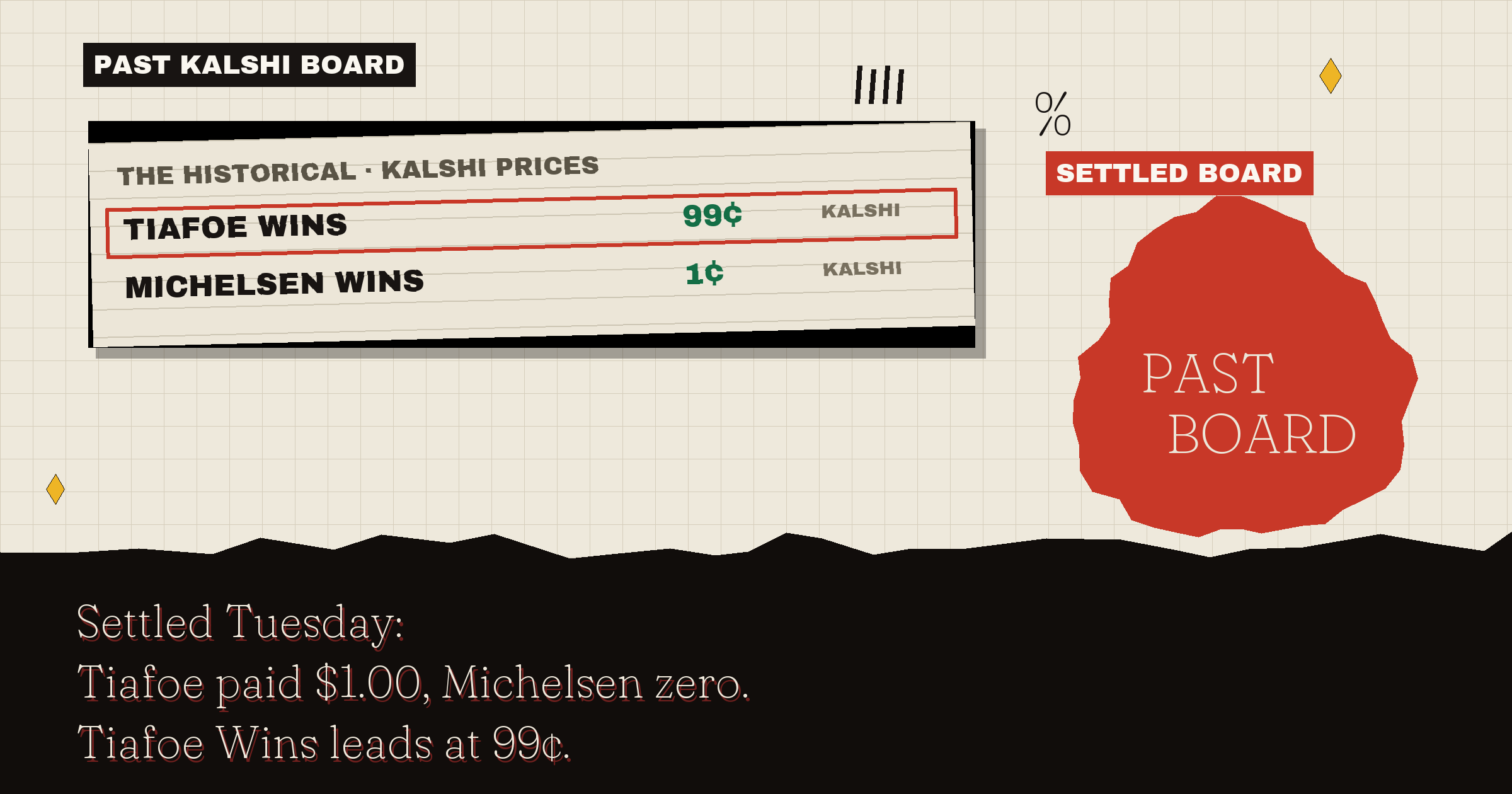
Kalshi lists each player as his own yes/no contract under the event ticker KXATPMATCH-26SEP08TIAMIC, and the Tiafoe contract's primary rule reads, in full: "If Frances Tiafoe wins the Tiafoe vs Michelsen professional tennis match in the 2026 US Open Men Singles Quarterfinal after a ball has been played, then the market resolves to Yes." A ball was played, Tiafoe won, and the exchange closed both contracts at 7:10:20 p.m. ET and finalized them at 7:11:25 p.m., per Kalshi's public market data, 65 seconds after closing them. The walkover and delay clauses Monday's edition walked through never came into it. The final print:
| Contract | Final print | Result | Monday bid / ask (7:56 a.m. ET, Sept. 7) | Contracts traded (lifetime) | Open interest at settlement |
|---|---|---|---|---|---|
| Tiafoe Wins | 99¢ | Yes, paid $1.00 | 57¢ / 58¢ | 22,843,735 | 7,653,020 |
| Michelsen Wins | 1¢ | No, paid $0 | 42¢ / 43¢ | 12,990,395 | 3,747,945 |
The row to read is the volume column, because it says what Monday's board was. When the original edition went up, the two contracts had traded about 76,400 contracts between them. By settlement they had traded about 35.8 million. Everything this page described on Monday, the 79,557-contract offer at 58¢, the 51,494-contract bid at 42¢, the 3 a.m. sweep that was half the market, was two-tenths of one percent of what the market became once the ball was in play. The original edition argued that the market maker's book was deep enough that a 33,000-contract sweep moved the price a cent. On Tuesday afternoon the sweeps were four to five times that size on the Michelsen side and nearly twice it on Tiafoe's: 149,827 Michelsen contracts bought at 42¢ in one print at 2:23 p.m. ET, eight minutes before the first in-play move, and 63,184 Tiafoe contracts bought at 59¢ at 1:17 p.m. Between the end of the 3 a.m. sweep and the first ball, takers bought about 1.25 million Michelsen contracts and sold about 79,000; on the Tiafoe side it was 1.49 million bought and 96,000 sold. Both crowds were buying, and the price never left 40¢ to 43¢ on Michelsen or 57¢ to 61¢ on Tiafoe until about 2:27 p.m., when the pre-serve drift started: Michelsen printed as low as 34¢ and Tiafoe as high as 66¢ in the two minutes before the first in-play move.
What The 3 A.M. Buyer Actually Collected
The position was about 32,900 Michelsen contracts at a volume-weighted 40.6¢, or roughly $13,340 laid out, 13,405 contracts at 40¢ at 3:24:17 a.m. Monday and 19,449 at 41¢ at 3:25:36. Kalshi's tape cannot say what one account did with it, and this page will not guess; what it can do is price the two ways it could have ended.
If the buyer sold before the match, the exit was worth about a cent and a half. Michelsen's contract never bid above 43¢ before the first ball, and every taker sale of size in the 35 hours after the sweep went through at 41¢ or 42¢; the largest single one was 14,438 contracts at 42¢ at 2:09 p.m. Tuesday, and the total sold by takers in that window, about 79,000 contracts, is spread across hundreds of fills rather than a block that looks like Monday's. A buyer who hit the 42¢ bid with the whole position would have cleared about $460 before Kalshi's taker fee on both legs, which at 0.07 times price times one minus price is roughly 1.7¢ a contract on each leg, or about $1,100 in and out on 32,900 contracts. Sold at 42, the trade lost money after fees.
If the buyer held, here is what the price history shows, in ET, from the hourly candles on the Michelsen contract:
| Window (ET, Sept. 8) | Michelsen low / high | Michelsen close | Tiafoe low / high | Contracts traded, both sides |
|---|---|---|---|---|
| 2 P.m. To 3 P.m. (In Play From About 2:31) | 28¢ / 60¢ | 44¢ | 41¢ / 72¢ | 2,990,871 |
| 3 P.m. To 4 P.m. | 40¢ / 87¢ | 86¢ | 13¢ / 61¢ | 4,174,615 |
| 4 P.m. To 5 P.m. | 77¢ / 98¢ | 79¢ | 2¢ / 24¢ | 6,629,696 |
| 5 P.m. To 6 P.m. | 38¢ / 79¢ | 41¢ | 21¢ / 62¢ | 6,959,704 |
| 6 P.m. To 7:11 P.m. (Settled) | 1¢ / 86¢ | 1¢ | 11¢ / 99¢ | 13,249,097 |
The 4 p.m. row is the one that matters. The Michelsen contract printed 98¢ at 4:51 p.m., two hours and 19 minutes into the match, and traded between 93¢ and 97¢ for most of the half hour before it. ESPN and CBS put Michelsen's two double faults at 5-4 in the third, serving for the match with a two-set lead; the price history puts the peak at 4:51 p.m., and the two line up. At 98¢ the 3 a.m. position was marked at about $32,200 against $13,340 paid, and a holder who sold into the 93¢ to 97¢ prints that half hour would have banked most of it. The Tiafoe contract traded at 2¢ in the same window, which is the callback to Monday's opening tape: the first six prints on the Tiafoe contract, 26 contracts at 75¢ to 79¢ on Sunday evening, had looked wild at the time, and on Tuesday the same contract touched 2¢ and settled at 99¢.
Then Michelsen double-faulted twice. His contract was 78¢ by 4:59 p.m., 66¢ by 5:07, 48¢ at 5:24, and it closed the hour at 41¢, back to where the 3 a.m. buyer had bought it. Tiafoe's contract printed 61¢ at 5:56 p.m. on a 460,201-contract minute, as he closed out the fourth set, and was 16¢ 20 minutes later; the 86¢ print on Michelsen at 6:18 p.m. is the price history's version of the 3-0 lead in the fifth that ESPN and CBS describe. Three anchors carry the rest. At 6:48 p.m. Michelsen was 27¢, which is Tiafoe back on serve and in front. By 7:01 p.m. he was 49¢, a match tiebreak the price could not call. Then 1¢ at 7:07 p.m., as the match ended on a forehand winner up the line, and there he stayed for the three minutes until the exchange closed the market. A position that was worth $32,200 at 4:51 p.m. was worth about $330 at the 1¢ print at 7:07, and zero four minutes later at settlement. Whether the buyer was holding it or had sold it a week's worth of price moves earlier, the price history does not say; both endings are above, and neither is the one the 3 a.m. sweep was priced for.
What the position was worth, by the hourabout $13,340 at 3:25 a.m. Monday; about $13,800 at the 42¢ bid all day Tuesday; about $32,200 at the 98¢ print at 4:51 p.m.; about $13,500 at the 41¢ close of the 5 p.m. hour; about $28,300 at 86¢ with Michelsen up 3-0 in the fifth; zero at 7:11 p.m. All marks are the 32,900-contract position at the printed price, before fees.
The Siblings, Graded: 55 Games And A One-Game Margin
Monday's board had eight contracts across the set-spread, total-games and game-spread markets, 569 contracts traded between them, and I wrote that anyone who traded them was the market. By settlement those eight contracts had traded about 1.05 million, and the 55-game, 28-27 scoreline graded every one of them. In Monday's terms:
| Contract | Monday bid / ask | Result | What settled it | Contracts traded (lifetime) |
|---|---|---|---|---|
| Tiafoe Wins By Over 1.5 Sets (3-0 Or 3-1) | 41¢ / 43¢ | No | Tiafoe won 3-2 | 115,798 |
| Michelsen Wins By Over 1.5 Sets | 26¢ / 31¢ | No | Michelsen lost | 31,448 |
| Over 34.5 Total Games | 64¢ / 68¢ | Yes | 42 games through four sets; settled 6:09 p.m. | 123,522 |
| Over 39.5 Total Games | 50¢ / 51¢ | Yes | 42 games through four sets; settled 6:09 p.m. | 322,029 |
| Over 44.5 Total Games | 19¢ / 54¢ | Yes | 55 games; settled at the final | 66,712 |
| Tiafoe -2.5 Games | 48¢ / 49¢ | No | Tiafoe won by one game, 28-27 | 290,745 |
| Tiafoe -5.5 Games | 29¢ / 31¢ | No | Margin of one | 32,371 |
| Michelsen -1.5 Games | 35¢ / 38¢ | No | Michelsen lost the game count 27-28 | 68,097 |
Monday quotes are the 7:57 a.m. ET, Sept. 7 snapshot from the original edition; results, settlement times and lifetime volume are from Kalshi's public market data pulled at 10:58 p.m. ET on Sept. 11. Nine contracts Monday's snapshot did not quote also graded: over 51.5 games (Yes, 8,917 traded), over 3.5 sets (Yes, 64,608), over 4.5 sets (Yes, 26,037), and the six exact-score legs, where Tiafoe 3-2 paid (91,866) and the other five went to zero, among them 265,004 traded on Michelsen 3-1 and 281,713 on Michelsen 3-0.
The row to sit with is over 39.5 games, because it was Monday's coin flip at 50¢ / 51¢, it became the busiest side contract on the match at 322,029 traded, and it did not need the fifth set. Four sets of 12, 9, 12 and 9 games is 42, so once the fourth set was over both totals were decided no matter what the fifth held, and Kalshi closed the 34.5 and 39.5 contracts at 6:09 p.m. ET, an hour before the match ended. That is a market settling on play already completed, not the retirement clause Monday's edition quoted; nobody retired. The over-44.5 contract, quoted 19¢ bid against a 54¢ ask on Monday with nobody willing to make a book, needed the fifth set and got 13 games of it.
The spreads are the other half of the lesson. Three game-spread rungs, 391,213 contracts traded across them, and none paid: Tiafoe -2.5 was the crowd's near-coin-flip on Monday, needed a three-game margin and got one, and Michelsen -1.5 needed him to win the game count by two, and he lost it 27-28. The original edition ran a simple model that treated each set as a coin weighted 54 percent to Tiafoe and priced a five-setter at 37 percent against the market's 29.5; both set-spread contracts at 41¢ / 43¢ and 26¢ / 31¢ said the crowd expected something more decisive. The market got the winner right at 57 and the shape wrong, and the shape was where the side markets paid.
The Semifinal Qualifier, And What Happened Friday
Tiafoe's semifinal is over too. On Friday night Shelton beat him 4-6, 6-3, 6-3, 7-5 to reach his first Grand Slam final, and the pricing of that match is its own page. Kalshi listed Shelton vs Tiafoe at 3:55 a.m. Wednesday, 22 minutes after Ben Shelton's 3:33 a.m. match point against Carlos Alcaraz, and priced Shelton at 72¢ / 73¢ by Wednesday afternoon, with a 33,333-contract fill of Tiafoe at 28¢ that was within 500 contracts of the size that bought Michelsen on Monday. That page has the price history. By 11 p.m. ET Friday the Kalshi semifinal market was closed and awaiting settlement at 99¢ bid on Shelton and a 1¢ ask on Tiafoe, with about 19.3 million contracts traded across the two legs. Alexander Zverev beat Karen Khachanov 6-3, 7-6(7), 7-6(6) in the other semifinal, so Sunday's final is Shelton against Zverev, and the 23-year question this page opened with, no American man since Andy Roddick here in 2003, is now a two-man question with one American in it.
One loose end from Monday's edition: the four-cent gap between the match market and Kalshi's semifinal-qualifier board, KXATPADVANCE-26USOSEMI, which had Tiafoe at 61¢ / 62¢. His qualifier contract finalized Yes at 7:25 p.m. ET Tuesday, 14 minutes after the match market, on 21,052 contracts traded lifetime. The Michelsen leg is the odd one: it finalized No with a last trade of 73¢, on 1,542 contracts in the market's entire life. That print landed at 5:03 p.m. Tuesday, a taker selling 43 contracts into the bid 12 minutes after the match ticker's 98¢ peak, and it was the last trade the leg ever saw; 117 contracts changed hands on it during the whole match. Nobody repriced it as the match turned, so a contract that graded to zero carried a 73¢ last trade to settlement. On a board nobody trades, the price is whatever the last person to bother with it paid.
A Worked Example, Graded: What 58¢ And 43¢ Paid
Monday's worked example priced both sides of this match at the ask; here is how each one settled. One hundred Tiafoe contracts bought at 58¢ cost $58 plus a taker fee of 0.07 x 0.58 x 0.42 a contract, rounded up, about $1.71 on the order, per the fee schedule we broke down. They paid $100 at 7:11 p.m. Tuesday: $40.29 net on $59.71 at risk, which is a 67 percent return on a contract the price called a 58 percent favorite. In payout terms, $100 became about $170 after the fee, exactly what Monday's edition said it would if he won.
One hundred Michelsen contracts at 43¢ cost $43 plus about $1.72 in fees and paid nothing, a loss of $44.72. The same 100 contracts printed 98¢ at 4:51 p.m., worth $98 to a holder who sold there; the 3 a.m. buyer's 40¢ and 41¢ entry was two cents better than yours and ended in the same place. Re-run the arithmetic on Sunday's final at whatever the screen shows when you read this; the numbers move, and this page will not.
One legal note before anyone opens an account for the final, because the $1. New York's attorney general sued Kalshi on July 31 claiming it is an illegal gambling operation, and that fight is pending. We track where prediction markets stand legally; check your state before you trade.
As the books post their Shelton-Zverev lines for Sunday, the live odds screen is where to shop the moneyline across every major book against what Kalshi is showing. If pricing a two-man exchange market isn't your edge, OddsShopper's free expert picks cover the day's slate the conventional way. Our comparison of US Open odds across Kalshi, Polymarket and the sportsbooks maps the title board this match fed into, and the withdrawal board covers the Jannik Sinner withdrawal that reshaped the title odds before the first round.
What The 57-43 Price Got Right, And Where It Was Wrong
The market was right about the winner and honest about how close it was: a 57¢ favorite is supposed to lose 43 times in 100, and for two hours and 20 minutes on Tuesday this was one of the 43. Where it was wrong was the shape. Every contract that paid on this match was a contract that said it would go long, over 34.5, 39.5, 44.5 and 51.5 games, over 3.5 and 4.5 sets, Tiafoe 3-2, and every contract that said it would be decisive, both set spreads and all three game spreads, went to zero on a one-game margin. The 3 a.m. buyer bought the one contract the shape could not save, and had two hours to notice.
That is the answer to Monday's question. The overnight money did not know anything; it had a view on the underdog at 40 that was worth 98 for half an hour and nothing at the end, which is what an underdog view usually looks like when it is played to settlement. The 79,557-contract wall at 58¢ was not a market maker's opinion about Tiafoe either. It was a book, and by Tuesday afternoon the book was a hundred times deeper and the same question had moved to a semifinal that Shelton has now won. On Sunday it moves to a final, and the drought this page has measured everything against since Monday morning is one match from ending or extending. At 11:22 p.m. ET Friday, Kalshi's title board had Zverev at 58¢ bid / 59¢ ask and Shelton at 41¢ / 42¢, so the American goes in as the underdog, and by less than the 5-0 head-to-head would suggest.
More on this: Shelton Vs Tiafoe Odds: 33,000 Contracts On The Underdog, Again · Barcelona Vs Feyenoord Odds: Does The Favorite Survive The Fee? · Where Does Bitcoin End 2026? Kalshi's Price-Band Odds · The Longest Shot On This Board Might Be The Best-Kept Secret · 2026 Governor Races: Every Kalshi Board We Track