A sportsbook spent years training you to be a customer. It gave you a number, baked its cut into that number, and hoped you'd take it and move on. A prediction market needs the opposite from you. It needs you to act like a trader: to read a price, decide it's wrong, and take the other side of whoever set it. Nobody has done the work of translating between those two jobs, and that gap is what trips up sharp bettors the first time they open Kalshi and see a market sitting at 62 cents instead of a familiar -160.
Here's the good news. You already own most of the instincts this takes. You shop for the best line. You hunt a longshot that isn't dead money. You know a stale number when you see one. This guide ports each of those habits, one at a time, into how prediction markets actually work, so that by the end you can glance at any event contract and read it the way you read a sportsbook line today.
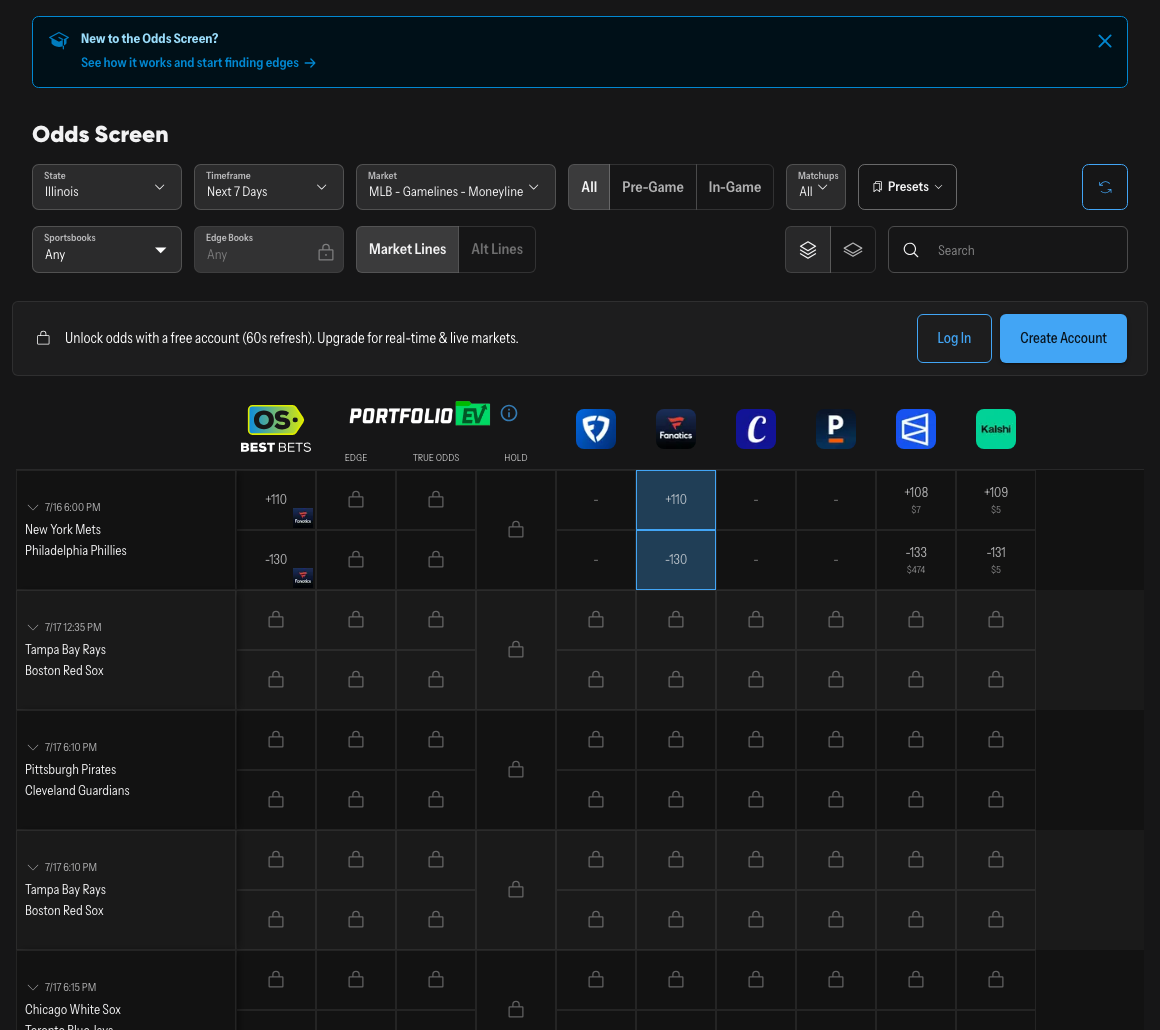 The OddsShopper live odds screen — every book's price on one board, refreshed in real time. Open the live board.
The Quick Answer
To use a prediction market, you buy or sell "yes/no" contracts on an event, where the price in cents is the crowd's live probability. A contract at 62¢ pays $1 if the event happens and $0 if it doesn't, so 62¢ means the market thinks it's about 62% likely. Your edge comes from the same four moves you already make at a sportsbook: read the price as a probability, shop it across venues, size the position to your bankroll, and decide in advance when you'll cash out. The full step-by-step is below, including how to spot a rigged-looking settlement rule, when these markets are actually sharp, and where they're legal as of September 29, 2026.
Betting a Kalshi combo on this game?run the combo through 10,000 sims before you buy it: 10,000 simulated games price every combo next to the price on Kalshi.
Prediction Markets Aren't Sportsbooks: One Mental Switch
Start with the piece of jargon that unlocks everything else: the event contract. It's a legally binding agreement that pays $1 if a specific, verifiable event happens and $0 if it doesn't. That's it. Because the payout is fixed at a dollar, the price (quoted in cents from 1 to 99) behaves like a probability. A contract at 62¢ is the market saying "about 62% likely." One at 8¢ is "long shot, roughly 8%." You are no longer reading odds. You're reading the crowd's estimate directly, which is a cleaner signal than a moneyline that's been shaded by the book's margin.
The second switch is who's on the other side. At a sportsbook, the house is your counterparty, and it prices in a margin (the vig) so the two sides of a market add up to more than 100%. On an exchange there is no house. An order book matches your buy against another trader's sell, the way a stock exchange does. The platform makes its money on trading fees, not by being the bookmaker who wants you to lose. That structural difference is the whole reason a mispriced contract can just sit there: nobody on a risk desk is watching to move it against you the second you show up. If that comparison is new, our breakdown of how a prediction market exchange differs from a sportsbook walks the mechanics in full, and how prediction markets work covers pricing and settlement end to end.
The one-line translationa sportsbook sells you a number with its cut baked in; an exchange lets you trade a number against other people. Your job stops being "take the price" and starts being "price it yourself."
One last thing to file away before we start trading: these are CFTC-regulated event contracts, not state-licensed sports betting as a legal category, and that distinction is exactly what 19 states are contesting with Kalshi right now. It matters for where you can use them and how old you have to be, and we'll get to both. It also means the words are different. You don't "place a bet." You buy a contract, at a price, that settles to a dollar or to zero.
Step 1: Read The Price Like An Implied Probability
Your first real move is the one you already make without thinking: convert a number into a probability. At a sportsbook you strip the vig off a -160 favorite to find its true no-vig price of roughly 60%. On a prediction market that step is done for you, because 60¢ is the probability, near enough, before fees. Your job flips from "de-vig this line" to "is this probability right?"
That's a more honest question, and it's where a bettor's edge lives. If you've built a read that a team wins its division about 70% of the time and the contract is trading at 58¢, the market is offering you a number you think is 12 points too cheap. The same disagreement at a sportsbook would be buried inside a plus-money price you'd have to decode first. Here it's naked. The discipline that finds it is identical to the one you'd run on the live odds screen, where you shop the number across every major book to see what the fair, no-vig probability really is, then carry that same number over and hold it up against the contract's price.
Step 2: Shop The Number, Your Line-Shopping Instinct Ported
If you take one habit with you from the sportsbook world, make it this one. The single biggest leak among new prediction-market traders is paying the spread without noticing it, and the fix is the exact move OddsShopper was built around: shop the price.
The same event can trade at slightly different prices on Kalshi and Polymarket, and inside a single market there's a round-trip cost hiding in plain sight. Because "yes" and "no" are two halves of the same dollar, a perfectly tight market would have the buy price of Yes and the buy price of No sum to exactly 100¢. Anything they sum to above 100¢ is the spread you pay, the exchange's version of the vig.
| The Market | Buy "Yes" at | Buy "No" at | They sum to | The spread you pay |
|---|---|---|---|---|
| Tight, Liquid Contract (illustrative) | 61¢ | 40¢ | 101¢ | 1¢ |
| Thin, Quiet Contract (illustrative) | 64¢ | 42¢ | 106¢ | 6¢ |
| Steelers Beat Browns, Thursday Oct. 1 (live Kalshi book, Sept. 29) | 58¢ | 43¢ | 101¢ | 1¢ |
| Steelers Beat Colts, Sunday Oct. 11 (live Kalshi book, Sept. 29) | 57¢ | 46¢ | 103¢ | 3¢ |
The first two rows are illustrative; the last two are Kalshi's real books on the Pittsburgh Steelers, pulled Tuesday, September 29 between 10:18 and 10:20 p.m. ET, and the lesson is the same in both pairs. Look at the illustrative thin row: Yes at 64¢ and No at 42¢ sum to 106¢, so a round trip costs you 6¢, and on a market you've priced at 70¢ that eats most of your six-point edge before the event even starts. The tight row's single penny leaves your edge intact. Now read the live pair, which puts one team's name on both lines: the Steelers' Thursday night market is a penny wide with hundreds of thousands of contracts resting at the touch, while the Steelers' Week 5 market, ten days out, is three cents wide on about a thousand contracts in its whole life. Same team, same product, ten days apart, and the round trip costs three times as much on the game nobody has priced yet. This is why "which venue, at what spread" is a bigger decision on an exchange than most people expect. Exchange fees tend to run smaller than a sportsbook's vig (full comparison here), but you only keep that edge if you refuse to cross a wide spread to get filled.
What Moved Since September 23
The last two commits to this page landed on September 23, 2026, and neither touched the substance: one added a link, the other swapped a callout image. Its price examples were illustrative and its legal snapshot was dated August. Three things changed on this pass.
- The spread table got two live rows. Pulled Tuesday, September 29 between 10:18 and 10:20 p.m. ET, Kalshi's market on the Steelers to beat the Browns in Thursday night's Week 4 game showed Yes offered at 58 cents and No at 43, a one-cent spread, with about 480,000 contracts bid at 57 and just over a million offered at 58. The two sides had traded roughly 277,000 contracts in the prior 24 hours. The same team's Week 5 market, Steelers over the Colts on October 11, was three cents wide, Yes at 57 and No at 46, and it had traded about 1,000 contracts in its entire life, roughly 900 on the Steelers side and 125 on the Colts side, all inside the last day. The wide book is the early one. The depth and the sharp price arrive together, and the spread you pay is the toll for showing up first. Those two books, ten days apart, are the sharp-versus-dull map in miniature, the real version of the hypothetical in "Where Prediction Markets Are Actually Sharp" below.
- Kalshi and 28 sportsbooks agree on Thursday. OddsShopper's de-vigged read on the Steelers was 57.5%. Kalshi's 58-cent offer sits half a point above that before its fee; the live odds screen folds the fee into the price it lists, and on that basis it shows Kalshi at -148, matching DraftKings, while the best sportsbook number for the Steelers was FanDuel at -142. Flip to the Browns and the picture repeats: fair value 42.5%, Kalshi's 43-cent offer listed at +124 all in, again matching DraftKings, the best offshore price was BookMaker at +132, and the best widely posted U.S. number was Fanatics at +125. Every executable price on both sides sits above fair, so under Step 1 there is nothing to buy. One caveat the numbers force: smaller fees than vig is the general case, not a guarantee on any single market, and here Kalshi's all-in 59.7% on the Steelers was a point worse than FanDuel's 58.7%. That is what "sharp where the money shows up" looks like in practice: an exchange and 28 books all pricing the Steelers between 58% and just over 60% on a market that traded 277,000 contracts in a day.
- The map moved, and one August sentence was wrong. Since this page's August snapshot, two federal appeals courts have ruled that states may enforce their own gambling laws against Kalshi's sports contracts: the Ninth Circuit on August 28 in Nevada's case and the Sixth Circuit on September 25 in Ohio's and Tennessee's, against the Third Circuit's April ruling for Kalshi in New Jersey. New Jersey took that split to the Supreme Court on September 2, Michigan's sports boards, dark since a June restraining order, came under a September 1 preliminary injunction, Utah and Iowa won the right to enforce on September 8, Montana's suit was dismissed on September 21 with its regulators agreeing to hold off, and Missouri gave Kalshi 30 days from September 18 to stop offering sports contracts there. The August version of this page also told Minnesota readers to expect access to be cut off; a federal judge had already put that statute on hold on July 27, and it stays on hold, so that line is corrected below.
What did not move is the method. The four steps were written to survive exactly this kind of month, and Step 3 is where the thin row turns into a rule: the wider the book, the smaller the position.
Step 3: Size The Position To Your Bankroll
Sizing is where the trader mindset earns its keep, because an exchange won't stop you from doing something dumb the way a book's limits eventually would. Buying at 62¢ risks 62 cents to make 38; buying at 8¢ risks 8 to make 92. Same dollar of exposure, wildly different shapes. Treat each position as a fraction of a bankroll you've decided in advance you can afford to lose, lean smaller on the wide-spread markets from Step 2, and never borrow to trade. Liquidity is a real hazard here that a sportsbook hides from you: if a market is thin, the price you see is not the price you'll get for size, and it may not be the price you can exit at either. Size as if you might have to sit in the position, because sometimes you will.
Step 4: Know When To Cash Out
Here's a skill your sportsbook never taught you, because it never let you sell. Once you've placed a straight bet, you're locked in until it grades. On an exchange you can sell your contract back at any point before settlement, which means you now need an exit plan. That is the one piece of the trader's job with no sportsbook equivalent.
The cleanest version: decide your fair value up front, and when the market prices up to it, sell. Suppose you bought at 45¢ because you thought the outcome was worth 60¢, and news pushes it to 60¢ two days before the event resolves. You don't have to ride it to the dollar. You were right, and you can bank the move and recycle the capital. That isn't timidity. It's the same closing-line-value instinct sharp bettors already prize, except now you can actually act on it instead of just noting it. Building that exit rule before you enter is the difference between trading a market and getting married to it.
Set your sell before you buy.Write down the price you'll exit at the moment you enter. An exchange gives you an out a sportsbook never did; a plan is what turns that out into profit instead of second-guessing.
The Longshot Trap: Cheap-Because-Dead Vs Cheap-Because-Mispriced
Every bettor loves a longshot, and prediction markets are full of them: contracts trading at a nickel that pay twenty-to-one if they hit. The trap is that most cheap contracts are cheap for a reason. The event is close to impossible, and you're buying a lottery ticket with a negative expectation. The whole game with longshots is separating cheap-because-dead from cheap-because-mispriced, the 8¢ contract that should be 3¢ versus the 8¢ contract that should be 15¢.
That's a research job, not a vibe. It's the exact filter we run on our own longshot board, which exists to sort the mispriced few out of the dead many. Bring the same skepticism you'd bring to a +2000 parlay leg: a big number is only a bargain if the real probability is bigger than the price implies.
"Is It Rigged?" Read The Settlement Rules
The most common panic among new traders is some version of "what stops them from just deciding I lost?" The answer is the settlement rule, and reading it before you trade is non-negotiable. Every contract resolves to $1 or $0 against a pre-defined, named source: a specific data feed, an official result, a stated cutoff time. Ambiguity in that rule is the actual risk, not some shadowy thumb on the scale.
So the pre-trade habit is simple: find the resolution criteria and read them like a contract, because they are one. What's the exact source? What's the cutoff? What happens on a postponement or a tie? The fine print is where markets that look identical turn out to be very different, which is why we keep a running watch on the settlement fine print and a plain-English take on whether you can trust Kalshi. A market you can't explain the settlement of is a market you're not ready to trade.
Where Prediction Markets Are Actually Sharp (And Where They're Not)
Prediction markets are not magic oracles. They're sharp where lots of informed money shows up and dull where it doesn't. A market on a marquee election with millions of dollars flowing through it tends to be efficient, because any mispricing gets arbitraged away fast. But picture a lightly-traded contract on a mid-week match sitting at 30¢ when your read says it's closer to 45¢: with nobody informed pushing back, that 15-point gap can sit there right up to settlement. Knowing which of those two you're looking at is most of the skill, and we keep a standing map of where prediction markets are sharp versus where they lag.
This is also where I'll make our bias plain, because trust-lane content should. We don't take a cut of where you trade, and instead of telling you to trust our reads, we grade them in public. Our AI panel versus the market scoreboard shows where our model agreed with the crowd, where it faded, and how those calls actually settled. A record you can check beats a "trust me" every time, and it's the same reason we publish free expert picks with the reasoning attached rather than just the pick. Use them as a second opinion, not a crutch.
Is It Legal? 18+, State-by-State, And Always Changing
Because event contracts are federally regulated rather than run as sportsbooks, the legal map is its own thing, and it's volatile, so treat any snapshot as dated. As of September 29, 2026, Kalshi operates nationwide as a CFTC-regulated exchange, but its sports contracts are restricted or contested in 19 states, and the federal appeals courts have split. The Third Circuit's April ruling protects Kalshi in New Jersey, while the Ninth Circuit (Nevada, August 28) and the Sixth Circuit (Ohio and Tennessee, September 25) held that states may enforce their own gambling laws against the sports contracts; New Jersey has asked the Supreme Court to hear the case, and the Court has not yet said whether it will. Sports boards are dark, or the state is cleared to enforce, in Michigan, Nevada, Washington (where an August court order covers most categories, not just sports), Utah, Iowa, and Ohio, with Tennessee to follow once the appeals court's order takes effect. Maryland has paused enforcement while its appeal waits, Massachusetts' injunction is stayed while its high court decides, Montana's regulators have agreed not to enforce while Kalshi's request for a rehearing in the Ninth Circuit is pending, and Missouri gave Kalshi 30 days from September 18 to stop offering sports contracts there. Polymarket's list differs from Kalshi's, so never assume one platform's map matches the other's: the states most consistently reported as walled off for Polymarket are Arizona, Illinois, Massachusetts, Maryland, Michigan, Montana, Nevada, and Ohio. Minnesota's 2026 law is written at the companies that operate or advertise a platform rather than at individual traders, and a federal judge put it on hold on July 27, so the platforms remain live there for now. None of this is legal advice, and it moves quickly, so let the platform's own eligibility screen be the final word.
Two fixed facts anchor the rest. These markets are 18+, not 21+, and the only authoritative answer to "can I use this today, here?" is the platform's own eligibility check at signup. For the current picture and how these fights are moving, see our standing explainer on whether prediction markets are legal. And the usual guardrails apply: only risk money you can afford to lose, and don't chase a losing day into a bigger position.
A Worked Example: One Market, Start To Finish
Put the four steps together on a single illustrative contract. Say a market asks whether a given team makes the playoffs, and it's trading at 45¢ "yes."
- Read It (Step 1): 45¢ means the crowd sees about a 45% chance. Your own read, built the same way you'd handicap a sportsbook line, lands closer to 58%. That 13-point gap is the entire reason to be here.
- Shop It (Step 2): you check both venues. The tightest lets you buy "yes" at 46¢ and carries just a 1¢ spread; a second venue wants 48¢ for the same "yes" and runs a 5¢ spread. You buy the tight one at 46¢, keeping your edge instead of donating it to the spread.
- Size It (Step 3): at 46¢ you're risking 46 cents to make 54. You commit a small, fixed slice of your bankroll, mindful that if the market thins out you may have to hold.
- Exit It (Step 4): you decide up front that fair value is 58¢. Three weeks later a strong stretch pushes the contract to 60¢. You were right and the market caught up, so you sell, banking roughly 14 cents a contract and freeing the capital instead of white-knuckling it to settlement.
Nothing there required a new superpower. It required doing the bettor things you already do, in the order an exchange rewards.
In Summary
The reason prediction markets feel foreign isn't that they're harder than sports betting. It's that they ask a different job of you. A sportsbook wanted a customer who takes the number. An exchange wants a trader who questions it, shops it, sizes it, and knows when to walk away with the profit. Every one of those moves maps onto an instinct you built at the book; the only thing that changes is that the price is now an honest probability and the exit is finally yours to take. Think back to that playoff contract: you bought "yes" at 46¢ because your read said 58¢, the market climbed to 60¢, and you sold and banked roughly 14 cents a contract. Nothing about that was exotic. It was the same edge you've always hunted, just quoted plainly enough that you could finally act on the exit too.
Frequently Asked Questions
What does a price in cents actually mean on a prediction market? The price is the market's estimate of how likely the event is, before fees and spread. Buy a contract at 62¢ and it pays $1 if the event happens and $0 if it doesn't, so 62¢ reads as roughly a 62% chance. That's why the price behaves like an implied probability instead of a moneyline you have to de-vig first.
How is trading an event contract different from placing a bet? There's no house setting the line and baking in a margin. An order book matches you against another trader, and you can sell your position back before the event settles. That means you get an exit you never had at a sportsbook, but you also carry liquidity risk: a thin market may not fill your size at the price you see.
Do I need to shop prices like I do at a sportsbook? Yes, and it may matter more here. The gap between the best "yes" and best "no" price is the exchange's version of the vig, and it varies by venue and by how liquid the market is. Crossing a wide spread to get filled can erase most of a real edge, so compare before you buy.
Are prediction markets legal, and how old do I have to be? They're CFTC-regulated event contracts, legal in many U.S. states but restricted in others, and the map differs by platform and changes often, so check the platform's own eligibility screen at signup rather than any article's snapshot. The age minimum is 18, not 21. See our legality explainer for the current, dated picture.
Where do prediction markets have an edge over sportsbooks? In heavily traded markets like big elections, macro events, and marquee outcomes, the crowd's price is often sharper than a book's shaded line. In quiet, niche contracts the opposite is true: they can sit mispriced because no informed money has corrected them, which is exactly where a prepared trader finds value.
Prices on this page are Kalshi's book. If you also trade on Polymarket, code OS4 gets new users a $50 trading bonus on a $10 deposit — affiliate link; terms as stated by Polymarket; 18+, availability varies by state.
More on this: Prediction Market Strategies: A Kalshi Beginner's Guide · How To Use The OddsShopper +EV Tool: A Beginner Guide · How To Use ESPN Bet Bonus Bets (Turn Them Into Cash) · Fanatics FanCash: $100 A Day For 10 Days · How To Use The OddsShopper Odds Screen To Find Value