Can you trust Kalshi? If you are asking, you have probably already heard both pitches: the one where prediction markets are the future of sports betting, and the one where they are a casino with a compliance department. Neither pitch answers the question a skeptic is actually asking, which is not "is this legal" but "is this thing set up so I can win, or set up so I lose?"
That question deserves a cents-first answer, so here is the honest one. Nobody at Kalshi is betting against you, and nothing in the structure is rigged. But two real costs are working against you from your first trade, one printed on a fee schedule and one hidden inside the prices, and most casual traders pay both at full price without ever noticing. By the end of this page you will know both costs in exact cents, and the two habits that separate the small group of traders who keep money from the much larger group who slowly leak it through fees and bad fills.
The Quick Answer
Kalshi is a federally regulated exchange where you trade against other people rather than the house, so the game itself is not tilted. Trading there is not free, though: a trading fee that peaks on coin-flip prices, plus a markup built into the prices themselves, which we measured at a median of 5.0% across full six-outcome ladders on one family of markets, are the honest reasons most casual traders lose. The exact fee arithmetic in cents, the measurement behind that 5.0%, and the two habits that separate winning traders are all below.
Stay ahead of the markets.
Daily insights and expert picks on Kalshi, Polymarket, and what's moving markets.
Free forever. Unsubscribe anytime.
Watch The Video
We walked through the practical side of this, including how to set your own price and rest your own order instead of taking whatever the board shows, on How to Use Kalshi to Make Money Sports Betting (Step-by-Step).
What The Skeptic Is Really Asking
"Can you trust Kalshi" is really three questions stacked on top of each other, and two of them already have clean answers. Is it legal and supervised? Yes, it is a CFTC-regulated exchange, and we cover exactly what that license protects, and what it never will, in our full breakdown of whether Kalshi is legit. Is the money handled honestly? Same answer, same page: member funds sit apart from company money, and settlement sources are defined in advance, though settlement disputes do happen and are worth understanding before you trade anything that resolves on a technicality. The legal picture is contested in places, and a trust article owes you the plain version: New York's attorney general sued Kalshi at the end of July 2026, arguing its sports contracts amount to unlicensed gambling, after federal courts declined Kalshi's requests to block the state's enforcement. That fight is unresolved. As of August 2026, availability varies by state, several states block or restrict the sports contracts outright, and the map can shift mid-litigation, so check Kalshi's own eligibility screen for your state before funding anything.
The third question is the one this page exists for: will you get a fair shot at winning? Start with the fear behind it. Kalshi does not take the other side of your trade. It is an exchange, not a sportsbook: your counterparty is another trader, and Kalshi earns a fee for matching you, the same way a stock exchange does. If your suspicion runs deeper, toward whales pushing prices around, our sister site answers the manipulation question directly in Are Prediction Markets Rigged?, and the short version is that manipulation is real but expensive, and it tends to get traded away quickly.
So if nobody is rigging it, why do most casual traders lose? Because of two separate charges, and the second one never shows up on any statement.
One version of the skeptic's question deserves its own page — our Kalshi conflict of interest breakdown examines whether the exchange has a stake in who wins.
The First Cost: A Fee That Peaks Where Beginners Trade
Kalshi's trading fee is not a flat commission. The published formula is 0.07 × contracts × price × (1 minus price), rounded up under Kalshi's published schedule, charged when your order crosses the spread and fills instantly. The engine of that formula is the price term: it is largest at 50 cents and shrinks toward nothing at either end of the board. In plain English, Kalshi charges you the most when the market is least sure, and almost nothing when the outcome is nearly decided. The 0.07 coefficient is confirmed against Kalshi's July 2026 schedule, a few products are priced on their own separate table, and because every fee rounds up to the next cent, very small longshot orders can cost more as a share of stake than the curve suggests, so check the current schedule before you trade anything unusual.
Here is what that means in dollars, on a standard 100-contract order. Most resting orders carry no maker fee at all; the maker column applies only to the markets Kalshi lists as carrying one:
| Contract Price | Taker Fee Per 100 Contracts | Maker Fee Per 100 (Where One Applies) |
|---|---|---|
| 50 Cents | $1.75 | $0.44 |
| 90 Cents | $0.63 | $0.16 |
| 99 Cents | $0.07 | $0.02 |
Read the top row twice, because it is the whole story. A coin-flip price is exactly where casual sports trading lives, an NFL side at 50 cents, a "will he play" market at 48, and that is precisely where the fee tops out at $1.75 per hundred contracts, four times what the same order costs resting on a market that carries a maker fee at all. Hold onto that $1.75; it comes back when we get to what winners do. And one honest comparison belongs here: crossing a 1-cent spread at 51 cents plus the peak fee puts a taker's break-even near 52.75%, a touch worse than the 52.38% a standard -110 sportsbook line demands, while resting at 50 cents drops it to about 50.44%, comfortably better. The habit is what beats the book, on either venue. The full schedule, including deposits, withdrawals, and the fine print on which markets carry maker fees, is in our complete guide to Kalshi fees.
A Worked Example: One Coin-Flip Trade, Costed In Cents
Put both costs on one illustrative ticket. A sports market is quoted 49 cents bid, 51 cents ask, so the midpoint says 50%. You buy 100 contracts the way nearly every new trader does, by hitting the ask for an instant fill at 51 cents. Your stake is $51. You paid 1 cent per contract over the midpoint, which is $1.00 handed to the trader on the other side, and the taker formula at that price charges another $1.75, about 3.4% of your stake on its own. Before you have been right about anything, you are down $2.75, roughly 5.4% of your money, and if you later exit by crossing the spread again you pay a second round.
Now run the same ticket the patient way. Rest your buy at the 50-cent midpoint and wait for a seller to come to you. The 1-cent spread premium disappears, and the fee drops to $0.44 on a market that carries a maker fee, or to nothing on one that does not. Same market, same opinion, same 100 contracts. The toll falls from $2.75 to well under 2% of the stake. That gap is the first thing winning traders bank, before any model or opinion enters the picture.
New to OddsShopper?We scan the betting markets across every major sportsbook and flag the prices that are actually in your favor, which is the same comparison this article teaches you to run on Kalshi by hand. You can try OS Pro free for 7 days, and code KALSHITRUST20 takes 20% off your first month of OS Pro or OS Core if you stay.
The Second Cost: The Spread Nobody Prints
The fee is at least published. The second cost never appears on any statement, because it is built into the prices themselves: the gap between what buyers are bidding and what sellers are asking. Cross that gap for an instant fill and you hand the difference to the trader resting on the other side.
We did not want to guess at its size, so we measured one family of markets end to end. Across 770 daily weather events, pricing a full six-outcome ladder mid-life with our own recorders, the ask prices summed to a median of 1.0500 when pure probabilities would sum to exactly 1.00. That is a median 5.0% carried in the prices across the whole six-rung ladder, a bit under a cent per rung, rather than listed anywhere as a charge, and the figure reproduced independently on 744 live order-book snapshots. The full measurement, including who actually collects that money, is in our breakdown of how Kalshi makes money. Two scope notes keep that 5.0% honest: it is a weather-ladder figure, the one family we could measure end to end, and a binary sports market is a different animal whose visible spread typically runs a cent or two, like the worked example earlier. Treat the 5.0% as measured proof that the toll exists, not as a universal Kalshi number. On top of it sits a subtler cost we measured at roughly 2 cents a contract: when your resting order does get filled, it is disproportionately filled by someone who knows something. And in thin markets, the visible spread itself widens from a penny to a nickel or more.
This is why "I keep buying at fair-looking prices and slowly losing" is almost never evidence of a scam. The arithmetic alone explains it. A trader who crosses a 2-cent spread and pays the peak taker fee needs to be meaningfully better than the market just to break even, and most people have no idea they signed up for that handicap.
What Winning Traders Actually Do
Everything above is the toll. What separates the traders who keep money is that they pay less of it, and they only trade when the price is wrong in their favor. Concretely, that is two habits.
They rest orders instead of crossing. Every trade has a maker, who posted a resting order and waited, and a taker, who crossed the spread for an instant fill. The taker pays the full fee and the spread; the maker pays a quarter of the fee, and on most markets nothing at all, though which markets carry a maker fee is something you check rather than assume. The maker also stops paying the spread. Rest at the bid instead of the midpoint and you collect it from the next taker. That $1.75 coin-flip order from the table becomes $0.44 resting, and on markets with no maker fee it becomes free. Waiting, literally, is the discount. The mechanics are in maker versus taker and our guide to Kalshi order types, and it is the exact flow we demonstrated in the video above: pick your number, post it, and let the market come to you.
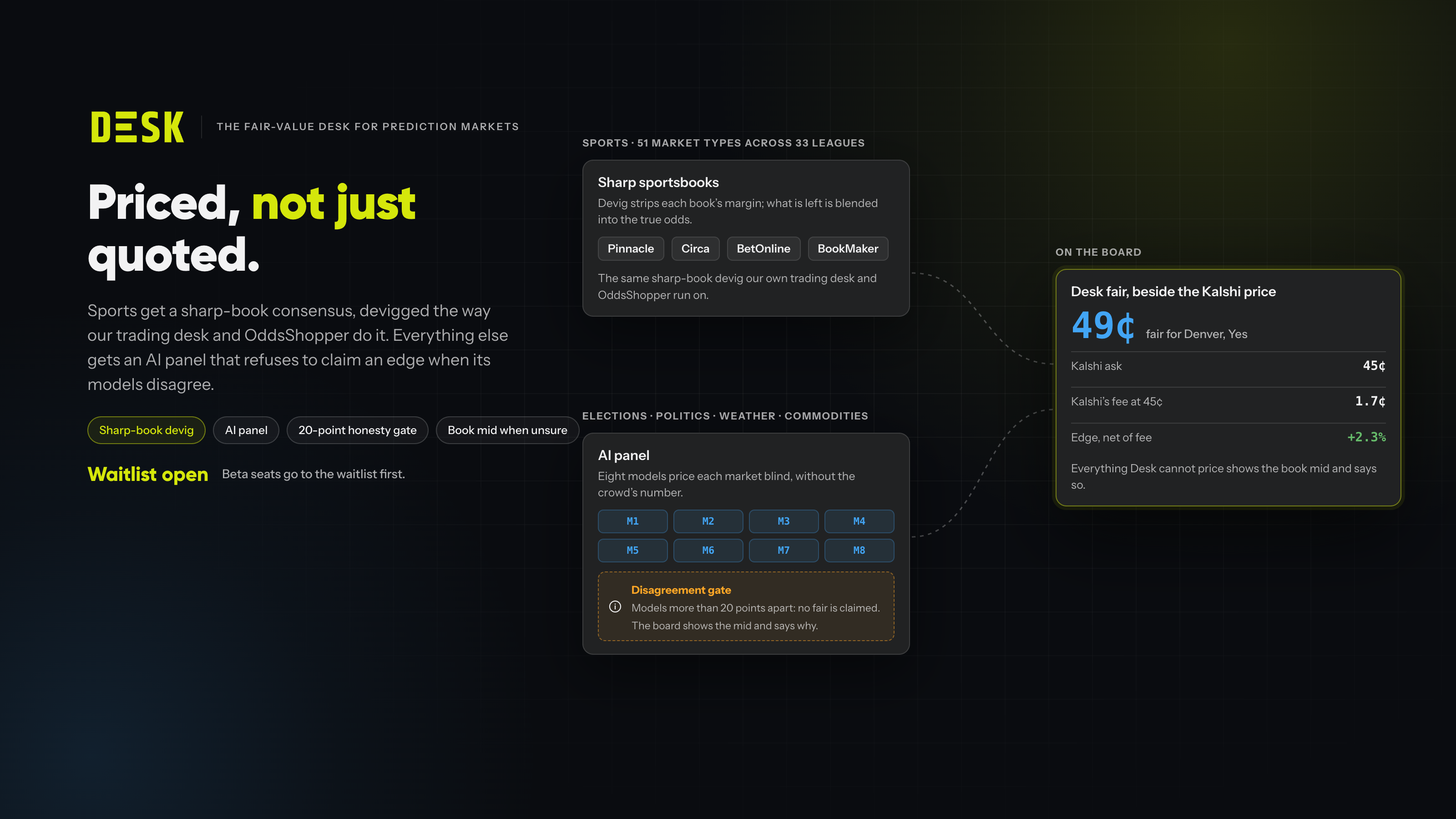
They shop the price before they trade. A Kalshi contract is only worth buying when it is cheaper than your honest estimate of the probability, and cheaper than the alternatives. Say you make a team 52% to win and its Yes is asking 50 cents; that is an illustrative edge, two cents, and it is the entire reason to trade. Winning traders make that comparison against the sportsbooks too, by removing the vig from a book's line and checking whether Kalshi or the book has the better number on the same game. Our live odds screen exists to shop the number across every major book in one place, which makes the Kalshi comparison a ten-second check instead of a spreadsheet project.
The Realistic Edge, And Why Most Casual Traders Lose
Now the part most pages selling you on prediction markets skip: the honest size of the prize. Edges on Kalshi are measured in cents. The best-documented one we have personally measured, selling a full six-outcome weather ladder priced above 1.00, where exactly one of the six rungs settles Yes every time, a 16.7% base rate for the average rung, netted +4.94 cents per ladder after maker fees across 1,566 measured ladders, a separate and larger sample than the 770-event median above. Even that figure is an upper estimate, because the measurement cannot see the roughly 2 cents of adverse selection described earlier, and quoting it gross would run 22% higher still, which is exactly the kind of flattering arithmetic this page exists to strip out. All six rungs are simultaneously fillable only 12.5% of the time, roughly 6.5 fillable baskets a day in our recorder data, which capped the whole strategy near $1,822 a year at twenty-contract size. We published that full accounting, including the four ways we fooled ourselves measuring it, the calls on our Kalshi picks hub are publicly graded against settlement, and our own trading log remains short, small, and currently negative. If a page promises you more than cents without showing its arithmetic, that page is selling something.
Casual traders lose for reasons that are boringly consistent with everything above:
- They cross spreads at coin-flip prices, paying the peak fee and the full spread on every entry and every exit.
- They trade thin markets where the spread is a nickel and their fill is somebody else's information.
- They buy longshots at prices the market already inflates, because a 6-cent contract feels like a lottery ticket.
- They trade often, without records, so the slow leak of fees and spreads never shows up as a line item they can see.
None of that requires a villain. It only requires a venue that charges for immediacy, and customers who keep buying immediacy without noticing.
The Bottom Line: Trust The Structure, Respect The Toll
So, can you trust Kalshi? Trust the structure: it is a regulated exchange where prices come from traders, settlement rules are written down in advance, and the exchange earns the same published fee whichever side wins, holding no position against your contract. Do not trust the assumption that a fair structure hands you an edge. The exchange charges a printed fee that peaks exactly where beginners trade, and its prices carry an unprinted markup we measured at 5.0% per ladder on the one family of markets we could measure end to end. The traders who win treat Kalshi the way sharp bettors treat sportsbooks: they rest their orders, shop every price against the wider market, and only trade when the number is wrong in their favor. The decision rule that falls out of all of it: if you cannot name your fair price, the current spread, the fee, and the no-vig sportsbook comparison for a market, do not trade it, because Kalshi can be trustworthy and still be a bad trade at the displayed price. If you want to see what the wider market says before your next trade, our free expert picks are open to everyone.
And if you want the price comparison done for you, OddsShopper Pro scans the board across every major sportsbook and flags the numbers priced in your favor, free for your first 7 days. Code KALSHITRUST20 takes 20% off your first month of OS Pro or OS Core after the trial.
Disclosure and fine print.Stokastic Inc., OddsShopper's parent company, trades event markets on Kalshi and holds positions in them; where this page cites measurements, they are measurements of our own trading, published in the linked articles. We have no affiliate or commercial relationship with Kalshi. 18+ under Kalshi's terms, and some states set a higher age for gambling products; state availability varies, is contested in several states as of August 2026, and can change, so check Kalshi's own eligibility screen. Nothing here is trading advice, and nothing here is a promise of profit.
Prices on this page are Kalshi's book. If you also trade on Polymarket, code OS4 gets new users a $50 trading bonus on a $10 deposit — affiliate link; terms as stated by Polymarket; 18+, availability varies by state.
More on this: What Can You Bet On Kalshi? Every Category, And How Often Each Settles · Can You Lose More Than You Put In On Kalshi? Event Contracts Vs Perps · What Can You Trade On Kalshi In California? The Live Board · Can You Take Both Sides On Kalshi? · Can Kalshi Change Market Rules After You Bet? What The Rulebook Allows