Dan Driscoll worked his last full day as Secretary of the Army on Wednesday, September 2. The same day Senator Thom Tillis, a North Carolina Republican, posted that he had "never witnessed more inept management of the brave men and women who serve our country" and urged the president "to find a new leader at the Pentagon." That night Representative Don Bacon, another Republican, told CNN that Pete Hegseth "would not be on my team." By Thursday the White House had named an acting Army secretary and said the president "has complete trust in Secretary Hegseth."
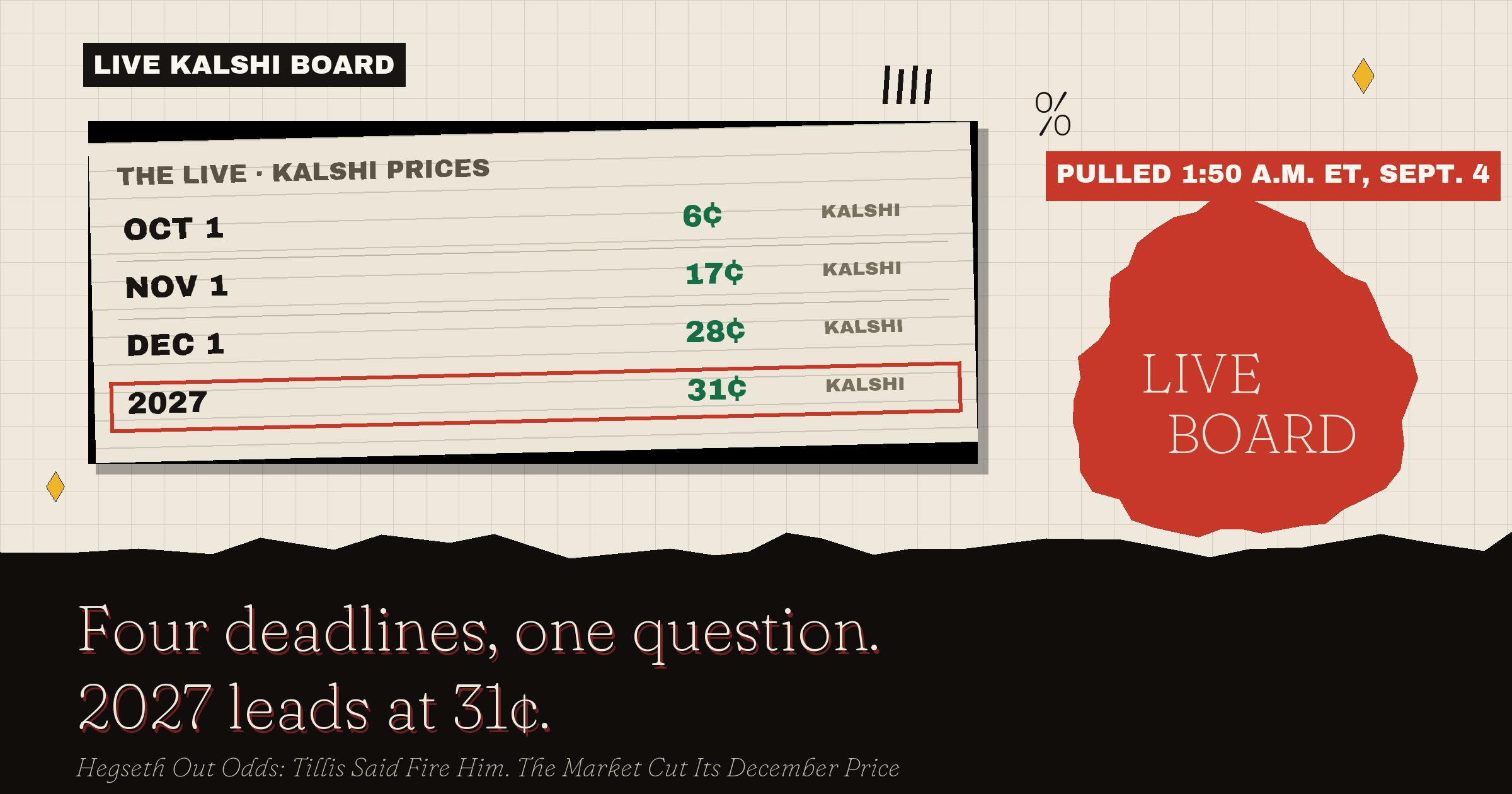
The Hegseth out odds on Kalshi took all of that in, and the near deadline moved two cents. When this page first went up on Monday, August 31, the contract on him being out as Secretary of Defense before November 1 was quoted at 15 to 16 cents. As of September 4, 2026, it sits at 17 bid, 19 ask. The contract on him being out before December 1 went the other way. It was 31 bid, 36 ask in that August 31 pull and is 28 bid, 29 ask now. The far-dated contract, out before 2027, firmed from 28 bid, 29 ask to 31 bid, 32 ask. A week that produced the loudest Republican criticism of his tenure left the near deadline a touch higher, the December deadline lower, and the year-end deadline three cents higher, the deep money's own small correction, which I get to below.
This is not a market shrugging. Behind the flat prices, the number of open contracts on the November rung went from about 4,900 on Monday to about 27,900 by Friday morning, and the December rung's from about 6,100 to about 24,900. These rungs are a week old, so some of that is a new book filling out. But the flow had a side: most of it took yes at the offer, and the price still only went from 16 to 18. That is not indifference. It is a deep seller. The two questions this page exists to answer are what the market now says about him being gone by November 1 versus December 1, and why the December price fell on a week like this one. There is also a loose end from the first edition: I flagged a price next door that did not fit the ladder. It has since done exactly what I said to watch for, and I will get to it after the table.
Stay ahead of the markets.
Daily insights and expert picks on Kalshi, Polymarket, and what's moving markets.
Free forever. Unsubscribe anytime.
What Changed This Week
The record, in order, because the market traded each item as it landed.
- Monday, August 31: the White House confirms Driscoll is leaving. Spokeswoman Anna Kelly said Driscoll had "been highly effective in advancing President Trump's agenda" and provided "outstanding leadership during historic military operations," the Associated Press reported via PBS News. A White House official said Driscoll had been asked to stay until after the midterms and told them it was time to go.
- Wednesday, September 2: his last full day, and a compliment for his boss. Driscoll said Wednesday was his last full day, called the job "the honor of a lifetime," and wrote that "we could not have made the progress we did without the support of Secretary Hegseth," per the AP's follow-up. He gave no reason for leaving. The friction with Hegseth, who in April pushed out the Army chief of staff and, per NBC, had fired people close to Driscoll and overruled his decisions, is covered below.
- Wednesday, September 2: Tillis tells Trump to replace him. In a post on X, Tillis wrote that a secretary "who maintained the same priorities and forward-thinking" would be "fighting to retain talented leaders like Dan and the many flag officers he has forced into retirement," that Hegseth "is intimidated by competence and retreats to ginning up culture wars," and that he urged the president "to find a new leader at the Pentagon who will retain and empower our military talent rather than diminish it," TIME reported. Asked about it, Trump said, "I think he's doing a fantastic job, but it's very early to talk about that."
- Wednesday night: Bacon agrees, and stops one step short. On CNN, Bacon said, "I hate to tell the president who he should hire and fire … but he would not be on my team," and that Hegseth "has not been a very good leader," per MS NOW. He did not call for a firing. Senator Mike Rounds, asked whether he still had confidence in Hegseth, answered that it is "a matter of whether the president" does. The New Republic's tally of Republican criticism names no second member of Congress who has asked for his removal.
- Thursday, September 3: an acting secretary, and a vote of confidence. Trump named Adam Telle, the assistant Army secretary for civil works, acting Army secretary in a Truth Social post, Federal News Network reported. The White House told Fox News that "the President has complete trust in Secretary Hegseth, who is doing an incredible job leading the Pentagon."
Read that list the way a contract reads it. Every item is pressure on Hegseth. Not one is a departure, a departure date, or a president who sounds like he is looking for one. The rules on this ladder pay on a vacated office, not on a bad week, and the market priced the week accordingly.
The August Record The Criticism Sits On
The first edition of this page was built on a different document, and it still matters because it is the record the week's criticism sits on. In the August 14 edition of the Secretary of Defense Orders Book, the classified planning document that tells the Pentagon which ships, planes, and troops are available, the heads of the Army, Navy, and Air Force and the four-star commanders for Europe, the Pacific, and Latin America told Hegseth that stretching the Iran campaign any further was unsustainable, according to the Washington Post report carried by The Spokesman-Review on August 30. Four of them formally marked the orders "non-concur." Admiral Daryl Caudle, the Chief of Naval Operations, wrote that the Navy "cannot sustain its current level of support for the Iran conflict because there is no anticipated end date," with barely one-fourth of the destroyer fleet ready to deploy. The Jerusalem Post carried the same reporting.
The personnel record behind Driscoll's exit runs back to spring. Hegseth asked Army Chief of Staff General Randy George to retire, effective immediately, on April 2, per CBS News, and General Christopher LaNeve has served as acting chief since; CBS counted George among more than a dozen senior officers Hegseth has removed, a list that includes the former Chairman of the Joint Chiefs, General C.Q. Brown. General Chris Donahue, widely expected to be the next Army chief, stepped down as commander of Army forces in Europe and Africa in June after, in the phrasing of MS NOW's June 24 report, earning the ire of the secretary. NBC News reported on August 26 that Driscoll had told associates he wanted out by Labor Day, in part because Hegseth had fired people close to him and overruled his decisions. He beat that date by five days.
So the Army now has an acting secretary and an acting chief of staff, and the man who runs the department has a senator from his own party asking for his job. The price history spent the week pricing that setup.
How The Price History Traded The Week
The November rung is where the week showed up first, and where it showed up least. Monday evening, the day the White House confirmed Driscoll was leaving, the out-before-November-1 contract traded about 2,000 contracts in the 7 p.m. Eastern hour, one sweep at 7:46 p.m. clearing the book from 16 cents to 54, its largest fill 259 contracts at the top, before the hour closed at 18. From there it spent Tuesday and Wednesday between 11 and 25 cents, mostly 17 to 19, on roughly 23,200 contracts from midnight Tuesday through Friday's pull. About three-quarters of those contracts were bought by someone taking the yes side at the offer. A market where three-quarters of the volume is yes-buyers and the price goes from 16 to 18 is a market where the sellers are deep. Somebody is offering "he stays past October" in size, and they have not had to raise their price to keep doing it.
The heaviest hour on that rung since Monday night came Thursday evening, a day after Tillis and Bacon spoke and the afternoon Telle was named: 1,941 contracts across 31 trades in the 7 p.m. hour, all between 18 and 23 cents, the largest of the late fills a 266-contract print at 23 cents at 7:49 p.m., the hour's high Open interest rose by about 1,850 contracts in that hour, so most of it was new positions, not old ones closing. An hour later the book was 19 bid, 21 ask. By 11 p.m. it was 18 bid, 19 ask. The shape is a market that was offered a reason to reprice and declined.
The tell of the weekabout three-quarters of the 23,000 contracts traded on the November rung since Tuesday were bought by yes-takers, and the price moved two cents. The sellers of "he stays past October" are deep, and they have not had to raise their price.
December is the rung that actually moved, and it moved down. Monday's 31-to-36 quote, built on one thin weekend of trading after the Orders Book story, gave way Tuesday to a wide 21-to-29 book, recovered to the mid-30s Tuesday afternoon, and then spent Wednesday and Thursday grinding lower to 28 bid, 29 ask. The biggest single order of the week on the three-rung ladder landed here: at 9:40 p.m. Thursday, one buyer took about 2,500 contracts at 29 cents and another 690 at 30, in a 3,279-contract hour that was almost entirely yes-side takers. Open interest rose by about 3,270 in that hour, which means the order opened positions rather than closing them. And the price did not budge. Somebody wanted 3,000 contracts of "gone before December," got most of them at 29 and the rest at 30, and the market's next quote was 28 to 29.
October, the rung the first edition called cheap, doubled: 3 bid, 6 ask on Monday, 6 bid, 7 ask now, with the last trade at 9. Open interest went from about 2,200 on Monday to about 17,800. Cheap rungs move on small money, and this one still prices a September exit at roughly one chance in fifteen. The out-before-2027 contract, the deepest market on the board with more than a million contracts traded, took its own path: 29 cents Monday, a 23-cent low in the hour after midnight Tuesday on more than 10,000 contracts, a 37-cent high in the early hours Wednesday, and 31 bid, 32 ask Friday morning. Its open interest grew from about 354,000 to about 407,000 across the week. It is the calmest and best-funded verdict on this page, and it came in three cents higher than it started.
One more thing the quotes tell you. November is 17 bid, 19 ask, a two-cent gap. December is 28 bid, 29 ask, one cent. The tighter spread sits on the rung that just absorbed a 3,279-contract hour without moving, and that is not a coincidence: the size resting at the touch on this ladder lives in December. November's wider gap says fewer people are willing to quote the near deadline tightly, which is why a 1,941-contract hour could print 23 there and give the level back by 11 p.m.
Four Deadlines, One Schedule
Here is how the ladder works, because the whole read depends on it. Each rung is its own yes-or-no contract: will Hegseth have left the Secretary of Defense role before that date? Buy a yes at the 19-cent ask on the November rung and it pays $1.00 if he is gone by then, nothing if he is not. Since every earlier deadline is contained inside every later one (if he is out by October 1, he is also out by November 1 and December 1), the prices have to rise as you move down the calendar. A shorter deadline can never be more likely than a longer one, so its price has to be equal or lower.
That ordering is what turns four prices into a schedule. The price of the October rung is the market's estimate for "gone by October 1." The difference between October and November is its estimate for "gone during October." The difference between November and December is "gone during November." Read that way, the ladder stops being four contracts and becomes one probability spread across the fall.
The ladder also has a history, and it grew by one entry this week. Kalshi has listed Hegseth-out deadlines since April. The out-before-July-1 rung traded about 206,700 contracts and settled No. The out-before-August-1 rung traded about 226,900 and settled No. The out-before-September-1 rung, which was still open when the first edition of this page ran, closed Monday night with about 475,100 contracts traded and settled No. Three monthly deadlines, three Nos. All three ran straight through the June exit of the Army's Europe commander, and the September rung closed at 11:59 p.m. Monday, hours after the White House confirmed the Army secretary was leaving and two days before he actually walked. The April ouster of the Army chief predates the ladder; Kalshi listed these contracts on April 7.
Month By Month: What Nov 1 Versus Dec 1 Actually Prices
All prices are from Kalshi's public API, pulled at about 1:50 a.m. Eastern on Friday, September 4, 2026. Open interest is the number of contracts still held. The last column is my translation into what a $100 yes position pays back, stake included, if the contract settles Yes.
| Out before | Bid / Ask | Last trade | Open interest | Contracts (lifetime) | Last 24 hours | $100 on yes pays (gross) |
|---|---|---|---|---|---|---|
| Oct 1 | 6¢ / 7¢ | 9¢ | 17,792 | 22,111 | 4,670 | $1,429 |
| Nov 1 | 17¢ / 19¢ | 17¢ | 27,907 | 36,069 | 6,888 | $526 |
| Dec 1 | 28¢ / 29¢ | 28¢ | 24,903 | 34,999 | 7,640 | $345 |
| 2027 | 31¢ / 32¢ | 31¢ | 406,736 | 1,017,352 | 10,900 | $313 |
The first three rows are the KXHEGSETHOUT ladder (out before October 1, November 1, and December 1, 2026). The fourth is Hegseth's contract on Kalshi's separate "who leaves the Trump administration in 2026" board, which asks whether he leaves before 2027; that board, name by name, is on our Trump cabinet departures page. Payouts are computed at the ask and rounded to the dollar, before Kalshi's fees.
Here is the same ladder against the first edition's Monday-morning quotes, so you can see what a week of headlines was worth.
| Deadline | Aug 31 bid / ask | Sep 4 bid / ask | Change at the midpoint | Open interest Aug 31 to Sep 4 |
|---|---|---|---|---|
| Before Oct 1 | 3 / 6 | 6 / 7 | up about 2 points | about 2,200 to 17,800 |
| Before Nov 1 | 15 / 16 | 17 / 19 | up about 2.5 points | about 4,900 to 27,900 |
| Before Dec 1 | 31 / 36 | 28 / 29 | down about 5 points | about 6,100 to 24,900 |
| Before 2027 | 28 / 29 | 31 / 32 | up about 3 points | about 354,000 to 407,000 |
The starting open-interest figures are the first hourly reading in the four-day window for each rung, all taken on Monday, August 31, Eastern time. By 1 a.m. Tuesday the November rung was already at about 10,800; the growth from there to Friday is the number that matters.
So, the answer to the question in the title of this section. Using midpoints, the market says Hegseth is gone by November 1 with about an 18 percent chance and gone by December 1 with about a 28 or 29 percent chance. Subtract down the column and the calendar reads: gone by October 1, roughly 6 or 7 points. Gone during October, roughly 11 or 12. Gone during November, roughly 10 or 11. Gone in December before the year turns, roughly 3.
Compare that with the Monday calendar of 4 or 5, 11, and 18, and the change is in one place. The November bucket, the one I read on Monday as the market's price on a post-election reshuffle, shrank from about 18 points to about 10 or 11. October barely changed. The near rung ticked up. In other words, the week did not move the market's view of whether he goes this fall so much as it flattened the market's view of when: a little more weight before the midterm, a lot less weight in the three weeks after it. My read is that the Monday December quote was never a considered view of November. It was a thin weekend market that had just watched a 63-cent print, and the week gave it 22,000 contracts of adult supervision.
More live boards on the same question: Hegseth's rung on the full administration departure board sits at 31 bid, 32 ask, third among the open names behind Amy Gleason and Howard Lutnick; on Kalshi's separate "next person to leave the Trump Cabinet" board he is the 18-to-19-cent favorite, a cent ahead of Robert F. Kennedy Jr., on a board Driscoll's exit could not settle, because an Army secretary is not a Cabinet member. The Trump resignation market and the early-departure board price the man who would have to accept the resignation.
The Price Next Door Fits Again
Now the loose end. On Monday, "out before December 1" on this ladder was bid at 31 cents while Hegseth's before-2027 contract on the departure board was offered at 29, and I wrote that the ladder's own logic said that should not persist: every world where he is gone by December 1 is a world where he is gone by January 1, so the longer contract has to be worth at least as much. I said the deep market had the longer track record, that the 31-cent bid was the least settled number on the page, and that if December drifted back under 29 or the before-2027 contract firmed above it, the oddity would have resolved in the deeper market's favor.
Both happened. December is 28 bid, 29 ask. Before-2027 is 31 bid, 32 ask. The gap between them, about 3 cents at the midpoint, is roughly the market's price on a December exit, which is the shape a ladder is supposed to have. The correction came from both sides, but not equally: the million-contract market moved three points, and the eight-thousand-contract market, now thirty-five thousand contracts deep, moved five, in the other direction. Most of the give was in the thin rung, which is the way these usually resolve. Keep that in mind the next time a three-day-old rung on any board prints a number the deep market next to it disagrees with.
What Has To Happen For November To Pay
The contract language is stricter than the headlines. Kalshi's rules say Hegseth "must have an actual departure date and vacate the role within the time period." A temporary leave, a suspension, or a recusal does not count. Neither does an announced resignation with an effective date on the far side of the deadline. If he announces on October 20 that he will step down effective December 31, the out-before-November-1 contract settles No, the out-before-December-1 contract settles No, and only the before-2027 contract pays.
So for the November rung to pay, one of a small number of things has to happen fast: a resignation that takes effect within days, the way cabinet exits sometimes do when the announcement and the departure land together; a removal by the president; or a departure tied to a specific event, with a successor already named. On Monday I wrote that Driscoll's exit was "the exact condition the November rung is built on." It arrived Wednesday, on schedule, and the rung went from 16 to 18. That is the most useful single fact on this page. The condition the market was supposedly waiting for showed up, and the market told you it was not waiting for that. It is waiting for the president, and on Thursday his press office answered for him: "complete trust."
The December rung needs the same thing to happen with a month more runway, and it gets the one calendar event that changes the politics: the midterm on November 3. Every path to a post-election reshuffle lives inside that rung and outside the November one. On Monday the market charged 18 points for that path. It now charges about 10 or 11. Either the crowd has decided a post-election exit is less likely than it looked on a weekend of bad headlines, or the weekend price was never a real view. Given who was on each side of the 31-versus-29 argument, I lean toward the second.
Why October Doubled And Still Reads Cheap
A 6-cent October rung after a week like this looks like a market ignoring the news. It is a market that has run this experiment three times. Three monthly deadlines, a summer of firings and warnings, a service secretary's exit, and three contracts that settled No. A trader who has watched all three has learned that pressure on this secretary does not convert to a vacated office on any short clock.
Add the mechanics from the previous section and October becomes hard to make pay even if a decision has already been made. A departure announced in mid-September with a two- or three-week transition, a normal shape for a cabinet exit, lands on the far side of October 1. So the rung doubling from 3 to 6 is not a signal of much. About 19,000 contracts did that doubling, against a Monday base of 2,800, and a rung that cheap reprices on far less. The market does not doubt the pressure; three settled Nos have taught it that the calendar between an announcement and an empty office usually runs past the nearest deadline.
Go back to Caudle's destroyer number, one-fourth of the fleet ready to deploy, and add the Army's civilian and uniformed leadership both sitting in acting hands. That is the kind of record that ends careers over quarters, not weeks. A market that priced it into the year-end contract and left September at 6 cents read it the same way.
What To Watch Next
Four things can move this ladder before the next Orders Book lands, and only one of them is another Republican with a microphone.
The first is a second senator. Tillis is retiring and has nothing to lose, which is exactly why the market discounted him. The New Republic's count has Rounds and Representative Mike Rogers expressing disappointment about Driscoll without asking for Hegseth's job. If a Republican who chairs something, or one who is on a ballot in November, says what Tillis said, that is a different market. If the criticism stays with the retirees, the November rung stays in the teens.
The second is the Army secretary nomination. Telle is acting. Whoever Trump nominates for the permanent job, and how fast, will tell the market whether the administration is stabilizing the building around Hegseth or preparing to reorganize it. A quick nomination of a Hegseth ally reads as the former.
The third is the next Orders Book. The document is produced twice a month, per the Post's reporting, which puts the next edition due around now. A second round of non-concurs from the service chiefs would tell the market the objection is standing rather than a one-off. A quiet edition would say the August warnings were absorbed, and that is the outcome the 28-cent December price is closer to.
The fourth is the gap between November and December itself. It is 10 or 11 points now. If it widens back toward the high teens, traders have started pricing the post-election reshuffle again and this week's grind lower in December will have been the anomaly. If it narrows further, the market is telling you that if he goes this year, it will be on a fast clock or not at all.
Kalshi's departure board has already settled Yes on two names this year, Todd Blanche and Karoline Leavitt, and the mechanics of how Kalshi decides someone has "left" are worth ten minutes if you are new to these boards; our election prediction markets explainer covers how a yes-or-no contract turns into a probability. Everything else on the prediction markets hub runs the same way: real prices, real settlement rules, and the reading between them. And if you are here from the sports side, our free expert picks board runs the same discipline on tonight's games, and the toolkit behind it starts with a free week trial.
Prices move daily; the numbers above are a snapshot from the early hours of September 4, 2026, not a standing quote. Re-run the arithmetic at whatever price you are actually offered.
Disclosure: Stokastic trades prediction markets and may hold positions in markets discussed here. We have no affiliate or commercial relationship with Kalshi. 18+, available where Kalshi operates. Nothing in this article is a pick, a recommendation, or trading advice.

More on this: Raiders Vs Dolphins Props: Bowers Is Out, Kalshi Prices Him Like He Plays · Cash Out Vs Hedging On Kalshi: One Ticket, Two Exits (2026) · Why Pete Ricketts (R) Will Win the Nebraska Senate Race · How Kalshi Cash Out Works (Why You Get Less) · Cash Out Or Let It Ride? A Decision Framework For Kalshi Positions