Can The San Diego Padres Still Win The 2026 NL West?
Every July, some fan base convinces itself the standings are just a first draft, and in 2026 that fan base is San Diego's. The question of whether the San Diego Padres can still win the 2026 NL West sits on Kalshi at a single penny, a price that treats the division race as all but decided. What follows is the case for and against that verdict, seven AI models weighing in, and the one number none of them could see, the actual standings, which settles the argument.
TL;DR
- The Market: Kalshi's YES trades around 1¢, or roughly 1% implied probability that San Diego is the 2026 NL West Division Winner.
- The AI Read: an equal-weight blend of seven models lands at 2%, a single point above the market. Six of the seven sit between 1% and 3%; the models agree with the traders that this is a longshot.
- The Fact The Models Lacked: none of them could see the live standings. By late July, San Diego sat roughly 50-52, third in the NL West, about 14½ games behind the Dodgers — and behind Arizona, too. That deficit is why 1¢ is not a glitch.
- The Tell To Watch: a Padres heater against division rivals. Head-to-head games are the only fast way to close a gap this size, so a two-week surge is what would move this quote before the standings make anything official.
- How To Use It: read the 1¢ price as a near no-vig probability, compare it to your own estimate, and treat the model blend as one more opinion, not a green light.
The Market
| Venue | Kalshi — a CFTC-regulated exchange (18+; availability varies by state, as of July 2026) |
| Ticker | KXMLBNLWEST-26-SD |
| The Contract | Resolves per the market's official settlement rules: Will San Diego be the 2026 NL West Division Winner? |
| Closes | On resolution; scheduled settlement November 1, 2026 |
| Current YES Price | 1¢ ≈ 1% implied (snapshot as of July 21, 2026 — confirm the live price on Kalshi before trading) |
Verify it yourself: the live market sits on Kalshi's MLB division markets, and the current NL West standings are tracked on Baseball-Reference's 2026 Padres page. As of this writing, San Diego is a third-place club chasing two teams, the exact backdrop this market is pricing.
The Fact The Models Lacked
Every model further down this page is honest about the same blind spot: none of them can see the actual 2026 NL West standings, so each one reverse-engineers a deficit from the 1¢ price and hopes it guessed right. Here is the number they were missing.
By late July 2026, the San Diego Padres sat a hair under .500, roughly 50-52, and third in the NL West — not even in second place, trailing both the Los Angeles Dodgers and the Arizona Diamondbacks. The gap to first was about 14½ games, with the Dodgers running near a .630 clip and only about 60 games left to play. Winning the division from there is not one comeback; it is two, because San Diego has to leap Arizona just to get a clean look at Los Angeles.
That is the whole story behind a one-cent price. The models were right to be nervous about a large deficit; the standings simply confirm it is real and roughly 14 games deep. A 1¢ quote is not a market that fell asleep — it is the standings, priced.
The Bull Case (Why YES)
Start with the calendar. There are still two-plus months of regular season left, a trade deadline in between, and a Padres front office with a long record of aggressive July moves. The franchise committed to this window long ago, handing Fernando Tatis Jr. and Manny Machado contracts that run into the 2030s, and this roster was built to chase Octobers, not to sell. Baseball history keeps receipts on races like this. The 1978 Yankees erased a double-digit summer deficit to win the AL East. The 2012 A's were 13 games back at the end of June and took the AL West on the season's final day. The one structural lever San Diego still holds is its remaining schedule: head-to-head series left against both the Dodgers and the Diamondbacks, the only games that let a trailing team gain ground on two rivals at once. And any injury to a Dodgers star would reshape the math in a hurry.
The Bear Case (Why NO)
A market does not bury a roster this talented for fun. When a division price sits at a penny in July, it usually means the gap in the standings has grown past what one hot month can fix, and as the standings above confirm, it has. Winning the NL West from here requires three things at once: San Diego playing near its ceiling for ten straight weeks, Arizona fading out of the way, and the Dodgers enduring a sustained collapse. Los Angeles, the division's perennial front-runner, is built to avoid exactly that, with depth at nearly every position, a payroll that absorbs injuries, and a farm system that patches holes at the deadline. There is also an incentive problem. With a deficit this large, San Diego's smarter play is to point its deadline moves at a wild card berth, which quietly retires the division chase. Comebacks like 1978 are famous precisely because they almost never happen.
What The Market Is Pricing
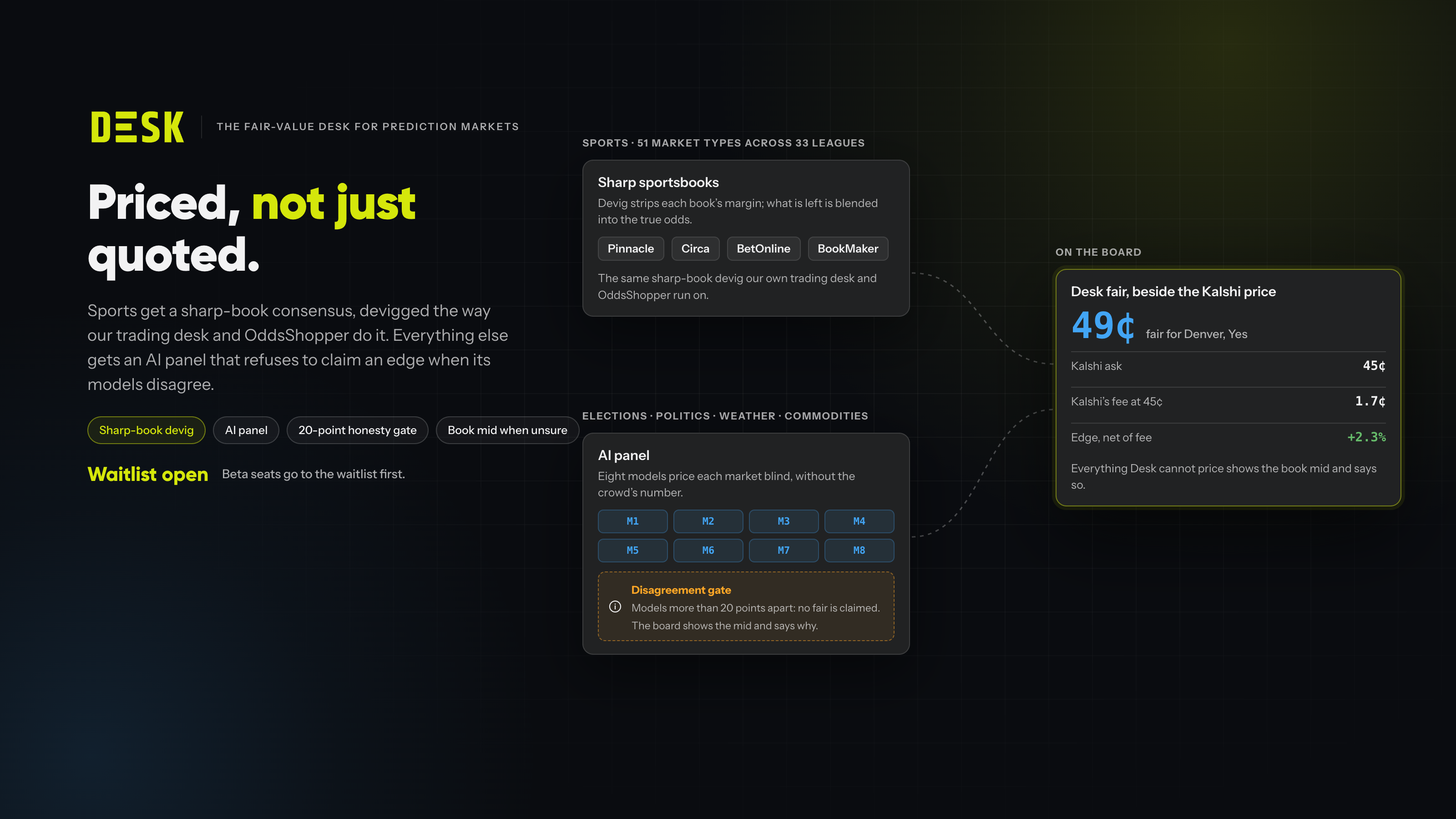
At 1¢, the market prices this as roughly a one-in-a-hundred shot, and the shape of that price is instructive. Traders are not saying San Diego is a bad team; they are saying the specific outcome of the Padres finishing ahead of two clubs, one of them a juggernaut, in ten weeks is close to impossible. This is an actively traded market that has watched most of a season, not a sleepy book with a stale quote. The realistic path for San Diego runs through the wild card race, while the division question resolves without drama. The market settles on the official 2026 NL West winner, listed for November 1, 2026, safely after the regular season ends and any mathematical tiebreakers are applied. One caution: sports markets reprice fast, and a two-week Padres heater against division opponents would move this quote well before the standings make anything official. The club San Diego is chasing trades separately: our Dodgers best-record verdict prices the other side of this same deficit. And for how sports markets on a CFTC exchange differ from a sportsbook, see our Kalshi sports betting review.
Model Verdicts
Market: 1¢ · AI blend: 2% — the models sit one point above the market.
| Model | YES | Why |
|---|---|---|
| ChatGPT | 3% | The one-cent market price strongly suggests San Diego is already far behind a powerful Dodgers club with little remaining divisional-upset path. |
| Gemini Flash | 1% | The market price of 1 cent strongly suggests the market has already resolved NO, or the event is virtually impossible. |
| Gemini Pro | 1% | The current market price of 1 cent strongly indicates the Padres are far behind in the late-July standings and practically eliminated from division contention. |
| Grok 4.5 | 5% | Dodgers' sustained roster and payroll dominance make them heavy favorites; mid-2026 market price implies Padres already trailing badly. |
| DeepSeek V4 | 1% | The Padres are in a distant third place at the All-Star break, trailing the Dodgers by a massive margin, making a comeback extremely unlikely. |
| Kimi K3 | 1% | With no verified 2026 standings, the 1¢ price implies a large late-July deficit; teams that far back historically win divisions only ~1% of the time. |
| GLM 5.2 | 2% | At 1 cent in mid-July 2026, the Padres are likely far behind the Dodgers in the NL West standings, making a division title extremely improbable. |
| Blended Verdict | 2% | equal-weight mean of 7 models (method always disclosed) |
The models span just a 4-point range on this one, and the disagreement is telling: Grok 4.5's 5% is the lone high mark, while four of the seven pin themselves to the 1% floor. The one that lands closest to the truth is DeepSeek V4, which, without any live data, correctly reasoned that San Diego was a "distant third place" trailing "by a massive margin." That is exactly what the standings show.
Model estimates generated 2026-07-21 00:16 UTC. These are model estimates, not predictions of fact and not financial or trading advice. Models are frequently wrong; the market price reflects real traders' money.
The Full Reasoning
ChatGPT (3%): My estimate is driven primarily by the one-cent price, which is the only contemporaneous signal provided and likely reflects a severe midseason standings deficit, major roster damage, or both. Second, the Dodgers have generally entered recent seasons as the NL West’s dominant organization, with superior depth and financial resources, making a late San Diego comeback harder than an ordinary divisional chase. Before knowing 2026 results, a competitive Padres roster might have carried roughly a 15–25% division chance, versus a naive 20% five-team base rate, but that preseason prior should receive little weight by July 21. A 1% quote may understate true probability because prediction markets can be illiquid, stale, or affected by unusual settlement wording; accordingly, I raise the estimate modestly to 3%. I am most uncertain about the actual 2026 standings, remaining schedule, injuries, and whether the displayed price has meaningful liquidity, since I cannot verify live information. The single piece of news that would most change my estimate is the Padres’ current games-behind figure, including how many teams they must overtake.
Gemini Flash (1%): The primary driver for this estimate is the current market price of 1 cent, which for a prediction market typically indicates a near-zero probability or that the market has already resolved 'No'. Given today's date (2026-07-21), the 2026 MLB season would be well underway, likely past the halfway point. If San Diego were a contender for the NL West title, their probability would be significantly higher than 1%. The base rate for any single team winning their division is roughly 1/5 (20%), but this varies greatly by team strength and current standings. I am most uncertain about the exact settlement rules and whether this market is still active or has already resolved. The single piece of news that would most change my estimate would be an official announcement that the market is still open and active, and that San Diego is currently leading the NL West by a significant margin.
Gemini Pro (1%): In late July of the MLB season, division races are often well-defined. A market price of 1 cent (1%) for the San Diego Padres to win the NL West strongly implies they are facing a massive deficit in the standings, likely trailing dominant teams such as the Los Angeles Dodgers by an insurmountable margin. Base rates for teams overcoming double-digit game deficits in the final two months of the season are exceptionally low, historically occurring only a handful of times in baseball history. My primary uncertainty lies in the exact standings, roster health, and performance metrics as of July 21, 2026, which I cannot directly access. However, the extreme market price reflects a near-certainty of their elimination from the division race, aligning with typical late-season baseball dynamics where trailing teams become sellers at the trade deadline. The one piece of news that would most change my estimate would be learning that the market price is a glitch and the Padres are actually within a few games of the division lead.
Grok 4.5 (5%): Key drivers: Dodgers have won the NL West in most recent seasons via superior talent and spending, establishing a ~50-60% base rate; Padres compete as a strong second but rarely overtake them over 162 games. Historical division win rates for non-Dodgers clubs hover under 20% combined. By late July the season is more than half complete, so current standings (unknown to me) heavily constrain remaining odds—market at 1¢ signals Padres are likely several games back with fading contention. Uncertainty centers on 2026 injuries, trades, or hot streaks I cannot observe. The single most pivotal news would be a sustained Padres surge plus Dodgers collapse in the next month that closes the gap to under 3 games.
DeepSeek V4 (1%): As of July 21, 2026, the primary driver is the current standings. The Los Angeles Dodgers are historically dominant and likely hold a commanding lead in the NL West. The Arizona Diamondbacks are the probable second-place team. The San Diego Padres, while talented, have not kept pace. Base rates for teams overcoming large divisional deficits (e.g., 10+ games) at this point in the season are extremely low, typically under 2%. The Padres' run differential and underlying metrics probably show them to be a good but not elite team, further reducing the chance of a historic surge. My greatest uncertainty is the exact games-back number and the health status of key players like Fernando Tatis Jr. or Manny Machado; a major injury to a Dodgers star could shift odds, but not enough to make San Diego the favorite. The single piece of news that would most change this estimate is a sudden, season-ending injury to Shohei Ohtani, which would dramatically weaken the Dodgers and open a narrow path for the Padres, though Arizona would likely become the primary beneficiary.
Kimi K3 (1%): My strongest evidence is the 1¢ market price itself: lacking reliable 2026-specific standings, a liquid market at 1¢ almost certainly reflects San Diego sitting many games behind the Dodgers (or another leader) in late July. Historical context reinforces this: the Dodgers won the NL West in 12 of 13 seasons through 2024, and the Padres have not won the division since 2006 despite fielding strong recent wild-card teams. Base rates show teams trailing by roughly 8+ games in late July win their division only ~1-3% of the time, and longshot bias suggests 1¢ may even overstate true odds, so I anchor at the 0.01 floor. Key uncertainty: I cannot verify actual July 2026 standings, injuries, or trade-deadline moves; if the market were somehow stale and San Diego were within ~5 games, true odds could be 10-20%, but deep markets rarely misprice that severely. Most decisive news: confirmed current standings and games-back/magic number, or a season-ending injury to the division leader's star players.
GLM 5.2 (2%): The NL West is typically dominated by the Dodgers, who have won the division nearly every year in recent history. The Padres are usually competitive but have rarely overcome LA for the division crown. At a market price of 1 cent in late July, the implied probability is ~1%, which strongly suggests the Padres are far out of first place with roughly 60 games remaining—likely 12+ games back. Historical comebacks from such deficits are rare but not unprecedented (e.g., the 1964 Phillies collapse, the 1995 Mariners). I lack specific 2026 standings data, so I rely heavily on the market price as a signal. My estimate of 2% is slightly above market to account for tail-risk comeback scenarios. The single piece of news that would most change my estimate: the Padres going on a 15-game win streak while the Dodgers lose 10 straight, closing the gap to under 5 games.
Reading A 1¢ Price The Way A Sharp Bettor Would
A prediction-market price is not a vibe; it is a probability with a dollar sign in front of it. YES at 1¢ is the market's shorthand for "about a 1% chance," the same implied-probability math you would run to de-vig a two-way sportsbook line. What sharp bettors like about a venue such as Kalshi is that the price sits close to no-vig. You are not paying the 4-5% hold a book bakes into a two-way market, so 1¢ is a cleaner read on true probability than a lopsided moneyline would be. If you have never turned a market price into a percentage before, our primer on how prediction markets work walks through it step by step.
The bettor's move from there is the same one you would make on any number: compare the price to your own estimate, and only act when they diverge. The on-topic tool for that here is OddsShopper's EV calculator, which turns any price-plus-estimate into an expected-value number in one step — feed it the 1¢ price and your own probability and it does the arithmetic below for you. The same reflex carries over to the games themselves: on a Padres-Dodgers moneyline you would shop the number across books first, the habit OddsShopper's live odds screen — shop the number across every major book is built for, and the free expert picks for today's games are where those game reads live. A prediction market like Kalshi already collapses that shopping step into one near-no-vig price, so here the estimate is the whole job. And before you trade any event market, confirm it is available where you live — we keep a running guide to whether prediction markets are legal in your state.
The one number I keep coming back to is not the 1-point gap between the 2% blend and the 1¢ market; that is noise. It is the 14½ games in the standings. The models and the traders already agree; the deficit is the reason they agree. When the model consensus and the market land on the same tiny number, the bet was decided long before the panel ever weighed in.
A Worked Example: Turning 1¢ Into An Expected-Value Read
Say you buy the model blend and set fair value at 2%. Here is the napkin math a bettor runs before risking a dollar:
| Input | Value |
|---|---|
| YES Price | 1¢ (risk 1¢ to win 99¢) |
| Your Estimated Fair Probability | 2% |
| Break-Even Probability | 1% |
| Expected Value Per Contract | (0.02 × $0.99) − (0.98 × $0.01) = +$0.01 |
On those inputs, every YES contract carries about a penny of theoretical edge: technically positive, but so thin it is meaningless. A one-tick market cannot be priced any finer than a cent, so a "penny of edge" is really just rounding, and any Kalshi fees drag it straight to negative. That is the honest read: the standings we opened with, not a modeling insight, are what this market is about. Flip the estimate and side with the traders at 1%, and the EV is exactly zero. I would not fire a longshot on a rounding error, but running the number instead of trading the headline is the whole discipline, and it is exactly what a 1¢ price is inviting you to do.
FAQ
Does this market settle on the regular season or the playoffs?
The regular season. It resolves on the official 2026 NL West division winner, which is decided by regular-season record, with settlement listed for November 1, 2026, per the market's settlement rules. Playoff results do not factor in.
Would a tie atop the NL West force an extra game?
No. Under the format MLB adopted in 2022, division ties are broken mathematically, starting with head-to-head record, so there is no tiebreaker game. The market simply follows MLB's official winner designation.
Is Kalshi legal in my state?
Availability varies by state and can change. Check your eligibility directly on the platform before trading; you must be 18 or older. Accurate as of July 2026.
Are the model verdicts advice?
No. Model verdicts are model estimates of how an event might resolve, not financial advice. Treat them as one input alongside your own research, not as instructions to trade.