The Quick Answer
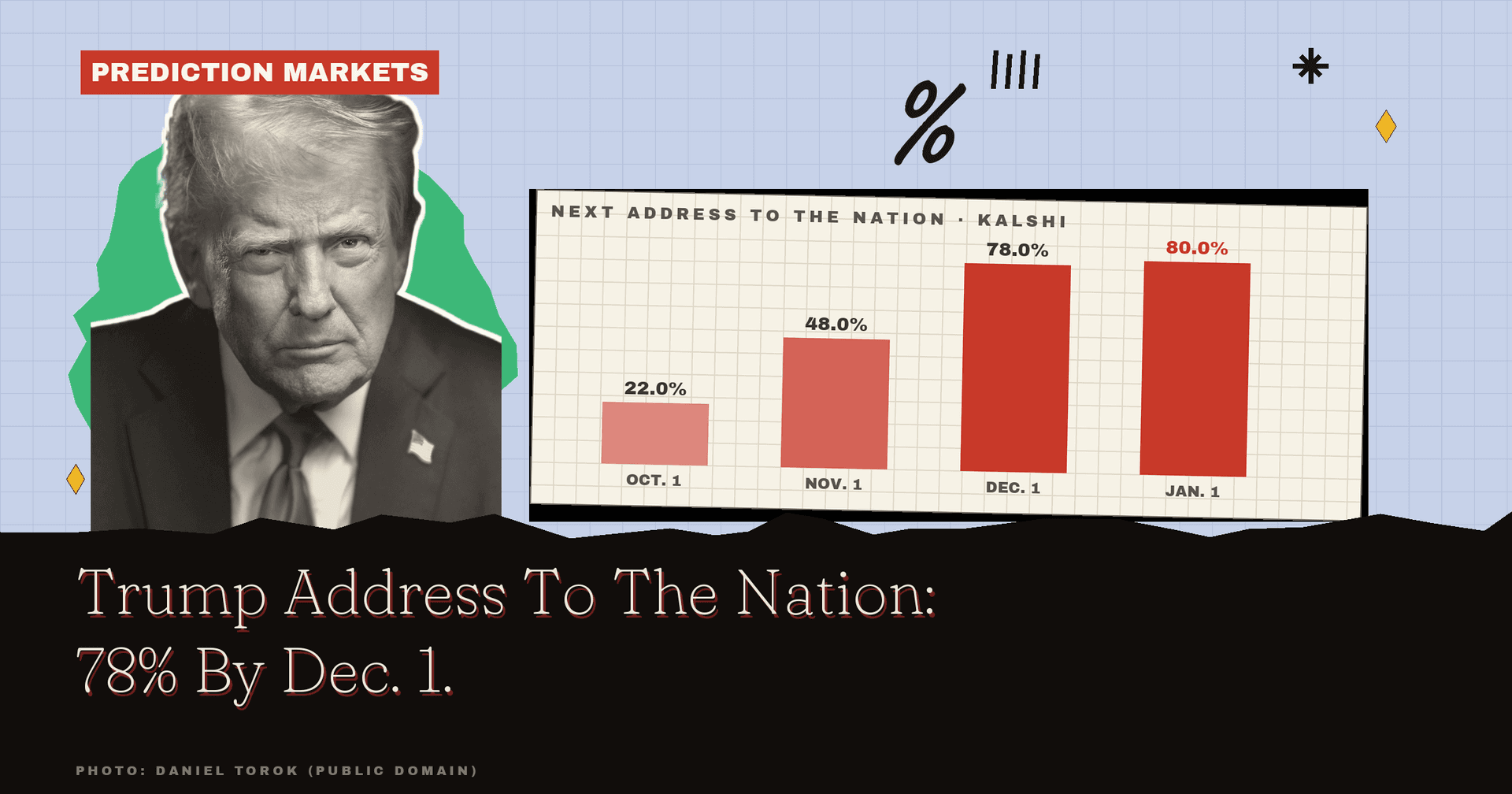
There is an enormous amount of Trump TV right now, and almost none of it is a Trump address to the nation, the one format this market pays on. Kalshi, a prediction market where contracts pay out based on whether an event happens, prices the next formal address at 22% before Oct. 1, 2026, 48% before Nov. 1, and 78% before Dec. 1. A rally, an Oval Office spray or a gaggle on the South Lawn settles nothing, because the contract runs on a four-source and network-telecast standard. He has not delivered one since July 16. When this president wants the country to hear something, he posts it.
The Numbers
| Item | Figure |
|---|---|
| Address Before Oct. 1, 2026 | 22% chance |
| Address Before Nov. 1, 2026 | 48% chance |
| Address Before Dec. 1, 2026 | 78% chance |
| Address Before Jan. 1, 2027 | 80% chance |
| Most Recent Address To The Nation | July 16, 2026 |
| The Address Before That One | April 1, 2026 |
He Types It
When Trump wants the country to hear what he has to say, it reads it on social media. The August push on the clock bill was an Aug. 16, 2026 Truth Social post: "The Senate must vote on the NO MORE CHANGING THE CLOCKS ACT as soon as possible."
So was the biggest press story of his September. On Friday, Sept. 18, 2026, he posted that he was banning three outlets from the building: "Effective immediately, I am banning Fake News CNN, MSNOW... and Politico... from the White House as a result of their constant 'reporting' FAKE NEWS!" The next day, credentialed journalists from CNN, MS NOW and Politico were turned away from the grounds and had their press passes confiscated. Asked to comment, a White House spokesperson pointed NBC News back to Trump's own Oval Office remarks rather than issuing a written statement.
A president who revokes press credentials for three national outlets without going near a podium is the whole case for the cheap October rung. The board expects a quiet October because he handles business in posts.
The Cadence Says Fall, And Only Fall
His most recent address in the network-telecast format was prime time from the White House on Thursday, July 16, 2026, on election security ahead of the November midterms, per the White House video archive. The one before it was April 1, 2026, on the Iran war. Roughly a quarter apart, which lands the next one squarely in the stretch the board prices between 48% and 78%.
He also telegraphs them. Two days before the July speech he told reporters exactly what was coming: "Our country has to shape up. But that's what we're going to be talking about Thursday. It doesn't get bigger, because without free and fair elections, you don't have a country." A preview from his own mouth is the thing that moves the October rung, and no such preview exists today.
One near-event is parked in the Senate, and it would not settle this market. The House passed the Sunshine Protection Act 308-117 on July 14, 2026, and the bill was read twice and referred to the Commerce Committee on July 15, where it has sat. A signing ceremony is not a network telecast. It could occasion an address; it is not one.
What The Board Is Actually Pricing
The Before Oct. 1 line fell from roughly 50% to about 20% in early September and has sat between 15% and 25% since, while the Before Dec. 1 line climbed from about 70% in late August to 78% by Sept. 22.
Read the quotes before sizing anything. On the Oct. 1 contract, Kalshi lists a Yes price of 22 cents against a No price of 84 cents. On the Nov. 1 contract it is a Yes of 55 against a No of 54. Those are very wide gaps, and this market has traded $11,836 across its entire life. A handful of orders can shove a rung around, and a gap that size is thin trading rather than a free lunch.
About The Numbers
A Kalshi contract settles at 100 cents if the outcome happens and zero if it does not, so a price of 22 cents corresponds to about a 22% chance. Yes and No are the two sides of the same contract. The $11,836 volume figure covers the entire life of the market, not a single day. The percentages here are the market's listed chances at one moment on Sept. 22, 2026, and they move. Every rung is cumulative: "before Dec. 1" includes an address delivered in October. Settlement runs on the four-source and network-telecast standard, so the format matters as much as the speech.