The bettors who actually turn a profit rarely look like the ones yelling about a lock of the year. They look bored. Few arenas put the Dunning-Kruger effect on display like sports betting, where watching a lot of games convinces people they can outsmart a market built by sharps and models. The ones who actually win do the opposite: they quietly take the best available number, bet only when the price is wrong, and pocket small edges over and over. That repetition is the whole game, and it's far more learnable than the highlight-reel version makes it look.
In Summary
There are three proven, repeatable ways to make money betting sports, and none of them depend on being a genius handicapper:
- Shop For The Best Number. The same bet pays differently at different books. Taking the best available price is one of the simplest edges a bettor can control.
- Bet Only On Positive Expected Value (+EV). Strip the sportsbook's built-in margin out of a line to find the "fair" price, then bet only when a book is offering you better than fair.
- Arbitrage When Books Disagree. When two sportsbooks price the same game far enough apart, you can back both sides and, once both bets are placed at those prices, come out ahead by a small, low-risk margin regardless of which side wins.
The boring part is the discipline: small edges, bet after bet, with a bankroll you manage like a professional. Below is how each method works, the math behind it, and the OddsShopper tools that do the heavy lifting.
| The Boring Way | What it is | The edge it captures |
|---|---|---|
| Line Shopping | Bet the best price across many books | A few cents of value on every wager |
| +EV Betting | Bet only when the price beats fair odds | The sportsbook's mispriced lines |
| Arbitrage | Back both sides at two books | A small margin when prices line up |
Way 1: Always Shop For The Best Number
Every sportsbook prices the same game a little differently. Say the Detroit Tigers are a road underdog tonight: one book lists them at +150, another at +168 for the identical bet. Most people never notice the gap, because they bet at whatever app they happened to download first. That habit quietly costs them money on every single wager.
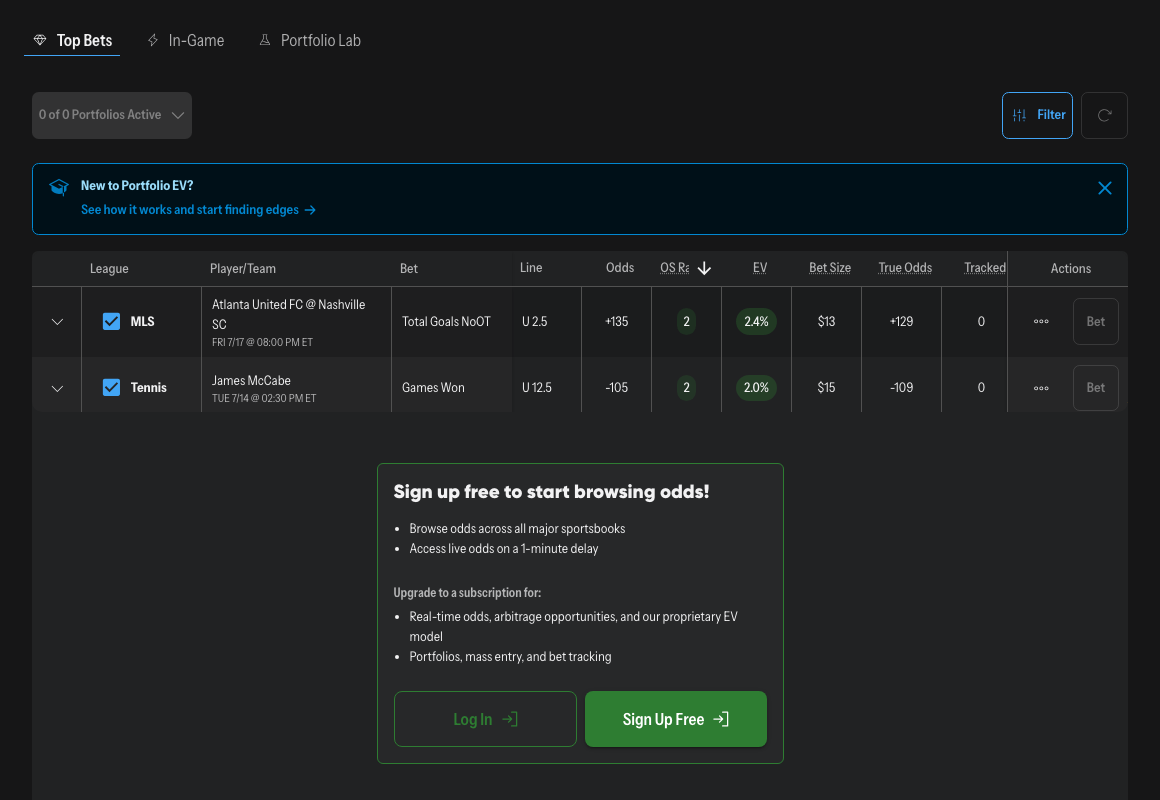
The OddsShopper +EV Screen.
A Quick Line-Shopping Example
Here is why the number matters so much. Bet $100 on the Tigers at +150 and a win returns $150 in profit. Place that same $100 at +168 and a win returns $168. Same risk, same outcome, $18 more in your pocket for nothing but opening a second app. Picture that gap repeated across hundreds of bets a year and the cost of lazy pricing adds up fast. Taking the best available number is not a trick; it is just refusing to accept a worse price than you have to.
A bigger plus number is also telling you something. A team priced at +220 pays more than one at +150 because the book thinks it is less likely to win. +150 implies roughly a 40% chance; +220 implies about 31%. The price is the book's opinion of the odds, so a higher number is both a bigger payout and a longer shot. Reading prices this way is the foundation everything else here is built on.
| Sportsbook | Price on the Tigers | $100 wager returns (profit) |
|---|---|---|
| Book A | +150 | $150 |
| Book B | +162 | $162 |
| Book C | +168 | $168 |
Checking three or four apps by hand for every bet is tedious, which is why a tool does it better. The OddsShopper odds comparison screen lines up every sportsbook's price on a game side by side, so the best available number is the one you see first. You take Book C's +168 without ever logging into Books A and B.
New to OddsShopper?It scans 100+ sportsbooks and instantly shows you the best price on any bet, plus the lines that are actually in your favor. Try it free for 7 days, and code BORING20 takes 20% off OS Pro or OS Core if you subscribe.
Way 2: Bet Only When The Price Is In Your Favor
Line shopping gets you the best price on a bet you already wanted. Positive expected value, or +EV, goes a step further and tells you whether the bet is worth making at all.
The idea starts with the sportsbook's margin. On a two-sided market, the implied probabilities of both sides add up to more than 100%, and that extra slice is the book's built-in profit (the "vig"). Strip it out proportionally and you are left with the fair odds, the market's best estimate of each outcome's real chance. A bet looks +EV whenever a sportsbook is offering you a better price than that fair estimate.
A Worked +EV Example
Suppose that, after stripping the vig out of both sides, the fair price on a team works out to +180, an implied win chance of about 35.7%. You then find a book listing that same team at +220. On a $100 bet, your expected value is:
(0.357 × $220) − (0.643 × $100) = $78.54 − $64.30 = +$14.24 expected profit per $100 bet.
A positive number means the price is in your favor. You will not win every one of those bets, but make enough of them at +EV prices and, over a large sample, the math is expected to work in your direction. That is the entire edge professional bettors live on: not picking more winners, but consistently paying less than fair for the bets they make. If you want the full breakdown, our positive expected value explainer walks through the fair-odds math step by step.
Doing this by hand for every line is impractical. OddsShopper's de-vig and Portfolio EV tools calculate the fair price across books for you and flag the bets where a sportsbook is offering better than fair, so the +EV plays surface automatically instead of you hunting for them.
Way 3: Capture The Margin When Books Disagree
Arbitrage is the most "boring" method of all, because it removes the outcome from the equation. When two sportsbooks price the same game far enough apart, you can bet both sides so that, once both bets are placed at those prices, the math comes out ahead regardless of which team wins, in theory, before any book voids or limits a leg.
A Worked Arbitrage Example
The math works when the combined implied probability of the two sides adds up to less than 100%. Suppose one book has the Tigers at +110 (implied 47.6%) and another book has their opponent at +105 (implied 48.8%) in the same game. Together that is 96.4%, which is below 100, and that 3.6% gap is your margin. Split your total stake between the two sides in proportion to each one's implied probability, and whichever team wins, the payout covers both bets and leaves a small profit. In theory, that margin holds once both legs are placed at those numbers, purely because the two books disagreed on the price.
A few honest caveats keep this realistic rather than a fantasy. Lines move, so both legs have to be placed before a price shifts. You need accounts and funds at multiple books. And sportsbooks do not love consistent arbers, so they can limit or restrict accounts that only ever take these bets. None of that makes arbitrage a bad strategy; it just means the returns are small and steady, not a jackpot.
This is the method that most needs a tool, because arbs appear and vanish in seconds across dozens of books. The free OddsShopper Arbitrage Finder scans 100+ sportsbooks across 40+ leagues in real time and surfaces the bets where the prices line up, with the stake split already calculated. The free tier shows arbs up to roughly a 2% margin; OS Pro unlocks the full live feed and the larger-margin opportunities.
For more on this, see ChatGPT Sports Betting: Can It Really Pick Your Bets?.
Why The Boring Way Actually Builds A Bankroll
Notice what none of these three methods require: a gut feeling, an injury rumor, or a "lock." They are mechanical. That is the point, and it is why they are repeatable in a way that hot takes never are.
The reason discipline beats confidence here is the trap that catches most new bettors: the feeling that watching a lot of games makes you sharp enough to beat the market. The market is made up of sharp bettors and sophisticated models, and it is very hard to out-handicap. What is far more achievable is refusing to take a bad price, only betting when the number is in your favor, and managing your bankroll so a normal losing streak never wipes you out. Small, structural edges compound; big swings on big opinions do not.
The boring bettor's mindsetyou are not trying to predict games better than the market does. You are trying to never pay a worse price than you have to, and to bet only when the price is wrong in your favor.
Bankroll management is what ties the three together. Decide on a unit size you can lose a string of without flinching, bet that size consistently, and never chase a loss by betting bigger. A 2-3% edge means nothing if you stake your whole roll on one game and run into a cold streak. The boring bettor sizes small, takes the best number, bets only +EV, scoops the occasional arb, and lets the math do its slow work. Treat it as a long game, and only ever stake what you can comfortably afford to lose.
Putting The Three Together
In practice the workflow is simple:
- Check the odds comparison screen first so you are never taking a worse price than the market offers.
- Run the +EV tools to see which of those bets are actually worth making.
- Keep the Arbitrage Finder open for the low-risk opportunities that appear when books disagree.
- Size every play to your bankroll and repeat.
None of this is exciting. But consistency, not excitement, is what separates bettors who keep their money from the ones who give it back.
Frequently Asked Questions
Can you really make money betting sports? Yes, but not the way most people try to. Long-term profit comes from structural edges — getting the best price, betting only on +EV lines, and arbitraging — rather than from picking more winners than everyone else. It's slow and unglamorous, and that is exactly why it works.
What is the easiest way to make money sports betting? Line shopping. Taking the best available number on every bet costs nothing extra and keeps you from giving up value whenever a better price is out there. It's the first habit any profitable bettor builds, and a tool like OddsShopper's odds comparison makes it automatic.
Go deeper: Sports Betting Strategy: How to Bet Smarter.
What does +EV mean in betting? Positive expected value means a sportsbook is offering you better odds than the "fair" price after the book's margin is removed. Over a large number of +EV bets, the math is expected to profit even though individual bets still lose.
Is arbitrage betting legal? Arbitrage is legal in regulated U.S. markets where sports betting is available. Individual sportsbooks may still limit or restrict accounts they identify as consistent arbers, so the real risk is practical rather than legal.
Do I need a big bankroll to start? No. You need a bankroll you can manage in small, consistent units and the discipline to size every bet to it. Edges compound regardless of bankroll size; betting too big for your roll is what ends most bettors, not starting small.
New to OddsShopper? It scans 100+ sportsbooks and shows you the best number, the +EV prices, and live arbs all in one place — the exact three things this article is about, done automatically. Stop leaving the better number on the table: try it free for 7 days, then code BORING20 takes 20% off OS Pro or OS Core. See today's edges free
More on this: The Stokastic Projection System For Player Props · How Does Kalshi Make Money? The Charge You Can't See · How Do Sportsbooks Make Money? The Vig And The Hold · LINDY'S LONG BALLS: Kauffman's Back, Eating Crow (In A Good Way), And A Dodger At Altitude (Aug. 17) · How Much Money Should You Put On Kalshi? Bankroll Rules For Event Contracts