The Broncos sit at 44¢ on Kalshi to beat the Rams on Sunday night, and six AI models put Denver at 62%. That is the widest underdog gap on the Week 3 board and the exact shape this page exists to find: a price that asks less of a team than its real chance. NFL underdog picks are a pricing game whether the price is a Kalshi contract or a Higher/Lower multiplier on Underdog, and the 57.7% break-even every pick'em guide quotes is the proof. It is real arithmetic, and on most of the entries you build today it is the wrong bar. The Week 3 dogs come first. The math that grades them follows.
Prices as of Wednesday, September 23, 2026, 7:33 a.m. ET, Kalshi asks before fees. The Tuesday prices and all 16 games are on the AI panel's Week 3 board, with Weeks 1 and 2 graded.
Week 3 Underdogs The Panel Likes At The Price
Six AI models priced every Week 3 game on Tuesday morning without seeing a price (Gemini did not return a board, so the blend is the six). These are the five moneyline underdogs where the blend sits furthest above the Kalshi ask. Gap is the panel minus Wednesday's ask.
| Underdog | Game, kickoff (ET) | Kalshi ask (Wed) | Panel | Gap |
|---|---|---|---|---|
| Broncos | Rams @ Broncos, Sun 8:20 p.m. | 44¢ | 62.0% | +18.0 |
| Raiders | Raiders @ Saints, Sun 4:25 p.m. | 40¢ | 52.3% | +12.3 |
| Browns | Panthers @ Browns, Sun 1:00 p.m. | 42¢ | 49.2% | +7.2 |
| Patriots | Patriots @ Jaguars, Sun 1:00 p.m. | 41¢ | 47.7% | +6.7 |
| Cowboys | Ravens @ Cowboys, Sun 4:25 p.m. | 38¢ | 43.8% | +5.8 |
Broncos, 44¢. Traders have the Rams as a road favorite off their 28-6 Monday night win over the Giants, and the price barely moved from Tuesday's 44.5¢. The six models sit inside a three-point band from 60 to 63 on Denver, a 14-3 team last season with Bo Nix off the injury report while the Rams' report carries Puka Nacua, Jordan Whittington and Kamren Kinchens. A 44¢ contract needs Denver to win more than 44 times in 100 to pay; the panel says 62, which clears even the 57.7% a three-pick Flex demands with four points to spare. That is the shape of value this page is built to find.
Raiders, 40¢. The Saints traded at 62.5¢ on Tuesday and sit at 61¢ now, a solid home favorite off a win at Baltimore. The panel makes the game a coin flip, 44 to 52 across the six seats, because Las Vegas is 2-0 with Kirk Cousins and just won at the Chargers while New Orleans is starting from a room of Spencer Rattler, Tyler Shough and Zach Wilson. A coin flip priced at 40¢ is a 12-point cushion, the second-widest on the board.
Browns, 42¢. Cleveland moved from 40.5¢ to 42¢ since Tuesday and is still a home underdog to a Panthers team the panel will not favor on the road: the six numbers run 45 to 52, blend 49.2%. The Browns just won at Tampa Bay and Carolina just beat Atlanta 34-3, and the read is less that Cleveland is good than that an 8-9 team from last year should not be laying this much away from home. At 42¢ the leg needs 42; the panel gives it 49.
Patriots, 41¢. Jacksonville opened the week at 58.5¢ and trades at 60¢ now, while the panel has the game a hair from even, 52.3% Jaguars to 47.7% Patriots. New England went 14-3 last year with Drake Maye and just held Pittsburgh to 3 points, and the models favoring New England point to that defense. Seven points of gap on a near coin flip is a keep.
Cowboys, 38¢. Dallas is the one home underdog on this list whose price went the wrong way for the market's own story: 41.5¢ on Tuesday, 38¢ now, after the Ravens lost at home to the Saints 24-17 and the Cowboys beat Washington 37-20. The six models run 40 to 46 on Dallas, blend 43.8%, and none of them has Baltimore as short as 62¢ says. Six points of gap on a home team coming off a 17-point win is the fifth-widest cushion on the board, and the cheapest of the five to be wrong about.
A Kalshi contract is not an Underdog line, but the grading is identical. The price is the bar, an independent estimate is the second opinion, and you play the gap. These are estimates, not predictions of fact and not financial advice. Everything below is how to get that second opinion on the prop board and what bar each entry type sets.
Betting a Kalshi combo on this game?Kalshi Parlay Simulator before you buy it: 10,000 simulated games price every combo next to the price on Kalshi.
How NFL Underdog Pick'em Actually Works
You choose NFL players, call each one Higher or Lower on a stat line Underdog sets (rushing yards, receiving yards, receptions, passing yards), and the entry type decides what has to happen for you to get paid. There are two of them on the standard board, plus a modifier:
| Entry Type | Picks allowed | What it takes to cash | The trade you are making |
|---|---|---|---|
| Standard | 2 to 5 on the classic board, and trackers now list multipliers out to 8 | Every pick correct, no exceptions | The highest multiplier at each pick count |
| Flex (Pick8) | 3 to 8 | A sweep pays top; missing one leg still returns something at any Flex size, and six or more picks are double-flexed so two misses return something too, though several of those salvage returns are below your stake | A lower ceiling in exchange for a softer loss |
| Scorchers | Modifier | The boosted pick itself must hit, even inside a Flex entry | A bigger multiplier, forfeited if that pick is voided or tied |
The row people misread is the Flex one. A one-miss three-pick pays 1x, your stake back and no profit, and a two-miss six-pick pays 0.25x. Flex does not buy extra lives; it buys smaller losses and charges for them at the top end. (Power Play and Flex Play are PrizePicks terms, and "Insured" belongs to Underdog's separate Rivals product.)
The part most players miss is that the flat multiplier is an implied price. If a two-pick pays 3x and both legs were true coin flips, the entry hits 25% of the time and loses you a quarter on every dollar. With independent legs at the same probability, a 3x two-pick breaks even only at 57.7% per leg, the square root of one-third. The famous number comes from exactly there.
The One Question Behind Every NFL Underdog Pick
Once you see the board as a set of prices, NFL pick'em strategy collapses into one question: is this Higher or Lower more likely to hit than the payout requires? To answer it you need a second opinion on the line, and the sharpest one available is the sportsbook market for that same prop.
The OddsShopper +EV Screen.
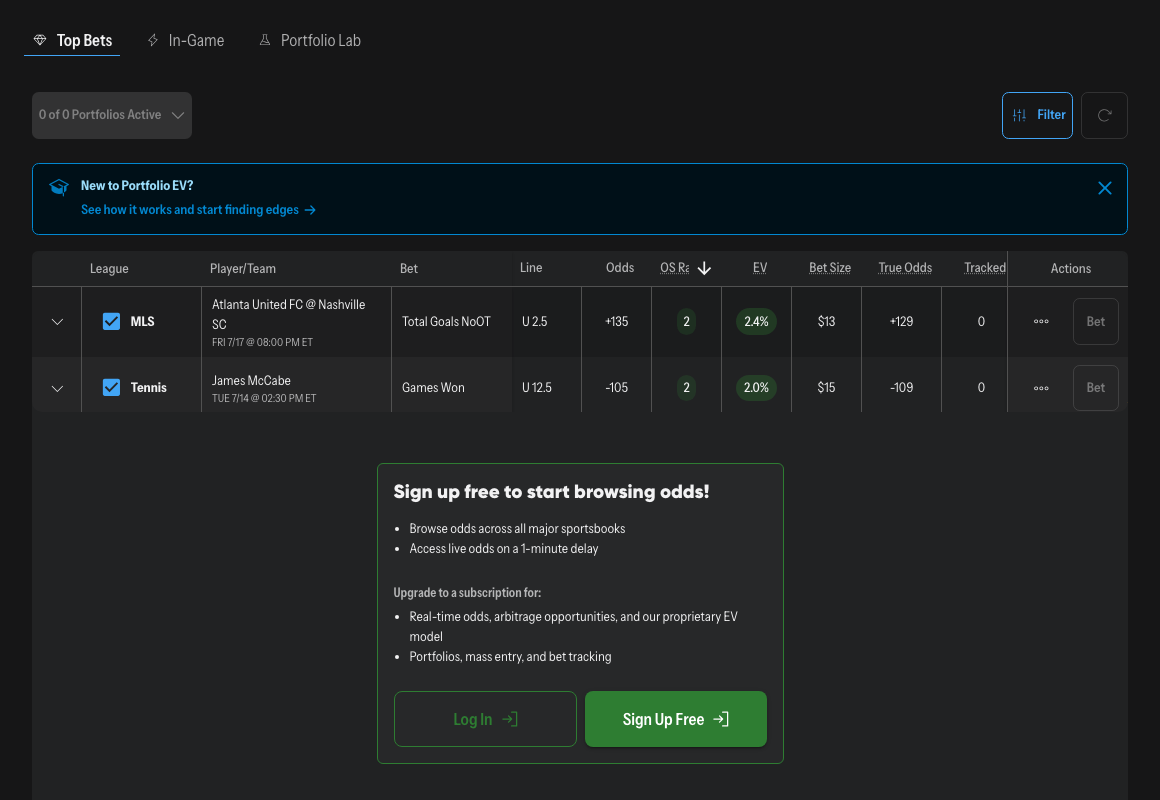
Books like DraftKings 🎁, FanDuel 🎁, BetMGM 🎁, and Caesars post the identical stat as an over/under with real odds attached. Those odds carry a hold, the book's built-in margin, often a 7% hold or higher on a two-way NFL prop. Strip that hold out and you get the market's honest estimate of how often the player clears the number. That de-vig is the whole game. OddsShopper's Sharp Sportsbook Algorithm does it automatically across 100+ books, turning a wall of prices into one fair probability, and the +EV screen ranks the props where a posted number sits far enough off that fair price to matter. When Underdog's line and the no-vig market disagree, the disagreement is the pick. When they agree, there is no bet, no matter how much you like the player.
The core movefor every leg, get the market's no-vig probability, then keep it only if it beats the break-even your entry type and multiplier demand.
Where NFL Pick'em Edges Actually Live
Underdog's numbers move on the same forces that move NFL prop markets, so the football research is the same research a sharp bettor does. In order of importance:
| What Moves An NFL Pick'em Line | Why it matters | The Higher/Lower read |
|---|---|---|
| Volume (Snap Share, Target Share, Carries) | A role changes in one week; the posted number takes several to catch up | A confirmed workload spike is the strongest Higher on the board |
| Game Script (From The Point Spread) | The spread is already a workload forecast, so the prop line is the slower of the two numbers | A moderate favorite's back gets the clock-killing carries; a trailing team's pass-catchers gain garbage-time volume |
| QB Rushing On Dual-Threat QBs | Designed runs and scrambles get priced as noise rather than volume | The Higher I check first most weeks, when the price supports it |
| aDOT And Longest Reception | One yardage line can sit on top of two very different distributions | For a big-play WR, price his longest-reception Higher rather than his yardage |
| Weather (Wind Over 15 Mph) | Wind is public, so the only question is whether it is already in the number | Lean Lower on passing lines and Higher on the run, but check the no-vig price first |
Read that table as a list of places the price lags the football. Volume leads every time: by Houston's Week 10 game against Jacksonville last season, Woody Marks's snap share had passed Nick Chubb's, 78.3% to 14.5%, and Marks's lines were live Highers before his name recognition caught up. The role had changed, and the number had not. The outlier I check most is QB rushing yards on dual-threat quarterbacks, Jalen Hurts, Lamar Jackson, Jayden Daniels, because designed runs and scrambles get posted as noise when they are volume. Game script ties it together: a seven-point favorite runs out the clock and its lead back's carries balloon, a touchdown underdog throws all day, and a true blowout empties the favorite's bench, so read the size of the spread and not just its direction. For the deeper mechanics, the NFL rushing yards props and anytime touchdown props guides go stat by stat.
The order I work involume first, game script second, price last. The football research tells me which lines might be wrong. Only the no-vig number tells me whether one actually is.
A Worked Example: Grading An NFL Underdog Line
Say the board lists Jalen Hurts at 33.5 rushing yards and your entry screen shows a 3.5x two-pick Standard, which is what the payout trackers currently list. Break-even is the square root of one over 3.5, 53.5% per leg, so the only question is whether Hurts clears 33.5 more than 53.5% of the time. Suppose DraftKings has the Over at -140 and the Under at +115. Those imply 58.3% and 46.5%, a 4.8% hold, and the no-vig Over is 55.6%. It clears 53.5% with two points to spare: a keep.
Now fold the same leg into a three-pick Flex and the bar jumps to 57.7%, because a three-pick Flex is a 3x two-pick in disguise, for a reason I derive in the next section. Nothing changed about Hurts. At 55.6% he clears a two-pick Standard by two points and misses a three-pick Flex by two, and you only knew because you priced the entry rather than the player. That is the trap in the 57.7% folklore: the number is misfiled, not wrong. It belongs to a 3x entry, and on Underdog's current board 3x lives on the three-pick Flex sweep, not the two-pick.
Grade the board, don't eyeball it.OddsShopper scans 100+ sportsbooks, strips the vig with the Sharp Sportsbook Algorithm, and flags the props priced in your favor, which is the same check this example did by hand, done in seconds across the whole NFL board. New here? Start a free 7-day OddsShopper Pro trial, and code UDNFLPICKS20 takes 20% off your first month of Pro or Core if you stay.
The Break-Even Table Most NFL Pick'em Strategy Guides Skip
Here is the whole board, priced, on the multipliers third-party payout trackers published in 2026 (OddsAssist on September 5, RotoGrinders on March 19, Propeller Picks verified August 17). The 3x two-pick row is the retired 2023-era number, kept to show where 57.7% came from. Underdog moves these by state, sport and promotion, so the number on your own entry screen is the one that counts. Every break-even assumes independent legs at the same probability.
Standard entries (every pick must hit). Break-even equals the multiplier raised to the power of negative one over the pick count.
| Standard Entry | Multiplier | Break-even per leg |
|---|---|---|
| 2 Picks | 3.5x | 53.5% |
| 2 Picks | 3x (the older number the 57.7% rule came from) | 57.7% |
| 3 Picks | 6.5x | 53.6% |
| 4 Picks | 10x | 56.2% |
| 4 Picks | 12x | 53.7% |
| 5 Picks | 20x | 54.9% |
| 6 Picks | 35x | 55.3% |
Trackers do not agree on the four-pick Standard multiplier, and the gap between 10x and 12x is 2.5 points of required win rate, larger than most edges you will ever find on a prop. That is the whole argument for pricing the entry rather than memorising a chart.
Flex entries (a miss still returns something). Flex needs the full binomial: multiply each outcome by how often it happens, add them up, and solve for the leg probability that returns your stake.
| Flex Entry | Sweep | One miss | Two misses | Break-even per leg |
|---|---|---|---|---|
| 3 Picks | 3x | 1x | not eligible | 57.7% |
| 4 Picks | 6x | 1.5x | not eligible | 55.0% |
| 5 Picks | 10x | 2.5x | not eligible | 54.8% |
| 6 Picks | 25x | 2.6x | 0.25x | 53.8% |
| 7 Picks | 40x | 2.75x | 0.5x | 55.4% |
| 8 Picks | 80x | 3x | 1x | 55.1% |
The row that should stop you is the seven-pick: the bar falls from three picks to six, jumps at seven, eases at eight, and nothing about it looks worse on the entry screen, where 40x is simply a larger number than 25x. The multiplier hides the price.
A rule hides underneath the Flex column. Whenever the salvage multiplier times the pick count equals the sweep multiplier, the sweep terms cancel and the entry prices exactly like a Standard entry one pick smaller at that same multiplier. Underdog's tracked numbers meet that condition twice: 1x across three picks is 3x, so a three-pick Flex is a 3x two-pick with a third leg attached, and 1.5x across four picks is 6x, so a four-pick Flex is a 6x three-pick. The identity breaks at five, where 2.5x across five picks comes to 12.5x against a 10x sweep, which is why the five-pick bar drops to 54.8%. So 57.7% was never Underdog's number. It was 3x's number, and 3x now lives one rung further down the Flex ladder.
That also settles Standard versus Flex: the rule that insurance always raises the bar holds at three picks (57.7% against 53.6%) and is backwards by six (53.8% Flex against 55.3% Standard). There is no rule of thumb, only the arithmetic applied to the numbers your screen is showing.
Weeks 1 And 2, What The Underdogs Did
Nine underdogs won in the season's first 32 games, four in Week 1 and five in Week 2, and the panel had the dog above its price on eight of the nine. The widest was the 49ers at the Rams in Week 1: Los Angeles traded at 64.5¢, the panel had the Rams at 52.8%, and San Francisco won 27-7. Week 2 ran the same way on the Browns at Tampa Bay (Buccaneers 78.5¢, panel 70.0%, Cleveland 23-19), the Vikings at Chicago (Bears 65.5¢, panel 59.4%, Minnesota 9-3) and the Raiders at the Chargers (Chargers 72.5¢, panel 66.4%, Las Vegas 26-14). The honest half of the record: across all 32 games the market was closer to the result 22 times, because the panel also sat above the price on plenty of dogs that lost. The dog label is not the pick; the gap is, and the gap needs sizing.
The Tools I Use To Grade NFL Pick'em Lines
None of this works if de-vigging four books by hand is your process, because by the time you finish, the board has moved. This is the actual stack:
- OddsShopper's Odds Screen And +EV Screen do the price side. The +EV screen lines up every book on each prop, de-vigs them, and surfaces the numbers sitting far enough off fair to be a bet, biggest edges first; the odds screen is where I shop the number across every major book before I trust it.
- The Underdog Entry Builder is the tables above, automated. It de-vigs the sportsbook market behind each square on the Underdog board, grades every Higher and Lower by expected value, and shows the entry's payout and win probability against the break-even for the format you picked as you add legs. The EV Calculator handles a single leg.
- A Projection For The Other Side Of The Read. Stokastic's Prop Tools run player projections and Higher/Lower win probabilities for pick'em boards. When the projection and the no-vig market point the same way, that is my highest-confidence pick.
- Somebody Else's Card, When You Want One. Our free expert picks today page carries a free picks feed and an expert leaderboard.
- The Platform Itself. If you are new to the app, you can claim the current Underdog Fantasy sign-up offer with code OS1 and play the board you are grading. Underdog's first-deposit match is 50% of your first deposit up to $1,000 in bonus funds in the full-product tier, and 25% up to $250 in bonus funds in the predictions-only tier, a match rate Underdog has said may still change. The predictions-only tier is Connecticut, Hawaii, Idaho, Iowa, Louisiana, Maine, Montana and Washington; the rest of Underdog's footprint sits in the full-product tier. Those tiers are match sizes rather than a map of where Underdog is available, so read the offer terms shown in your own state before you size a deposit. Our link pre-fills the code; if the field is empty, enter OS1, and if a code is already there, leave it.
Two independent reads pointing the same direction, the market's and a projection's, is the strongest NFL Underdog pick you can make. One without the other is half a bet, which is why my Underdog NFL picks tend to be short lists, and why the Week 3 list above stops at five.
Ready to grade the board?OddsShopper scans 100+ sportsbooks, de-vigs every NFL prop with the Sharp Sportsbook Algorithm, and shows you which Underdog lines are actually in your favor. Try it free for 7 days, and code UDNFLPICKS20 takes 20% off OddsShopper Pro or Core if you subscribe.
More on this: NFL Underdog Betting: Finding Moneyline Value On Dogs · NFL Preseason Event Contracts, Explained In 60 Seconds · Don't Bet NFL Preseason Totals Before Reading This · How To Bet NFL Rushing Yards Props: A Strategy Guide · NFL Offensive Player Of The Year Odds 2026: Pacheco IR Hands Gibbs