Good morning, and happy Dinger Tuesday. The Kyle Schwarber home run prop is the one I keep coming back to every morning he's on the board, and it's not for the reason you'd guess. Everybody already knows Schwarber can leave the yard. He's the National League leader in home runs. That part isn't the bet. The bet is the price. A home run ticket is won at the register, not at the plate, and this piece is half information and half how I actually bet it: I'll give you my read on him, and then the coupon-clipping method behind it, so the decision always runs back through the number instead of the name on the jersey.
By the end you'll have a repeatable way to look at any home run prop, Schwarber's or anyone's, and know in about ten seconds whether it's on sale or full price.
Want to run this with me this morning?Start the 7-day OddsShopper Pro free trial and price today's whole home run board yourself. If you keep it, code CLIP20 takes 20% off.
Start your free OddsShopper Pro trial
How I Clip The Coupon On A Home Run: The Oreos, Worked Out
Here's the whole idea in a grocery store. A pack of Oreos is worth $5.50. You walk in and the shelf tag says $3.00. You don't buy one pack; you buy the aisle, because the store is handing you $2.50 of value on every box. Same move when your kid's $80 sneakers hit the clearance rack at $45: the shoe didn't change, the price did.
A home run bet works exactly the same way. Every dinger prop has a true price, meaning what the odds should really be once you strip out the sportsbook's built-in juice. (The base rate underneath that, which I counted from settled markets, is how often MLB hitters actually homer: just under one game in eight.) Then there's the shelf price, what a given book is actually paying you. When a book is paying you more than the true number says the outcome is worth, you're standing in front of $3.00 Oreos. That gap is the coupon. You clip it and you buy the aisle. One dose of reality before you do: on a real home run board the markdown is a few cents on the dollar, not $2.50 off a $5.50 pack, which is exactly why you size small and do it every single day.
Notice what did the work there. It wasn't a hunch that Schwarber feels due, and it wasn't the shortest, flashiest odds on the screen. It was one comparison: shelf price versus true worth. Get that habit and you stop betting names and start betting margins. Over a full season of swings, that's the job.
Why Schwarber Is The Aisle Worth Pricing First
So why lead with Schwarber? Because his bat is about as reliable a power profile as this sport offers, and that makes him the cleanest way to show the method. He's sitting on 44 home runs through 144 games, and as of this mid-September update that leads not just the National League but all of baseball. His isolated power (ISO, the cleanest one-number read on raw pop) is .280 and his slugging is .518. The number I care about most as a home run shopper is the split: a .257 ISO against left-handers and .291 against righties. Thirty of the 44 came off right-handers, so the power tilts that way, but whoever's on the mound, the power plays.
The row I keep re-reading, though, is the lefty column. Books normally lengthen a left-handed bat's home run price against a left-handed starter, because most lefty hitters lose real pop to same-side pitching. Schwarber's version of that penalty is real but modest: 14 of his 44 came against lefties, one every 14 at-bats versus one every 11 against righties, and a .257 ISO against same-side arms is still big-league power, not a platoon bat hiding from lefties. The market knows all of this, so none of it is a coupon by itself. What it does mean is that a lefty starter is never a reason to skip the price check on him. The "he's in a bad spot tonight" angle is smaller for him than the textbook says, and the only question left is the shelf tag.
Now the honest part, because this is where most home run articles go square. Every one of those numbers (the 44 bombs, the .280 ISO, the both-hands power) is already baked into his price. The books read the same stat sheet you do. So none of that is your edge; it's the context that explains why his line looks the way it does. The edge only ever shows up in one place: a book that's a step slow to update, still paying a little more than the true number. Schwarber's bat is why the whole market is looking at him. The coupon is whether one book is late to the register.
The Tools That Do The Clipping
You could de-vig a home run market by hand, pulling the two-way price, stripping the juice, and figuring the fair number, but doing that across a dozen books before first pitch is a second job. The tools do it in seconds, so here's my actual order of operations most mornings.
I start on the OddsShopper +EV screen, which scans 100-plus sportsbooks, runs each home run market through no-vig fair-odds pricing to find the true number, and flags the exact book paying more than that, the shelf price sitting under true worth. If one homer jumps out, I drop it into the EV Calculator and sanity-check it myself: the price I'm being offered against the fair number, real value or retail. Then, once I've settled on the bat, I shop the Schwarber home run odds the same way I'd shop a moneyline: the live odds screen lines the price up across every major book so I'm never leaving a better number sitting a click away.
That last point is the whole reason a coupon can vanish. The same Schwarber home run can be a genuine buy at the one book that's late and a flat pass everywhere else, and nothing about Schwarber changed between those two tickets; only the shelf tag did. The tool surfaces which book is which; you just take the better tag. If you want the mechanics of stripping the juice, the remove-the-vig walkthrough is the short version of the math, and Ben Rasa's guide to how to bet MLB home run props covers the matchup side (the pitcher, the park, the split) that I'm deliberately not leaning on here, because the books already have.
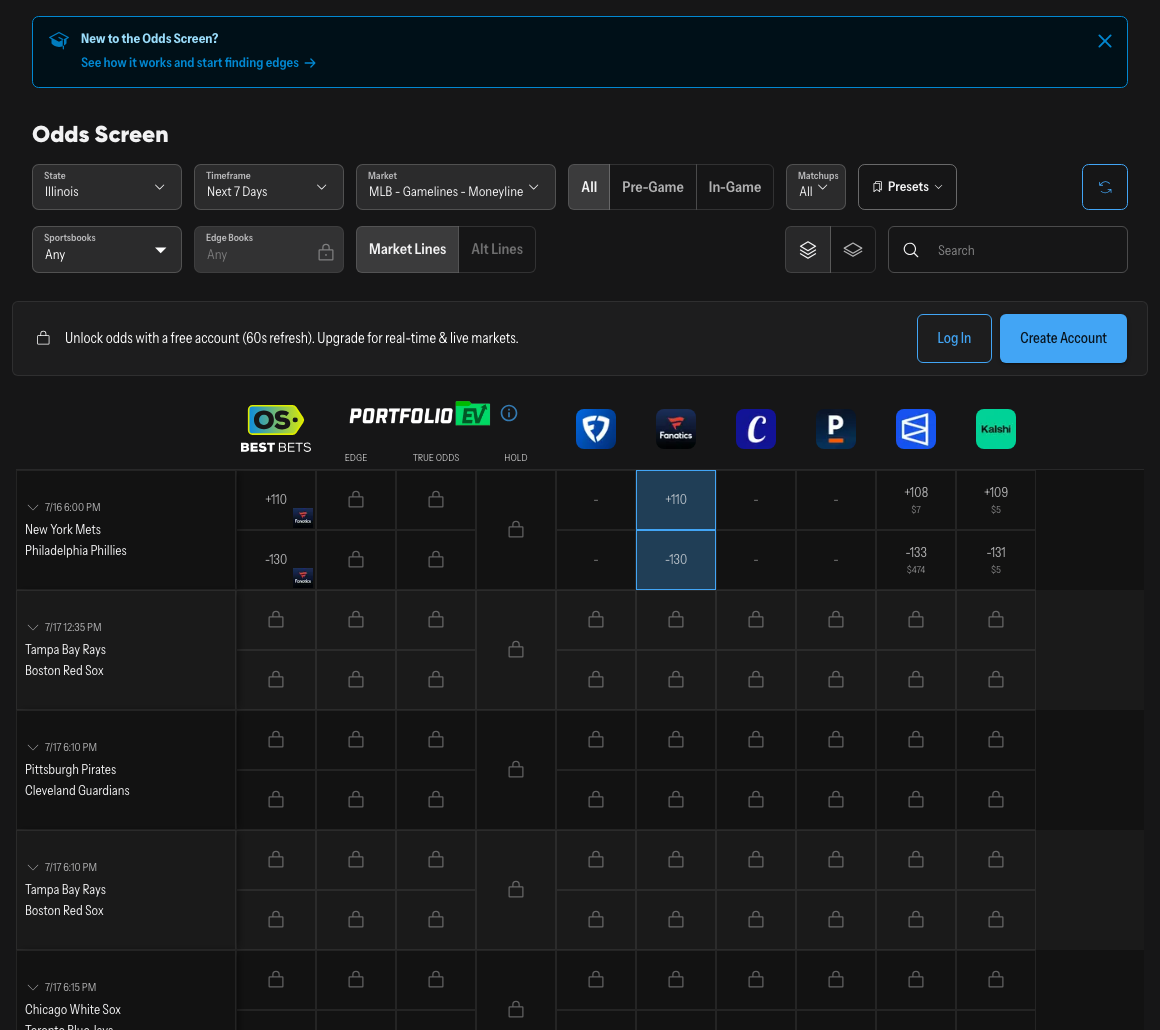 The OddsShopper live odds screen: every book's price on one board, refreshed in real time. Open the live board.
More Dingers On The Board This Dinger Tuesday
Schwarber's the headliner, but he is rarely the only coupon on the shelf. Run the same screen on the rest of the board; if a book is late on anyone, that's where it shows. Dinger Tuesday tends to shake a handful of +EV home run bets loose, and here's the mechanic that decides which Dinger Tuesday home run picks are actually worth the click: the fatter coupons often hide on the quieter bats. Books tend to fix the heavily bet names first, the Schwarbers and the Ohtanis, so a stale price on the league leader usually doesn't last. A No. 6 hitter almost nobody is betting to homer draws far less market pressure, so when his fair number drifts, the gap can sit there longer, though those markets often carry more juice and lower limits, so the screen has to show a real edge after the vig, not just a slower book. That is why the screen surfacing a mid-order bat at a real edge is often a better buy than the obvious slugger: same test, less competition to erase the price.
If you like more than one, the Parlay Builder assembles a ticket out of the +EV homers already on the board and lets you edit the legs from there, instead of you clicking book to book. And if you'd rather see what our staff is actually on today before you build anything, the free expert picks board is the place to start. If the prediction-market side of the same board is more your speed, the MLB home run cheat sheet runs the Kalshi and Polymarket contracts through the same price-first read.
The Tools Work For Everyone, Even The NL Home Run Leader
And to be clear, that mid-order edge is a bonus, not a reason to skip the headliner. The tools work for everyone: the biggest bat on the board and a bottom-of-the-order sleeper get judged by the exact same test, best price versus fair number. A Kyle Schwarber home run bet is never "too chalky" to make. He's a good bet the moment a book is a step behind on his number and a pass the moment it isn't, and that call has nothing to do with how famous he is. It isn't a baseball-only trick, either. An NFL anytime touchdown prop is a home run prop in a helmet: same true price, same shelf tag, same coupon, and now that the NFL season is under way the screen runs the identical test on Sunday's board.
That's also why I keep pushing new bettors to just open the trial and look. You don't have to bet a dollar to see the method working on live prices; pricing the board for free is the fastest way this clicks. The sharp betting guide is a good next read once it does.
New to OddsShopper?Try it free for 7 days and price today's home run board yourself, watching the +EV screen de-vig every dinger prop and flag the book that's paying too much. If you keep it, code CLIP20 takes 20% off OS Pro.
Start your free OddsShopper Pro trial
More on this: MLB Picks Hub: Today's Live Boards and Series · MLB Home Run Picks Today: The Live Board · Aaron Judge Home Run Odds: A Penny On The Fallen King · MLB Home Run Prediction Markets: Kalshi Vs Polymarket · How MLB Home Run Contracts Work On Kalshi
In Summary
The Kyle Schwarber home run prop is the perfect teaching case because his bat removes the question of whether he can homer and leaves only the part that actually matters: the price. He's the National League home run leader, 44 and counting, with a .280 ISO that plays against both hands, and every bit of that is already in his number. So you don't bet Schwarber because he's good; you bet him when a book hands you $5.50 Oreos for $3.00. Clip that coupon, skip the full-price shelves, do it on the loud names and the quiet ones alike, and let a season of small margins pile up. Price the board free this morning, find the book that's late, and buy the aisle.