The Washington Commanders 2026 NFL win total is a bet on a record that may not describe the team that produced it. Washington went 5-12 last season, two years removed from an NFC Championship Game appearance, and the market responded by cutting its season win total from 9.5 to 7.5. That is a two-win haircut on a franchise quarterback's team, and it reads like a verdict on the roster. It probably isn't. There is one integer that explains the 2025 Commanders better than 5-12 does, and it is not on the schedule or the depth chart, so hold that thought, because everything on this page runs through it. This guide works the number the way our NFL win totals hub teaches every season total: strip the vig out of the price to find what the market actually believes, audit the schedule, weigh what changed on the roster, then build both cases before you fire.
TL;DR: Commanders Win Total 2026
- The Bet: the season-long over/under on how many of its 17 regular-season games Washington wins in 2026, graded when the NFL regular season ends in January. Playoffs never count toward it, and your money is tied up for roughly five months.
- The Setup: a 5-12 season that started 3-2 and ended with 10 losses in the final 12 games, played 10 of 17 games without Jayden Daniels, behind a defense that gave up 451 points. The front office spent the offseason buying front-seven help.
- What Decides It: whether a healthy Daniels plus a re-tooled defense is worth three more wins than last year's wreckage, or whether a first-time offensive coordinator and one proven receiver cap this team below .500 again.
- The Odds: the total is 7.5 at every book we checked. BetMGM prices the over at -130 and the under at +110. Take the vig out of that pair and the market's honest read is roughly 54% on the over: a lean, not a conviction, on a team that just won five games.
Each section below works one of those, and the whole thing lands on a single integer.
Where The Commanders Win Total Sits For 2026
A win total is a futures market: the book posts a number for Washington's full 17-game regular season, always at a half-win so there is no push, and you take the over or the under. What makes this one interesting is the size of the move. Washington carried a 9.5 win total into 2025 on the back of that NFC Championship run, missed it by four and a half games, and the books took only two wins off for 2026. After a 5-12 season, that is the market telling you it does not believe 5-12.
| Book | Line | Over price | Under price |
|---|---|---|---|
| BetMGM | 7.5 | -130 | +110 |
| FanDuel | 7.5 | -130 | +110 |
Two books, the same number, the same price to the cent. That agreement is itself information: on a market this soft you will often find a half-win of daylight between books, and here there is none. The prices are the tell. Both lean over and charge you for it, and both pay plus money to anyone willing to bet against a rebound. A market that juices the over on a 5-12 team is not delivering a referendum on last season's results; it is projecting a healthy roster it has already partly paid for. Juice moves through camp and preseason even when the number holds, so treat the table above as a snapshot and confirm the live price wherever you bet.
Before you touch either side, run the check that turns a posted price into a decision: take the vig out. That is the same no-vig logic behind the OddsShopper live odds screen, where you shop the number across every major book and its +EV bet finder once the weekly game board opens. The tool surfaces the no-vig fair price beside the best available number at each book, stripping the hold out of a two-way line to show the market's honest implied probability on each side. On a futures ticket you can run it yourself in 30 seconds, and on this one it pays.
Worked example: what 7.5 actually implies.Convert BetMGM's prices to implied probability. The over at -130 implies 130/230, or 56.5%. The under at +110 implies 100/210, or 47.6%. Add them and you get 104.1%; that extra 4.1 points is the book's hold, not a real probability. Divide each by 104.1% to strip it out and the honest line is 54.3% over, 45.7% under. Read that back: the market gives a team that won five games a 54.3% shot at eight or more wins. That is not a rebound narrative priced in full. It is a lean, and the gap between 56.5% (what the over costs) and 54.3% (what the over is worth) is the toll you pay for taking the popular side.
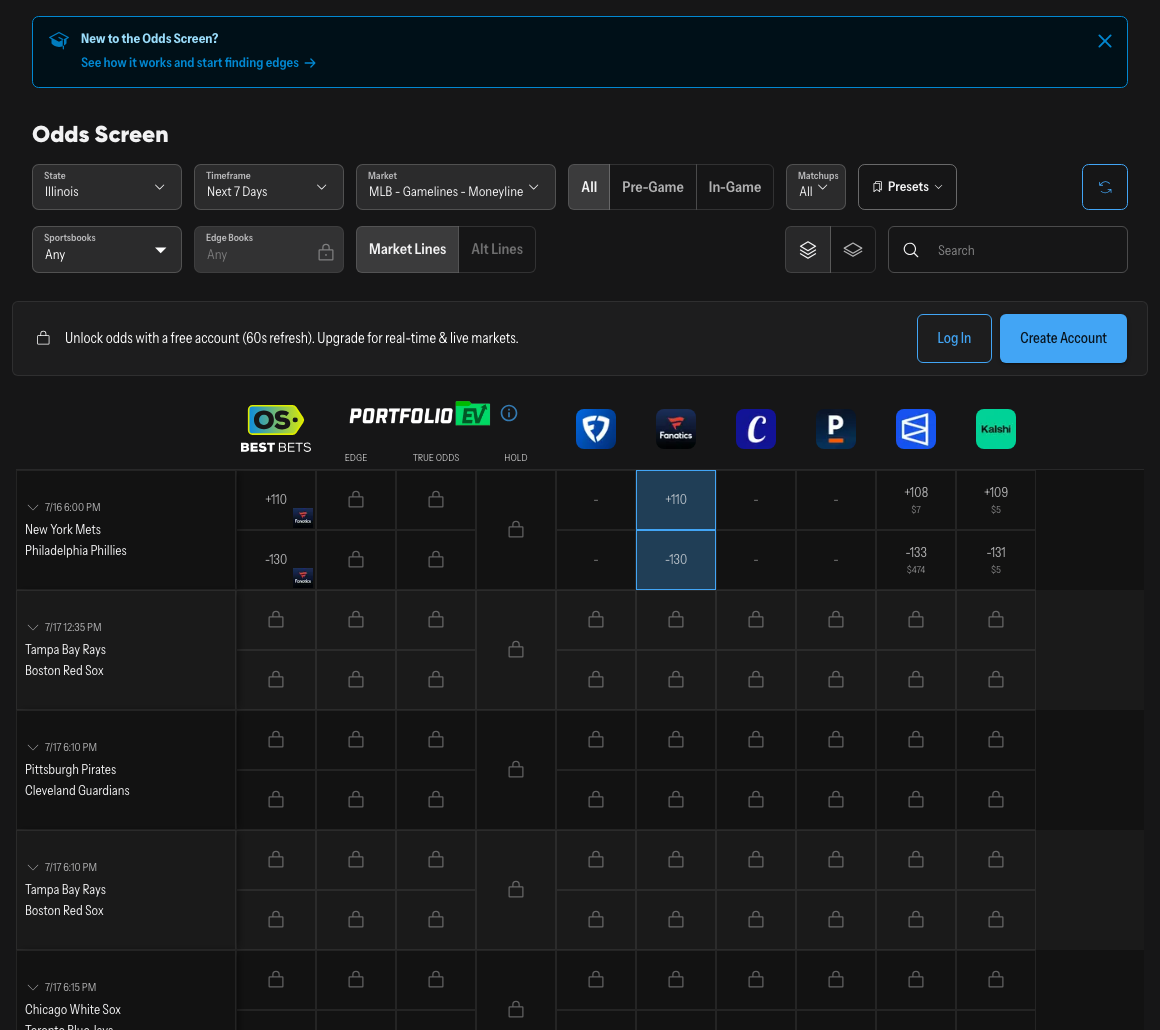 The OddsShopper live odds screen — every book's price on one board, refreshed in real time. Open the live board.
That thirty-second check, on every line you bet.OddsShopper runs the same no-vig math across every major sportsbook automatically and flags where a price sits in your favor. Take it for a free 7-day OddsShopper Pro trial, and code COMMANDERS20 takes 20% off your first OS Pro or OS Core payment if you stay.
The 7 That Explains 2025 Better Than 5-12 Does
Here is the integer promised at the top: seven. That is how many games Jayden Daniels played in 2025, and the number is uglier than it looks, because he was pulled out of several of them: a knee sprain in Week 2, a hamstring in Week 7, a dislocated elbow in Week 9. He re-aggravated the elbow in Week 14, and Dan Quinn shut him down for the final three games with the season already gone. He threw for 1,262 yards with eight touchdowns and three interceptions across those seven appearances, and ran for two more scores. Everything else about last season is downstream of that number.
Look at what happened around it. Washington started 3-2, then lost 10 of its final 12. The offense still averaged 5.47 yards per play and finished top-five in the league in red-zone touchdown rate, which is not what a broken offense looks like. It is what a functional offense looks like when the quarterback keeps changing. The defense is where the season actually died. Washington finished near the bottom of the league in yards allowed and gave up 451 points across 17 games, and the run defense was the open wound: a front seven playing backups by October got gashed on the ground week after week. That is the unit the front office spent the offseason rebuilding, and it is the half of this roster where the money went.
Then there is the part the win total is really pricing. Washington went 2-5 in one-score games in 2025 after going 8-4 in them the year before, and finished at -13 in turnover margin. Those two numbers are the most volatile things in football and they both broke the same way. A 5-12 team with a functional offense by efficiency, a defense missing starters all year, seven starts from its franchise quarterback, and a -13 turnover margin is not a 5-12 roster. It is a 5-12 outcome, which is a different thing entirely, and it is why the books cut only two wins instead of four.
Reading The Commanders' 2026 Schedule
If health explains the record, the calendar decides whether the correction actually shows up in the standings, and Washington's calendar is not kind. Strength-of-schedule rankings disagree sharply on this team depending on method, which is itself worth knowing: by last year's opponent win percentage Washington sits mid-pack, while projection-based models that price this year's rosters read the road harder. What is not in dispute is the shape of it. Washington went 2-7 against winning-record teams last season, and a large share of its 2026 opponents are priced as contenders.
| Tier | What it holds | What it means for the number |
|---|---|---|
| The Gauntlet | At Philadelphia (10.5), at Dallas (9.5), home for Seattle (10.5), then Indianapolis in London in Week 4 | Where an over gets buried before it starts. A slow start with a QB shaking off an elbow injury is how 7.5 goes under early. |
| The Reset | The bye lands at Week 7, unusually early | Little help. A Week 7 bye means a long unbroken back half with no scheduled recovery. |
| The Bankable | Later dates against Arizona and Tennessee, the two clearest soft spots on the calendar | Where the over gets built. There are not many of these, which is the problem. |
The row worth sitting with is the first one. Washington opens at the Philadelphia Eagles, whose own win total is 10.5, three full wins clear of Washington's and the highest in the division, then travels to the Dallas Cowboys at 9.5, hosts the Seattle Seahawks at 10.5 in Week 3, and boards a plane to London in Week 4. Three of the first four games come against teams the market prices as double-digit-adjacent. The NFC East prices out as Eagles 10.5, Cowboys 9.5, Commanders 7.5, Giants 7.5, which leaves Washington tied with the Giants for the bottom of its own division on the market's read. Our Philadelphia Eagles win total breakdown is worth reading beside this one, because these two tickets touch: the six NFC East games Washington needs to steal are the same games Philadelphia is expected to bank. For the full framework on how soft spots and traps shape a season total, our NFL strength of schedule breakdown walks it game by game.
The Roster: A Rebuilt Defense And One Proven Receiver
A hard schedule punishes thin rosters, so the question becomes what Washington actually did about the 30th-ranked defense that lost it the season. The answer is: a lot, and almost all of it on that side of the ball.
Washington signed edge rusher Odafe Oweh to a four-year deal reported at roughly $100 million, added edge K'Lavon Chaisson and linebacker Leo Chenal, brought in cornerback Amik Robertson and safety Nick Cross, and spent the seventh overall pick on Ohio State linebacker Sonny Styles. That churn is real: roughly seven new starters are projected on defense, under new defensive coordinator Daronte Jones. The old guard is gone: Bobby Wagner and Marshon Lattimore both left, and center Tyler Biadasz departed up front. Von Miller remains an unsigned free agent as of mid-July, with Washington one of several teams still in the picture. Read as a whole, the offseason bought youth and speed on defense by design.
The offense got the opposite treatment. Deebo Samuel, Noah Brown, Austin Ekeler, and Chase Edmonds all left; the replacements are Rachaad White at running back, with rookie sixth-rounder Kaytron Allen behind him, and Van Jefferson at receiver, with third-round rookie Antonio Williams behind him. Terry McLaurin is still the only receiver on this roster a defense has to plan for. And the play-caller changed: Kliff Kingsbury was let go after the 5-12 finish, and assistant quarterbacks coach David Blough was promoted to offensive coordinator, a first-time coordinator inheriting a quarterback coming off an elbow injury.
What both cases are really arguing7.5 wins on a 5-12 team whose quarterback started seven of them. Is a healthy Daniels behind a rebuilt defense worth three more wins than last year, or does a first-time coordinator with one real receiver cap this team where it finished?
Hold onto that split, a defense rebuilt against an offense stripped, because both cases below keep reaching for it.
The Case For The Over
The over is the bet that 5-12 was a health outcome, not a talent level, and that 7.5 is still too low for a roster with this quarterback:
- The Quarterback Plays, And Nothing Else Here Matters As Much. Daniels started seven games. The over needs eight wins from a team that, two seasons ago with a healthy Daniels, reached the NFC Championship Game. You are not betting on development; you are betting on availability, and he spent the offseason getting physically stronger to stay on the field.
- The Bad Luck Was Measurable And It Regresses. A 2-5 record in one-score games after an 8-4 mark the year before, plus a -13 turnover margin, is the statistical signature of a team that lost more than it played like. Both of those numbers revert toward neutral more often than they repeat, and either one alone is worth multiple wins.
- The Defense That Lost The Season Got Rebuilt, Not Patched. Roughly seven new projected starters, nine figures committed to Oweh, the seventh overall pick spent on a linebacker, and a new coordinator. The defense that lost the season spent it on backups, so some of that repairs itself, and the front office paid to repair the rest.
- The Offense Was Never The Problem. 5.47 yards per play and a top-five red-zone touchdown rate, achieved while cycling quarterbacks. Read that as a floor, not a ceiling.
The through-line: the over asks for eight wins from a team the market itself now believes in more than last year's record does. Set that against the 54.3% the no-vig line gives the over, and the question is whether a fully healthy Daniels behind seven new defensive starters is worth better than a coin flip plus a nudge.
The Case For The Under
The under is the bet that the roster you are buying the rebound on has one receiver, a rookie play-caller, and an opening month built to punish both:
- A First-Time Offensive Coordinator Is The Hidden Variable. David Blough goes from assistant quarterbacks coach to running the offense. Kingsbury's offense was efficient by yards per play even in the wreckage; there is no evidence yet that the replacement clears that bar, and a new voice plus a returning-from-injury quarterback is not a fast start.
- Terry McLaurin Is The Passing Game. Deebo Samuel and Noah Brown are gone, replaced by Van Jefferson and a third-round rookie. The backfield lost Ekeler and Edmonds and got Rachaad White. If defenses can bracket McLaurin without paying for it, that top-five red-zone rate does not survive contact.
- The Calendar Does Not Grant A Soft Landing. Philadelphia and Dallas on the road out of the gate, Seattle in Week 3, London in Week 4, and a bye at Week 7 that leaves a long unbroken second half. Against winning teams last season Washington went 2-7.
- The Health Case Cuts Both Ways. "He'll be healthy this time" is an assumption, not a fact, and it is the single load-bearing assumption under the over. Daniels lost time to three separate injuries in one season: a knee, a hamstring, and the elbow. The over is buying 17 games from a quarterback who managed seven, and this is not one fluke elbow regressing to neutral. It is an availability pattern in year two.
The honest version of the under is not that Washington is bad. It is that eight wins requires a first-time coordinator, one real receiver, and a returning quarterback to clear a schedule stacked with priced-up contenders, and the under does not need a collapse, only a repeat of a 7-10 season that good-not-great teams post constantly. At +110 it pays plus money to say so.
Key Thresholds: Why 7 Vs 8 Wins Is The Whole Bet
The line is a clean 7.5 everywhere we checked, so there is no half-point to shop and no alternate number doing quiet work. The whole ticket hangs on a single win. The over needs eight. The under cashes at seven or fewer.
- The Over (Needs 8): the "he plays 17 games" ticket. It asks for three more wins than last season from a team whose quarterback missed 10 games and whose defense was rebuilt around nine figures of new edge money.
- The Under (Needs 7 Or Fewer): the "the offense is McLaurin and hope" ticket. It needs only a two-win improvement to fail. Washington can be visibly better than 5-12, finish 7-10, and this still cashes at plus money.
- The Eight-Win Hinge: because the line sits at 7.5, seven and eight are opposite results on the same ticket. Washington was 2-5 in one-score games. In a season decided by a single win, that bucket is the bet. One coin flip in December is the entire margin.
The practical move follows from the de-vig math above. The market's honest line is 54.3% over. If your read on a healthy Daniels lands north of that, the over is your side; if the coordinator change and the receiver room land you south of it, take the under and the plus money. Then shop that side everywhere you can reach, because a nickel of price on a five-month hold is real money. That is separate from closing line value but related: lock the friendliest number now, and if it is still the right side when the market settles in Week 1, that is closing line value, the strongest evidence your read beat the market instead of catching a bounce.
How This Class Of Team Gets Priced
A bad record produced by a hurt quarterback is one of the most systematically mispriced things in football, and the market knows it, which is why the correction is usually already half in the number by July. That is the lesson worth carrying off this page. Books do not price the record; they price the roster and the schedule, then adjust for the games the quarterback missed. A 5-12 season with 10 quarterback absences, a -13 turnover margin, and a 2-5 one-score record gets read as roughly a 7-to-8-win team having a terrible year, not as a 5-win team. That is how you get a two-win cut instead of a four-win cut, and why the over is juiced to -130 rather than hanging at even money.
The trap sits on the other side of that same insight. Because the correction is public, the value is not in noticing that Daniels was hurt: everyone noticed, and it is why the over costs -130. Whatever edge exists lives in the pieces the market weights loosely, and they cut both ways. On the under's side, a first-time coordinator, a receiver room down to one name, and an early schedule stacked with priced-up contenders. On the over's, nine figures of new edge money on a defense that got its starters back, and two of the most reversible numbers in the sport sitting at -13 and 2-5. Which of those you weight heavier is what decides whether a no-vig 54.3% reads generous or stingy, and it is why this total is worth a read instead of a reflex.
New to OddsShopper?It scans every major sportsbook and flags the bets priced in your favor, so you can compare the Commanders total across books and take the best available price on whichever side your projection picks. Start with a free 7-day OddsShopper Pro trial, and if you subscribe, code COMMANDERS20 takes 20% off your first OS Pro or OS Core payment.
How To Bet The Commanders Win Total The Smart Way
A season-win future is a five-month hold you cannot hedge cheaply, so what matters is knowing in advance what moves this specific number and what it would have to become before the other side is live.
- One Story Moves 7.5 More Than Everything Else Combined: The Elbow. This is not a normal futures ticket where a dozen inputs each nudge the price. A clean camp report on Daniels firms the over past -130 and the under's +110 gets better; a setback in August takes the total to 6.5 and hands the over a price it has not offered all summer. If you like the over, the case for firing before camp opens is that you are buying ahead of the only news that reprices it.
- The Second Mover Is Blough's Preseason Install. A first-time coordinator is the market's loosest input here precisely because there is no tape on him. Three preseason drives that look organized will not move 7.5, but a Week 1 line against Philadelphia that comes in a point friendlier than expected tells you the market has quietly upgraded the offense.
- Know Your Own Trigger Before You Shop. The no-vig line is 54.3%. If your read is 58% on the over, -130 is a bet and -145 probably is not; if you are at 50%, +110 is thin and +130 is the ticket. Set that threshold first, then go find the book that beats it, because BetMGM and FanDuel agreeing today does not mean the third book you check does. Our bankroll management guide covers sizing a long-dated position, and the same read applies to the other rebound totals on the board, like our Baltimore Ravens win total breakdown.
Bottom Line
Go back to the seven. Everything on this page has been an argument about what that number means, and the two sides are really disagreeing about one thing: whether a season is a measurement or an accident. Bet the over and you are saying 5-12 measured an injury, not a roster, and that the arithmetic of a healthy quarterback plus a rebuilt defense clears eight without needing anything to go right. Bet the under and you are saying the seven starts were the excuse rather than the reason, and that a first-time coordinator with one receiver worth double-teaming would have struggled through this schedule whether Daniels played or not. The market has already picked a side, gently: 54.3%, which is what a lean looks like when it is honest about being a lean. Your job is not to agree or disagree with 5-12. It is to land somewhere other than 54.3% and know why.
Ready to shop the number?OddsShopper compares the Commanders win total across every major sportsbook and flags where the price is in your favor. Try it free for 7 days, then code COMMANDERS20 takes 20% off OS Pro or OS Core if you subscribe.
More on this: Shaedon Sharpe Injury: Blazers Win Total Odds On Kalshi · Las Vegas Raiders Win Total 2026: Over/Under Wins & Odds · Lindy Vs. The Machine: Attacking The Saints Win Total On Kalshi · Saints Win Total 2026: The 7.5 Line, Kalshi Priced · Kalshi Steelers Over 8.5 Settlement: Refunded, Not Paid