Updated August 25, 2026 · 10 min read · by Eric Lindquist
In late May, the day after a new chair was sworn in at the Federal Reserve, the Kalshi contract asking whether the Fed would cut rates at all in 2026 traded at 31.6 cents. By June 4 it had climbed to 38. On the afternoon of August 25 it is bid 12.5 cents, with the last trade at 13 and the offer drifting between 13.5 and 14.4 through the session.
Nothing dramatic happened in between. There was no crash, no emergency, no surprise policy statement. The Fed simply kept not cutting, meeting after meeting, and the market spent the summer taking the possibility apart one week at a time. What is left is a year with three scheduled decisions in it and a market that has effectively closed the file on all three.
There is a second number that explains the first, and it is stranger than the collapse itself. We will get to it below, along with what eight AI models made of this contract when they were shown every fetched fact and no prices at all.
Stay ahead of the markets.
Daily insights and expert picks on Kalshi, Polymarket, and what's moving markets.
Free forever. Unsubscribe anytime.
What The Summer Actually Did To This Number
The contract is KXRATECUT-26DEC31, and its settlement language is short enough to quote whole: "If the Federal Reserve cuts its target federal funds rate range at least once between February 26, 2026 and December 31, 2026, then the market resolves to Yes."
That is a low bar by design. One quarter-point cut at any of the three remaining meetings resolves it. An emergency intermeeting cut resolves it. Size does not matter and timing does not matter. The only way it resolves No is if the Federal Open Market Committee reaches December 31 having never once moved the target range down. The exchange counts by the range itself rather than by meetings, which is a distinction our breakdown of how Kalshi counts a rate cut walks through in detail.
Here is the year, priced. The first five rows are Kalshi's daily closes for this contract, retrieved from its price history on August 25, 2026; the last row is the live quote:
| Date | Any 2026 cut | What happened |
|---|---|---|
| May 23 | 31.6¢ | The day after Kevin Warsh was sworn in as chair |
| June 4 | 38.0¢ | The high-water mark of the last 90 days |
| July 1 | 25.0¢ | Halfway through the year, still no cut |
| July 29 | 18.1¢ | The FOMC holds, with three dissents to hike |
| August 19 | 12.1¢ | The July minutes are published |
| August 25 | 12.5¢ bid | Live quote; last trade 13¢ |
The July inflation report barely registered: the contract sat at 16.1¢ on August 12 and was still at 15.8¢ on August 18. So the single sharpest move of the summer came from a document rather than from data, and it came overnight. On August 19 the Fed published the minutes of its July meeting, the contract fell 3.7 cents in a day, and the sentence that did the damage reads: "policy tightening would likely be necessary if inflation did not decline." Some participants went further and said financial conditions "might not currently be sufficiently restrictive to facilitate a return of inflation to 2 percent."
Read that as a trader and the conclusion is uncomfortable. The live argument inside the committee that week was not about how soon to ease. It was about whether policy was tight enough already.
The Committee This Chair Inherited
Kevin Warsh was confirmed by the Senate on May 13, 2026 and took office as chair on May 22. He arrived with a public record on exactly this question, and the record is why the contract was priced near 38 cents in his first two weeks.
Before his nomination, Warsh said of the Fed: "The specter of the miss they made on inflation, it has stuck with them. So one of the reasons why the president ... is right to be pushing the Fed publicly is we need regime change in the conduct of policy," as recounted by economists Cristina Bodea and Andrew Kerner writing in The Conversation.
The nomination was fought over precisely that. At his April 21 confirmation hearing, Sen. Ruben Gallego told him "We're worried about your independence," and Sen. John Kennedy framed the problem from the other side of the aisle: "The problem is that President Trump has said he's not going to appoint anybody who wouldn't agree to lower interest rates." Warsh's answer, carried by PBS NewsHour, was that "the president never asked me to predetermine, commit, fix, decide on any interest rate decision in any of our discussions," and that "I take my responsibility to be an independent leader of the Federal Reserve very seriously, if confirmed by this body."
Prediction markets do not settle arguments about motive. They price outcomes, and the outcome so far is a matter of record: since Warsh took office the committee has met twice and cut zero times, the target range has sat at 3.50 to 3.75 percent since the Fed's last cut in December 2025, and the only dissents at the July meeting came from Beth Hammack, Neel Kashkari and Lorie Logan, all three of whom wanted to raise rates by a quarter point. Jerome Powell remains a sitting governor on the same board. Whatever a president wants, a chair gets one vote, and this committee's dissenting wing is pulling the other way.
Where The Money Actually Sits
Now the second number.
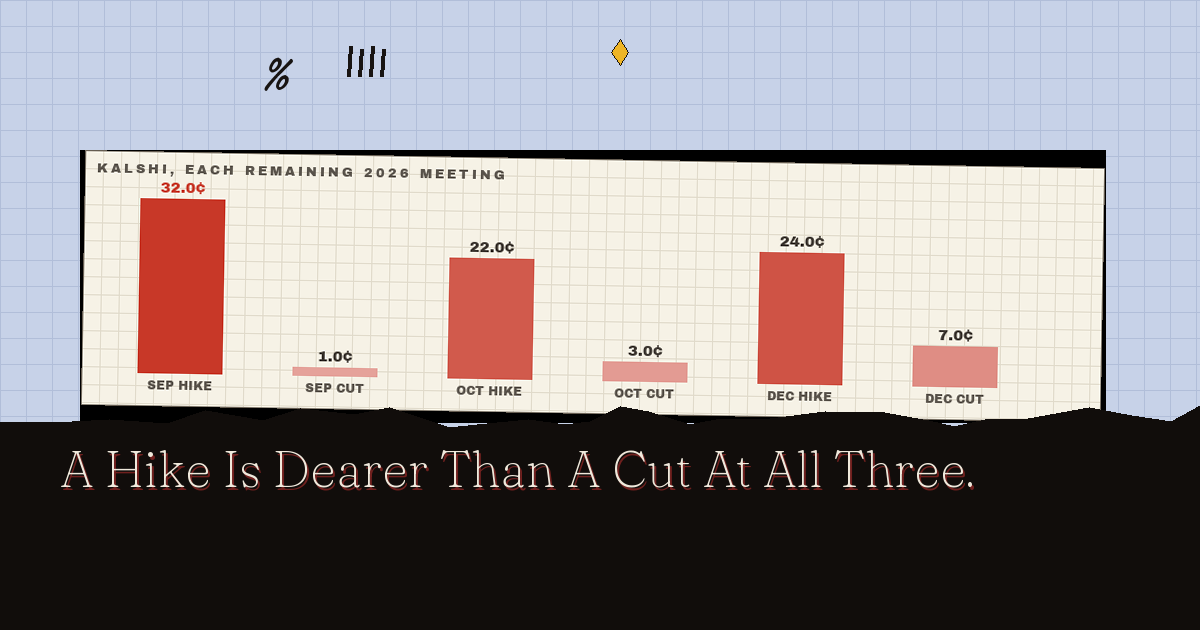
On the same exchange, on the same afternoon, a rate hike is priced higher than a cut at every remaining meeting of 2026. Not close to a cut. Higher than it, by multiples.
| Meeting | Hike 25bp | Cut 25bp | Hold |
|---|---|---|---|
| September 15-16 | 32¢ | 1¢ | 68¢ |
| October 27-28 | 22¢ | 3¢ | 72¢ |
| December 8-9 | 24¢ | 7¢ | 65¢ |
September is the one that stops you. The market gives a quarter-point hike a one-in-three chance, while the September cut contract has no bid at all and is merely offered at a cent. That is not a market hedging its bets on the direction of policy. That is a market that has picked a direction, and it is up.
The companion count market agrees from the other side. Kalshi's separate board on how many times the Fed cuts in 2026 has exactly zero cuts bid at 87.4¢, exactly one cut at 10.9, and exactly two at 2.2. That implies roughly 12.6 cents on at least one cut, which is the same answer the headline contract gives to a tenth of a cent. Two independently traded boards, one number.
The headline contract has real depth behind it: 505,131 contracts of open interest and 1,019,833 traded over its life. The bid has been pinned at 12.5 all afternoon while the offer has drifted between 13.5 and 14.4, so the spread is worth naming. At the 13-cent last trade you are getting roughly +669 in American odds, and crossing to the offer costs you another one to two cents on a contract priced in the low teens. On a market this size that spread is the cost of admission rather than a sign of a thin book, but it is real money on a small-priced contract.
Every Seat's Number
We put the contract to eight AI models with no price attached. Each received the same fetched dossier: the July FOMC statement, the August 19 minutes, the current Board of Governors, July CPI, July payrolls, the Treasury yield curve as of August 24, the FOMC calendar and the verbatim settlement rule. None of them saw a quote, a spread, or an implied probability. Then each model read the other seven's anonymized reasoning and was invited to revise.
| Model | First pass | After revision |
|---|---|---|
| Sonnet | 40% | 13% |
| Kimi | 22% | 16% |
| GLM | 20% | 14% |
| ChatGPT | 19% | 18% |
| Fable | 17% | 15% |
| Opus | 10% | 11% |
| Gemini | 9% | 15% |
| DeepSeek | 7% | 12% |
| Panel Blend (Seat Median) | 18.0% | 14.5% |
Every seat on this panel is graded against real market settlements — records to date: Gemini 86% on 4,760 graded calls · Kimi 83% on 2,494 graded calls · GLM 81% on 2,504 graded calls · DeepSeek 80% on 2,542 graded calls. Recomputed daily; the full scoreboard is public.
More live boards from the same panel: Fed emergency meeting before 2027 at 4.2¢ bid · how Kalshi counts a rate cut, where zero 2026 cuts is bid 87.4¢ · the two Kalshi Fed markets explained. Prices fetched August 25, 2026.
These are model estimates, not predictions of fact and not financial advice. Kalshi event contracts trade on a CFTC-regulated exchange; participation is 18+ and limited to eligible states.
Every panel number in this piece gets graded in public once the market settles, and you can check the panel's history on the full graded scoreboard before deciding how much weight any of it deserves.
The blend is the seat median, 14.5%, against a contract last traded at 13 cents. Those two numbers are close enough that the honest description is agreement rather than disagreement. What is worth reading is not the gap. It is how the panel got there.
Note also what the seats said about the other tail. Asked separately for the odds of a 2026 hike, the panel's answers ran from Sonnet's 10 to 15 percent up to Gemini's 40, with several seats sitting in the mid-20s. On both our numbers and the market's, the Fed is roughly twice as likely to raise rates this year as to lower them.
Where The Panel Changed Its Mind
The first round produced a 33-point spread. The second produced a 7-point one, and the collapse came from a single argument being tested and rejected in public.
Sonnet opened at 40%, the highest number on the board, and its case was textual: the July minutes tie further tightening to inflation not declining, and core CPI had just eased from 2.59% to 2.48% year over year. On that reading the committee's own stated condition for hiking had just failed, so the path bends toward easing.
Five seats went after it independently, and they all found the same flaw. In the revision round each model reads the others' reasoning anonymised, labelled Forecaster A through H rather than by name, so that no seat defers to a brand. Sonnet was Forecaster F.
Forecaster F's 40% reading of the minutes' conditional language ('tightening necessary if inflation does not decline') is the most interesting argument, but it conflates 'not tightening' with 'cutting' — inflation declining removes the hike trigger but does not create a cut trigger. — GLM
The natural endpoint of that condition being met is a prolonged hold, not easing. — Kimi
Opus moved only from 10% to 11%, and explained why the panel's strongest new argument was one it had already priced:
I held at 11%. Forecaster E's correlation point (the meeting probabilities are one regime break, not independent draws) matched what I had already applied. — Opus
That correlation point is the quiet technical insight of the whole run, and by round two several seats had adopted it explicitly. A cut in September, a cut in October and a cut in December are not three independent coin flips to be added up. They are three expressions of one event: this committee changing its mind about the balance of risks. Treat them as independent and you get about 15%. Treat them as one correlated regime break, which is what the seats that spelled out their arithmetic concluded, and you get 11 to 14. The full revised panel ran from 11% to 18%, with a 14.5% median. Sonnet finished at 13%, having tested its own thesis against seven others and found it wanting.
What Would Change The Panel's Mind
The seats were asked for event-shaped triggers, not sentiment. Four came back repeatedly, and each has a date attached.
- The August Employment Report, Due In Early September. July payrolls came in at -23,000, continuing a four-month deceleration from +148,000 in April. A second negative print, especially with the unemployment rate turning up from its current 4.1%, was the single most-cited catalyst on the board. Opus put it plainly: unemployment at 4.4% with another negative payroll print "pushes me sharply UP, toward 30-35%."
- The August CPI Report, Also Due Before The September Meeting. Core inflation is at 2.48% and falling; headline is still 3.36%. Several seats said core re-accelerating above roughly 2.7% would push their numbers toward 5% and effectively end the question for the year.
- Jackson Hole, August 27-29. Warsh is scheduled to give his first symposium remarks as chair. Most seats treated a speech as a modest mover in either direction, on the reasoning that one chair cannot cut alone against a committee whose dissenters want to hike.
- The September Meeting Itself, On The 15th And 16th, And Its Updated Projections. A dovish dissent replacing a hawkish one, or a median dot showing any 2026 easing, was the trigger seats said would move them hardest upward. An actual hike, or a fourth hawkish dissent, pushes the panel toward 3 to 5 percent.
Two things the panel explicitly refused to treat as triggers: political pressure on the Fed, and the chair's own pre-confirmation rhetoric. As Sonnet put it in its written reasoning, rhetoric is "a soft tailwind, not a mechanism, until it shows up as an actual vote shift."
When This Settles, And What Lands First
| Event | Date |
|---|---|
| Jackson Hole Symposium, Warsh's First As Chair | August 27-29, 2026 |
| August Employment Report | early September 2026 (expected) |
| August CPI Report | early September 2026 (expected) |
| FOMC Meeting, With Updated Projections | September 15-16, 2026 |
| FOMC Meeting | October 27-28, 2026 |
| FOMC Meeting, With Updated Projections | December 8-9, 2026 |
| Contract Settles | January 1, 2027, 10 a.m. ET |
This page is re-scored when the story moves, and the triggers above are the moves that count. Prices and panel numbers on this page are as of August 25, 2026.
Hottest Prediction Markets Right Now
- 2028 Democratic presidential nominee · $193M traded
- 2027 Pro Football Champion · $72M traded
- 2028 U.S. Presidential Election winner? · $62M traded
- Pro Baseball Champion · $60M traded
- 2028 Republican presidential nominee · $60M traded
- Bitcoin price at the end of 2026 · $33M traded
Every market above links to our full AI model verdict; browse them all on the OddsShopper prediction markets hub, and see how every settled call actually scored on the full graded scoreboard.
More on this: Fed Rate Cut in September? Traders Are Betting on a Hike · Traders Are Betting On A Quiet Fed. The Machines Are Not So Sure · NFL Spread Predictions: The Panel Doubts Almost Every Favorite · Colorado Vs Georgia Tech Picks: Two Untested QBs, One Team That Can Run · Kalshi Fed Odds: Trump's Own Pick Might Hike On Him
The Bottom Line
The Kalshi contract on any 2026 Fed cut is bid 12.5 cents and offered at 14.4, down from 38 in early June. Eight models, shown every fetched fact and no prices, blended to 14.5% after a revision round. Two boards on the same exchange and one price-blind panel have converged on the same answer, which is that this committee is very unlikely to cut before the year is out.
The reason is not that the economy is strong. Payrolls have gone from +148,000 in April to -23,000 in July, and the yield curve is steep enough that the 30-year sits at 5.23% against a policy rate under 4. The reason is that this particular committee, in its own most recent published words, is still arguing about whether it needs to tighten. Falling inflation weakens one condition for a hike. It does not build the case for a cut, and the eight-model panel spent a full round of debate establishing exactly that distinction.
Watch the payroll print in early September. It is the one release on the calendar that every seat agreed would move the number, and it lands before the Fed next meets.