Kalshi combos generate more confused math questions than any other corner of the exchange, and I understand why: multiply a few 60-cent legs together and the payout number gets exciting fast. I trade combos occasionally and skip them most of the time, and the difference between those two decisions is never the size of the multiplier. It is one question: is the combo price cheaper or richer than what the legs are honestly worth together? This guide is the pricing literacy to answer that. How a fair combo price is derived, the one situation where stacking legs is the sharper entry, the several situations where it quietly robs you, and what the fees and the exit actually cost on each structure.
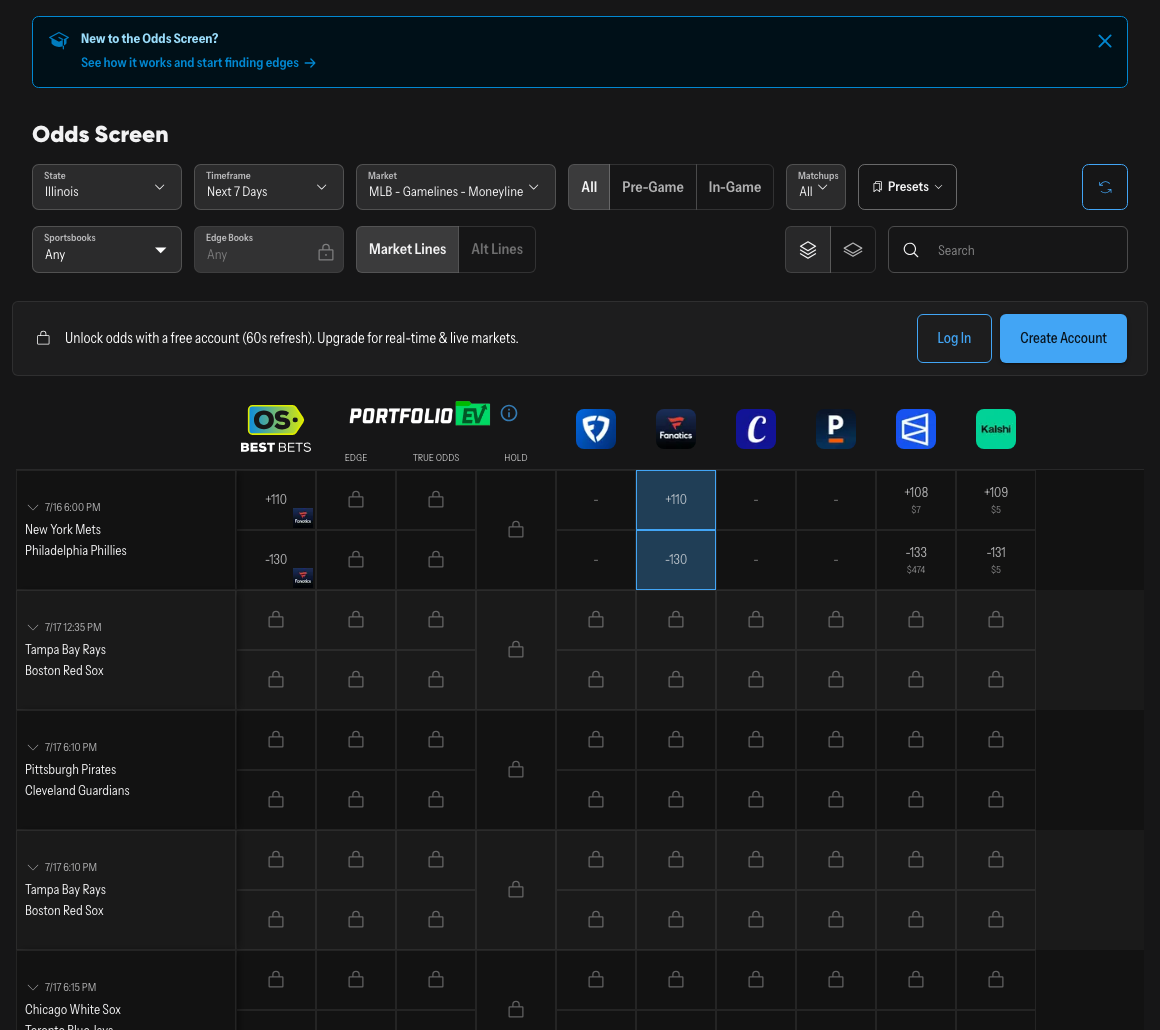 The OddsShopper live odds screen — every book's price on one board, refreshed in real time. Open the live board.
In Summary
- A Fair Combo Is The Product Of Its Legs. Three independent legs at 60 cents imply 0.60 x 0.60 x 0.60, a 21.6% joint probability, so about 21.6 cents is the honest benchmark for the combo.
- Correlation Is The Only Structural Reason To Stack. When one leg hitting makes another more likely, the true joint probability beats the naive product, and a combo priced off independence is cheap.
- Independent Legs Compound Whatever You Bring. A small per-leg edge grows when multiplied, and a small per-leg mistake grows just as fast. Stacks amplify judgment in both directions.
- Fees Hit Combos Harder Per Dollar. Three 60-cent singles cost about 2.8% of stake in taker fees; the equivalent combo costs about 5.5%. The fee formula rewards mid-range prices held separately.
- The Exit Is The Hidden Cost. Combo books run thin, spreads run wide, and a mid-run exit can give back several cents of value. Never enter a stack you cannot afford to hold to settlement.
Stay ahead of the markets.
Daily insights and expert picks on Kalshi, Polymarket, and what's moving markets.
Free forever. Unsubscribe anytime.
How A Fair Combo Price Is Derived
Most Kalshi markets are Yes/No contracts that settle at $1.00 or $0.00 on a CFTC-regulated event-contract exchange (combos can settle at intermediate values under the partial-resolution rule below), and the price in cents reads as the market's probability. A combo simply asks several of those questions at once: every leg has to come true for the contract to pay the dollar.
For independent legs, probability theory prices that in one line: multiply. If leg A trades at 60 cents, leg B at 60 cents, and leg C at 60 cents, and none of them influence the others, the joint probability is 0.60 x 0.60 x 0.60 = 0.216. A fair combo sits near 21.6 cents. That single multiplication is the benchmark for all Kalshi combo pricing, and it is the number I compute before I even look at what the combo market is asking. Cents-to-odds conversion, if you want the sportsbook translation of any leg, is covered in our Kalshi odds guide.
Two things follow immediately from the product rule. First, combo prices collapse quickly: three modest favorites become a roughly 22% long shot when multiplied. Second, the combo market can only be attractive relative to that product, never in isolation. A combo asking 18 cents for legs whose product is 21.6% is offering value. The same combo asking 26 cents is charging you a premium for the thrill of the stack.
Worked Example: Three 60-Cent Legs, Priced Both Ways
Put real order arithmetic on it. Suppose you like three outcomes, each trading at 60 cents, and you have about $200 to commit. Here are the two structures, fees computed with Kalshi's standard taker formula, round up of 0.07 x C x P x (1-P) per order, the same formula walked through in our Kalshi fees breakdown:
| Structure | Contracts | Stake | Taker Fees | Total Cost | Pays If All Three Hit | Fee As % Of Stake |
|---|---|---|---|---|---|---|
| Three Singles At 60c | 100 each | $180.00 | $1.68 x 3 = $5.04 | $185.04 | $300.00 | 2.8% |
| One Combo At 21.6c | 100 | $21.60 | $1.19 | $22.79 | $100.00 | 5.5% |
The fee line deserves a pause. Each 60-cent single costs 0.07 x 100 x 0.60 x 0.40 = $1.68, and three of them cost $5.04 on $180 staked, about 2.8%. The combo is one order at 0.07 x 100 x 0.216 x 0.784 = $1.19 on only $21.60 staked, about 5.5%. The combo writes a smaller check in dollars and a larger one per dollar at risk, because the P x (1-P) curve penalizes you relatively harder at long-shot prices with small stakes.
The structures also fail differently. Go 2-for-3 and the singles return $200 on the two winners, which clears the $185.04 all-in cost with a small profit. The combo returns nothing. Singles pay you for being mostly right; the combo pays only for being entirely right. That asymmetry is not a flaw, it is the product, but you should price what you are giving up: the partial-credit outcomes that singles preserve and stacks destroy.
When Combos Beat Singles: Real Correlation
There is exactly one structural situation where the stack is the sharper entry, and it is when the legs push on each other. The numbers that follow are illustrative, chosen to make the mechanism visible.
Suppose leg A is a team winning its match, trading at 60 cents, and leg B is that team's star scoring, also trading at 60 cents standalone. Those two events are not independent: in the matches the team wins, the star is more likely to have scored. Say your honest estimate is that when A happens, B happens 75% of the time. The true joint probability is then 0.60 x 0.75 = 0.45, a 45% chance, while the naive independence product says 0.60 x 0.60 = 0.36. If the combo market prices the pair anywhere near the 36-cent product, you are buying a 45% event for 36 cents, a nine-point gap that dwarfs anything you will find shopping single legs.
That is the entire honest case for combos: correlation the price has not absorbed. Same-team stacks, cause-and-effect pairs, outcomes that share a driver. The skill is estimating the conditional probability, the "75% given A" number, with something better than enthusiasm, and being honest when the correlation is weaker than the story suggests. The related question of stacking opposite sides is a different tool entirely, covered in trading both sides of a market on Kalshi.
Every leg deserves a fair price before it enters a stack. The live odds screen is where I build mine: the tool surfaces the de-vigged, no-vig fair probability across DraftKings, FanDuel, and every other major book, so each leg's true number comes from the sharpest market consensus available instead of my own optimism. Multiply honest legs and you get an honest combo benchmark. That no-vig layer is part of OS Pro, and a free 7-day trial lets new users build these benchmarks before paying a cent.
When Combos Quietly Rob You
Stack independent legs and the multiplication works on everything you feed it, including your mistakes.
Compounding amplifies estimation error. Buy three 60-cent legs that are truly worth 63% each and the combo's true probability is 0.63 x 0.63 x 0.63 = 25.0% against a 21.6-cent product price, a relative edge of nearly 16%, better than the 5% edge on any single. Now flip the sign. If those legs are truly worth 58%, each single overpays by two points, a small mistake. The stack's true probability is 0.58 x 0.58 x 0.58 = 19.5% against the same 21.6 cents, and your small per-leg mistake has compounded into paying 21.6 for 19.5, roughly a 10% overpay. Stacking is a lever. It multiplies good judgment and bad judgment with equal enthusiasm, which is why the compounding math deserves its own article, and has one in the sibling piece on Kalshi parlay math.
The fee drag stacks with the structure. As the worked example showed, the combo's fee is a larger share of stake than the singles' fees, and if you exit early by crossing the spread, the sale is another taker order with another fee on top of the spread you cross.
Thin books charge admission twice. Popular single-leg markets carry tight spreads. Combo books are thinner, so you often pay a wider spread entering, and a much wider one if you try to leave. Every cent of spread is pure cost measured against fair value.
None of this says never stack. It says the multiplier is the price tag, not the product. When the legs are independent and fairly priced, the combo is the same expected value as the singles, minus more friction, which is the polite way of saying it robs you slowly.
The Exit Problem, And What Settlement Does To A Stack
Two mechanics finish the picture. First, the exit. A combo mid-run, with two legs banked and one pending, can be sold into the order book like any position, and the mechanics of that sale, bid, spread, and fee, are exactly the ones in our guide to how Kalshi cash out works. But combo depth is thin, and thin books quote insulting exits precisely when your position is most interesting. My rule: never enter a stack I am not comfortable holding to settlement, because the exit door is narrow and the toll is variable.
Second, settlement itself. With partial resolutions, the payout is the product of all individual position values. Two legs at full value and a third valued at 0.70 pays $0.70 per contract, not $1.00. The multiplication that built your payout scales it down the same way, leg by leg, so a stack can win almost everything and still pay noticeably less than the sticker.
More on this: Correlated Parlays On Kalshi: The Team-To-Advance Plus Striker-To-Score · Barcelona Vs Feyenoord Odds: Does The Favorite Survive The Fee? · Where Does Bitcoin End 2026? Kalshi's Price-Band Odds · The Longest Shot On This Board Might Be The Best-Kept Secret · 2026 Governor Races: Every Kalshi Board We Track
Multiply The Probabilities Before You Admire The Payout
The workflow that keeps combos honest takes under a minute. Price each leg on its own. Multiply the probabilities for the independence benchmark. Ask whether real correlation lifts the joint number above that product, and by how much. Then compare the combo's asking price to your answer, fees and exit included. When the stack survives that arithmetic, take it, and when it only survives on excitement, take the singles. Combos vs singles Kalshi decisions are just pricing decisions wearing a costume.
Build the benchmark before you build the stack. The odds comparison turns any price into an implied probability in one step, and the live odds screen shows the no-vig fair number on every sports market, so every leg you multiply starts honest. That no-vig layer is part of OS Pro, and new users get a free 7-day trial.
Event contracts involve risk and are not appropriate for everyone. Any probabilities discussed here are model estimates, not predictions of fact and not financial or trading advice. 18+. Availability varies by state. Trade responsibly.