The most interesting question I see in prediction market communities every tournament cycle is some version of the same stack: a team to advance paired with its star to score, bought as one combo or held as two singles, and the poster asking whether the payout was luck or an actual edge. Kalshi correlated parlays are the one corner of combo trading where the honest answer can be yes, because correlation between legs is one of the few forces that can push a combo's fair value above the quote you are handed. It can also be a story you told yourself. The difference is one conditional probability, and this article is about computing it instead of feeling it.
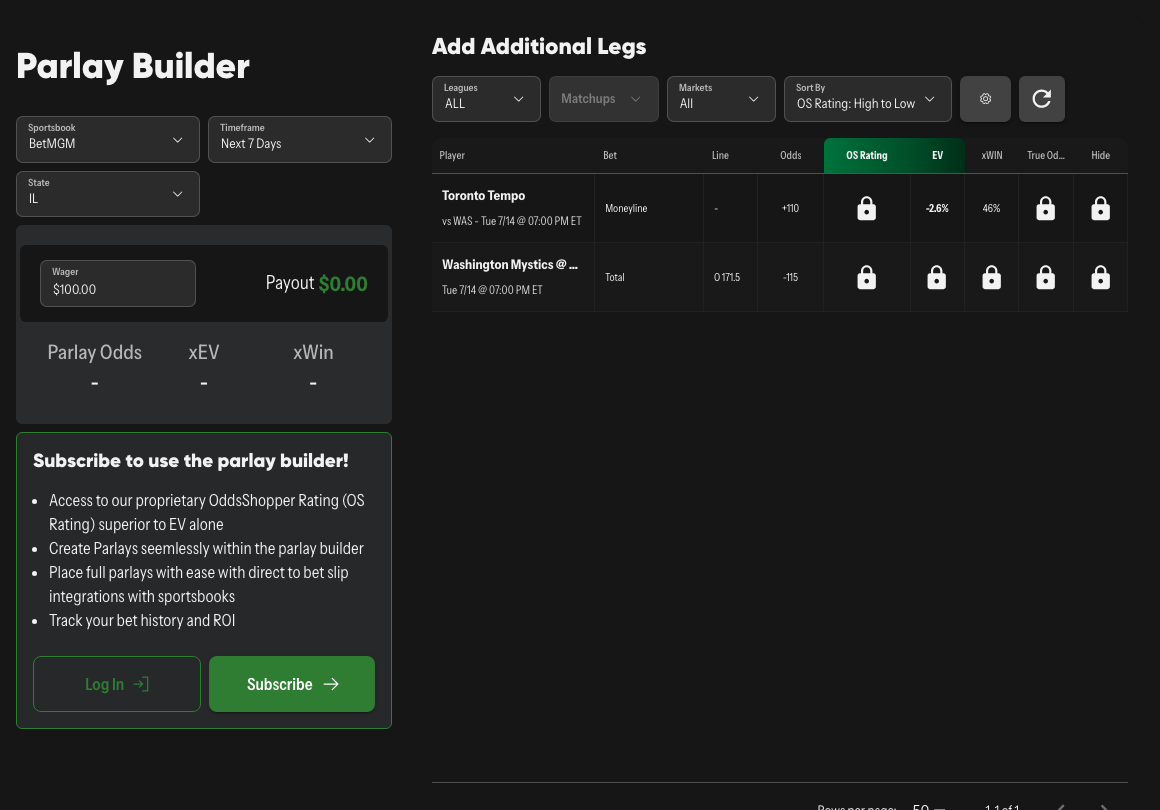 The OddsShopper Parlay Builder — every leg graded live (EV, xWin, true odds) before you lock a ticket. Open the live board.
In Summary
- Independence Is The Default Math. A combo of a 60% leg and a 45% leg is worth 60% x 45% = 27% if the legs have nothing to do with each other. Fair price: 27 cents.
- Correlation Changes The Second Number. The right formula is P(A) x P(B given A). If the striker scores 55% of the time in the runs where his team advances, the stack is worth 60% x 55% = 33%, six points more than the naive product.
- Kalshi Quotes Combos On Request. Each combo is its own market with its own order book, but the price comes from a request-for-quote: you submit the legs, market makers answer, and a combo nobody is quoting shows "payout unavailable." The question is whether the number that comes back already contains the correlation.
- That Gap Is The Entire Edge. A quote that lands near the naive product while the legs are positively correlated is priced below its true chance. No gap after fees, spread, and model error, no trade.
- Soccer To-Advance Markets Settle On Any Route. Extra time and penalties count, so both sides are shorter to advance than to win in 90 minutes. Read it as a longer-priced moneyline and the stack starts broken; other sports' advance markets follow their own overtime rules.
- Correlation Is Local. Same team, same run, same game state: real. Different games, different weeks: an illusion that costs you the premium you paid for it.
Stay ahead of the markets.
Daily insights and expert picks on Kalshi, Polymarket, and what's moving markets.
Free forever. Unsubscribe anytime.
These are market prices and model estimates, not predictions of fact and not financial advice.
The Independence Math Every Combo Price Starts From
Kalshi is a CFTC-regulated event-contract exchange, so most markets in a stack are Yes/No contracts that settle at $1.00 or $0.00, with a price in cents that reads directly as an implied probability. The exception matters for player legs, and Kalshi's combos help page states it directly: if a player in your combo does not play, that position settles according to the rules of the underlying market, the combo is not refunded or canceled, and the payout is recalculated as the product of all position values, including the adjusted value of the affected leg. Kalshi's own example is a leg that settles at $0.70 on a DNP alongside two legs at $1.00, which pays $0.70 per contract. Our leg-voids guide walks through where that money goes. With that caveat filed, combo pricing is unusually transparent. If two legs are independent, the chance both hit is the product of the two probabilities, and the fair price of the combo in cents is that product.
Two independent legs at 60 cents and 45 cents:
0.60 x 0.45 = 0.27, a fair combo price of 27 cents
At 27 cents the combo is roughly a +270 proposition in sportsbook language, against +203 at the 33-cent fair value we will get to shortly; the Kalshi odds guide covers the cents-to-American conversion if that bridge helps. Independence is the right assumption more often than stackers want to believe: outcomes from different games, different days, and different sports do not move each other, and their combo is worth exactly the multiplication, minus the fees you pay to hold it.
One structural fact before the correlation math, because it changes what "the price the market quotes" even means. Kalshi's own help center spells out the mechanism: each combo is a unique market with its own dedicated order book, and its price is determined through a request-for-quote system. You assemble the legs, the platform sends the quote request out to the market, and participants answer with a price; if nobody is quoting that exact combination, the builder shows "payout unavailable" instead of a number. So there is no stale public parlay board priced mechanically off the naive product, waiting to be picked off. The counterparty is a professional pricing your exact stack on demand, so the working assumption is that the returned quote already carries some of the correlation. The edge, when it exists, is the gap between your honest conditional number and the quote that comes back, and a lazy quote from a professional market maker is the exception, not the rule. That is the reason to do the conditioning work before you submit: it tells you in one glance whether the quote is worth taking.
The whole subject of correlation stacking is about the cases where that multiplication is wrong.
New to OddsShopper? It scans every major sportsbook and shows the no-vig fair probability on every market, which is exactly where the P(A) and P(B) in this article should come from. You can try it free for 7 days, and code KALSHISTACK20 takes 20% off your first payment of OS Pro or OS Core if you subscribe.
Same Game Parlay Logic: When One Leg Carries The Other
Two legs are positively correlated when one hitting raises the probability the other hits. The formula stops being P(A) x P(B) and becomes:
P(A and B) = P(A) x P(B given A)
The second term is the conditional probability, and it is the only variable that decides whether the stack is mispriced. A striker's overall scoring rate blends every version of the tournament: the runs where his team controls games and generates chances, and the runs where it is eliminated early or plays from behind. Condition on the team advancing and you have thrown away most of the bad worlds. The scoring rate inside the surviving worlds is higher than the blended rate, and the stack's fair value rises with it.
One market-reading note before the arithmetic, because it breaks more stacks than bad math does. In soccer knockout play, on Kalshi and everywhere else, the team-to-advance market settles on advancing by any route, extra time and penalty shootouts included. Both sides of that market are therefore shorter to advance than they are to win in 90 minutes: advancing is the more likely event, so it prices shorter than the three-way win, never longer. If your mental model of the leg is "win the match," you are conditioning on the wrong event, and the conditional scoring rate you attach to it will be wrong too. Other sports' advance markets follow their own overtime formats, so read the specific contract's rules before you condition on it.
For the practical how-to — building one on the exchange, leg by leg — see Kalshi same game parlays.
Can You Actually Build This Stack On Kalshi?
Here is the caveat the archetype hides. Kalshi combos are built from legs the exchange has grouped as eligible for combination, and for sports that group is usually one game's collection: the winner, the spread, the total, and, where the collection lists them, player props. A team-to-advance contract is a tournament-level market that lives outside any single game's menu, so the advance-plus-score pair is the cleanest way to see the correlation, not a guaranteed item on the combo builder.
Two ways to express it. If the builder will not quote the pair, you can still hold the two singles side by side, but be clear about what that does and does not give you. The correlation edge lives only in a combined payoff priced too close to independence; two separately priced singles carry no such edge, and each one has to clear its own standalone fair-price and fee test. What the conditional work still buys you is an honest read of the exposure: two singles that win and lose together are one bet's worth of risk, not two, and should be sized that way. Or move the same math into a game where both legs live in one collection: a team to win paired with its own striker to score, or, with NFL Week 1 arriving in September and Kalshi carrying a deep football prop menu, a quarterback's passing yards paired with his top receiver's receiving yards. Those two share snaps and drives, which is exactly the shared machinery the formula needs. Our Kalshi same game parlay guide pulls the actual collection menus by sport, so check it before you assume a leg is combinable. The arithmetic below keeps the soccer archetype because it makes the conditional intuitive; every number transfers unchanged to the NFL pair.
Worked Example: Pricing The Advance-Plus-Score Stack
Illustrative numbers, chosen to keep the arithmetic clean; every row is the formula, not a quote from any live market.
A knockout-round setup: the team is 60% to advance. The striker's unconditional tournament scoring probability for this window is 45%. Film and minutes say that in the worlds where this team advances, it plays more attacking football and he takes the set pieces, so your conditional estimate is 55%.
Do not take that 55% on faith, because it is the only number the stack turns on. Two checks turn it from a feeling into a method. First, split the striker's sample: in the matches where his team went through, how often did he score? Read the rate straight from that subset. Second, check the complement the math implies. If he scores 45% of the time overall and 55% in the 60% of worlds where the team advances, then in the 40% of worlds where the team goes out his rate must be (0.45 minus 0.33) divided by 0.40, which is 30%. If 30% looks wrong for the games where his team is eliminated, the 55% is wrong too, and the stack has no edge.
| Input | Independent Read | Correlated Read |
|---|---|---|
| Team To Advance, P(A) | 60% | 60% |
| Striker To Score, P(B) Or P(B Given A) | 45% | 55% |
| Joint Probability | 0.60 x 0.45 = 27% | 0.60 x 0.55 = 33% |
| Fair Combo Price | 27 cents | 33 cents |
If the quote comes back near 27 cents while your honest conditional math says 33%, the gap is six points of probability you are being paid to accept. Put a fee on it, with one caveat: Kalshi's published taker formula, round up of 0.07 x C x P x (1-P), is the ceiling I use for combos, and the exchange's fee treatment can differ by market, so check the current fee schedule before you size. Under that ceiling, 100 contracts at 27 cents cost $27.00 plus $1.38 in fees (0.07 x 100 x 0.27 x 0.73), $28.38 all-in, against an expected settlement value of $33.00 at a true 33%, roughly $4.60 of expected edge on the position. The Kalshi fees breakdown covers the full fee curve; the shorthand here is that the fee is real but small next to a six-point probability gap, and combos, like any Kalshi order, pay it when the order executes.
Reverse the exercise before you trust it. If the returned quote is already at or above your correlated number, there is no edge in the stack, no matter how good the story sounds. The market maker on the other side may be conditioning better than you are, and with a professional pricing on demand, that is the base case.
Your conditional probability is only as honest as the inputs underneath it. The live odds screen is where I build mine for the sports side: the tool surfaces the de-vigged, no-vig fair probability on every market across DraftKings, FanDuel, and the rest of the major books, so each leg starts from a market-grade number instead of a fan's number. Correlation adjustments belong on top of honest inputs, never instead of them. The screen is part of OddsShopper Pro, which is free for the first 7 days, so checking both legs against a real number costs nothing.
Where Correlation Is Real, And Where It Is Illusory
The strongest correlations are local: same team, same game, same run, same underlying cause. A team advancing and its striker scoring share machinery, because the game states that produce one produce the other. A quarterback's passing production and his top receiver's receiving production share snaps and drives. When one event is partly made of the other, conditioning moves the number a lot.
Stretch the distance between legs and the correlation dies fast. Two teams in different matches do not transmit probability to each other. A Tuesday result does not lean on a Sunday result. Stacks built across unrelated games are independence wearing a narrative, and the naive product is their true worth; pay a premium above it for imagined momentum and you have donated the difference. The candid test I use: can I name the specific shared cause, in one sentence, that makes P(B given A) different from P(B)? If the sentence is about vibes rather than mechanism, the legs are independent and I price them that way. The mechanism checklist I run on a player leg: expected minutes if the team leg hits, the player's role in the scoring (set pieces, penalties, target share), where the team total moves when the game state favors the team, and how the opponent plays when trailing. Each item either raises P(B given A) for a reason you can name, or it stays out of the number.
There is also a quieter failure mode: real correlation, overstated. Conditioning on the team advancing might honestly move a striker from 45% to 51%, not 55%. The formula does not defend you from feeding it a hopeful conditional. When my correlated read and the naive product differ by more than a few points, I make myself argue the case for the smaller gap before sizing anything, and our strategy guide is blunt about how often the market's price is the better estimate.
Fees, Sizing, And The Exit
Three practical rails keep correlation stacking from becoming an expensive hobby.
Count the fee before the edge. At 27 cents the taker formula runs at about four-fifths of its peak, because P x (1-P) tops out near 50 cents. A real edge survives $1.38 per hundred contracts; a two-point imagined edge mostly does not.
Size it like the longshot it is. A 33% stack loses twice for every win, and five straight misses happen about 13% of the time (0.67 to the fifth power). That is the deal you signed. It belongs in the small, flat-capped slice of a bankroll, a flat unit of no more than 1% per stack, sized so a five-loss run is boring instead of destabilizing.
If you would rather see how our analysts size and reason through real prices before building your own stack, the free expert picks today publish the reasoning next to every selection at no cost.
Treat it as hold-to-settlement money. A filled combo cannot be canceled or reversed, and reselling it needs a live bid on a listing where one often does not exist; combo books run thinner than single-leg books, and the spread is wider when a bid is there. Size every stack as if you will hold it to settlement. If the first leg banks, the price rerates, and a bid appears, selling into the order book is a bonus exit, not a plan, and it is a second taker order that pays a second fee. The hold-or-sell framework then applies: your updated probability against the net bid, after that fee, nothing else.
More on this: Kalshi Parlays Are Called Combos, And The Math Is Not What You Think · Barcelona Vs Feyenoord Odds: Does The Favorite Survive The Fee? · Where Does Bitcoin End 2026? Kalshi's Price-Band Odds · The Longest Shot On This Board Might Be The Best-Kept Secret · 2026 Governor Races: Every Kalshi Board We Track
Stack With A Number, Not A Story
Every correlated parlay worth making can be written as one line of arithmetic: P(A) x P(B given A), compared against the quoted price, with the fee counted and the size capped. If you cannot fill in the conditional term with something you would defend out loud, the stack is a story, and the market charges for stories. Kalshi correlated parlays reward the trader who does the boring conditioning work, prices the to-advance leg for what it actually settles on, and walks away the moment the quote that comes back already contains the correlation. That trader wins the argument either way: cheap combo, take it; fair combo, keep the powder.
Build the inputs before the stack. The odds comparison turns any price into an implied probability in one step, and the live odds screen shows the no-vig fair number on every sports market, so both legs of your next combo start from prices you can trust. Try OddsShopper Pro free for 7 days, then code KALSHISTACK20 takes 20% off your first payment of OS Pro or OS Core.
Event contracts involve risk and are not appropriate for everyone. Any probabilities discussed here are model estimates, not predictions of fact and not financial or trading advice. 18+. Availability varies by state. Trade responsibly.
Trade prediction markets on Polymarket too. Most readers here already have Kalshi — Polymarket is the other major venue, and code OS4 adds a $50 trading bonus on a $10 deposit: Get the Polymarket bonus →
Affiliate disclosure: OddsShopper earns a commission on signups through this link. Terms as stated by Polymarket; 18+, availability varies by state.