A same game parlay on a sportsbook is a product: the house builds the menu, prices every combination in advance, and stands ready to take your money on any of them. A same game parlay on Kalshi is something stranger. The legs it is built from (typically the winner, the spread and the total) are live markets with prices you can watch move all day. The combination itself is a new market of its own, one that usually exists before anyone has priced it, and it has to find that price before you can trade it. That one difference explains everything else about how these combinations behave, including the strangest habit these listings have — trading real volume while the visible board looks empty — which we will get to in a minute.
This page covers the mechanics only: which legs a Kalshi SGP can include, how the combined contract settles, and where the price actually comes from. "Same game parlay" is the sportsbook's term, and we use it here as shorthand for what Kalshi builds as a combination from one game's listed markets. Nothing here is a pick or a recommendation.
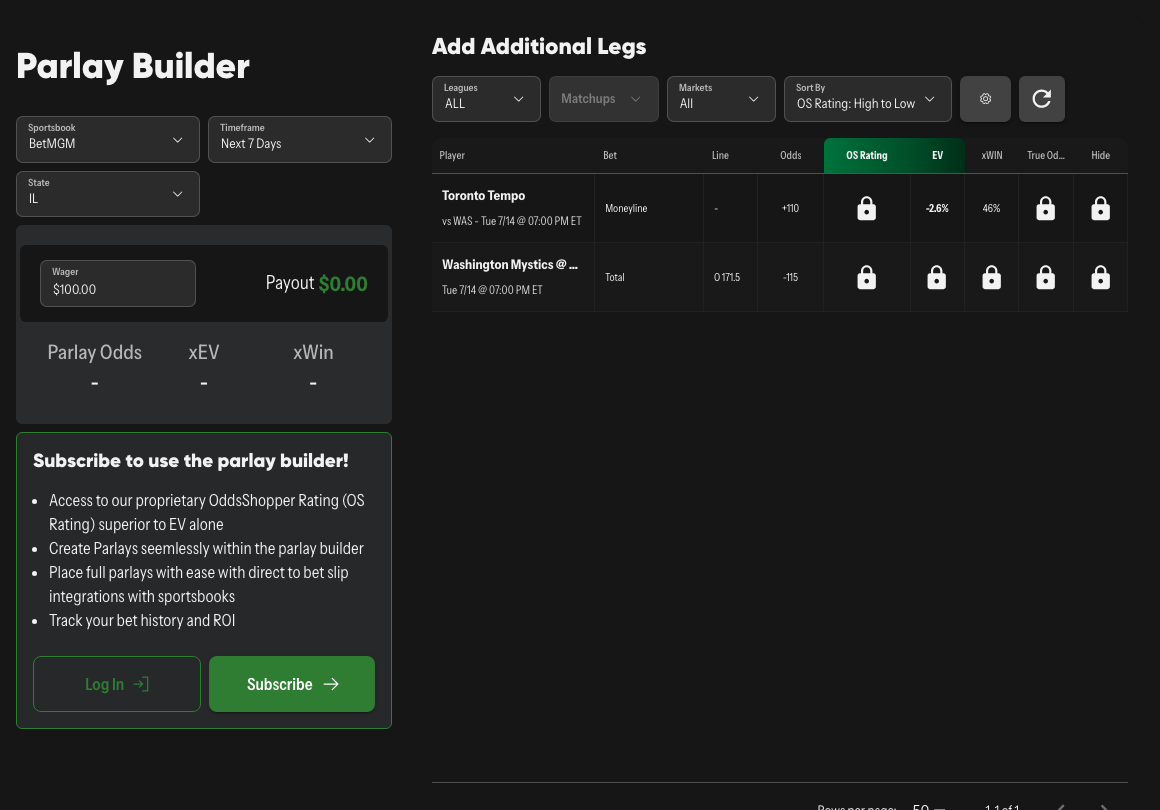 The OddsShopper Parlay Builder — every leg graded live (EV, xWin, true odds) before you lock a ticket. Open the live board.
The Quick Answer
Can you do same game parlays on Kalshi? Yes. Pick two or more markets from one game's collection, typically the winner, the point spread and the total, and the exchange builds a single yes/no contract that pays $1 only if every leg hits. The legs themselves trade live with visible prices. The combined listings mostly arrive on the board auto-generated, and instead of resting orders they are typically priced on request: a market maker answers, the trade prints, and the settled listings carry the volume to show for it. Which legs are combinable, why the board looks the way it does, and how correlation works with no oddsmaker — all of it is below.
Stay ahead of the markets.
Daily insights and expert picks on Kalshi, Polymarket, and what's moving markets.
Free forever. Unsubscribe anytime.
A Parlay Here Is A New Market, Not A Bet Slip
Start with what an exchange is, because the parlay inherits all of it. Every Kalshi contract is a yes/no question that settles at $1 or $0, with a price in cents, and every trade needs someone willing to take the other side. There is no house building odds; an exchange is not a sportsbook, and that stops being a slogan the moment you try to combine legs.
When you group markets on Kalshi, the exchange does not staple your selections together on a slip. It creates a new derived contract whose rule is brutal and simple: the combined market resolves YES only if every one of its associated markets resolves YES. One leg fails, the whole contract settles at zero. The minimum is two legs, and the result is one instrument with one price, tradable like any other contract on the exchange once it actually has a price.
Hold onto that phrase, "a new contract." A sportsbook prices any combination you assemble instantly, by formula. An exchange that manufactures a new market for each combination has a different problem: somebody has to show up and price it. Side by side, the two products barely resemble each other under the hood.
| Sportsbook SGP | Kalshi same game combination | |
|---|---|---|
| What It Is | Legs stapled to one slip, one payout | A brand-new yes/no contract built from your legs |
| Who Prices It | The house, instantly, by formula | A market maker answering a request for a quote |
| Correlation | Adjusted by the book before you see the payout | Embedded in whatever quote comes back |
| Can You Exit Early? | Only if the book offers a cash-out, on its terms | Structurally yes, by selling — but only if a live bid exists |
| Can You Take The Other Side? | No | Yes, the No side is a tradable position |
| The Catch | The price bakes in the house's margin | Most combinations have no live price until asked |
The row that changes behavior is the exit. A slip lives and dies with the book that wrote it; a contract can be sold back mid-game to whoever is bidding. On these combination listings, though, "whoever is bidding" can be nobody at all: the resale mechanism the rest of the exchange runs on sits dormant here until someone has actually quoted the market. The structural right to exit is real. A live bid to exit into is not assured.
What You Can Combine, And What You Cannot
For the major sports, Kalshi's same game collections are built around that game's core markets: the winner, the point spread and the total. How deep the menu goes past that varies by sport, and rather than guess, I pulled the collection menus themselves on August 18, 2026. A pro football game's single-game collection carried exactly those three legs, winner, spread and total, with the minimum set at two. A pro basketball game's menu ran nine deep: the same three core markets plus player markets for points, rebounds, assists, threes, steals and blocks. Baseball's same-game series had no open menu to pull that day, but the combinable baseball market types listed across Kalshi's collection menus run 15 deep: the winner, spread and total, first-five-innings versions of all three, and player and situational markets like hits, home runs, strikeouts, RBIs, total bases, stolen bases, pitcher outs and a first-inning run. Pick two or more legs from one game's collection and the exchange builds the combined contract. Separate Kalshi collections also support multi-game and cross-category combinations, but those are not same game parlays; this page is about combinations built from one game's listed markets.
The boundary is the collection's own menu, and the "cannot" side is just as concrete as the menu. A leg from a different game is not in it; that is a multi-game combination, a different product. A market type the collection never listed (an alternate line that does not exist on the exchange, a prop from a sportsbook's deeper menu) cannot be conjured into it, no matter how tradable it is on its own elsewhere, and a big sportsbook's SGP menu will still usually run deeper on alternates and props. What Kalshi gives you instead is the exchange structure itself: a transparent all-or-nothing contract you can exit, and both sides of which can be taken, rather than a slip that lives and dies with the book.
The menu, though, is not the real story. What happens to those listings once they hit the board is.
The Legs Are Priced. The Combinations Trade Differently.
Be precise here, because this is the part of the product that is easiest to read wrong in both directions. The single markets a parlay is built from are live, functioning markets with real quotes. When I checked the board on August 18, 2026, every MLB game winner market I pulled carried a bid and an ask a cent or two apart, and the spread and total ladders I checked were quoted just as tight. The season-long markets looked the same: all 32 NFL per-team playoff markets carried a live two-sided quote. If you want to trade a leg on its own, the price is sitting there waiting.
The combination listings run on different machinery. Auto-generated combinations are not a corner of the exchange; they are most of it. Pull up the combination series and you will find thousands of open listings at a time, the bulk of them multi-game and cross-category builds the exchange manufactured on its own, roughly nine in ten flagged provisional in the mid-August 2026 pass I pulled. Very few of those listings carry a standing two-sided book at any given moment, and that is not a malfunction to catch the exchange in — it is the design. These markets are priced when someone asks, not while the inventory sits waiting. Which brings us to the habit I promised you at the top: the combinations trade anyway. Walk the settled side of the same series and the most-traded combination listings show thousands of contracts of lifetime volume apiece — five figures on the busiest one in my sample — volume that printed without a quote ever needing to sit on the screen between trades. Note also what the open board does not contain: a single same-game listing. The per-game combination series I pulled for pro football, baseball and basketball carried no open listings at all — the menus exist for every game, and a same-game market only comes into being when somebody asks.
Let that reframe the product. The parlay menu on Kalshi can look enormous because most of those listings are manufactured by the exchange, not priced in advance by anyone; a page that told you same game parlays are freely available and liquid in the sportsbook sense would be describing the menu, not the market. But the opposite reading — that the combinations are dead — is just as wrong, and the settled volume is the proof. Liquidity is the thing that decides whether you can actually trade, and it lives in two different places here: on the individual legs it sits on the screen all day, while on most combinations it shows up at the moment of the trade and then leaves the visible book looking empty again.
How A Price Actually Appears
So how does a combination listing rack up thousands of contracts of volume without a quote sitting on the screen? On these combinations, a price is typically arranged rather than displayed. Instead of resting orders waiting in a standing book, a trade generally comes together through a request for a quote: a specific combination gets priced when one of the firms whose whole job is making a price instead of paying one responds to the request, the trade prints, and the visible book goes back to looking empty. That request-for-quote layer is the exchange's substitute for the sportsbook's pricing engine, and it is why a listing's lifetime volume and its visible quotes tell such different stories. A handful of combinations do graduate to a standing two-sided book, but on this board, that is the exception that proves the mechanism.
This mechanism is also why parlays came up in a regulatory proposal. Sportico has reported on a CFTC proposal that would require market makers affiliated with an exchange to quote both sides of markets continuously, and the proposal would exempt parlays from that requirement precisely because they trade through request-for-quote rather than a standing order book; the same reporting notes that parlays run north of 30% of volume at some exchanges and are the most dependable market-maker revenue stream there. That is a proposal working through its comment process (the comment window closes October 5, 2026), not a finished rule, but it tells you how central this quiet corner of the product actually is.
Correlation: Priced By A Judgment, Not A Formula
On a sportsbook, the house knows your legs are related, a favorite covering the spread usually wins the game too, and it applies a correlation adjustment so the payout is less than the naive multiplication of the legs. On Kalshi there is no oddsmaker to apply anything. Whoever answers the quote request decides what the combination as a whole is worth, correlation included. Overlapping legs get priced as overlap by a firm's own model, backed by its own money, not by a published formula, and a combination too redundant to interest anyone may simply never draw a response. The menus we pulled make the overlap problem concrete: Kalshi's collection menus list baseball's winner alongside its first-five-innings winner, and the game total alongside the first-five total. Wherever a menu offers both the full-game leg and its first-five version, stacking the two hands the quote-responder a correlation puzzle a sportsbook's formula would price instantly; here, one firm has to decide what that overlap is worth and back the answer with its own money.
We keep the deeper treatment on two dedicated pages: how correlated legs are handled on an exchange, and the parlay math of what multiplying legs does to probability and payout. On the sportsbook side of the fence, a parlay builder does the assembly job leg by leg with the numbers in view, the same assembly I have walked through on camera plenty of times, and the contrast is worth keeping in mind: same instinct, completely different pricing machinery underneath.
A Worked Example: Two Legs, One Contract
Numbers make the machinery concrete, so run one combination end to end. The figures are illustrative round numbers, not live prices.
Take an NFL game where the favorite's winner contract trades at 60 cents and the game total's Over trades at 50 cents. Combine them and the exchange builds one new contract: "favorite wins AND the game goes Over." Naive multiplication says 60% times 50% is 30%, so a 30-cent price. But if this favorite piles up points when it wins, the two legs travel together, and the honest chance of both hitting sits somewhere above 30%. A sportsbook's correlation adjustment handles that gap before you ever see a payout. On the exchange, the market maker who answers the quote request decides where in that range the price lands, and the spread between what they will pay and what they will sell at is their compensation for doing the deciding.
Say the quote comes back and you buy 100 contracts at 34 cents: $34 leaves your balance, the position pays $100 if both legs hit, and it settles at zero if either fails. There is no partial credit for one leg, and there is also no slip that traps you: if the favorite leads big at halftime and a buyer is bidding 70 cents, you can sell. That exit is the piece a sportsbook parlay simply does not have, provided a bid exists to sell into; on an unquoted combination, there may be nothing to sell into until a market maker answers the next request.
The Risk Shape Does Not Care Which Platform You Are On
An all-must-hit contract is a long shot by construction, and the asymmetry cuts both ways depending on which side you take. Buying one risks a small stake to chase a large payout that rarely arrives. Selling one is the mirror image: you collect a small premium on an outcome that probably will not happen, you risk most of a dollar if it does, and the ratio depends entirely on the price. Sell a 7-cent long shot and one loss erases roughly 13 wins' worth of premium; sell the 34-cent combination from the example above and one loss erases about two. That arithmetic, not any hit rate, is what makes position sizing the whole game.
Execution is where the empty-book reality bites hardest. On a listing with no standing two-sided quote there is no spread to shop in the normal sense; the one responding market maker's bid and ask are the entire market for that combination, so an instant fill is not a good fill you found, it is the only fill on offer. And the standing caution on any few-cent contract applies double here: crossing the spread to get filled instantly can cost more than the view is worth, because an instant fill usually means you paid for it. The order type you choose decides whether you pay that toll to get in and out, and it matters more here than anywhere else on the exchange.
None of that is a reason to combine legs or avoid combining them. It is the shape of the instrument, and it looks the same whether the wrapper says sportsbook or exchange.
More on this: Game Awards 2026 Odds · Golf Top 20 Parlay Odds: Scheffler Plus Two: Kalshi Odds · Kalshi Postponed Game Rules: What Happens To Your Market? · Game Of The Year 2026: The Favorite Might Not Be On The Ballot · What Happens To Your Kalshi Parlay When A Leg Voids
Where This Leaves You
Back to the opening split, because it resolves into three concrete checks. First, the legs: a same game combination is built only from that game's collection, minimum two markets, and nothing outside the menu can be a leg. Second, the price: the game's own markets will greet you with live quotes, but the combined listing will usually arrive without a standing one, so before treating a Kalshi combination like a sportsbook SGP, look for an actual bid and an actual ask; volume on a listing tells you it has traded through quote requests, not that a price is sitting there for you now. Third, the exit: it works like every other contract on the exchange, selling to whoever is bidding, if anyone is. None of this changes with the sport or the category; the same contract structure runs across everything the exchange lists, and for one category worked end to end, start with how these markets work.