Every time a fighter falls off a card or a game slides off the schedule, the same confused post appears in every trading community I read. Kalshi parlay leg voids are the most misunderstood settlement event on the exchange: a 12-leg ticket "hits" and pays less than the headline number, and the holder concludes something was taken from them. Nothing was. One rule, published before the market ever traded, explains every shrunken payout I have ever seen posted, and it takes about 90 seconds to understand. This is that rule, the arithmetic it produces, and the checklist I run whenever a payout looks wrong.
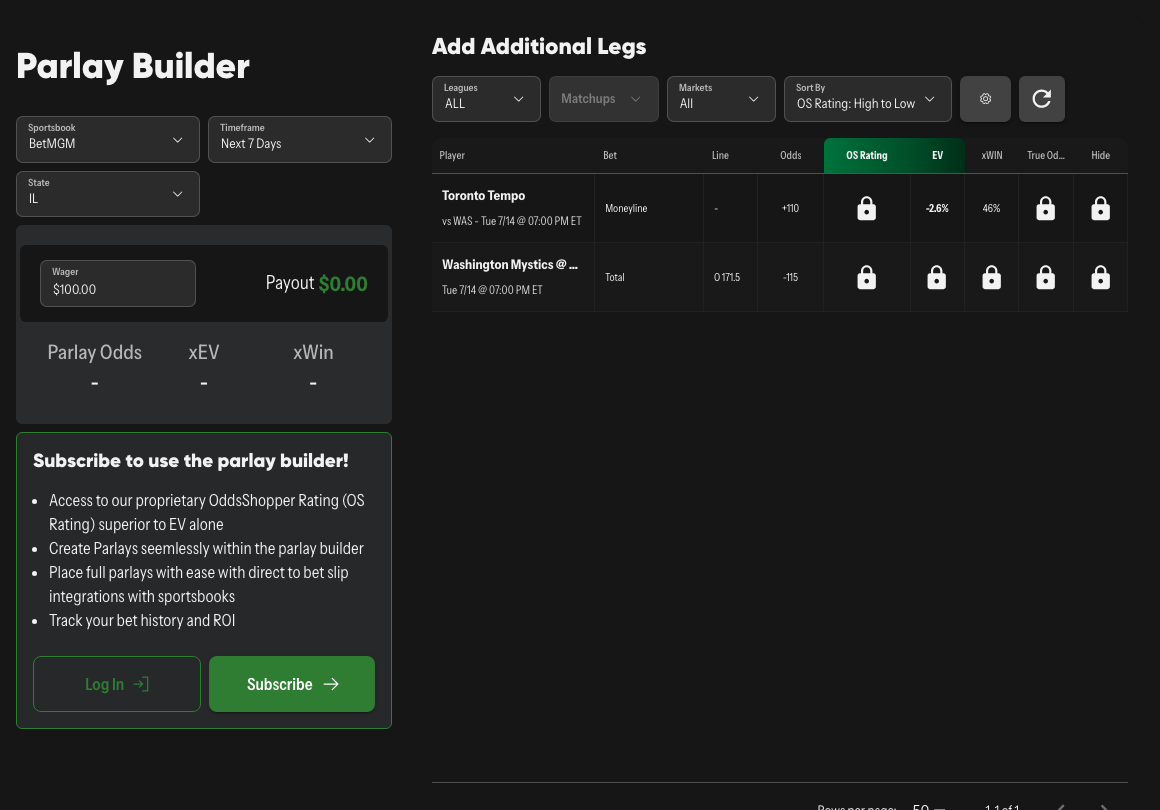 The OddsShopper Parlay Builder — every leg graded live (EV, xWin, true odds) before you lock a ticket. Open the live board.
In Summary
- One Rule Decides Everything: The Product. With partial resolutions, a Kalshi combo pays the product of all individual position values. Every leg's value multiplies through the ticket.
- A Disrupted Leg Gets A Value, Not A Verdict. When a leg cannot resolve normally, its own market's rules govern the value it is assigned. That value then multiplies the combo payout.
- Shrunk Beats Dead. A leg valued at 0.70 cuts the payout by 30% instead of killing the ticket. Only a leg valued at zero zeroes the product.
- It Is Not A Fee. Kalshi charges no settlement fee. A lighter-than-expected payout is the product rule at work, not a deduction.
- Sportsbooks Do It Differently. A book typically drops the void leg and reprices the parlay. Neither system matches all-or-nothing intuition, and both are in the rules.
Stay ahead of the markets.
Daily insights and expert picks on Kalshi, Polymarket, and what's moving markets.
Free forever. Unsubscribe anytime.
These are market prices and model estimates, not predictions of fact and not financial advice.
One Rule Explains Every Shrunken Ticket
Kalshi is a CFTC-regulated event-contract exchange, and its combo markets, the parlay-style product, settle by a single published principle: with partial resolutions, the payout is the product of all individual position values. Not the sum, not a repriced remainder, the product. Each leg carries a value, a healthy winning leg carries 1.00, and every leg's value multiplies together to produce what each contract pays.
The elegance of the product rule is that it handles every messy scenario with the same arithmetic. There is no separate procedure for a scratched fighter, a postponed match, or a partially resolved leg. Whatever value a leg's own market rules assign it, that value multiplies through. And that is the key mental shift: the combo does not have opinions about your disrupted leg. The leg's market resolves under its own rules, produces a number, and the combo simply multiplies the numbers it is handed. When a payout surprises you, the question is never "what did the parlay do," it is "what value did that leg resolve at, and why," and the answer lives in that leg's rules page, which is exactly the habit our sibling piece on Kalshi resolution criteria builds from scratch.
Worked Example: The Five-Leg Combo That Paid 70 Cents
Take a five-leg combo, 100 contracts, every leg a Yes you like. The headline math says each contract pays $1.00 if the ticket hits, $100.00 total. Now run the product rule through the scenarios that actually happen:
| Scenario | Leg Values | Payout Per Contract | On 100 Contracts |
|---|---|---|---|
| All Five Legs Resolve At Full Value | 1.00 x 1.00 x 1.00 x 1.00 x 1.00 | $1.00 | $100.00 |
| One Leg Resolves At 0.70 | 1.00 x 1.00 x 1.00 x 1.00 x 0.70 | $0.70 | $70.00 |
| Two Legs Reduced, 0.70 And 0.80 | 1.00 x 1.00 x 1.00 x 0.70 x 0.80 | $0.56 | $56.00 |
| Any Leg Valued At Zero | includes a 0.00 | $0.00 | $0.00 |
Check the middle rows, because they are where the confusion is minted. One leg at 0.70 does not cost you that leg's share of five, it costs you 30% of the entire payout, $100.00 down to $70.00. Two reduced legs compound: 0.70 x 0.80 is 0.56, a 44% haircut, because multiplication punishes twice. The holder of that third-row ticket sees "$56.00" where they expected "$100.00" and feels robbed of $44.00, but every dollar of the difference is two published numbers multiplied together.
The compounding is also why long tickets feel the rule hardest. The more legs you stack, the more chances one of them resolves below 1.00, and a single reduced leg scales everything the other legs earned. A 12-leg ticket with 11 perfect legs and one leg at 0.70 pays 70 cents on the dollar, same as a 2-leg ticket would, but it feels worse because more went right first.
Why A Disrupted Leg Shrinks The Ticket Instead Of Killing It
The all-or-nothing instinct comes from sportsbooks, and it fails here because an event contract leg does not have to end in win or lose. A leg's market can resolve at a partial value when its rules say so, and when an event is scratched or postponed, what happens next is governed by that market's own rules, not by the combo. The assigned value might preserve your stake's share, reduce it, or zero it, depending entirely on what the rules of that specific market specify for that specific disruption. I will not pretend there is a universal answer, because there is not: check the market rules of the leg in question, every time.
What I can say categorically is how whatever value emerges treats your ticket, because that is the product rule again. A value of 1.00 passes through as if the leg never wobbled. A value between zero and one shrinks the payout by exactly that factor. Zero kills it. The combo is a calculator, not a judge.
The product rule prices the disaster. Your job is pricing the legs. Before stacking any sports combo, I hold each leg against a real number: the live odds screen does the work, because the tool surfaces the de-vigged, no-vig fair probability on every market across DraftKings, FanDuel, and the rest of the major books. Legs that each clear their price are the only combos worth the compounding. OddsShopper Pro comes with a free week trial for new subscribers, so running that check on your next combo costs nothing.
How Sportsbooks Handle A Void, And Why That Intuition Misleads
The sportsbook convention most people carry in their heads works differently. When a leg voids at a book such as DraftKings or FanDuel, the book typically removes the leg and reprices the parlay at the remaining legs' combined odds: your six-leg becomes a five-leg, the potential payout drops to the five-leg number, and the ticket lives on. The details vary by book and by market, which is why "typically" is doing honest work in that sentence, and the house rules page is the final word at any book.
Notice what the two systems share: neither one honors the all-or-nothing story. Both published a procedure in advance, and both procedures shrink your payout when a leg cannot resolve normally. Where they differ is mechanism. The book substitutes a new, shorter parlay. Kalshi multiplies the assigned value through the existing one. Depending on the legs and the values, either system can leave you better off than the other, and comparing how the two venues price the same slate of outcomes is a discipline of its own, one we walk through in the sportsbook-to-Kalshi translation guide.
The Checklist When A Payout Looks Wrong
When a combo credits less than you expected, run these in order before drawing any conclusions.
- Pull up each leg's settlement value. The product rule means one number per leg tells the whole story. Multiply them. If the product matches your credit, the ticket paid correctly.
- Read the rules of the leg that resolved below 1.00. The assigned value came from that market's own resolution criteria, and the explanation for a scratch, postponement, or partial outcome is written there.
- Remember there is no settlement fee. Kalshi's charges are trading fees at execution, detailed in our Kalshi fees breakdown. Settlement credits the full product with nothing skimmed, so the product is the entire explanation.
- Escalate only after the rules check. If a standard market shows no update roughly 12 hours after the outcome and the rules appear satisfied, contact support through the in-app chat. In my experience the product-and-rules check resolves the mystery long before a ticket needs writing.
More on this: Kalshi's 45-Leg Parlay Paid $3,087 On $18. Still A Bad Bet. · Week 1 Underdog Moneyline Combo: Broncos And Giants · Golf Top 20 Parlay Odds: Scheffler Plus Two: Kalshi Odds · Kalshi Same Game Parlays: What You Can And Cannot Combine · How Do Kalshi Parlays Work? The Math, Plainly
The Ticket Is A Product, Not A Promise
Once the product rule clicks, Kalshi combo markets stop being mysterious and start being arithmetic. Every leg contributes a value, every value multiplies, and the payout is whatever the multiplication says, with no settlement fee taking a cut and no judgment call in the middle. The traders who post shrunken-ticket screenshots are not victims of a machine. They are holders of a contract that did exactly what its text said, legs valued, product taken, dollars credited. Read the legs' rules before you stack them, price each one like it has to stand alone, and a shrunken payout will never ambush you again: you will know exactly how the number was built.
Price the legs before the product prices you. The odds comparison converts any cent price into an implied probability in one step, and the live odds screen shows the no-vig fair number on every sports market, so every leg you stack has a defensible number behind it. Our free expert picks apply the same price-first read to real slates every day. And if you want the pricing done for you before the product rule does its multiplication, code LEGVOID20 takes 20% off your first OS Pro payment when you stay past the free week.
Event contracts involve risk and are not appropriate for everyone. Any probabilities discussed here are model estimates, not predictions of fact and not financial or trading advice. 18+. Availability varies by state. Trade responsibly.
Trade prediction markets on Polymarket too. Most readers here already have Kalshi — Polymarket is the other major venue, and code OS4 adds a $50 trading bonus on a $10 deposit: Get the Polymarket bonus →
Affiliate disclosure: OddsShopper earns a commission on signups through this link. Terms as stated by Polymarket; 18+, availability varies by state.