Every few weeks a monster ticket makes the rounds in every community, a run of 15 or 19 legs on a prediction market that all came true, and the replies split instantly between "legend" and "lucky." I enjoy those posts as much as anyone. But the interesting question is never whether the run was fun, it is whether it was a good decision, and that question has an exact answer, because Kalshi parlay math is just multiplication you can do on a napkin. This is the full arithmetic: what long stacks are really worth, what they must pay to be worth entering, why your feed makes them look routine, and the one honest way a stack earns its multiplier.
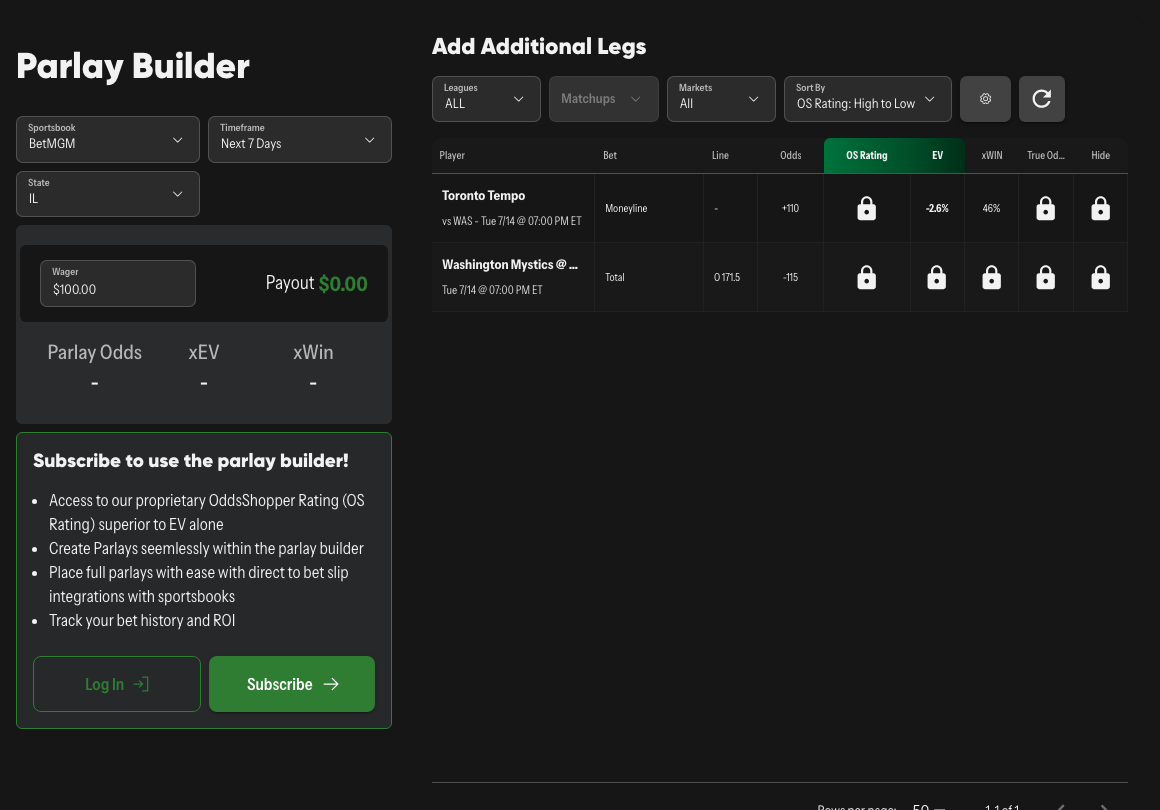 The OddsShopper Parlay Builder — every leg graded live (EV, xWin, true odds) before you lock a ticket. Open the live board.
In Summary
- Compounding Is Merciless. Nineteen legs at 80% each survive 0.80^19 of the time, about 1.4%. At 90% per leg, still only 13.5%. Every added leg multiplies the failure chance again.
- The Payout Has A Breakeven. A 1.44% stack breaks even at about 69.4x. Pay less than the inverse of the true joint probability and the ticket is negative expected value before fees.
- You See The Winners Only. At fair odds, about 68 runs like it die quietly for every 19-leg ticket that cashes. Survivorship makes long stacks look repeatable when they are just visible.
- A Hit Is Not A Verdict. Results do not grade decisions. The price against the probability grades decisions, and it does so before the games start.
- Correlation Is The One Honest Multiplier. Legs that make each other more likely lift the true joint probability above the naive product. Everything else is paying for excitement.
Stay ahead of the markets.
Daily insights and expert picks on Kalshi, Polymarket, and what's moving markets.
Free forever. Unsubscribe anytime.
These are market prices and model estimates, not predictions of fact and not financial advice.
The Compounding Table Nobody Runs Before Entering
A Kalshi contract is a Yes/No question that settles at $1.00 or $0.00 on a CFTC-regulated event-contract exchange, and its price in cents is a probability. A stack asks many questions at once and pays only if every answer is yes, so its true probability is the product of the legs. That is the entire theory. What people consistently misjudge is how fast a product of numbers below 1 collapses:
| Legs | At 80% Per Leg | At 90% Per Leg |
|---|---|---|
| 1 | 80.0% | 90.0% |
| 3 | 51.2% | 72.9% |
| 5 | 32.8% | 59.0% |
| 10 | 10.7% | 34.9% |
| 15 | 3.5% | 20.6% |
| 19 | 1.4% | 13.5% |
Read the left column honestly. An 80% leg is a strong leg, a solid favorite, the kind of pick you feel good about. Chain 19 of them and you hold a 1.4% ticket. Three coin-flip-adjacent legs already put you under 52%. Ten strong legs are a 1-in-9 shot. This is not pessimism, it is exponentiation, and it applies identically at a sportsbook or an exchange, which is why the classic why-you-can't-win-parlays breakdown reads the same in both worlds. The difference on Kalshi is that the market hands you the probability directly in cents, so the honest multiplication is one screen away, as our Kalshi odds guide walks through.
Worked Example: What A 19-Leg Stack Must Pay To Be Worth It
Expected value turns the survival number into a verdict. Take the 19-leg stack at 80% per leg, joint probability 0.80^19 = 1.44%. Invert it: 1 divided by 0.0144 is about 69.4. That is the breakeven multiple. A ticket with a 1.44% chance must pay at least 69.4 times your money for the entry to be worth it, before a cent of fees.
Now run a concrete ticket. Stake $10 on that stack at a 65x payout:
- Expected Value: 0.0144 x $650 = $9.36 back per $10 in, a loss of $0.64 per ticket, about minus 6.4%.
- At 75x Instead: 0.0144 x $750 = $10.80, a positive $0.80 per ticket. The same legs, the same games, and the sign of the whole enterprise flipped on nothing but the price.
That is the entire discipline in two bullets. The legs are not the decision; the payout against the true joint probability is the decision. And notice how narrow the honest window is: the difference between a fun losing proposition and a sharp entry was ten payout turns on a 69.4x breakeven. Fees tighten it further. Kalshi's taker fee is small per order, largest near 50 cents per the standard formula in our Kalshi fees breakdown, but a long-shot entry pays it too, and the rounding on cheap contracts runs proportionally rich, so the true breakeven sits a touch above the clean inverse.
One settlement note specific to stacks: with partial resolutions, the payout is the product of all individual position values, so a leg valued at 0.70 scales every contract's payout by 0.70. The multiplication that builds the ticket also grades it.
The number that decides everything is the per-leg probability, so get it from somewhere honest. The live odds screen is my source: the tool surfaces the de-vigged, no-vig fair probability on every market across DraftKings, FanDuel, and the rest of the major books, so each leg enters the multiplication as the sharpest consensus available rather than a hopeful 80% that is truly 72%. On a 19-leg product, that gap per leg is the difference between 1.4% and 0.2%. OddsShopper Pro comes with a free week trial for new subscribers, so checking your next stack against the honest numbers costs nothing.
Survivorship: The 68 Runs You Never See
Why does every feed seem to feature a miracle ticket if the arithmetic is this brutal? Because you are looking at the survivors. At fair 1.44% odds, roughly 68 runs of that same 19-leg shape fail for every one that cashes, 0.9856 divided by 0.0144 is about 68.4, and the failures generate no screenshots. Nobody posts leg 14 dying in the final minute. The winning ticket, meanwhile, travels for a week.
This is not a moral failing of the people posting, it is a property of what gets shared, and it quietly rewires intuition. See ten monster hits a month and long stacks start to feel like a repeatable strategy rather than a visible tail. The correction is not cynicism, it is just running the table above before the excitement makes the decision for you. The same filter explains most too-good-to-be-true patterns in trading communities, and it costs nothing to apply.
Same Game Parlay Correlation: The One Honest Way A Stack Gains Value
Everything so far assumed independent legs, and independence is exactly what makes long stacks a tax on enthusiasm. The one structural exception is correlation. When legs share a driver, one outcome hitting makes others more likely, and the true joint probability climbs above the naive product. A stack priced off independence in that spot is cheap, and that is a real edge, not a story.
The mechanics of finding and pricing that edge, conditional probabilities, worked correlation examples, and the fee drag comparison between stacking and taking legs as singles, get full treatment in the sibling piece on when combos beat singles on Kalshi. The one-line version: correlation is the only multiplier the math respects. If you cannot name the mechanism connecting your legs, they are independent, and the table above is your ceiling.
We go deeper on that structure in our Kalshi same game parlay guide.
A Hit Is Not Proof Of A Good Decision
The hardest idea in this entire subject is that the 19-leg winner and the 19-leg loser can be the same quality of decision. Process and outcome are different axes. A 65x payout on a 1-in-69 shot is a negative-EV entry whether it wins or not; a 75x payout on the same legs is a positive-EV entry even when leg six dies early. The result tells you what happened once. The price against the probability tells you what happens on average, forever.
Sharp sports bettors already live by this through closing-line thinking: judge the entry by the number you beat, not the ticket that cashed. Trading brings the same honesty through fair value. So when the next monster ticket makes the rounds, my suggestion is to enjoy it, congratulate the winner, and then do the one thing the replies never do: invert the probability, look at what the ticket paid, and decide what it actually was. Most are expensive fireworks. Occasionally one was a real edge, and knowing the difference is the whole skill.
Size It For Entertainment, Because The Shape Demands It
Even a positive-EV long stack keeps a top-heavy, long-shot payout profile: it almost always loses and occasionally pays enormously. Expected value does not smooth variance, and no honest per-leg estimate makes a 1-in-69 profile behave like a savings account. So the sizing rule is simple and non-negotiable: money whose loss changes nothing. A few dollars on a big fun stack is a perfectly good time, and the arithmetic above even tells you when the fun is fairly priced. Sizing that assumes the hit is due, or that chases the last near-miss, is how entertainment quietly becomes oversizing. If the stake would sting on a Tuesday, it is too big for a ticket that wins on the 69th Tuesday.
One mechanic the math cannot save you from is a postponed leg — our guide to Kalshi parlay leg voids covers what happens when one game in your combo disappears.
More on this: Golf Top 20 Parlay Odds: Scheffler Plus Two: Kalshi Odds · Kalshi Same Game Parlays: What You Can And Cannot Combine · What Happens To Your Kalshi Parlay When A Leg Voids
Run The Multiplication, Then Enjoy The Show
Kalshi parlay math fits in three moves: multiply honest per-leg probabilities for the true chance, invert that chance for the breakeven payout, and compare it to what the ticket actually pays, fees included. Do that before entering and long stacks stop being mysterious. Some are entertainment at a fair price, a few are correlated edges wearing a costume, and most are donations with great production value. The winners will keep making the rounds either way. Now you can tell which ones deserved to.
Start every leg from an honest number. The odds comparison converts any price into an implied probability in one step, and the live odds screen shows the no-vig fair probability on every sports market, so the product you compute is built from real inputs instead of round numbers. Our free expert picks apply the same probability-first read to real slates every day. Code PARLAYMATH20 takes 20% off your first OS Pro payment if you stay past the free week.
Event contracts involve risk and are not appropriate for everyone. Any probabilities discussed here are model estimates, not predictions of fact and not financial or trading advice. 18+. Availability varies by state. Trade responsibly.
Trade prediction markets on Polymarket too. Most readers here already have Kalshi — Polymarket is the other major venue, and code OS4 adds a $50 trading bonus on a $10 deposit: Get the Polymarket bonus →
Affiliate disclosure: OddsShopper earns a commission on signups through this link. Terms as stated by Polymarket; 18+, availability varies by state.