The only survey of this runoff published since the June primary was invented. On August 17, 2026, a firm calling itself Median Strategies withdrew a survey showing Karen Bass ahead of Nithya Raman by nearly 12 points and admitted it had made the numbers up, describing the release as a "short-term social experiment examining how purported polling information could enter and spread through the political information ecosystem without independent verification" (NOTUS). The Bass campaign had already amplified it on X and deleted the post. The firm then took its website dark and shut down after a second fabricated poll surfaced.
Strip that away and here is what is actually known about the November 3 race to run Los Angeles: a certified June result, a campaign-finance filing, a homeless count, and one real head-to-head poll fielded in May, before the matchup existed. Kalshi has turned the question into two yes/no contracts, and roughly 30 million of them have changed hands. We handed eight AI models the fetched record and asked each to price the race without letting any of them see a price.
New to Kalshi event markets? Start here → how election prediction markets work.
The Quick Answer
Kalshi's traders make Karen Bass a solid favorite at 63.5 cents (63¢ bid / 64¢ ask as of August 23, 2026), with Nithya Raman at 36.5 cents (36/37). Our price-blind panel of eight models, working only from fetched facts, lands in a different place: it puts Bass at about 52.5% and Raman at about 47.5%. That 11-point gap is the argument, and it comes down to one question neither side can settle with data.
- Market favorite: Karen Bass, 63.5¢ (about -174 in sportsbook terms)
- Panel favorite: Karen Bass, but by a nose at 52.5% (about -111)
- The challenger: Nithya Raman, 47.5% from the panel against a 36.5¢ price
- The whole question in one line: where Spencer Pratt's 217,977 first-round voters go, and how many of them come back at all in November
- What the models keep saying: a sitting mayor who took 34.3% of her own city's first-round vote has no party cue to consolidate behind her in a Democrat-versus-Democrat runoff
The full seat-by-seat board, the revision arcs from the round where each model read the others, and the four things that would move the number are all below.
Free: The Weekly PM Market Brief — the 8-model panel's graded record, the week's biggest market-vs-model gaps, and what's spiking next. One email, Sundays.
The Market At A Glance
| Venue | Kalshi, a CFTC-regulated event-contract exchange (18+; availability varies by state, as of August 2026) |
| The event | "Los Angeles Mayor winner?" (Kalshi event KXMAYORLA-26), one yes/no contract per candidate |
| The contract | KXMAYORLA-26-KBAS resolves YES only "if Karen Bass wins the 2026 Los Angeles Mayoral Election"; KXMAYORLA-26-NRAM is the same sentence with Raman's name |
| Live outcomes | Two. Every other name from the June field is gone, so the two prices sum to 100 cents with no house margin to strip out |
| Depth | About 30.2 million contracts of lifetime volume across the two sides, roughly 11.1 million of them still open, on 1-cent-wide quotes both ways |
| Settles | The runoff is Tuesday, November 3, 2026. Kalshi lists a far-dated expiration of June 2, 2027 and closes the market early once the election is decided |
| Prices as of | August 23, 2026, 2:20 AM ET |
These are model estimates, not predictions of fact and not financial advice, not voting advice, and not an endorsement of any candidate. Every number in this piece gets graded in public once the market settles, in the full graded scoreboard.
Hottest Prediction Markets Right Now
- 2028 Democratic presidential nominee · $189M traded
- 2027 Pro Football Champion · $69M traded
- 2028 U.S. Presidential Election winner? · $61M traded
- 2028 Republican presidential nominee · $59M traded
- Pro Baseball Champion · $58M traded
- Bitcoin price at the end of 2026 · $32M traded
Every market above links to our full AI model verdict; browse them all on the OddsShopper prediction markets hub, and see how every settled call actually scored on the full graded scoreboard.
The Race Has Not Been Polled Since May
Los Angeles runs an all-party first round. Win a majority and you are mayor; fall short and the top two go to a November runoff. On June 2, 2026, consolidated with California's statewide primary, 853,892 people voted for mayor and nobody came close to a majority.
| June 2, 2026 first round (certified) | Votes | Share |
|---|---|---|
| Karen Bass (incumbent) | 292,593 | 34.3% |
| Nithya Raman | 247,781 | 29.0% |
| Spencer Pratt | 217,977 | 25.5% |
| Adam Miller | 30,008 | 3.5% |
| Rae Chen Huang | 25,220 | 3.0% |
| Nine others | 40,313 | 4.7% |
Certified by the Los Angeles County Registrar-Recorder on June 26, 2026. Bass and Raman advance to November 3.
Three numbers in that table do all the work. A sitting mayor took 34.3% of her own city. Bass and Raman together took 63.3%, which leaves 36.7% of the electorate holding a ballot for someone who is no longer running. And Bass's margin over Raman was 44,812 votes, about a fifth of the size of the bloc Pratt walked away with.
The count itself took six days. On election night Bass led, Pratt was second and Raman third; late-tabulated mail ballots moved Raman past Pratt, and the race was called on June 8 with 93% counted (CNN). Late ballots in this city broke toward the challenger.
What does not exist is a measurement of the runoff. The single published head-to-head was fielded by UC Berkeley's Institute of Governmental Studies with the Los Angeles Times on May 19-24, 2026, among 1,913 registered voters, and it had Raman 32, Bass 28, with 25% saying "neither" and 15% undecided. That poll was taken before the June primary, so respondents were not choosing between these two people; they were being asked about a matchup that did not exist yet. The same instrument's first-round test had Bass at 26% against her actual 34.3%, an eight-point miss on the one number it could be checked against.
The only measurement anyone has: Raman 32, Bass 28, with a quarter of respondents picking "neither" and another 15% undecided — taken two weeks before the first round, by an instrument that then missed Bass's actual first-round share by eight points.
Ninety-one days have passed. In that window the city has held a first round, seen a fire chief sue the mayor personally, watched a council committee get dissolved around the challenger, and sat through a fabricated poll and its retraction. Nobody has published a real survey through any of it.
The Board
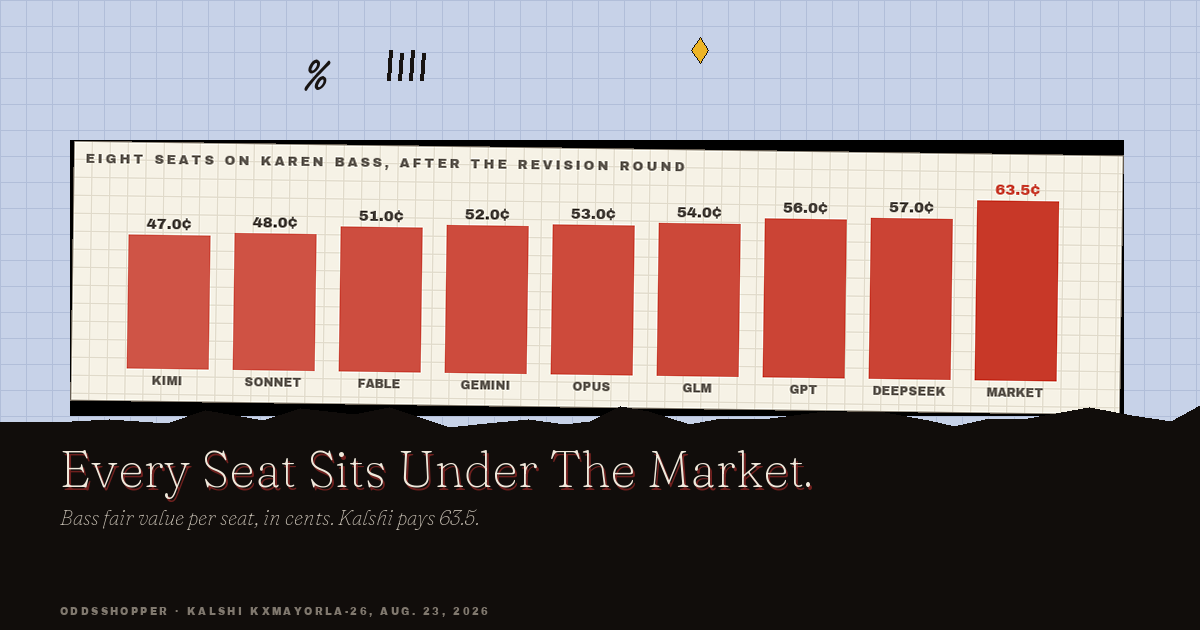
All eight seats, plus what the market pays. On a two-way board a probability and a price are the same number: 52.5% is 52.5 cents. Every seat prices Bass below the 63.5 cents traders are paying for her. Kalshi prices fetched August 23, 2026.
| Candidate | Where they stand | Market | Panel blend |
|---|---|---|---|
| Karen Bass | Incumbent mayor; first in the June round with 34.3% | 63.5¢ | 52.5% |
| Nithya Raman | City councilmember, District 4; second with 29.0% | 36.5¢ | 47.5% |
Every Seat's Number
| Candidate | Market | Fable | Opus | Sonnet | GPT | Gemini | Kimi | GLM | DeepSeek | Blend |
|---|---|---|---|---|---|---|---|---|---|---|
| Karen Bass | 63.5¢ | 51.0 | 53.0 | 48.0 | 56.0 | 52.0 | 47.0 | 54.0 | 57.0 | 52.5% |
| Nithya Raman | 36.5¢ | 49.0 | 47.0 | 52.0 | 44.0 | 48.0 | 53.0 | 46.0 | 43.0 | 47.5% |
Every seat on this panel is graded against real market settlements — records to date: Claude Fable 82% on 616 graded calls · Claude Opus 83% on 686 graded calls · Claude Sonnet 81% on 664 graded calls · GPT 84% on 5,836 graded calls · Gemini 86% on 4,570 graded calls · Kimi 82% on 2,442 graded calls · GLM 81% on 2,465 graded calls · DeepSeek 80% on 2,490 graded calls. Recomputed daily; the full scoreboard is public.
These are model estimates, not predictions of fact and not financial advice, not voting advice, and not an endorsement of any candidate. The Blend column is the median of the eight seat numbers in its row, not the average, because a median does not let one outlier drag the panel. All eight scored the runoff on August 23, 2026 without seeing a price, then read one another's reasoning with the names stripped off and revised. Before that revision round the panel had Bass at 54.5%; afterward, 52.5%. The market column and the panel column were captured the same day, so the 11-point gap is a real disagreement rather than a stale comparison.
More live boards from the same panel: California governor 2026, same November 3 ballot, where Xavier Becerra trades at 96¢ and the board is all but decided · House control 2026, where Democrats trade at 85¢ on the same election night · the whole 2026 midterm board on one page. Prices fetched August 23, 2026.
Spencer Pratt's 217,977 Voters Are The Whole Race
Every seat on the panel, in both rounds, circled the same bloc. Pratt, the Hills reality-TV personality who ran as a Republican and finished 25.5%, is not on the November ballot, and his voters have no obvious home.
The tidy answer is that a right-leaning protest bloc consolidates behind the more moderate of two Democrats. Three seats bought a version of it. DeepSeek, the panel's most bullish on Bass at 57%, put "the Bass share at roughly 55-60% of returning Pratt voters," and was explicit that this was "not an ideological conversion model; it is a public-safety/moderate homeowner model plus the LAPD union's $1.2m defining Raman to exactly those voters."
The other seats refused the reflex. Opus put it most directly:
"The moderate here is the incumbent Pratt ran against, named as the target, and declared war on after losing. My split stays roughly: a bit under a third to Bass, about a third to Raman, the rest undervoting or not returning as the same people." — Claude Opus
Pratt did declare war. In a video posted the weekend after the count, having conceded his campaign was over, he said he was no longer constrained by campaign rules and claimed to hold a recording of Bass or Raman "doing and saying something that would make her resign in shame" (NBC Los Angeles). No recording has appeared. He has endorsed nobody. He also claimed, without evidence, that 43,000 homeless people voted improperly for Raman (Reuters).
Raman has been openly courting the bloc anyway, telling ABC7 that Pratt "tapped into very real frustrations that people are facing here in this city" over "a city that has failed on some of the most basic functions" — a marked softening from how she talked about those voters in the spring.
GPT split the difference and named the honest uncertainty: the returning Pratt voters "modestly favoring Bass, perhaps around the mid-50s to low-60s share of the Bass/Raman split, not an 85% transfer." That 85% is a reference to the fabricated poll, which claimed 85.23% of Pratt voters had moved to Bass. The invented number was the most confident thing anyone has published about this bloc, and it was fiction.
Karen Bass: An Incumbent With Everything Except A Majority
Bass has the machine. Her endorsement list runs to Governor Gavin Newsom, former Vice President Kamala Harris, Senators Alex Padilla and Adam Schiff, Attorney General Rob Bonta, Los Angeles County Sheriff Robert Luna, the Los Angeles County Federation of Labor, SEIU Local 721, the Teamsters, EMILYs List, the county Democratic Party, and both La Opinión and the Los Angeles Sentinel, per the endorsement record. Post-primary she added California Treasurer Fiona Ma.
She has the money to match. Through the August 1 filing deadline Bass had raised more than $3.7 million to Raman's more than $1.1 million, and took in $510,000 in the most recent reporting period against Raman's $170,000 (NBC Los Angeles). Counting direct donations, public matching funds and outside spending together, money supporting Bass "has outpaced money backing City Councilmember Nithya Raman by about 3 to 1," and among independent-expenditure committees specifically the ratio is "36-to-1," according to LAist's analysis of the filings. Airbnb alone gave $750,000 to a committee backing her. The largest single outside spender is the Los Angeles Police Protective League, the LAPD officers' union, which has put $1.2 million into ads against Raman.
What she does not have is a record voters are happy with. The 2026 Greater Los Angeles Homeless Count put homelessness in the city at an estimated 45,194 people, up 3.4%, with unsheltered homelessness up nearly 8% — the first increase after two straight years of decline. Inside Safe, her signature encampment program, has cost roughly $400 million, and a Los Angeles Times analysis found about 41% of the people who entered it later returned to homelessness. Both numbers were the spine of the first runoff debate on Wednesday, August 19, 2026, a 90-minute event hosted by the Sherman Oaks Neighborhood Council and the Sherman Oaks/Encino Chamber of Commerce (NBC Los Angeles).
And the January 2025 Palisades fire has not stopped generating litigation. Bass was in Ghana when it broke out. She removed Fire Chief Kristin Crowley the following month. Crowley sued the city in 2025 alleging retaliatory termination, and in June 2026 sued Bass personally for defamation over a campaign-trail claim that "1,000 firefighters that could have been on duty on the morning the fires broke out were instead sent home on Chief Crowley's watch." Crowley says the statement is false and argues it is not shielded by governmental immunity, so Bass should pay damages out of her own pocket (LAMag). Crowley has separately said she "did not refuse to conduct an after-action report" on the fire, arguing the department lacked the resources to do one properly.
Nithya Raman: A Challenger Her Own Party Will Not Fully Claim
Raman is a Los Angeles City Councilmember from District 4 and a member of the Democratic Socialists of America. Her post-primary endorsements are thinner and stranger than Bass's: City Controller Kenneth Mejia, who won re-election in June by a wide margin and now openly backs her; the Western States Regional Council of Carpenters; and Our Revolution. From the primary period she carries United Auto Workers Region 6, Abundant Housing LA, YIMBY Los Angeles, and the actors Hannah Einbinder and Michael Schur.
The most telling line on the endorsement page is a blank. Democratic Socialists of America Los Angeles, the chapter of the organization Raman belongs to, is listed under "declined to endorse."
Her strongest single number is local. Raman told the August 19 debate that unsheltered homelessness in her own Council District 4 — Sherman Oaks, the Hollywood Hills, parts of Reseda and Van Nuys — fell 49% while the citywide figure rose. That is the entire argument of her campaign compressed into one statistic, and it is why she has pressed for an audit of Inside Safe rather than simply attacking it.
Six days before that debate, the council took her committee away. Council President Marqueece Harris-Dawson, a close Bass ally, moved to split the Housing and Homelessness Committee into two panels, neither chaired by Raman, who had been chairing the combined committee. The council approved it 13-1 on August 13; Raman cast the only no vote. "Mayor Bass' top City Council ally removed me as Chair of the Housing and Homelessness Committee," she said. "The Mayor may be trying to punish me for challenging her, but Angelenos are the ones who pay the price for these political games" (ABC7). Harris-Dawson has publicly disputed that the move was punitive. The attack line followed her onto the debate stage. "She has no support from the councilmembers because nobody can work with her," Bass said, adding that Raman "didn't even show up to your last meeting" and had "missed several thousand votes because you don't show up to work." Raman's answer: "I have had regular absences because I've been appointed to external boards" (ABC7).
Where The Panel Changed Its Mind
Seven of the eight seats moved after reading the others with the names stripped off. Six moved toward Raman.
Gemini moved the furthest, three points:
"Peers correctly highlighted that the 11.2% minor-candidate vote leans heavily progressive/anti-incumbent, a factor I neglected in Round 1, which easily erodes Bass's 5.3-point lead." — Gemini
Opus gave up a point to a piece of local history nobody else had raised, and explained exactly why it gave up only one:
"One peer's Caruso-2022 point — a roughly 10-to-1 spending edge losing this exact office four years ago — is the best available local test of the money mechanism, and it is stronger evidence than the generic 'she outspent the field and got 34.3%' argument I made. I shaved a point for it, but only one: Caruso was spending to rehabilitate himself against an opponent voters already knew, whereas Bass is spending to introduce an opponent two-thirds of the city cannot describe, which is the more efficient use of the asymmetry." — Claude Opus
[Editor's note: the Caruso comparison checks out. Rick Caruso spent more than $100 million of his own money on the 2022 Los Angeles mayoral race, outspending Bass by roughly ten to one in the general-election period, and lost; he paid $162 per vote to Bass's $10. The claim that two-thirds of the city cannot describe Raman is the model's own estimate; no public survey has measured her citywide name recognition, and the closest fetched figure is the 25% of respondents who chose "neither" in the May poll.]
Kimi moved two points the other way, toward Bass, and was unusually precise about which argument did it:
"The only peer reasoning I had underweighted was B's and F's electorate-composition argument: the November midterm ballot roughly doubles the electorate, and the money asymmetry's real function is defining an unknown Raman to lower-information voters who never saw the primary — a distinct mechanism from the primary spending I had already discounted. That moved me two points toward Bass. I did not move further because no peer rebutted the core base rate." — Kimi
DeepSeek was the one seat that did not move at all, and its reason is the cleanest statement of the bull case for Bass on the whole board:
"Held. The strongest opposing base-rate argument does not move me because generic top-two incumbent-failure priors fit poorly when the challenger is DSA-aligned and the decisive Pratt bloc is ideologically closer to Bass on public safety, even if anti-incumbent." — DeepSeek
What Would Change The Panel's Mind
Four things are checkable between now and November 3, and each pushes the number in a stated direction.
- A real runoff poll. Any legitimate public survey of Bass versus Raman would be the first in three months. A Bass lead outside the margin of error validates the market and pulls the panel up toward 60; a close race or a Raman lead pushes it under 50 and makes the current 63.5¢ price look expensive.
- Spencer Pratt endorses, or releases the recording. He has promised damaging audio and delivered nothing. An endorsement of either candidate moves the single bloc that decides this race; audio that lands on Bass moves it much harder, because she is the one with something to lose.
- The Crowley defamation suit produces a ruling or a discovery fight. A court letting a personal-liability claim against a sitting mayor proceed, in October, on the fire that defines her term, is the highest-variance dated event on this calendar.
- Independent-expenditure filings after Labor Day. The LAPD union has spent $1.2 million against Raman with no comparable counterweight. If the 36-to-1 outside-money ratio holds through the fall, the seats that leaned on money have their thesis confirmed; if labor or a progressive committee closes it, the case for Bass thins.
The Traps: Rows That Look Like Signal But Are Not
- An 11-point gap is a disagreement, not an edge. The panel median and the market are two methods reaching different answers from the same public record. On a board with no polling, "the models are lower" means the models weight the first-round result more heavily than traders do. It does not mean traders are wrong.
- The base rate the panel argued over has no citation. Three seats leaned on a claim that incumbents who finish under 40% in a top-two first round usually lose the runoff. Opus flagged it directly: "asserted without a citation." We could not verify it either. Treat it as a prior the panel argued about, not a fact this article is asserting.
- The May poll is not evidence Raman leads. It predates the matchup, 40% of respondents refused both names, and its own first-round numbers were eight points off on Bass. Six of eight seats explicitly discounted it to near zero. Nobody on this panel is trading on Raman +4.
- Volume is not depth. About 30.2 million contracts have traded on this board over its life, which is a large cumulative number and says nothing about how much size you can move today. The live evidence of depth is the 1-cent spread and roughly 11.1 million contracts still open, both quoted above.
Settlement Timeline
| Date | What happens |
|---|---|
| October 5, 2026 | County elections officials begin mailing a ballot to every active registered California voter |
| October 19, 2026 | Last day to register to vote in the runoff |
| Tuesday, November 3, 2026 | Runoff election; polls open 7:00 AM and close 8:00 PM PT |
| Through November 10, 2026 | Mailed ballots postmarked by Election Day still count if they arrive within seven days, so the count runs well past election night; the June round took six days to resolve second place |
| June 2, 2027 | Kalshi's listed expiration, a placeholder — the market closes early once the election is decided |
Election mechanics per the California Secretary of State.
This page is re-scored when the story moves. Prices and panel numbers as of August 23, 2026.
How To Read These Prices
A Kalshi contract settles at $1.00 if the event happens and $0 if it does not, so the price in cents is the crowd's live estimate of the chance. Bass at 63.5¢ is the market saying about a 63.5% chance, which in sportsbook terms is roughly -174; Raman at 36.5¢ is about +174. The panel's 52.5% on Bass would price closer to -111. If you want to move between the two formats yourself, we walk through the arithmetic in what a Kalshi price means in American odds.
This board is unusually clean to read. The two contracts sum to exactly 100 cents on 1-cent-wide quotes, so there is no house margin baked into the pair and the number you see is close to what traders actually believe. That is rarer than it sounds, and it is why the disagreement with the panel is legible at all.
- Eligibility. Kalshi is a CFTC-regulated event-contract exchange, not a sportsbook. You must be 18 or older and in an eligible state, and availability varies by state and can change.
- The spread and the fees are real costs. Buying the ask and selling the bid on a 1-cent market costs you a cent in each direction before you are right about anything, and Kalshi's trading fee is largest on contracts priced near the middle of the range, which both of these are. We break the formula down in how Kalshi fees work.
- This page is one of a pair. The prices here are a snapshot; our live Los Angeles mayor odds board rebuilds from the Kalshi API through the day if you want the current quote rather than this morning's.
- Not advice. Everything here is analysis for information. It is not a recommendation to trade, and it is not a recommendation to vote for anyone.
FAQ
When is the 2026 Los Angeles mayoral runoff and why is there one? The runoff is Tuesday, November 3, 2026, on the same ballot as California's statewide midterm elections. Los Angeles holds an all-party first round, and a candidate who wins an outright majority is elected. In the June 2, 2026 first round nobody came close: Karen Bass finished first with 34.3% and Nithya Raman second with 29.0%, so the two of them advance to a head-to-head runoff.
Who is favored to win the Los Angeles mayor race? Kalshi's traders make incumbent Mayor Karen Bass the favorite at 63.5 cents as of August 23, 2026, against Nithya Raman at 36.5 cents. Our eight-model panel also makes Bass the favorite but by far less: it blends her to about 52.5%, an 11-point disagreement with the market driven by her weak 34.3% first-round share and the absence of any recent polling.
Has there been a poll of Bass versus Raman? Only one, and it predates the matchup. UC Berkeley's Institute of Governmental Studies polled 1,913 registered voters with the Los Angeles Times on May 19-24, 2026 and found Raman 32%, Bass 28%, with 25% choosing neither and 15% undecided. A survey circulated in August showing Bass ahead by nearly 12 points was fabricated and withdrawn by its own publisher.
How does the Kalshi Los Angeles mayor market settle? Kalshi lists one yes/no contract per candidate under the event ticker KXMAYORLA-26. The Bass contract resolves YES only if Karen Bass wins the 2026 Los Angeles mayoral election, and the Raman contract does the same for Raman. Only those two contracts are still live. The listed expiration is June 2, 2027, but the market can close early once the election is decided.
- Kalshi LA Mayor 2026 Odds: Who Runs L.A. Next?
- Los Angeles Chargers Playoff Chances In 2026
- Los Angeles Rams Playoff Chances: Why They Get In
- Los Angeles Angels @ Texas Rangers Home Run Picks Today (8/23)
- Pittsburgh Pirates @ Los Angeles Dodgers Home Run Picks Today (8/23)
The Bottom Line
The market and the panel agree on the direction and disagree on the size, and the disagreement is honest rather than clever. Traders are paying 63.5 cents for an incumbent with a governor, two senators, the county labor federation, a 3-to-1 money edge and a 36-to-1 outside-spending edge. The models keep coming back to the fact that this same incumbent won 34.3% of her own city on June 2, that the runoff offers no party label for anyone to rally behind, and that the largest voting bloc left in the race belongs to a man who declared war on both candidates and endorsed neither.
Six of eight seats moved toward Raman after reading each other. None of them moved because of a poll, because there isn't one. If a real survey lands before November 3, it will be the first hard information this race has produced since June, and it will settle an argument that eight models and a market that has traded 30 million contracts have so far had to conduct entirely without it.
Prices on this page are Kalshi's book. If you also trade on Polymarket, code OS4 gets new users a $20 bonus on a $10 deposit — affiliate link; terms as stated by Polymarket; 18+, availability varies by state.