Prices as of September 22, 2026, 11:15 a.m. ET. Updated September 22 with the September polling and the price move; the August 30 record below is kept as written.
This is the strongest honest case for Jon Husted. The companion piece argues the other side: Why Sherrod Brown (D) Will Win the Ohio Senate Race.
Ohio's biggest corruption case now has a courtroom date, and it lands five weeks before the state votes on its senator. Judge Susan Baker Ross plans to begin the retrial of former FirstEnergy chief executive Chuck Jones and former senior vice president Michael Dowling on Monday, September 28, 2026, according to the Ohio Capital Journal's account of the do-over. The first trial, on charges of bribery, fraud, money laundering, records tampering, racketeering and conspiracy tied to House Bill 6, ended in a hung jury in March 2026 after nine days of deliberations. A Summit County grand jury reindicted both men on June 3.
Sen. Jon Husted is not a defendant and has never been accused of wrongdoing. He is, however, a witness: on March 11, 2026, he testified remotely about a December 18, 2018 dinner at the Athletic Club of Columbus with the two defendants and then-Governor-elect Mike DeWine. "I don't precisely know. I did not organize it," he told the jury, per the Associated Press. "But it was, I think basically, it was that FirstEnergy was going to be in town and they wanted to say 'hi' and congratulate us on winning." Thirty-six days before Ohioans decide whether to keep him, that case goes back in front of a jury.
On Kalshi, where a price in cents is a probability, Husted's contract to win the November 3, 2026 special election is bid 38 cents and offered at 39 as of September 22, down from 45 and 46 when this page went up on August 30. Sherrod Brown, the Democrat he has to beat, is bid 60 and offered at 61.
This board is not where it was three weeks ago. Husted closed at 52 cents on August 9 and was still the favorite on August 13. What happened next is worth noticing: Fox News and Wedgewood both put Brown ahead in the first half of the month, every aggregate had flipped blue by August 17, and the contract still held between 48 and 50 cents through August 25. It did not break until August 26, closing at 47, and it closed at 46 today. The polls moved first; the price took nearly two weeks to agree.
What Changed Since August
The post-Labor Day polls this page was waiting for came in, all three with Brown ahead. Bowling Green State University/YouGov (September 1 to 10, 1,000 likely voters) had Brown 48, Husted 45. InsiderAdvantage, a Republican firm, polling September 8 to 9, had Brown 47, Husted 42. Trafalgar, also Republican-aligned, polling September 14 to 16, had Brown 45, Husted 42. The averages sit at Brown by three to four and a half, and Split Ticket rated the race Lean Democratic on September 20. On Kalshi, Brown's contract went from 56 cents to buy on August 30 to 61 on September 22; Husted's went from 46 to 39. The FirstEnergy retrial flagged below opens September 28, still ahead of the price.
So the strongest case for the 39-cent side is not an argument that things are going well. It is an argument that Ohio, a state Donald Trump carried by 11 points in 2024, has swallowed better Augusts than this one, and that the price is paying you to bet on gravity.
Stay ahead of the markets.
Daily insights and expert picks on Kalshi, Polymarket, and what's moving markets.
Free forever. Unsubscribe anytime.
The Board
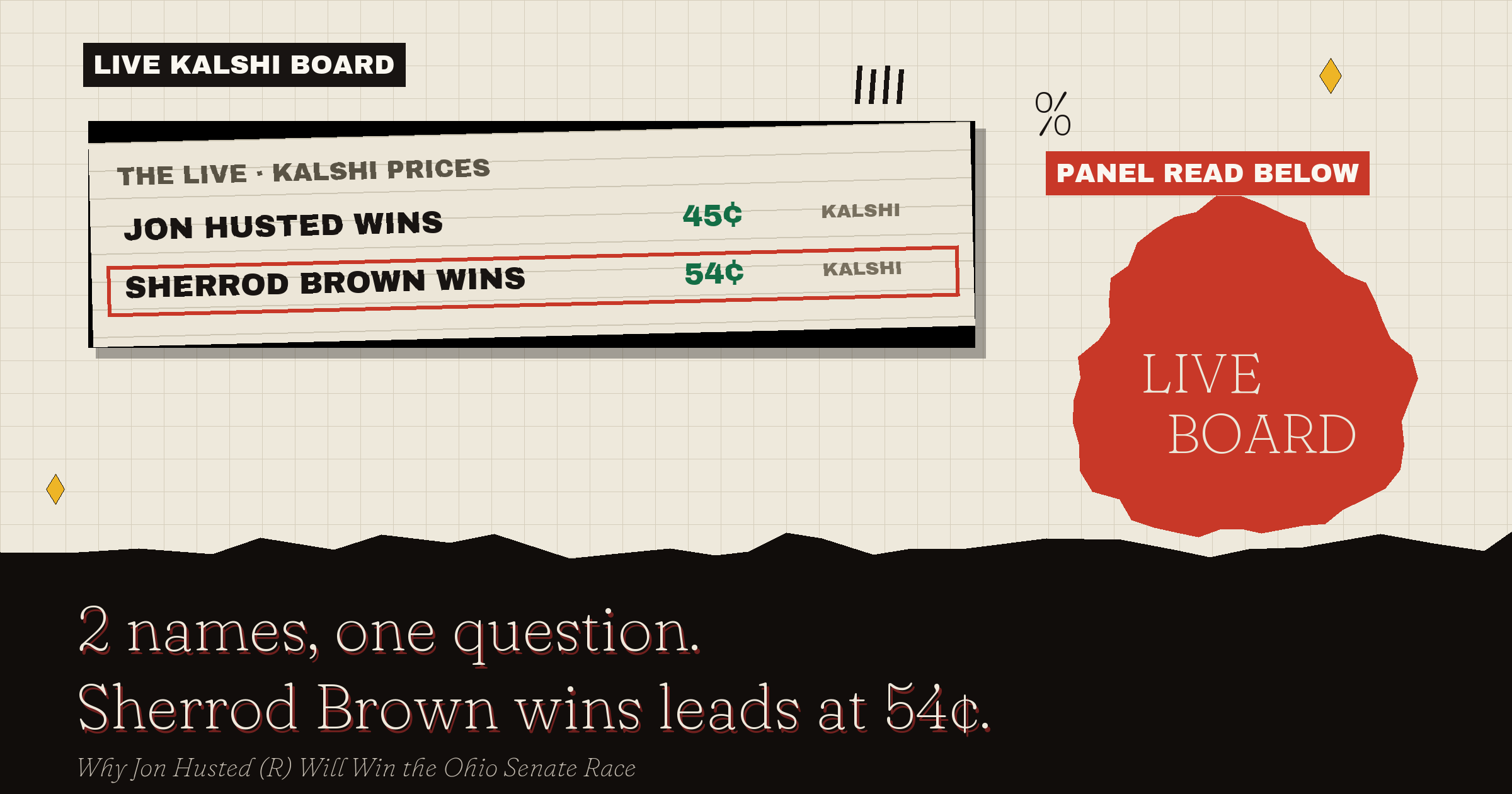
August 30 and September 22, 2026 (Kalshi; the bid is what a buyer will pay, the ask is what a seller wants). The board image below is the August 30 snapshot.
| Outcome | Price | Reads as |
|---|---|---|
| Jon Husted Wins | 45¢ bid / 46¢ ask on Aug. 30; 38¢ / 39¢ on Sept. 22 | about 39% now |
| Sherrod Brown Wins | 54¢ bid / 56¢ ask on Aug. 30; 60¢ / 61¢ on Sept. 22 | about 61% now |
The November 3, 2026 special election decides who finishes the term JD Vance vacated for the vice presidency, and the contract follows that result. The exact wording matters: it resolves Yes for Republicans if a Republican "is sworn in as a Senator of Ohio for the term beginning in 2027," and it expires January 4, 2027, not on election night. That 2027 is the new Congress convening in January, not a fresh six-year term. In plain terms the contract pays out on whoever is sworn into that seat in January 2027, and the winner serves out the balance of the Vance term, which runs to January 2029.
Read across Kalshi's other Ohio boards and the market is telling one coherent story: a close race in a state that still votes as a single coalition. The margin ladders quote a Republican win by 2 or more points at 32 bid and 36 offered, and a Democratic win by 2 or more at 44 bid and 48 offered, which leaves somewhere between 16 and 24 cents of probability, depending which side of the spread you read, on a finish inside two points either way. Double-digit margins trade under a dime on both sides. And on the thinly traded board that pairs the governor's race with this one, a straight Republican sweep of Vivek Ramaswamy and Husted is quoted 24 bid at 30, while the two candidates priced separately would multiply out to about 20 percent. A straight Democratic sweep of Amy Acton, the Democratic nominee for governor, and Brown is quoted 44 bid at 48, against about 31 percent multiplied out. Traders are paying real money for the idea that Ohio breaks one way top to bottom. That correlation is the strongest structural argument on the board for the 45-cent contract, with the caveat that the combo market is thin, its spreads are wide, and a few thousand dollars of volume is not a crowd.
What The Models Think
We also asked a panel of AI models the same question, without showing them a single price. All they got was the sourced record this article is built on. Every one of the panel's eight seats ran this board, and after a second round in which each seat read the others' reasoning and could revise, their middle answer put Husted at 45 percent. That is the market's own number, almost exactly. Four days earlier, on a record that did not yet contain the September 28 retrial date, a six-seat run of the same panel had him at 41.5.
The seats did not agree quietly. The widest gap between two of them was 7 points, from 41 to 48, and the argument splits on one question: how much credit to give Ohio polls for having been wrong about this exact candidate before. "Ohio's structural Republican advantage and historical polling errors favor Husted," one model wrote, before landing below the market anyway on the strength of the retrial calendar. These are model estimates, not predictions of fact. The market has real dollars behind it; the panel has only the record. Every call the panel makes is stored with its ask-time price and graded in public on the full model verdict scoreboard, wins and misses alike.
Where The Panel Changed Its Mind
The revision round is where this panel earned its keep, because two seats moved in opposite directions and both explained themselves.
The most bullish seat on Husted started at 51 percent and came down to 47. "I moved down from 0.51 because peers correctly emphasized that every recent poll and aggregate now has Brown ahead and that the retrial begins five weeks before Election Day, a timing risk I underweighted relative to structural partisanship," it wrote. The most bearish seat did the reverse, moving from 37 up to 41: "the one thing I had underweighted" was the roughly five-and-a-half-point miss on Brown himself in 2024, "a candidate-specific, not generic, error signal." It stopped short of joining the pack for a reason worth reading twice: that 2024 error "came from presidential-year low-propensity Trump voters who are exactly the cohort least likely to turn out in a midterm."
One seat held at 48 and said why. The midterm penalty does fall on the president's party, it conceded, "but the base-rate data explicitly describes the Senate midterm penalty as 'much gentler' than the House's because state lean dominates, and the 2024 polling-error precedent is uniquely specific to Brown as a candidate in Ohio."
More live boards from the same panel: Ohio Senate 2026, the full board · Ohio governor: Amy Acton 56¢, Vivek Ramaswamy 43¢ · every 2026 Senate race we track. Prices fetched August 30, 2026.
Appointed, Endorsed, Unopposed, And Trailing
The résumé half of this race could not have been scripted better for the incumbent. Governor Mike DeWine passed over Vivek Ramaswamy and appointed his own lieutenant governor to the Vance seat on January 17, 2025, handing Husted, a former Ohio House speaker and two-term secretary of state, the advantages of incumbency without a single competitive race for it. President Trump followed on April 9, 2025 with "Jon Husted has my Complete and Total Endorsement — HE WILL NOT LET YOU DOWN!" on Truth Social, and the May 5, 2026 primary made the party's unity literal: Husted ran unopposed and took 736,413 votes, while Brown gave up 10.6 percent of his own primary to a little-known challenger. The price-blind panel's full read on this race and the rest of the 2026 Senate map both treat Ohio as the Republicans' most watchable defense of the cycle, because it is the one where the fundamentals and the polls point in opposite directions.
And they genuinely do point in opposite directions. In August 2025, Emerson College had Husted up 50 to 44. As late as June 28, 2026, the New York Times/Siena poll of likely voters had him 50 to 47. Since then the public polling has gone one way: Fox News' bipartisan poll of August 6-10, 2026 put Brown up 53 to 45, and Wedgewood Polls' August 11-13 survey had him up 48 to 44. By August 17 every aggregate had flipped blue, from RealClearPolitics' razor-thin Brown +0.6 to Decision Desk HQ's +5.4; Wikipedia's average of all six aggregates is Brown +3.6. Two raters moved in mid-August, Race to the WH to Tilt Democratic and Nate Silver's model to Lean Democratic, while Cook, Sabato and most of the field still say Tossup and Inside Elections still says Tilt Republican. Nothing has moved since: no public poll of this race has been released in more than two weeks, and no rater has changed its call since Cook restated Tossup on August 20.
The money tells the story in one line, and then immediately complicates it. Through June 30, 2026, Brown had raised $38,566,234 to Husted's $14,360,028, a margin of nearly three to one. The outside money runs the other way. The Republican-aligned Senate Leadership Fund has spent $700,000 in Ohio so far and plans to spend $79 million; the Democratic-aligned Senate Majority PAC has committed $64 million; outside groups in total have committed more than $174 million to this one race. AdImpact projects $749 million in political advertising across every Ohio race this cycle, not this one alone, up 70 percent from its own first estimate. The best case does not get to wave away the polls. It gets to point out that the fundraising gap everyone quotes is measuring the half of the money where Brown is ahead.
Then it gets to ask what Ohio has done to August polling leads before, and that question has a documented answer. In September 2024, with Emerson showing Sherrod Brown ahead of Bernie Moreno 46 to 44, Brown went on to lose by slightly over 3.5 points. Vance beat Tim Ryan by just over 6 points in 2022, Trump stretched his Ohio margin from 8 to 11 across three elections, and Republicans hold every statewide office, both legislative chambers and 10 of 15 congressional seats. That is the gravity the 45-cent price is discounting, in a chamber the market still expects Republicans to hold.
The Trial In The Middle Of The Race
The reason this is not a normal red-state defense is a word that appears nowhere in Husted's official biography: FirstEnergy. The documented record is specific. In FirstEnergy's federal deferred prosecution agreement, Husted was identified as "State Official 2," described as "fighting to the end" for an extension of the House Bill 6 nuclear bailout. In a July 1, 2019 text released through public records and reported by the Statehouse News Bureau on August 11, 2022, FirstEnergy executive Michael Dowling told Jones: "Just had a long convo with JHusted just now. All is well. JH is working on the 10 years. He's afraid it's going to end up being 8." The Ohio Capital Journal reported on February 19, 2026 that Husted's official calendar showed a meeting with Sam Randazzo, the regulator accused of taking a $4.3 million bribe, two days before HB6 was introduced. Husted's office has never disputed the advocacy, only its framing: "There is nothing new here," his spokesperson said in 2022. "This kind of advocacy is well within his responsibilities as a public official." He has never been charged, and the reporting that carries these documents states plainly that the texts do not suggest he was part of any wrongdoing.
The calendar is the campaign's problem. Brown opened his campaign on May 30, 2026 with a video built on Husted's donor history, green groups launched a $9 million Ohio Senate ad campaign against him, and a standing opposition website exists under the name "State Official Two." Now the retrial's September 28 start date puts weeks of courtroom coverage inside the early-voting window. This is the honest weakest link in the case: the case for Husted needs an electorate that treats "never accused of wrongdoing" as the end of the story, in the same news cycle where the scandal is relitigated in front of a jury.
What the case gets in return is that the attack has already been priced through an entire August of bad polls, and that Brown carries his own coalition crack. Signal Ohio reports that Brown's attacks on Husted's support for data centers have put him at odds with the labor and construction unions building them. The midterm wind Democrats are counting on is also historically gentler in the Senate than anywhere else: since 1946, the president's party has actually gained Senate seats in five midterms, including each of the last two, against an average loss of about three.
The Deadline Nobody Is Polling Yet
There is a second date on this calendar, and it is closer than the trial. U.S.-Canada trade talks collapsed over the weekend of August 22, and Prime Minister Mark Carney announced counter-tariffs that take effect September 8, 2026. "Canada will match Washington's new tariffs dollar for dollar in order to protect Canadian workers, farmers, families, and businesses," he said. The Globe and Mail's account of Ottawa's target list, 15 to 50 percent duties on more than 700 American goods concentrated in steel, aluminum, appliances, agricultural equipment and electronics, reports that by value of imports the hardest-hit states are Ohio, Illinois, Pennsylvania, California and Michigan.
Husted's own position is on the record in both directions. He signed a bipartisan letter earlier this year urging the administration to proceed carefully in renegotiating the trade agreement with Canada and Mexico, per the Associated Press. He has also stood at an Ohio steel plant with Vice President Vance and said, "Today is a new day, it truly is. It's a new day because of the 'America First' agenda."
Here is why this cuts for the 45-cent side rather than against it, at least for now: the AP reported on August 25 that Brown "has not yet criticized Husted on Canadian tariffs, concentrating instead on the senator's support for data centers and Trump's war with Iran." No public poll of this race has been taken since the collapse. The tariffs are a live risk to Husted's number that is not yet in anyone's data, and a challenger who has not picked the fight is a challenger leaving the argument on the table. Anyone pricing this contract off the August polls is pricing a race that has not been surveyed since its economy changed.
What The 45-Cent Contract Actually Pays
One Yes contract on Husted at the 46-cent ask pays $1.00 if he wins. You risk 46 cents to make 54 cents of profit, a total return of about 2.17 times the stake. Because this is an underdog price with nine weeks of news left, it also carries the underdog's second exit: a position does not have to be held to settlement. Husted closed above 50 cents as recently as August 13, so the low 50s are not a hypothetical level for this contract, they are where it traded three weeks ago. A single fall poll putting him back in front, the exact result the Times/Siena survey printed in June, would plausibly take it back there long before November 3. The same thesis expressed through the margin ladder is a Republican win by 2 or more points, quoted 32 bid at 36, which cashes on nothing more exotic than Ohio reverting halfway toward the margin it gave the top of its ticket in 2024. Fees and a wide spread on the thinner rungs are part of the cost of that trade, and on the combo board they are most of it.
The Bottom Line
Husted is bid 38 cents, down from 45 in August, in a state Trump won by 11, with the incumbency, the endorsement, an unopposed primary and a 2024 precedent in which this exact opponent led the September polls and lost by slightly over 3.5 points. Brown is bid 60 with every August and September poll, every aggregate and a $38.6 million-to-$14.4 million candidate fundraising edge behind him, offset by an outside-money ledger that leans Republican $79 million to $64 million. A blind model panel that read the whole record and then argued with itself landed at 45, which is to say it landed on the market. The honest version of the case is narrow but real: everything bad about Husted's year, the testimony, the "State Official 2" label, the $9 million in attack ads, was already public through the entire slide from 52 cents to 46, while the two things that could still move it, Ohio's coalition gravity and a tariff shock nobody has polled, only show up later. The 45-cent question is whether a documented scandal, relitigated in a courtroom that opens five weeks before the vote, can do what Tim Ryan and Sherrod Brown's own 2024 campaign could not.
The panel's calls are on the record. Our 8-model AI panel puts a graded, public verdict on the Ohio Senate race, refreshed with the live board and every seat's number, at the live model verdict.
More on this: 2026 Senate Races: Every Kalshi Board We Track · Why Sherrod Brown (D) Will Win the Ohio Senate Race · Why Jon Ossoff (D) Will Win The Georgia Senate Race · Ohio's Pandemic Doctor Is Running For A Different Job · Ohio State Lost Four Top-11 Picks. Texas Went Shopping.
What Moves The Price From Here
- Canada's Counter-Tariffs, September 8, 2026. Ohio is named among the states most exposed by value of imports, and no poll of this race has been taken since the talks collapsed. If the first post-Labor Day survey shows the economy hurting the incumbent, this price goes lower than the August polls imply. If Ohio manufacturing absorbs it quietly, and if Brown continues to leave the argument alone as he had through August 25, the risk passes without ever reaching a poll.
- The FirstEnergy Retrial, Opening September 28, 2026. Weeks of testimony about House Bill 6, with Husted's name in the exhibits, land inside the early-voting window. Sustained coverage pushes this price down. A verdict or a plea that adds nothing new about Husted removes the single largest overhang on the 45-cent side before Election Day.
- The October Polls. September's three surveys all had Brown ahead, by three to five, and the aggregates now span Brown +3 to Brown +4.5. One nonpartisan survey with Husted back in front, as the Times/Siena had it in June, is still the specific evidence a repricing waits for, and it has not arrived.
- A Debate, Or The Decision Not To Hold One. As of August 6 no Ohio campaign had agreed to a general-election debate. Brown said, "I assume we are. I've debated in most of my campaigns." A Husted spokesperson said she'd be "shocked" if Brown debated this time, after he did not debate Bernie Moreno in 2024. A scheduled debate is a dated event risk for both sides; no debate freezes the race roughly where the polls leave it.
- Third-Quarter Money, Due At The FEC In mid-October 2026. Watch whether the Republican outside commitments actually convert to booked airtime, and whether the Republican-sweep contract on the governor-Senate combo board starts moving with Husted's topline. That correlation is the argument's mechanism, and it is observable in advance.
Settlement timeline. Canada's counter-tariffs take effect September 8, 2026. The FirstEnergy retrial opens September 28, 2026. Third-quarter FEC reports are due mid-October 2026. Ohio votes on Tuesday, November 3, 2026, and the winner is sworn in for the term beginning in 2027; the contract expires January 4, 2027. This page is re-scored when the story moves, and every price on it is stamped as of September 22, 2026, 11:15 a.m. ET.
Hero illustration: OddsShopper, in the house collage style. Jon Husted photo by United States Senate, licensed Public domain; photos cropped, toned, and composited.
Prices quoted are live Kalshi market prices as of September 22, 2026, 11:15 a.m. ET, and will keep moving until this market settles after the November 3, 2026 vote. OddsShopper covers prediction markets as an independent analyst: any model or panel figures referenced are model estimates, not predictions of fact and not financial advice. This article does not advocate for or against any candidate or party. Trading involves risk; contracts can go to zero. The panel's graded record lives on the public Model Verdict Scoreboard.