I have watched more people quit sports betting over a bad number than over a bad opinion. They picked the right side, they were right about the game, and they still lost money over a full season. That is the tell that something in the story we get sold about betting is broken.
The biggest lie in sports betting is that winning is about picking winners. It is the lie the pick-sellers in your mentions need you to believe, and it is the lie the sportsbook is quietly counting on. The truth is smaller, more boring, and far more useful: you do not beat the book by being right more often, you beat it by paying a better price than the bet is actually worth. There is one number that proves it, and I will get to it in a minute, because once you see it you cannot unsee it.
What Is The Biggest Lie In Sports Betting?
Walk through betting Twitter or a YouTube search and the pitch is always the same. Buy these picks. Follow this capper. Fade the public. Every one of them is selling the same premise: that the hard part of betting is deciding who wins, and if you just get the sides right, the money takes care of itself.
The lie in one linebetting is sold as a contest of picking winners. It is actually a contest of prices, and the people who tell you otherwise are the ones profiting from the difference.
That premise is worth billions of dollars to two groups. The first is the army of touts selling $99 pick packages, because "pick winners" is a service you can charge for. The second is the sportsbooks themselves, because as long as you are staring at the matchup instead of the price tag, you are not noticing the tax they attach to every bet you make. The lie survives because both the people selling you information and the people taking your action are rowing in the same direction. Nobody in that room makes money teaching you to read a price.
The Vig: The Number That Exposes The Lie
Here is the number I promised. A standard bet is priced at -110. That means you risk $110 to win $100, and it looks like a coin flip. It is not a coin flip. To break even at -110 you have to win 52.4% of the time, not 50%. That 2.4% gap is what the vig costs you on your side of the bet; count both sides and the sportsbook's built-in cut on a -110/-110 market is about 4.8%. Either way you slice it, that cut is the whole business model in three digits.
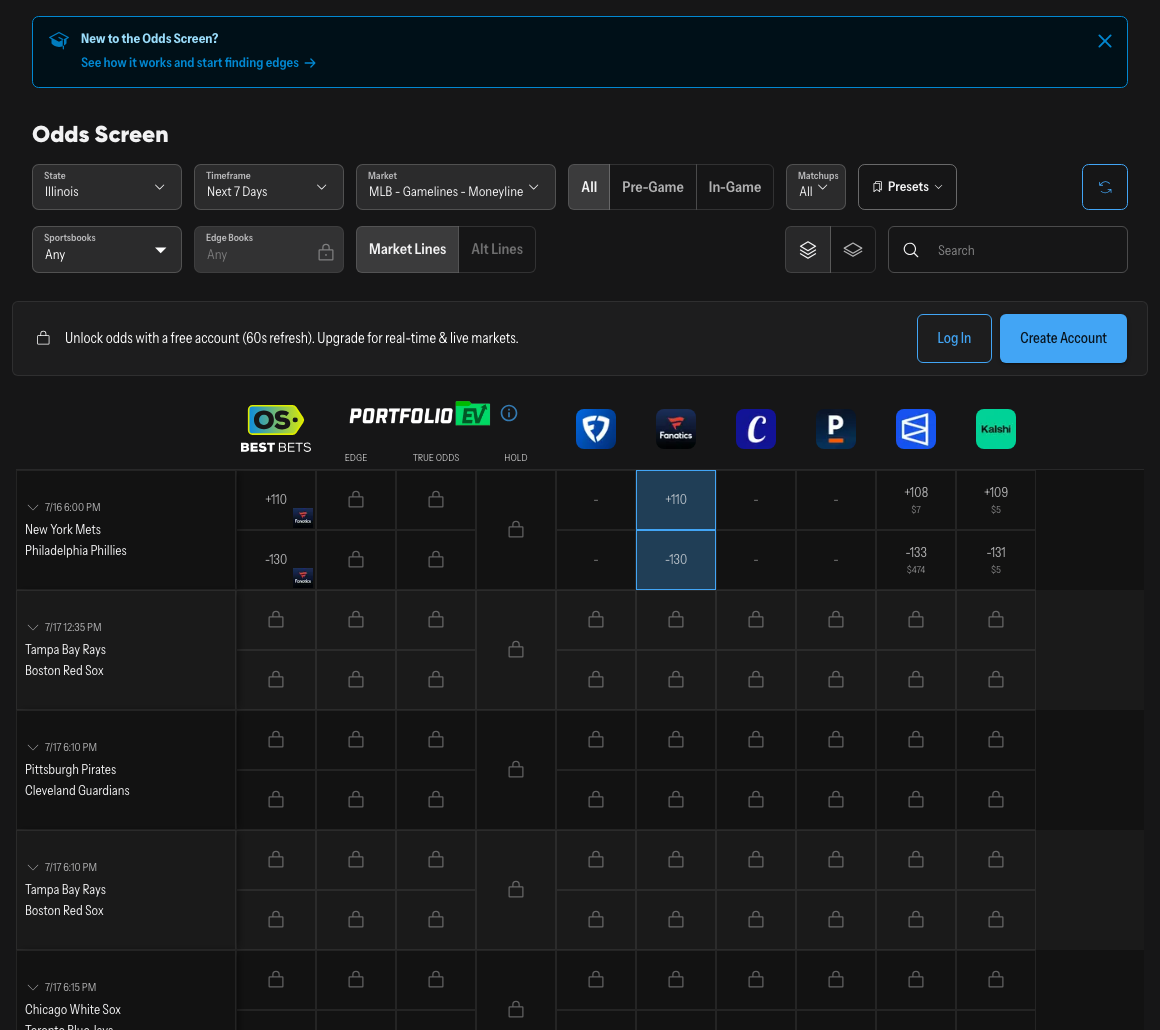
The OddsShopper Odds Screen.
Sit with what that does to the "pick winners" story. A pure 50/50 bettor, a true coin-flipper, does not walk away even at -110. They slowly go broke, because every wager is quietly taxed before the game even starts. You can be right exactly half the time, which is what "picking winners" promises, and still lose, because the price was against you the entire way. Hitting 52.4% at -110 does not make you a profitable bettor either. It makes you break even. Profit lives on the other side of that number, and you get there far faster by improving your price than by improving your record.
The hold is sitting in plain sight on every market once you know to read both prices, and after you start noticing it, you notice it everywhere: the -110/-110 that is really about a 4.8% tax, the boosted parlay that is still minus value after the boost, the "even money" prop that quietly costs you a nickel. New to OddsShopper? It flags that hidden cost for you and points you at the better number instead, and you can try the whole thing free for 7 days before you pay a cent.
The Truth: You Bet The Price, Not The Pick
If the vig is the lie's mechanism, price is its antidote. Let me make it concrete with two bettors making the same bets over a full NBA season.
A Worked Example: When The Worse Picker Wins
Bettor A is the better handicapper. He wins 54% of his bets, which sounds like a season most people would kill for. But he never shops, he just fires at whatever number is in front of him, and it averages out to -120. Bettor B is the worse handicapper. He wins only 52%, two full points behind A, but he always takes the best available price, and it averages out to +100.
You would bet on Bettor A every time if all you saw was the win rate. Watch what the price does to them over 100 bets, with each one staked to win a flat $100 (so Bettor A risks $120 a bet and Bettor B risks $100).
| Bettor | Win rate | Price taken | Net per 100 bets |
|---|---|---|---|
| A (Better Picker) | 54% | -120 | -1.2 units (loses) |
| B (Worse Picker) | 52% | +100 | +4.0 units (wins) |
The better handicapper loses money and the worse one prints it, and nothing changed except the number they habitually take. At -120 you need to win 54.5% just to break even, so Bettor A's excellent 54% is quietly underwater. At +100 the bar is only 50%, so Bettor B's mediocre 52% clears it comfortably. That is the truth the lie is built to hide: the price you get is doing more work than the pick you make. Being right is nice. Getting paid correctly for being right is the actual job.
Stop leaving the better number on the table.OddsShopper compares every major sportsbook in real time and flags the bets priced in your favor, so you can be Bettor B without doing more homework than Bettor A. Try it free for 7 days, and code BIGLIE20 takes 20% off OS Pro or OS Core if you subscribe.
Line Shopping: The Everyday Version Of The Truth
The simplest way to start living in the truth is line shopping, and it is exactly what Bettor B was doing. The same market is priced differently at different books at the same moment, because they do not all move their numbers at the same speed. On a Yankees moneyline you might see DraftKings at -140 while FanDuel sits at -125 and BetMGM has it at -130. Same team, same game, three different prices. The bettor who takes -125 is paying less for the identical outcome than the bettor who grabs the first -140 he sees.
One bet, that gap looks like nothing. Over a season of them, it is the entire difference between the two bettors in the table above. You can watch this play out yourself on the live odds screen, where you shop the number across every major book and the same market is sitting there at four or five prices at once. There is no handicapping in this step at all. You already decided on the bet; line shopping just makes sure you are not overpaying for it. If you want the mechanics of reading that board, how to use the OddsShopper odds screen walks through it.
From Line Shopping To +EV: Letting The Market Reveal The Bet
Line shopping finds you the best price on a bet you already like. Positive expected value, or +EV, takes the next step and lets the market tell you which bets are worth making in the first place. The engine underneath it is de-vigging.
Here is the move. Take the sharpest book on a two-sided market. Say the favorite is -120 and the underdog is +100. Convert those to implied chances: -120 is 54.5% and +100 is 50%, which add up to 104.5% instead of a clean 100%. That extra 4.5% is the hold I keep coming back to. Strip it out by dividing the favorite's 54.5% by the 104.5% total, and the fair, no-vig chance the favorite wins is about 52%. Now you scan the rest of the board. Any book still paying that team as if it is a 50% coin flip, +100 or better, is handing you a 52% outcome at a 50% price. That is a +EV bet, and it exists because two books disagree, not because you predicted anything.
Doing that math by hand on every game is a full-time job. OddsShopper de-vigs every market automatically, stripping the hold out to reveal each side's true no-vig price, and the Positive EV odds screen ranks the results by expected ROI (xROI) and expected win percentage (xWin%), so the tool surfaces the mispriced bets in a sorted list instead of leaving you to find them one book at a time. You are not being asked to out-think the market. You are being handed the spots where the market already disagrees with itself. For the full walkthrough, positive expected value explained breaks the concept down, and how to find +EV bets is the step-by-step.
Closing Line Value: The Honest Scoreboard
There is one more truth that finishes the story, and it answers the question the lie can never answer honestly: how do you know if you are actually good? Your win-loss record will not tell you over any sample a normal person can bet. You can make ten perfect bets and lose seven of them to variance, or make ten terrible ones and cash on a heater. Wins and losses are too noisy to trust in the short run.
Closing line value is the honest scoreboard instead. It measures whether the price you bet beat the market's final, closing number at kickoff. If you took a team at +100 and it closed at -120, you got a better number than the sharpest version of the market did, which means you were on the right side of the information before it fully priced in. Do that consistently and profit follows, even on the days the ball bounces wrong, because you are grading yourself on the one thing that predicts long-term results rather than the one thing that feels like results.
The honest scoreboardgrade yourself on whether you beat the closing number, not on your last ten tickets. A handful of wins and losses is mostly noise; beating the close is the signal that you are betting the right prices.
Closing line value is a different animal from line shopping: shopping is about beating the OTHER books right now, while beating the closing line is about beating the market's final word. Both are about price, and neither is about your gut read on the game.
The Bottom Line
Circle back to that first number. The whole lie collapses on 52.4%, the win rate a -110 bettor needs just to break even. It proves that being right is not enough, and that if being right is not enough, then "pick winners" was never the real game. The books and the touts want you scoring yourself by wins because a wins-obsessed bettor never looks at the price, and the price is where they make their money and where you lose yours.
The truth is less exciting and far more profitable: shop every bet for the best number, use de-vig math to bet only when the price is in your favor, and grade yourself on closing line value instead of your last ten tickets. None of it requires you to be a genius. It requires you to stop paying the tax the lie was designed to hide. If you want the wider playbook, how to beat the sportsbook lays out the five kinds of bettors who actually win, and the sports betting strategy hub ties the pieces together.
Bet the price, not the lie.OddsShopper compares every major sportsbook, de-vigs the market, and ranks the +EV bets for you on the Positive EV odds screen, so the truth in this article takes minutes instead of a spreadsheet. Try it free for 7 days, then code BIGLIE20 takes 20% off OS Pro or OS Core.
Prefer to see the truth applied first? Our free expert picks today are posted with the price reasoning attached. Bet responsibly, 21+ where legal.
More on this: Louisiana Sports Betting Guide: Rules, Promos & Strategy · Arizona Sports Betting: Is It Legal? Apps & Rules · Illinois Sports Betting: Is It Legal? Apps & Rules · Massachusetts Sports Betting: Is It Legal? Apps & Rules · Michigan Sports Betting: Is It Legal? Apps & Tools
Frequently Asked Questions
What is the biggest lie in sports betting? That winning is about picking winners. In reality the price you bet at matters more than your win rate, because the vig taxes every wager before the game starts. You can pick sides at a 52% clip and profit, or at 54% and lose, depending entirely on the number you take.
Why do I lose at sports betting even when I pick a lot of winners? Almost always the price. At the standard -110 you have to win 52.4% just to break even, so a 50% picker slowly loses to the vig. Taking bad numbers, laying extra juice, and never line shopping quietly turns a decent record into a losing season.
What does line shopping do for a sports bettor? It gets you the best available price on a bet you already want to make. The same market is priced differently across books at the same time, and taking -125 instead of -140 on the identical outcome saves money on every ticket, which compounds into real profit over a full season.
What is closing line value and why does it matter? Closing line value measures whether the price you bet beat the market's final closing number. It is a more reliable scoreboard than your win-loss record because a small sample of results is mostly variance, while consistently beating the close is the strongest signal that you are betting profitably long term.
How does OddsShopper help me bet the price instead of the pick? It compares every major sportsbook in real time, de-vigs each market to a true no-vig price, and ranks the +EV bets on the Positive EV odds screen by expected ROI and win percentage. That turns the price-first approach in this article into a sorted list instead of manual math.