Winning NBA bets over a full season has very little to do with picking the right side on a hunch. It comes down to three repeatable moves:
- Get the best price on the number you like.
- Know your real chance of cashing it.
- Bet the right amount when you find an edge.
A good NBA betting tool does all three of those for you across the core NBA player props, faster than you could check a single book by hand. Below is exactly how that workflow runs.
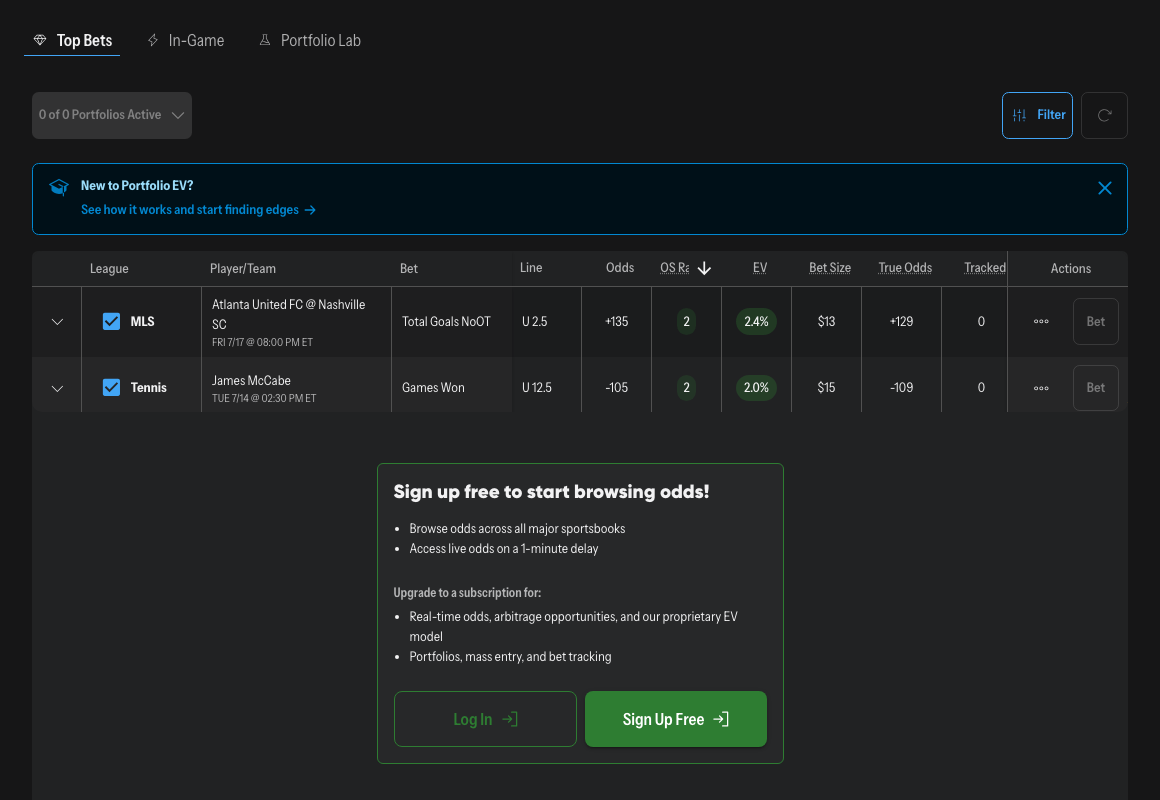
The OddsShopper +EV Screen.
TL;DR: The +EV NBA Betting Workflow
- Shop The Number. The tool scans every major book and surfaces the single best price on the prop you want, because +115 pays more than +100 for the identical result.
- Price Your Edge. It turns an NBA projection into a real win probability and compares it to the odds — that gap, not a hunch, is the whole bet.
- Size It With Kelly. It recommends what share of your bankroll to stake, so normal variance is far less likely to wreck your roll.
- The Worked Example Below runs a real Darius Garland rebound prop start to finish: +115 price, 3.2 projection, 51% win probability, +11% EV, 7% Kelly stake.
That three-move loop is the core of any repeatable +EV NBA betting strategy, and the rest of this guide walks each step.
Watch The Video
Here is the full walkthrough of the OddsShopper NBA betting workflow, from finding the best price to sizing the bet. Watch on YouTube.
Why Winning NBA Bets Is A Numbers Game, Not A Hunch
NBA player-prop boards run deep. Points, rebounds, assists, blocks, and steals are posted across a lot of players and a lot of books every night. That volume is the opportunity: with so many numbers moving, the books do not all land on the same price, and those gaps are where an edge can hide.
The catch is that finding those spots by hand is slow. You would have to open several betting apps, compare the same rebound line across all of them, estimate a fair projection, convert odds into an implied probability, and then figure out a responsible bet size, all before the line moves. Do that manually and most of your edge evaporates before you place the bet. That is the exact job an NBA betting tool is built to automate, and it runs in the same three steps every time.
Step 1: Shop Every Book For The Best Number
The first move is line shopping, and it is the one with the least skill and the most dependable value. The OddsShopper odds screen scans every major sportsbook (DraftKings, FanDuel, BetMGM, Caesars, and more) and surfaces the single best available price on the bet you want. The Best Bets view does the comparison for you and tells you which book to place the bet at.
Why does this matter so much? Because the same rebound prop might be +100 at one book and +115 at another for the identical outcome. Betting the +115 version is free value, the payout is bigger for the exact same result, and over hundreds of bets that gap is a real chunk of your bottom line. If you want the full breakdown of why a bigger plus number always beats a smaller one, our guide to plus and minus odds covers it. The tool applies that logic automatically, so you never leave the better number on the table.
But a great price is only worth betting if you actually have an edge on the number, and the second step is where you confirm one.
Step 2: Turn A Projection Into A Real Win Probability
Getting the best odds means nothing if the bet is a loser to begin with. The second move is to compare the line against a real projection and turn that into a win probability. This is the layer most casual bettors skip entirely.
OddsShopper runs simulations on each prop, using Stokastic's NBA projections, and outputs a model win probability plus an expected value (EV) for the bet. Take the worked example from the video: a Darius Garland rebounds Over 2.5 prop, with one book posting +115. It projects Garland for 3.2 rebounds, comfortably clear of the 2.5 line, and the simulations return a 51% win probability. A +115 price carries an implied probability of only about 46.5%. When your model gives the bet a better chance than the price implies, you have a positive-EV bet, and the simulation flags this one at roughly +11% EV.
This is the entire idea behind finding +EV bets: you are betting your true probability against the book's implied probability, and betting only when the gap is in your favor. The same +EV logic carries over to Portfolio EV when you are weighing more than one bet at a time.
The takeawaya bet is only worth making when your model's win probability is higher than the odds imply. On the Garland prop, 51% projected against 46.5% implied is the edge. Everything else is noise.
Step 3: Size The Bet With Kelly
You have found the best price and confirmed a real edge. The third move, and the one most bettors never make, is sizing the bet correctly. A +EV bet you stake too small barely grows your bankroll, and one you stake too large can wipe you out during a normal cold stretch.
OddsShopper handles this with a Kelly Criterion feature that reads your edge and recommends the optimal percentage of your bankroll to bet. On the Garland example, with a 51% win probability at +115, it suggests putting about 7% of your bankroll on the play. It also projects the long-run growth of that bet: staking 7% here is expected to grow your bankroll by about 0.5% on this bet. Small, but that is how a bankroll compounds, one +EV bet at a time.
Worked Example: One NBA Prop, Start To Finish
Here is the full read on that single prop, with all three moves in one place:
| Metric | Value |
|---|---|
| Bet | Darius Garland rebounds Over 2.5 |
| Best Available Price | +115 |
| OddsShopper Projection | 3.2 rebounds |
| Model Win Probability | 51% |
| Implied Probability (From +115) | 46.5% |
| Expected Value | about +11% |
| Suggested Stake (Kelly) | 7% of bankroll |
| Expected Bankroll Growth | about +0.5% |
The row that matters most is the gap between the two probabilities: 51% versus 46.5%. That four-and-a-half-point difference is the entire bet. It is not the storyline, the matchup, or a gut feel about Garland; it is the model saying the market underpriced this rebound number, and the price agreeing to pay you for it. The EV and stake shown are the tool's own model outputs, priced off its projected fair line, so they can read slightly different from a quick hand calculation on the displayed odds.
One important sizing note the video calls out: if you are placing several bets at once on the same night, do not stake each one at its full recommended percentage. You will not know whether the Garland bet has won by the time you place, say, a Jabari Smith Jr. prop, so those bets are live at the same time. Trim the later stakes so your total exposure stays reasonable. For the full framework on protecting your roll, see our bankroll management guide.
New to OddsShopper?The tool scans every major book, runs the projection-and-simulation math on the supported NBA props, and shows you the win probability, the EV, and the suggested bet size, the whole workflow above, automatically. You can try it free for 7 days, and code NBAEV20 takes 20% off OS Pro if you subscribe.
What NBA Props The Tool Covers
In the video, the tool currently covers points, rebounds, blocks, assists, and steals, so the same three-move process applies whether you are betting a scoring line or a role-player rebound number like the Garland example. New to how these markets work? Our player props explainer breaks down each prop type.
The reason a fresh projection beats a raw stat line is exactly what the Garland example shows: the tool reprices the number through its own simulation for that specific matchup, rather than leaning on a season average. That is why the 3.2 projection can sit comfortably over a 2.5 line the book posted, and why the win probability the simulation returns is what you actually bet against, not the raw box-score number. Sharpening up on live NBA markets? Our NBA Summer League betting guide is a good next read.
The Bottom Line
A good NBA betting tool is not a crystal ball, and no tool can promise a winning bet. What it does is remove the three places where bettors leak value, and the Garland prop shows all three at once: it caught the +115 top price instead of a worse number, it surfaced a 51% simulated win probability against a 46.5% implied one so you were not betting a line you had no edge on, and its Kelly read set a 7% stake instead of a number picked by feel. When you are running several props on the same night, it also flags the exposure adjustment so your open bets do not stack past what your bankroll can carry. Automate those moves and you give yourself the best long-run chance the market allows. None of this promises a winning night, but it is how the disciplined side of the board operates.
FAQ
What is a +EV NBA bet? A positive expected value NBA bet is one where your true chance of winning is higher than the probability implied by the odds. If a projection says a rebound Over hits 51% of the time and the price of +115 only implies 46.5%, that gap makes it a +EV bet worth taking over the long run.
How does an NBA betting tool calculate win probability? OddsShopper runs simulations on each prop using Stokastic's NBA projections, then outputs a model win probability for the line. It compares that number to the implied probability from the best available odds to flag whether the bet is +EV.
What NBA props can I bet with OddsShopper? The tool covers the core NBA player props: points, rebounds, assists, blocks, and steals, with the best available price and the model win probability shown for each.
How much of my bankroll should I bet on one NBA prop? OddsShopper's Kelly Criterion feature recommends a stake based on your edge, often a single-digit percentage of your bankroll for a typical prop. If you are betting several props on the same night, trim each stake so your total exposure stays controlled.
Is OddsShopper free to try? New users get a free 7-day OS Pro trial, and code NBAEV20 takes 20% off OS Pro if you decide to subscribe.
Ready to stop leaving the better number on the table?Try OddsShopper free for 7 days and let it find, price, and size your NBA props for you. Code NBAEV20 takes 20% off OS Pro if you subscribe.
More on this: NBA Championship 2027 Odds: Live Title Prices By Team · NBA Next Team Odds: Every Star's Landing-Spot Market, Scored · How To Bet NBA Assists Props: A Strategy Guide · How To Bet NBA Points Props: A Strategy Guide · How To Make Your Own NBA Projections For Player Props