September's ladder lost its first rung in three days. Bitcoin jumped more than 5% on September 3 and traded briefly above $82,000, and by late that morning Kalshi had settled the $80,000 rung of its "How high will BTC get in September?" board as YES. Then the market gave the move back, as it has at nearly every approach to this zone since late August. Everything still trading is a bet that Bitcoin gets a second leg, and the calendar says the second leg runs straight into a Federal Reserve meeting.
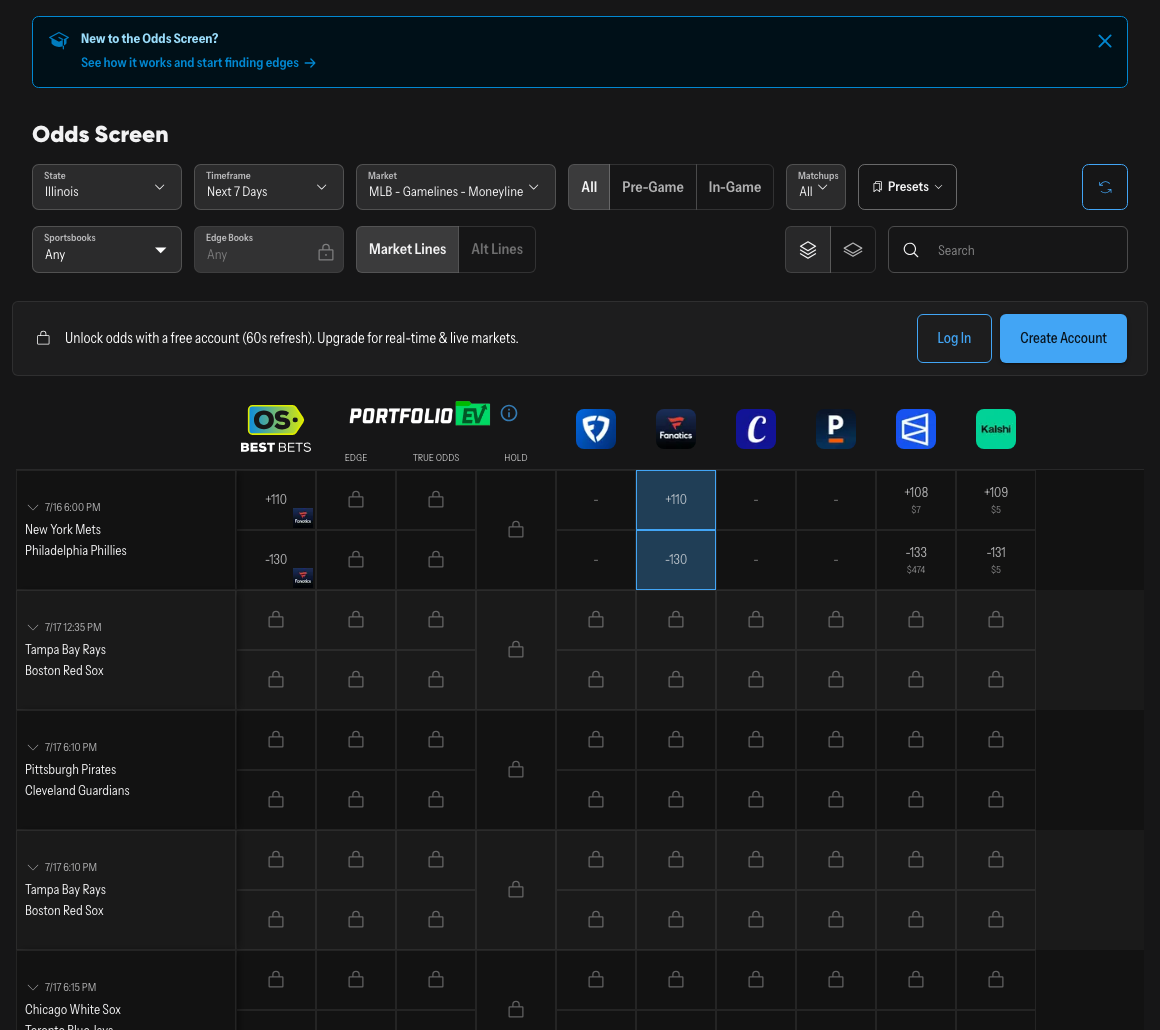 The OddsShopper live odds screen — every book's price on one board, refreshed in real time. Open the live board.
The Quick Answer
As of September 4, 2026, Bitcoin trades near $79,600 after printing a September high of $82,283 on September 3, the session that settled Kalshi's first rung. Seven rungs are still live. The market prices "above $82,500" at 71¢. The next rung, $85,000, is a coin flip at 48¢, and the odds fall fast from there. Our eight-model AI panel, scoring blind, lands level with the market on the first rung and a few points above it through the middle of the ladder. The month's swing factor is the September 16 Fed decision, where Kalshi's own Fed board prices a quarter-point hike at roughly a coin flip.
Stay ahead of the markets.
Daily insights and expert picks on Kalshi, Polymarket, and what's moving markets.
Free forever. Unsubscribe anytime.
New to event contracts on Bitcoin? Our plain-English guide to how Bitcoin price contracts work on Kalshi covers the mechanics, so this page can stay on the prices.
Every quote below is stamped "as of September 4, 2026" so you can see when it was last read.
The Board
The market is Kalshi's ladder of "above $X" contracts under event ticker KXBTCMAXMON-BTC-26SEP30: each rung settles YES if the CF Bitcoin Real-Time Index, on a trimmed-mean reading, tops the level at any point through September 30, 2026 at 11:59pm ET, and the $80,000 rung did so on September 3. Verify the live rungs on Kalshi's Bitcoin markets and spot on Coinbase.
"Market (YES)" is the current Kalshi ask, the price a YES buyer pays. "AI panel blend" is the median of the eight models after a revision round, and "Seat range" is the lowest and highest of the eight. Prices as of September 4, 2026, 9:00 PM ET.
| Will Bitcoin's September High Top… | Market (YES) | AI panel blend | Seat range |
|---|---|---|---|
| $82,500 | 71¢ | 70% | 66% to 75% |
| $85,000 | 48¢ | 51% | 49% to 55% |
| $87,500 | 31¢ | 37% | 35% to 41% |
| $90,000 | 20¢ | 26% | 24% to 30% |
| $92,500 | 14¢ | 18% | 16% to 21% |
| $95,000 | 10¢ | 12% | 10% to 15% |
| $97,500 | 8¢ | 7% | 6% to 10% |
Every seat is graded against real market settlements; the full scoreboard is public and recomputed daily. Model estimates generated September 4, 2026, from a price-blind data card: each model saw Bitcoin's price path, realized volatility, the market's settlement rules and dated news, but never the market's prices. The blend is the seat median, not the average.
More live boards from the same panel: Bitcoin's 2026 annual high ladder: the $100,000 rung at 29¢ · when Bitcoin gets back to $100,000 · how low Bitcoin goes this month: the $75,000 floor rung at 52¢. Prices fetched September 4, 2026.
The line worth staring at is the top one. A 71¢ price on "above $82,500" says the market thinks a level Bitcoin nearly touched on September 3 is far from a formality with most of the month left. That is a quiet admission that the last two weeks have been a series of rejections at exactly that altitude. Six sessions since August 24 have printed highs between $80,000 and $82,300 on Coinbase's daily candles, and every one of them closed back below $81,500. The panel, scoring blind, arrived at the same 70%.
Where The Panel Splits From The Money
Start with where they agree, because it is most of the board. On the first rung the blend and the market are within a point of each other, and on $85,000 both call it a coin flip. At the very top, the market's 8¢ on $97,500 sits a point above the panel, and that rung was the busiest on the board in the day before this pull. Cheap tails attract volume after a breakout day.
The gap is in the middle two rungs, $87,500 and $90,000, where the panel runs six points above the market on each. The panel's reasoning is consistent from seat to seat: if the month gets a second leg at all, the leg that clears $85,000 does not stop there. GPT put the fork plainly:
The September 15-16 FOMC is the main fork: a hike or hawkish hold likely leaves the high at no further settlement or one rung; a hold with falling yields and ETF inflows can carry BTC into the high $80ks or low $90ks. — GPT
It is a legitimate read with a mixed record. Across our graded history, when this panel and a Kalshi price have disagreed by ten cents or more, the market has been right roughly two-thirds of the time, and the gaps here are smaller than that. The panel's number is context and a graded record, never a signal. The market says the second leg is less likely than the models think; the models say the second leg, if it comes, is bigger than the market thinks. The scoreboard will show who read it right.
What August Taught This Page
This page priced the August edition of the same board, and August graded it hard. On August 20, with Bitcoin near $69,700, the market had "above $80,000" at 6¢ and the panel's blind blend had it at 4%. Bitcoin cleared that level on the settlement index on August 25, and every rung up to it settled YES. The $82,500 rung, which both had put in low single digits, became the most traded contract on the August board before settling NO on the month's last day.
Two lessons carried into this run. The first is the tail: a month that has just produced a 25% rally is not a month in which a further 20% move is exotic, so every seat kept real weight above $95,000 this time. The second is the settlement trim, which the panel argued about in public, below.
The Bull Case (Why The Rungs Could Hit)
The case for the ladder is a case for the Fed getting out of the way: a hold on September 16, yields falling after it, on top of ETF flows already running positive. Yahoo Finance's September 4 report attributed the September 3 move to easing rate-hike fears and falling Treasury yields, and noted that the U.S. spot-Bitcoin ETFs took in $252.8 million that day. Per SoSoValue data in a separate Yahoo Finance piece on September 1, the same funds absorbed $3.52 billion in August, though in most prior months with inflows that large Bitcoin fell the month after.
Bitcoin's own volatility does the rest of the work. Claude Opus, the most constructive seat on the middle of the board, started from the raw math: at recent realized volatility of about 2.4% a day, a move to $85,000 over the rest of the month is close to a coin flip before anyone forms a view on direction. The panel's data card, built from Coinbase daily candles back to 2018, was more generous still. In past windows that opened this far below Bitcoin's running high, the high went on to reach the equivalent of $82,500 about 80% of the time. The panel treated that as a ceiling, but a ceiling that high is why no seat put the first rung below 66%.
The Bear Case (Why They Probably Do Not)
The bear case has a date on it. The FOMC meets September 15-16, and after Chair Kevin Warsh's Jackson Hole remark that the Fed has "work to do" on inflation, CNBC described the September decision as a coin flip between a hold and a quarter-point hike. Kalshi's own Fed board agreed at this page's September 4 pull, pricing a hike at 51¢ and no change at 48¢; we track it on Fed rate odds for September 2026. The August CPI report lands before the meeting and will move that price first. Gemini spelled out what a hike does to this ladder:
A 25bp hike (which J.P. Morgan now holds as a base case) or a hawkish hold would likely kill a second upside leg, capping the month near the September 3 highs. — Gemini
If that branch plays out, the month's high is already in and every live rung settles NO. That is why the panel's single most likely outcome, at about 30% of the blended distribution, is "no further rung settles."
The second bear argument is about what kind of rally this is. Kimi put the cycle position bluntly:
Cycle position: ATH was 11 months ago, spot is -37% from it, and the 2026 high ($97,964) hasn't been approached since — this is a recovery, not cycle euphoria, so the bull-dominated empiricals overstate the upper rungs. — Kimi
Bitcoin's all-time high came in October 2025 and its 2026 high in January. The sessions since August 24 have been chop between $76,000 and $82,300 on Coinbase's daily candles, with one squeeze that faded the next day. Combine a coin-flip hike with a market that has not trended for two weeks, and the ladder's steep decay above $87,500 is the panel's honest read.
Where The Panel Changed Its Mind
We run these panels twice: after the first pass, each model reads the others' anonymized distributions and may revise. This run produced the most instructive revision round we have seen on a Bitcoin board, because the panel argued about a mistake in public and only half fixed it.
In round one, seven of the eight seats read the same fact as evidence about the settlement mechanic: spot printed $82,283 on September 3 and the $82,500 rung did not settle, so the trimmed-mean settlement must impose a large hidden margin above every strike. Four of them haircut the empirical touch rates by 15 to 20 points on that basis. Claude Opus refused, and its objection is simply correct:
Four forecasters haircut every rung 15-20 points because 'spot hit $82,283 on Sep 3 and $82,500 didn't settle,' and because August's $81,480 high never settled $82,500. Neither is evidence about the trim: in both cases spot never reached the strike at all. — Claude Opus, after the revision round
The record backs it. Both $80,000 settlements, August 25 and September 3, landed inside the session in which spot first cleared the strike, so whatever margin the trim needs looks small.
It only half landed. DeepSeek, the most bullish seat in round one, came down 14 points on the first rung after adopting the trim discount, and Sonnet fell the same amount and kept its haircut. The seats that rose did so for Opus's reason: GPT moved up nine points on the plain volatility math. The spread on the first rung narrowed from 19 points to nine and the blend barely moved, so the median is well defended, though most of the seats defended it with the wrong argument. That is what the scoreboard will grade at month-end: which road to 70% survives contact with September.
The Bottom Line
The market and the panel agree on the shape: a likely new high above $82,500, a coin flip at $85,000, and a fast decay above that. They part ways only on how far a real second leg would run. If the Fed holds on September 16, the middle rungs are the ones to watch. If it hikes, the month's high is probably already in, and this board becomes a snapshot of September 3.
To be explicitnothing here is advice to buy or sell anything.
More on this: How Low Will Bitcoin Get In August? The Floor It Hit Twice · Where Does Bitcoin End 2026? Kalshi's Price-Band Odds · How Bitcoin Price Contracts Work On Kalshi · Bitcoin 250K By 2027? Kalshi's Longshot Just Woke Up · How High Will Oil Go In 2026? April Nearly Paid And Hormuz Is Burning Again