The Florida governor primary is over, and so is the market. Byron Donalds won the Republican nomination on August 18 with 47.8% of the vote, and Kalshi, the regulated exchange where traders had priced this race all summer, has already settled its nomination market: the Donalds contract paid out at $1, and every other candidate's paid nothing. The market spent the whole summer telling you this would happen. What it got wrong was the size of the win: on primary eve Kalshi priced Donalds at 85 cents to clear 50% of the vote, and he finished at 47.8. That miss, and its mirror image on Jay Collins's line, is the most instructive thing on the whole board.
Updated August 22, 2026 · 7 min read · By Jake Hari
For most of the summer this page tracked a market with no suspense at the top. Donalds traded near 98 cents for weeks, we published the full case for why before the vote, and our AI panel scored the same market price-blind and landed on the same name. The count graded everyone. The market's report card has a clean top line and a real miss on the margin worth understanding, and the board it hands off to, the November general, is less settled than you would guess for a state Trump carried by 13 points. That November number is where this ends.
The Quick Answer
Byron Donalds won the 2026 Florida Republican governor primary with 47.8% of the vote on the near-complete unofficial count, about 810,600 votes to Jay Collins's 426,700 (25.2%), a margin of about 22.6 points as the count advanced past election night's first tallies. Kalshi has finalized its nomination market: Donalds resolved Yes, and all eight other listed candidates, Collins, James Fishback, Paul Renner, Jimmy Patronis, Wilton Simpson, Matt Gaetz, Charles Burkett and Casey DeSantis, resolved No. The market had also been betting on the vote shares themselves, and there it missed: Donalds clearing 50% traded at 85 cents on primary eve and is now priced at a penny, while Collins clearing 25% traded at 15 cents and is now quoted 94 bid, 99 ask, pending certification. The lesson is not that the market missed the winner; it is that the side markets on the margin were priced off the same lopsided story as the nomination, and the count was closer than the story. What that miss means, and what the still-open November market says about Donalds versus David Jolly, is below.
Stay ahead of the markets.
Daily insights and expert picks on Kalshi, Polymarket, and what's moving markets.
Free forever. Unsubscribe anytime.
The Settled Board: Donalds Yes, Everyone Else No
A Kalshi contract pays $1 if its question resolves Yes and nothing if it resolves No, so the settlement, finalized by Kalshi just after midnight on August 19, is the market's way of banking the result. This is how the nomination event, ticker KXGOVFLNOMR-26, finalized, next to where each name actually landed in the count.
| Kalshi Contract | Settlement | Unofficial Vote Share |
|---|---|---|
| Byron Donalds | Yes — paid $1 | 47.8% (810,552 votes) |
| Jay Collins | No | 25.2% (426,696) |
| James Fishback | No | 10.5% (177,660) |
| Paul Renner | No | 8.5% (144,950) |
| Jimmy Patronis, Wilton Simpson, Matt Gaetz, Charles Burkett, Casey DeSantis | No | not on the Republican primary ballot |
Settlement from the Kalshi API (event KXGOVFLNOMR-26), finalized 12:12 AM ET August 19, 2026; vote figures from the unofficial count reported by Decision Desk HQ and the AP with about 99% of the expected vote in. Florida's county canvassing boards file official returns in the week after the vote and the state Elections Canvassing Commission certifies them after that, so certified numbers can shift the percentages slightly.
That last table row deserves a sentence, because it is a quiet lesson in how these markets work. Kalshi listed nine names in this event, and five of them were never on the Republican primary ballot. Four, including Casey DeSantis and Matt Gaetz, never filed for the nomination, and their contracts carried live prices for months on speculation about campaigns that never existed; the fifth, former Surfside mayor Charles Burkett, qualified for November as a no-party-affiliation candidate instead. All five resolved No and paid nothing. Meanwhile seven minor candidates who actually were on the eleven-name ballot, and who took about 8% of the vote between them, never got a Kalshi listing. An exchange's list of outcomes is itself an editorial judgment about who matters, and it is worth checking against the real ballot before you read anything into a price. We flagged that gap in an earlier edition of this page; the ballot proved it.
The favorite's settlement was never in doubt. Donalds took Trump's endorsement in February 2025, led every public poll all summer, by 30-plus points in most surveys, and his contract closed primary eve at 98.7 cents, meaning the market gave him about a 98.7% chance. Wire to wire, the market was right, and there is not much more to say about the top line. The interesting grading happens one level down.
The Market Was Also Betting On The Margin
Alongside the who-wins market, Kalshi runs side markets on how big a slice of the vote each candidate gets. Think of them as the market betting on the margin, one threshold at a time: separate contracts ask whether Donalds finishes with at least 45% of the certified vote, at least 50%, at least 55%, and so on, each paying $1 if he clears that bar. Read together, the prices tell you the exact range the market expects a candidate to land in.
On primary eve the ladder read like a landslide. Donalds's "at least 45%" contract closed August 17 around 92 cents, "at least 50%" around 85, and "at least 55%" in the low 70s. In plain English, the market put roughly a five-in-six chance on a Donalds majority and better than two-in-three on him clearing 55. The count came in at 47.8. The 45% line paid, the 50% and 55% lines went to a penny, and the money that had been sitting on a majority, about 16,000 contracts traded on the 50% line in the first hour after polls closed alone, repriced from 83 cents to 9 in 60 minutes.
Every edition of this page has made the same argument about why a candidate polling in the 40s can trade at 98 cents to win, and that part held up: a poll lead and a price are different claims. The price counts winning scenarios, the same way a simulation turns a modest projection edge into a lopsided win rate, and with a double-digit lead and days left, nearly every scenario ended with Donalds first. What the vote-share contracts, the ladder of at-least-X% lines, show is the board taking that compression one step too far. "He wins nearly every time" is a probability about rank. "He wins with a majority" is a claim about the median vote share, and the median never moved much past the polling, which had him in the 40s all summer. The market priced the rank and the margin off the same story.
Here is the promised report card, market on primary eve against the count.
| Question | Primary-Eve Price | The Unofficial Count | Grade |
|---|---|---|---|
| Donalds Wins The Nomination | 98.7¢ | Won by ~22.6 points | ✓ |
| Donalds Gets At Least 45% | ~92¢ | 47.8% | ✓ |
| Donalds Gets At Least 50% | ~85¢ | 47.8% | miss |
| Donalds Gets At Least 55% | ~73¢ | 47.8% | miss |
| Collins Finishes Second | 77¢ | Second, 25.2% | ✓ |
| Collins Gets At Least 25% | 15¢ | 25.2%, right on the line | miss |
Primary-eve prices are the last trades on the evening of August 17, 2026, from the Kalshi candlestick history for the KXVOTEPRIMARY and KXPRIMARYPLACE markets on this race, pulled August 22; the 45/50/55 rungs closed with bid-ask spreads of two to four cents.
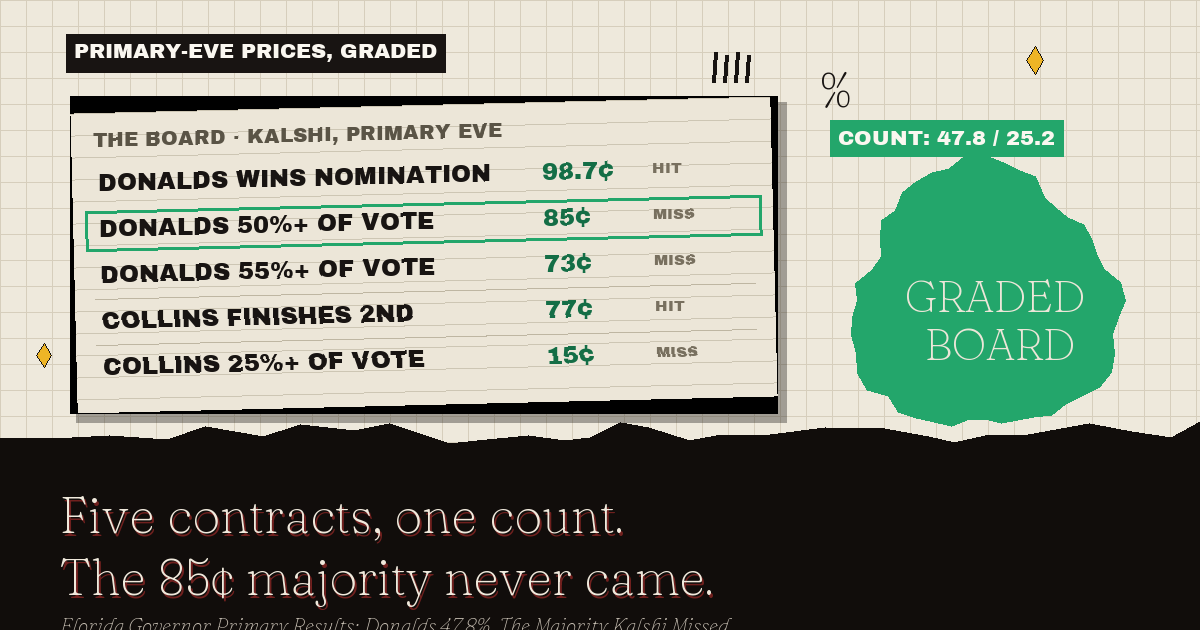
The report card as a board: two hits on rank, three misses on margin, all from the same primary-eve read.
The row I keep coming back to is the 55% line. Nobody had Donalds at 55 in a public poll, and the contract still traded above 70 cents the night before the vote. That is not a read on the polling; it is the nomination board's near-certainty leaking down into contracts that asked a different question.
The Mirror Image: Collins Was Better Than His Own Market
The Collins lines are the same miss seen from the other side. Before a single result posted, the market had Jay Collins pegged as the clear runner-up. His finish-second contract traded at 77 cents on primary eve, and it was right; Florida's lieutenant governor beat Fishback and Renner comfortably for second. What the market did not believe was his size. As late as primary eve, the contract on Collins reaching at least 25% of the vote traded at 15 cents, a priced-in 15% chance, and the bar one notch below it, at least 20%, traded at just 33 cents. The market expected a distant second in the teens, which is exactly what a Donalds majority would have required.
Then the count started, and the board repriced in real time as the returns rolled in: the 25% contract was 17 cents at 5 PM ET on primary day, 69 by 8 PM, an hour into the count, 86 an hour after that, and 98 by 10 PM. Roughly 8,400 contracts have ever traded on Collins's 25% line, and most of them changed hands on election night; only a few hundred a day had traded on it in the week before. Collins did not just hold second; he cleared a bar the market had priced at better than 5-to-1 against.
One honest wrinkle keeps that contract from being fully settled business: Collins sits at 25.2% on the unofficial count, barely past the bar, and the contract pays on the certified percentage, the official number Florida publishes after canvassing, not election night's tally. That is why, five days later, the book still shows a 94-cent bid against a 99-cent ask instead of treating it as done: the last few cents are the residual chance the certified percentage slips below 25.00% in canvassing, on a bar he currently clears by about a quarter of a point.
A Worked Example: Why Nobody Should Chase The Last Penny
The Collins contract is also this race's cleanest lesson in why a near-certain price is not free money, so walk through the actual trade. The board shows a 94-cent bid against a 99-cent ask. If you want in right now, you pay the 99-cent ask, risking 99 cents to make a maximum of 1 cent when the certified results confirm the bar. Kalshi's standard trading fee, broken down on our Kalshi fees page, runs about 0.07 times the price times one minus the price, a fraction of a cent here, but the exchange rounds fees up to the next whole cent per order, so on a small ticket the fee can swallow the entire 1-cent ceiling. You would be risking 99 cents, for the week or two the canvassing process takes, to win roughly nothing. At 94 cents, the bid side of the same book, the arithmetic looks different, five cents of upside against 94 at risk, but a resting bid only fills if a nervous holder sells into it, and on a line this thin it may simply never trade. Converting a price into what it implies takes a second, and on a 99-cent contract it usually tells you the same thing: the market being right is not the same thing as the contract being worth buying. A settled-looking price that refuses to touch 100 is telling you exactly where the leftover doubt lives, and here it lives in the certification math.
Does the miss embarrass the market? A little, and the reason is itself the lesson. This event's attention, and most of its contracts, had spent the summer piled on Fishback's lawsuit drama; the question that still had real juice in it, how the vote would split between Donalds and Collins, was among the least-traded corners of the whole board. One 15-cent contract hitting is noise; a 15-cent Collins line and an 85-cent Donalds-majority line both missing in the same direction is one stale read, repeated. For the full grade card, note that the AI panel that scored this race price-blind missed in the opposite direction: it gave Collins roughly a 14% chance to win the nomination outright, and that call was simply wrong; the market's price on the Collins outright, a fraction of a cent on a book quoted 0 bid, 1 ask, was the better one. What the count cannot settle is whether the panel was seeing Collins's real strength through the wrong contract. Its case rested on his polling floor and a large undecided bloc, and the market lines that measured exactly that, the vote shares, are the lines the market got wrong. Nobody had priced the floor until the count did it for them.
The Fishback Grade: 44 Million Contracts, Third Place
Every previous edition of this page kept returning to one strange number: James Fishback, priced at a penny or two to win all summer, was somehow the most-traded candidate in the entire event. By the time the event finalized, roughly 44.7 million of the nominee board's 71 million lifetime contracts were his, nearly two of every three, the residue of Collins's June lawsuit to knock him off the ballot over Florida's seven-year residency rule, which a Leon County judge dismissed on July 27, and an accusation Fishback made about Donalds at an August 6 press conference, which the Justice Department called "absolutely false" the next day, stating that Donalds is not under investigation. We called that shape ownership without equity, volume built on argument rather than any path to winning, and said the price, not the volume, was the signal.
The count agreed with the price. Fishback finished third at 10%, behind the man the market always said would be runner-up, and his finish-second contract collapsed from 22 cents on primary eve to a penny. On the runner-up board, Collins's contract did the opposite, 77 cents to 99, with roughly 119,000 contracts still open, and like the vote-share contracts it settles for good when the certified results publish. The third- and fourth-place boards closed the ladder exactly as the market had sketched it on primary eve: Fishback's third-place contract and Renner's fourth-place contract both sit at 99 cents. If you ever need a one-race case study for why contract counts are not belief, this primary is it: the name with the most contracts on the board finished nearly 15 points behind the quiet one. And remember the mechanics: a contract at a penny or two costs a fraction of what a 98-cent contract costs, so the same dollar prints dozens of times more volume on the longshot. In dollars, the favorite always carried more money; the contract leaderboard just cannot show it.
What The Settled Board Says About November
And so to the November number this page promised at the top. Kalshi's market on which party wins the Florida governorship on November 3 currently shows the Republican side bid 81, ask 82, and the Democratic side bid 20, ask 22, so the bid side overlaps by about a cent while the asks sum to roughly 104, the usual overround on a two-sided book. The major-party matchup is Donalds against Democrat David Jolly, the former congressman who won his own primary the same night with 61.0% of the Democratic vote, and whose Kalshi nomination contract finalized Yes alongside Donalds's.
Read that Republican price against the state's recent history and it is lower than instinct suggests. Trump carried Florida by about 13 points in 2024, and no Democrat has won the governorship since 1994. A roughly four-in-five chance is a heavy favorite, but it is nothing like the 98-cent price Donalds enjoyed in the primary, and the gap has a name: the president's party tends to lose ground in midterms, and a market that just watched its own majority call miss by two points has a fresh reason not to over-compress the margin again. Jolly, for his part, served in Congress as a Republican before leaving the party, a resume built for exactly the crossover a Democrat needs here. The market is holding back real probability for the ten weeks left between two major-party nominees who each just won convincingly, with no-party and third-party names on the ballot beside them. And the board carries one more detail worth watching: the Democratic contract has more open positions, about 131,000 contracts, than the Republican contract's 91,000. That is not a prediction, since every open contract has a Yes holder and a No holder on it, but it tells you where the disagreement still lives. The 20-cent side of this board is the one traders are still arguing about, on a race the same crowd had just priced almost perfectly. Whether that gap is caution or opportunity is the next question this page's successor takes up: our AI panel has already scored Donalds versus Jolly price-blind, and the same-night Florida Senate primary board plus the early 2028 presidential markets give the repriced landscape around it.
The nomination market is finalized; the vote-share and finishing-order contracts settle on Florida's certified results, and prices quoted here are from the Kalshi API as of the evening of August 22, 2026.
The Bottom Line
The Florida governor primary results gave the market its grade, and it earned a split grade: the winner priced near 98 cents for weeks and settled Yes, the runner-up named at 77 cents, and then a Donalds majority priced at 85 cents that never came, with Collins at 15 cents to clear a quarter of the vote landing on the other side of the same miss. That pair is the reminder of what these boards are for. Prices are probabilities, probabilities sometimes cash on the short side, and the honest way to use a prediction market is to grade it in public, miss included, the way we grade every call on the daily Kalshi board. The rule I am taking into November is simple: read the rank market and the margin market as two different questions. A 98-cent winner price tells you who; it does not license an 85-cent majority price when the polling never left the 40s. Florida's governor race now belongs to the November market, and that is the lens this page carries into it.
Prices on this page are Kalshi's book. If you also trade on Polymarket, code OS4 gets new users a $50 trading bonus on a $10 deposit — affiliate link; terms as stated by Polymarket; 18+, availability varies by state.
More on this: 2026 Governor Races: Every Kalshi Board We Track · Michigan Governor Odds: Seven Raters, Not One Says Safe · Rhode Island Governor Primary: McKee Says 'I Am the State · Florida Governor Odds 2026: Donalds vs. Jolly · SMU Vs Florida State Picks: A Labor Day ACC Showdown