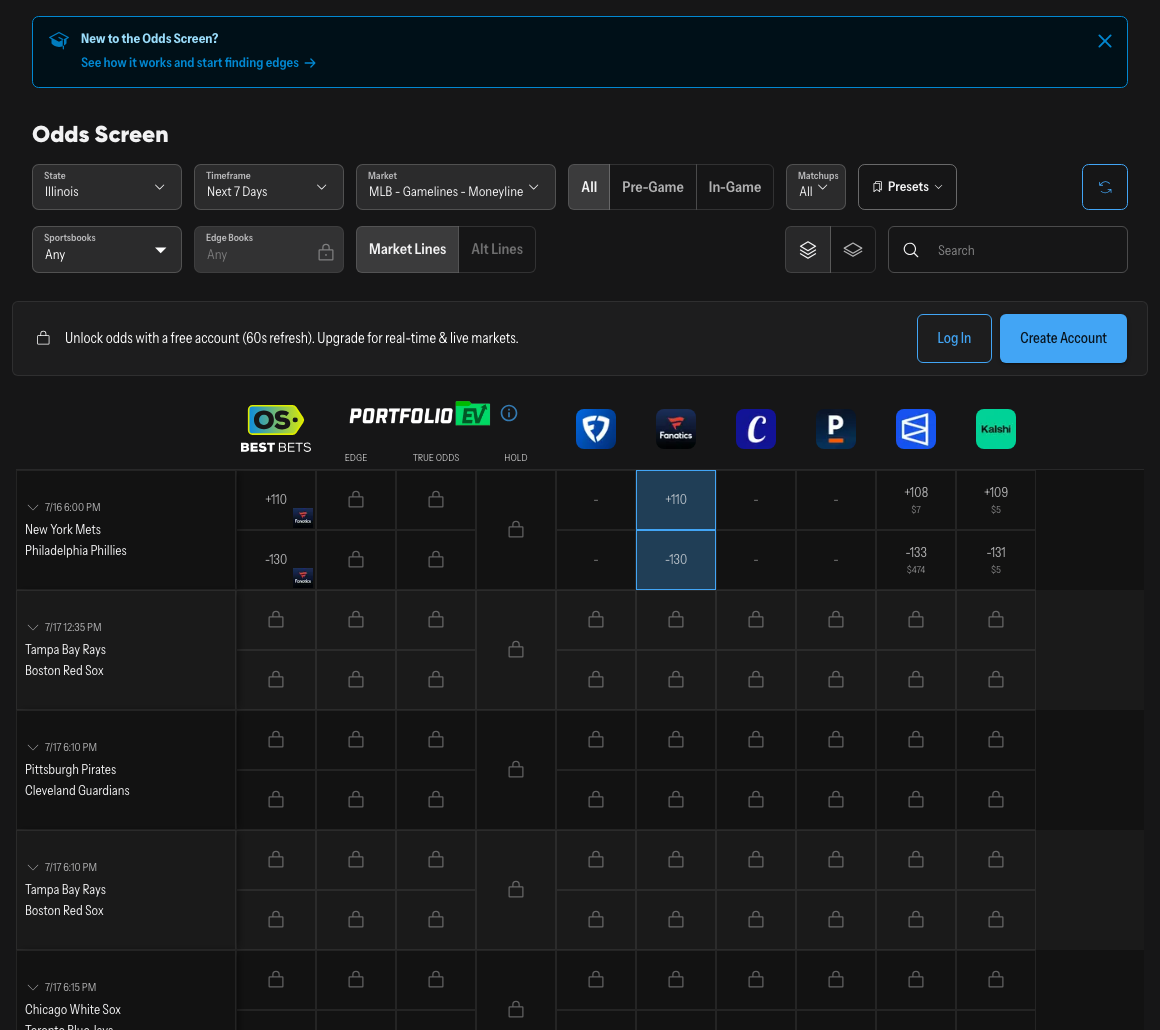
 The OddsShopper live odds screen — every book's price on one board, refreshed in real time. Open the live board.
The Quick Answer
Yes, and if anything 19 cents was generous. Salahdine Parnasse stopped Dan Hooker at 2:35 of the first round in Saturday's UFC Paris main event, and Kalshi finalized the fight market within 15 minutes of the stoppage. Parnasse's mark sat at 81 to 82 cents all week, and buyers at Wednesday's 82-cent ask were paid $1.00. The exchange was the cheap side of Parnasse before a punch was thrown: the sportsbooks devigged to about 17% on Hooker while Kalshi asked 19 to 20, and the result only confirmed it. The money on the exchange did not agree. The Hooker contract carried almost all of the trading, and most of it was buying him. The two minutes of tape inside the round, and the Max Holloway fight Parnasse asked for, which has no Kalshi market yet, are below.
Kalshi prices, settlement and trade tape as of Saturday, September 5, 2026, at the 6:00 p.m. ET settlement, from Kalshi's public market data. Exchange listings and prices, the UFC's official rankings and both fighters' UFC.com pages re-checked Friday, September 11, 2026, at 5:20 a.m. ET.
Free: The PM Weekly Brief covers fight markets like this one and the rest of the week's prediction-market moves in one email.
What The Market Had
This page went up on Wednesday, September 2, as a pregame board. Kalshi listed one yes/no contract per fighter and nothing on method or round, and the sportsbook column came from the OddsShopper live board, 19 books deep, at the same time. Here is that board with the walkout print and the settlement added.
| Fighter | Kalshi Bid / Ask, Sept. 2 | Kalshi Last Print Before The Walkouts | DraftKings, Sept. 2 | Kalshi Settlement |
|---|---|---|---|---|
| Dan Hooker | 19¢ / 20¢ | 21¢ | +455 | $0.00 |
| Salahdine Parnasse | 81¢ / 82¢ | 80¢ | -625 | $1.00 |
The price barely moved in three days. Hooker's last print before the walk, at 5:40 p.m. ET, was 21 cents. Parnasse's was 80. By settlement, the Hooker leg had traded about 3.65 million contracts over the prior 24 hours against about 602,000 on the Parnasse leg. On Wednesday I wrote that a market this well traded with almost no repricing had made up its mind. It had, and it was right about the fighter. What the volume alone could not tell you was which way the crowd leaned, because a no on Hooker is the same position as a yes on Parnasse.
The trade log can. Of the roughly 2.7 million contracts that changed hands on the Hooker leg in the 24 hours before the walkouts, about 2.65 million were initiated by buyers of Hooker. About 61,000 were initiated by sellers. On the Hooker contract the aggressive money went to the dog by better than 40 to 1. Fold in the Parnasse leg, where takers were also net buyers of the favorite, and the exchange-wide tilt toward Hooker was closer to 8 to 1. Either way it points one direction, and it stayed that way right up to the cage door. That is the part of Saturday worth keeping, and it is why the in-round tape below reads the way it does.
What Moved Since September 8
Nothing on this market, which is what a settled contract is supposed to do: both legs are still finalized at $1.00 on Parnasse and $0.00 on Hooker, and the Hooker leg closed its six-day life at about 4.38 million contracts traded against about 679,000 on Parnasse. Everything around it moved. The UFC's official lightweight rankings, updated after the card, put Parnasse straight in at No. 9 as a new entry and dropped Hooker three spots to No. 13, per UFC.com. Holloway sits at No. 4. Parnasse, who took no damage, was back in training the Monday after the fight and wants at least one more bout in 2026, per Yahoo Sports, whose read is that Holloway seems content to wait for a McGregor trilogy in 2027. UFC.com still lists no upcoming bout for any of the three.
Parnasse has no contract of his own anywhere on the exchange yet. Holloway and Hooker show up only in the title-holder futures, where the December 31, 2026 market has both at 0 to 1 cent and the champion, Justin Gaethje, at 92 to 94. Kalshi's next MMA listings are the 13-bout Fight Night card on September 12, five Contender Series bouts on the 15th, and UFC 331 on the 19th, where Arman Tsarukyan, the man who submitted Hooker last November, is 73 to 74 cents against Mauricio Ruffy in the co-main event. Tsarukyan is the only top-five lightweight with a fight listed on the exchange right now, and that tier is the one Parnasse said he wants next.
Inside The Cage, By The Clock
The opening minute was leg kicks both ways, and Hooker was the busier kicker. It is also the minute the Hooker contract ticked from 21 cents to 23. Then a body kick hurt Hooker and sent him back to the fence, a left hook dropped him, and the referee waved it off during the follow-up ground strikes, per CBS Sports. The official time was 2:35 of round one, and UFC.com lists it as a first-round TKO. Parnasse improves to 24-2 with the win in his UFC debut. Hooker, at 36, drops to 24-15 and has now lost three straight, all by stoppage, after the Arman Tsarukyan submission and the Benoît Saint Denis TKO covered on the pregame version of this page.
On Wednesday the case for the price was one sentence: the price is about Hooker's chin. It was, and a body kick that sends a man to the fence is where a 36-year-old with two stoppage losses behind him gets found out. Parnasse's post-fight ask was just as short. "I'm ready for the next fight, top five. My dream fight is Max Holloway," he said in the cage, as quoted by Yahoo Sports.
The Two Minutes The Price History Got Wrong
Kalshi kept trading through the round, and the Hooker contract briefly ran the wrong way. It sat at 21 cents through the walkouts, ticked to 23 during the kicking exchanges, and touched 38 cents at 5:45:56 p.m. ET, roughly two minutes in. In the 49 seconds around that peak the contract printed at 30 cents or higher 623 times, about 29,000 contracts in all. Somebody was watching Hooker land kicks and paying nearly double the pregame price for him.
Then the body kick landed. Between 5:46:32 and 5:46:36 p.m. ET the Hooker contract went from 21 cents to one cent. The largest single print of the entire day hit at 5:46:36 as the referee waved it off. It was 18,000 no-Hooker contracts bought at 99 cents, a penny of profit on each one before fees. The 5-to-6 p.m. ET hour, the last 40 minutes of pregame plus the fight, did about 2.3 million contracts on the Hooker leg, more than the other 23 hours combined. Roughly a million of that traded after the walkouts began.
The one I keep coming back to is that block of 29,000 contracts. Buyers paid 30 cents or better for a fighter whose price had been 19 to 21 all week, with a single tick as high as 38, on the strength of one minute of leg kicks. That is not a reason to nearly double a chin-based price, and the body kick that followed is exactly the collapse point the pregame read implied: the favorite was priced to break a chin, not to win rounds. Live trading is a real UFC edge, but only in the direction the matchup already pointed.
What The Price Paid
A Parnasse buyer at Wednesday's 82-cent ask collected 18 cents per contract, about 17 after Kalshi's fee, a return of roughly 21% in three days. The same position on DraftKings at -625 returned $16 on $100. Hooker buyers at 19 to 21 cents lost the stake. The draw-or-no-contest rule flagged on the pregame page, which would have settled both contracts at 50 cents, never came into play.
The sharper question all week was the method, not the winner. On Wednesday's board the moneyline cost -625 for a favorite whose whole case was the other man's chin, which is a finish read paying a decision price. The one method quote I can source went the wrong way: Bet365 had Parnasse by submission at +310 two days out, per Sports Betting Dime, and that ticket lost when the finish came by strikes. I do not have a captured close on the knockout side, so I will not pretend to know what it paid. The clean takeaway is that the moneyline was expensive and the method market carried the real question. When the next Parnasse line posts, the live odds screen is where to shop the number across every major book, and the method props will be one tab over.
The Holloway Market To Watch
There is no Parnasse-Holloway contract on Kalshi yet. Max Holloway, 27-9, has not fought since beating Conor McGregor by first-round injury TKO at UFC 329 on July 11, and UFC.com lists no upcoming bout for him. He lost the BMF title to Charles Oliveira in March. Kalshi opened the Hooker-Parnasse market on August 30, six days before the fight, so a Holloway market would not appear until a bout is booked and close to fight week. As of Friday morning, September 11, the exchange's MMA listings run from the September 12 Fight Night card through UFC 331 on the 19th.
The timing is the lesson, and this fight is the proof. Kalshi listed Hooker-Parnasse six days out, and the price never went anywhere: 83 cents on Parnasse at the first prints on August 30, 81 to 82 on Wednesday's board, 80 at the walkouts. On Wednesday's board the exchange held Hooker two to three points richer than Pinnacle's devig, 19 to 20 cents against 17.0%, and it offered no price discovery of its own. So when a Parnasse-Holloway fight is booked, the window is the first hours of the Kalshi listing measured against the book consensus you already have, not a wait for the exchange to find a price it never finds. The interesting number will be Parnasse's, and it will be set by what he did to Hooker's chin on Saturday rather than by anything he has done against a top-five opponent, because he has not faced one yet.
The Bottom Line
Was Hooker really a 4-1 dog? Yes, and the market was generous. The exchange had the winner right, the aggressive money on the Hooker contract ran better than 40 to 1 toward the dog anyway, and the moneyline paid a decision price for a fight the matchup said would end early. Carry that into whatever Kalshi lists for Parnasse next.
The Hooker-Parnasse gap between the exchange and the books was visible for three days to anyone comparing the two boards, and that comparison is what OddsShopper runs automatically across every book, flagging the prices in your favor. For the rest of this week's cards, today's free expert picks are up. The 7-day OS Pro trial is free, and code PARNASSE20 takes 20% off your first month after it.
More on this: AFC East Odds: Drake Maye Made The Super Bowl, Buffalo's Favored · Where Does Bitcoin End 2026? Kalshi's Price-Band Odds · Kansas Senate Race 2026 Odds: The Bet That Moved Nothing · Malachi Toney Heisman Odds: One Record Night, 800K Contracts · Who Wins The 2027 NBA Title? Kalshi Championship Odds