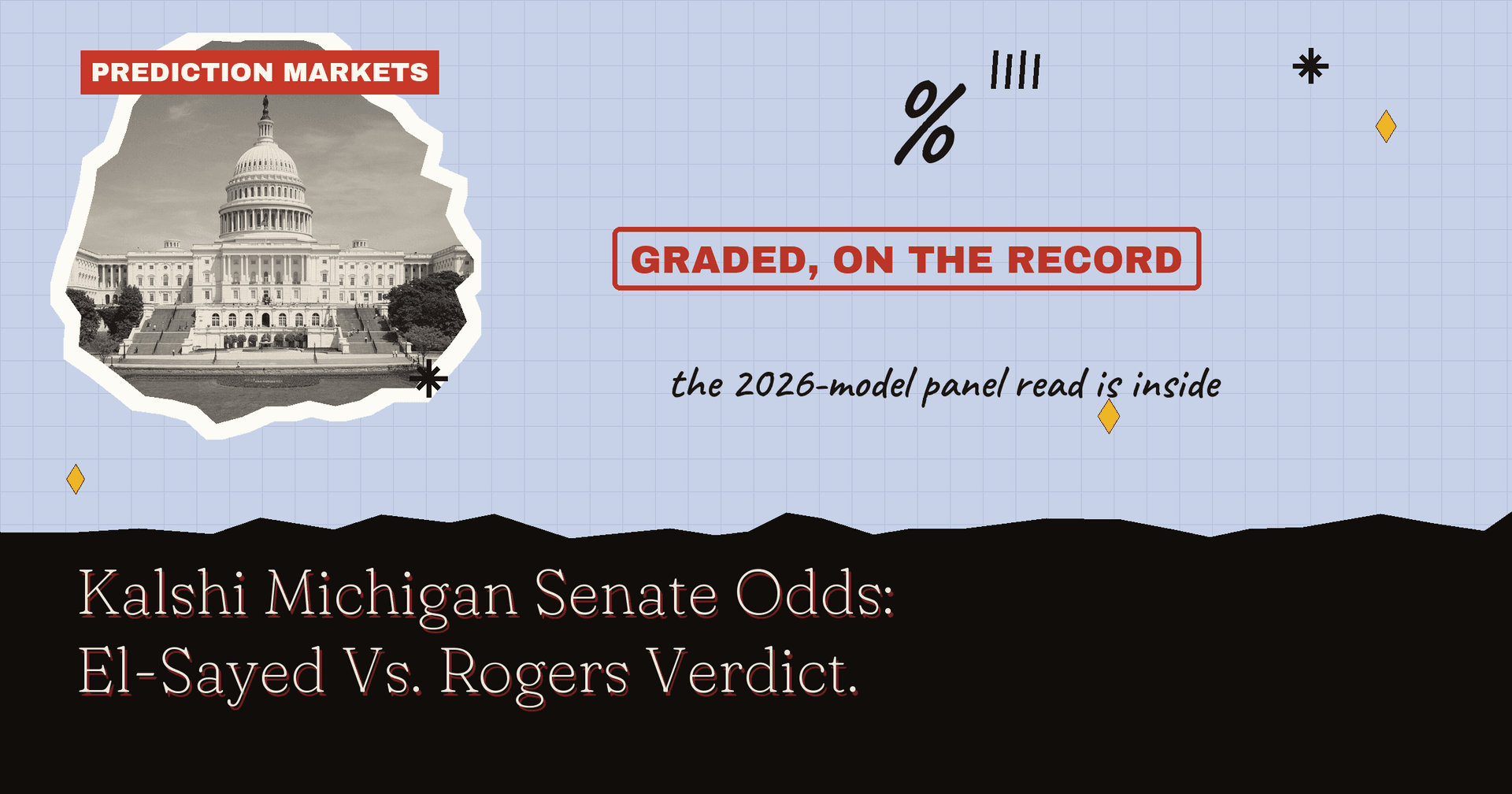
Who will win the Michigan Senate race? Democrat Abdul El-Sayed is the favorite, but not a heavy one. As of September 17, Kalshi has El-Sayed at 64 to 65 cents to beat Republican Mike Rogers on November 3, and a 64-cent contract means the market gives him a 64% chance. Our price-blind AI panel, which scores the race without seeing the market, has it closer at 54-46 El-Sayed.
The two numbers moved together in August. A Susquehanna poll taken August 11 to 17 had El-Sayed up seven, the polling average swung from a Rogers lead back to roughly a tie, and Kalshi pushed El-Sayed to a 60-cent favorite on heavy trading. The panel, re-scored on the new polls, moved up from a coin flip but stopped short of the market, and the market has since kept climbing without it, with a dip to 57 and back in mid-September. That ten-point gap is what the rest of this page is about.
The Board
| Kalshi price | AI panel | |
|---|---|---|
| Abdul El-Sayed (D) wins | 64 bid / 65 ask | 54% |
| Mike Rogers (R) wins | 35 bid / 36 ask | 46% |
| Market | "Michigan Senate winner?" (Kalshi event SENATEMI-26), one yes/no contract per party. Settles by party at the January 4, 2027 swearing-in, or earlier once a consensus of media organizations projects the November 3 winner | |
| Depth | Open interest of about 995,000 contracts on the Democratic line and 1.54 million on the Republican line, with about 50,000 El-Sayed contracts traded in the last day | |
| Snapshot | Prices as of September 17, 2026, 2:05 p.m. ET. Verdicts generated August 20, 2026, from five seats |
More live boards from the same panel: Iowa Senate (Republican Ashley Hinson 60¢ bid / 61¢ ask at 2:05 p.m. ET on September 17) · Minnesota Senate (Democrat Peggy Flanagan 90¢ bid / 91¢ ask) · North Carolina Senate (Democrat Roy Cooper 92¢ bid / 93¢ ask)
Kalshi event contracts trade on a CFTC-regulated exchange; you must be 18 or older and in an eligible state to participate, and this article does not advocate for or against any candidate or party.
What Moved Since September 7
The price went down before it went up. El-Sayed's contract, 63 to 64 cents when this page last changed, slid through the middle of the month and touched 57 on Sunday, September 13, before a Wednesday rally carried it to 64 to 65. Rogers traced the mirror image, 36 to 37 up to a 41-cent peak and back to 35 to 36. Between the two stamps about 177,800 El-Sayed contracts and 333,500 Rogers contracts changed hands.
- The dip was bought on the Rogers side, in 10,000-lots. From Thursday, September 10, through Sunday, September 13, buyers lifting the Rogers offer put through 15 same-second bursts of 10,000 contracts or more, from 37 cents on Thursday evening to 41 on Friday afternoon, roughly 160,000 contracts in those bursts alone, out of about 210,000 Rogers contracts traded over the four days. The biggest print on the El-Sayed line in that stretch went the same direction: a 29-fill, roughly 16,000-contract sweep on the no side at 5:12 p.m. ET Sunday walked the price from 61 down to 57, the low of the whole window. It was back to 61 within the hour. Three smaller same-second clusters of 6,000 to 7,700 contracts on September 10 and 12 lifted the El-Sayed offer, so the buying in that stretch was not one-sided.
- The polls that hit the tape just before that window were the closest of the cycle. Glengariff for The Detroit News, fielded August 31 to September 3 among 600 likely voters, had Rogers 45.8 to 44.4, the only poll in the PollingSource average with him ahead. CNN's poll, as reported by Newsweek, fielded August 31 to September 6 among 843 likely voters, had El-Sayed 47 to 44, and Trafalgar, a Republican pollster, had El-Sayed up one, 46 to 45, on September 7 to 9, per PollingSource.
- Wednesday's rally came with a debate fight and an endorsement, not a poll. On September 15 Rogers skipped a Fox 2 Detroit town hall with El-Sayed, saying "We never agreed to it"; his campaign separately accused the moderator of favoritism and says it remains committed to the two scheduled debates, October 8 and October 21. On September 16 The Detroit News endorsed Rogers, calling him "clearly the best choice." That same day El-Sayed's contract went from 62 to 65 on about 45,700 contracts, roughly 37,800 of them buyers lifting the offer, and a 12,000-contract no-side sweep took Rogers from 37 to 36 at 4:14 p.m. ET. I cannot tell you which of those a Wednesday buyer was trading on.
- Thursday's polls landed on El-Sayed's side. Emerson, fielded September 12 to 14 among 1,000 likely voters, had El-Sayed 48, Rogers 46, with what Emerson's executive director, Spencer Kimball, called "a substantial educational divide": Rogers 48 to 45 among voters without a four-year degree, El-Sayed 53 to 42 among graduates. A Washington Post-Schar School poll released the same day had him up 48 to 45 among likely voters. The PollingSource 30-day average read El-Sayed 46.9 to Rogers 44.7 at the September 17 fetch, seven polls, against 47.0 to 43.9 on September 7. Both Thursday polls have El-Sayed ahead, but the 30-day average narrowed over this stretch, from El-Sayed +3.1 to +2.2, as Glengariff and Trafalgar rolled in and the two Thursday polls came in under the old average. The market repriced up a cent into an average that moved a point the other way. The Detroit Regional Chamber PAC endorsed Rogers the same day.
The week before that stamp did the bigger work. From August 27 through September 1, about 392,800 Rogers contracts changed hands against about 100,700 on the El-Sayed line, the biggest single print a 41,689-contract no-side fill at 39 cents at 9:34 a.m. ET on August 28, and that repricing took the board from 60-61 to 63-64. EPIC-MRA, fielded August 22 to 28 among 600 likely voters, had El-Sayed 47 to 43, and Michigan State University's State of the State survey, fielded August 10 to 20 with YouGov, had him 48 to 44 among registered voters and 50 to 45 among likely voters, with director Matt Grossmann noting Rogers "is running ahead of James, with more success among independents." Both campaigns agreed to an October 8 debate in late August and a second, October 21, on September 2.
The panel's 54 is frozen at its August 20 run. It has not seen EPIC-MRA, MSU, Glengariff, CNN, Trafalgar, Emerson or the Post, six of which have El-Sayed ahead and one of which has Rogers. Its own August note said a run of polls in one direction would pull it toward the market. The run arrived, the market moved on it, and the 54 could not. That is the whole reason the gap was six points on August 20 and is ten today.
What Moved In August
On August 5, the day after the primary, the exchange had El-Sayed at 62.5 cents and the panel scored a coin flip. By August 18 the first post-primary polls had favored Rogers and the market had drifted El-Sayed down to 56.5 cents. Then the polling turned.
- A fresh poll flipped the average. Susquehanna Polling and Research, a pollster PollingSource labels Republican-aligned, surveyed likely voters August 11 to 17 and had El-Sayed 46, Rogers 39, with 91% of Democrats behind their nominee. It was the clearest sign at the time that the party had consolidated after a bruising primary.
- The average followed. The PollingSource 30-day aggregate, which includes partisan and sponsored polls, read El-Sayed 44.8 to Rogers 44.4 at the August 20 fetch, after carrying a roughly four-point Rogers edge two weeks earlier.
- The market repriced on volume. El-Sayed's contract climbed from a 56.5-cent mid to about 60.5 cents on roughly 92,700 contracts in a day, real money resetting the price rather than one market maker re-quoting.
What Decides This Race
Six facts pull against each other.
The freshest polls favor El-Sayed. The fuller record at the August 20 run still favored Rogers. Susquehanna had El-Sayed up seven, GBAO a week earlier had him up six among likely voters, and TIPP had him up four among registered voters, 43-39. Against that, the Beacon Research and Shaw poll for Fox News through August 10 had Rogers up four, and the ToWin poll completed August 14 also had Rogers ahead.
Averaged across the non-partisan head-to-heads the seats saw at the August 20 fetch, Rogers led by about three. Averaged across only the month before that fetch, the two were tied. The trend has bent toward El-Sayed since, while the level stays close.
The Democrat who polled better against Rogers is the one who lost. Through the primary, Haley Stevens ran roughly even with Rogers in the same pollsters' head-to-heads while El-Sayed trailed by about three. Michigan Democrats nominated the weaker general-election poller by about 15,000 votes. The bearish seats keep returning to that gap, and the consolidation in the Susquehanna numbers is the counter-argument to it.
The national environment points El-Sayed's way. The generic congressional ballot stood at D+6.6 and presidential approval at a net −21.7 on August 17, the last read the panel saw. The president's party has lost House seats in 18 of the last 20 midterms, and the two exceptions needed an impeachment backlash or a wartime rally that is nowhere in evidence. The same wind blows through every open seat this cycle, and on Iowa's open Senate race the same method still keeps Republican Ashley Hinson favored in spite of it.
Michigan decides these races by fractions. In 2024, running for the state's other Senate seat, Elissa Slotkin beat this same Mike Rogers by 19,006 votes, or 0.34 points, while Donald Trump carried the state by about a point and a half at the top of the same ballot. Nobody on either side of this disagreement is arguing for a comfortable margin.
Midterm polls in the Trump era have been nearly unbiased. Presidential-year surveys understated Republicans by three to five points, but the two midterms without Trump on the ballot missed by −0.3 in 2018 and +0.9 in 2022. There is no recent history of midterm polls underselling either party, so read these numbers close to face value.
The traditional handicappers still call it even. The models do not. Cook Political Report, Sabato's Crystal Ball and Inside Elections all rate the open seat a Toss-up, per PollingSource. Decision Desk HQ's forecast, which its August 22 write-up described as only narrowly leaning Democratic, gives El-Sayed 67% as of September 17 and lists the seat Lean Democratic, and The Economist, Silver Bulletin, Split Ticket and FiftyPlusOne have it Lean Democratic as well, per Wikipedia's ratings table.
Why The Panel Sits Ten Points Below The Market
Every seat started from the same place: the midterm base rate and a deeply negative approval number put the Democrat ahead of even in a swing state. They split on how much weight the state polls deserve.
The high seat, Fable, sat at 60%, level with the market at the time of the run, and let the environment dominate:
A D+6.6 generic ballot with presidential approval at −22 tilts an evenly divided open seat Democratic, despite El-Sayed's measured underperformance versus Stevens and near-tied recent polling. — Claude Fable (84% on 508 graded calls)
The seats at 52% read the head-to-heads as already containing the environment. Opus made that case most directly and held it after seeing the others push the national number:
The most direct evidence remains the live head-to-head feed: the non-partisan El-Sayed-vs-Rogers average sits at about Rogers +3, and the second aggregator has only just been dragged to a near-tie by a single new poll. That state-level polling already incorporates the national environment. — Claude Opus (85% on 578 graded calls)
Every seat read the other four in the revision round and held its number. The blend landed at 54, six below the market's 60 at the time of the run and ten below where it trades today, because the fuller polling record still tilts Rogers and the exchange, reacting to the newest survey, has largely priced that tilt out.
The market's case is not careless. Democratic enthusiasm in a referendum midterm is exactly what a registered-voter sample misses, the generic ballot is the strongest single number on the board, and the campaign had barely begun at the stamp. The panel weighed all three and still would not chase El-Sayed to the market's price. It is not the only Midwest board where that happens: on Minnesota's open Senate seat, the models likewise shave points off a confident DFL price.
One caveat on the instrument: three of the usual eight seats were unavailable this run, so the blend is a five-model mean rather than the full panel.
What Would Move The Number
- Likely-voter polling through September. One strong poll is not a trend, and the screen matters: in the same August window, Beacon's Rogers +4 was registered voters and Susquehanna's El-Sayed +7 was likely voters. A run of likely-voter polls in one direction settles it. A sustained El-Sayed lead pulls the panel up to the market; a reversion to the Rogers-plus-three average makes today's 64-cent price the outlier.
- The first of the two scheduled debates, October 8. Both candidates are new to a statewide general-election stage against each other. El-Sayed asked for five debates and Rogers agreed to two, October 8 on WOOD-TV and October 21 on WXYZ-TV, after skipping a Fox 2 Detroit town hall on September 15 over the moderator. One August poll, Susquehanna's, was enough to move this board four cents, and a debate moment is a bigger input than one poll.
- A traditional handicapper moving off Toss-up. The model-based forecasters already have. Cook, Sabato or Inside Elections shifting off Toss-up would be the first handicapper rating to follow the models.
- Third-quarter fundraising, reported in October. Through the July 15 filings, El-Sayed had out-raised Rogers for the cycle, $14.5 million to $10.9 million, but held the smaller cash reserve, $2.6 million to $4.5 million, after spending through a contested primary, per FEC filings. Whether El-Sayed refills that account is a real test of the consolidation thesis.
What The Panel Doesn't Score: The Controversies
The panel prices polls, environment and structure, not the day-to-day campaign. For the record, and framed strictly as the public record rather than judgment, both candidates have drawn scrutiny this cycle.
- Mike Rogers. Rogers has repeatedly claimed, without evidence, that his narrow 2024 loss and Michigan's 2024 election were tainted by fraud, claims Michigan officials and fact-checkers have rejected. He has faced carpetbagger questions over relocating to Florida after leaving Congress. PolitiFact rated as false his ad tying El-Sayed to a streamer's 2019 remarks about 9/11. His joint fundraising committee also lost $16,700 in April to a fake invoice sent from a hacked vendor email.
- Abdul El-Sayed. El-Sayed has faced criticism over resurfaced and since-deleted clips and posts of past progressive statements, and over a campus appearance with a streamer that Jewish groups and opponents criticized. He was also, per Al Jazeera, the target of an organized anti-Muslim messaging effort.
None of this enters the panel's number.
The Bottom Line
The market and the panel agree El-Sayed is the favorite and disagree only on how clear a one, 64 to 65 cents against 54. The next round of likely-voter polls decides which was right. Until then the traditional handicappers still call it a toss-up, which is the safest reading of a state that settles its Senate races by fractions of a point. If this method is your thing, our North Carolina Senate board and our 2026 Senate election odds chamber breakdown are the natural next reads.
Prices on this page are Kalshi's book. If you also trade on Polymarket, code OS4 gets new users a $50 trading bonus on a $10 deposit — affiliate link; terms as stated by Polymarket; 18+, availability varies by state.
More on this: 2026 Senate Races: Every Kalshi Board We Track · Michigan Senate Election 2026 Candidates: El-Sayed Favored · Why Abdul El-Sayed (D) Will Win the Michigan Senate Race · Why Mike Rogers (R) Will Win the Michigan Senate Race · Is It Legal To Bet On Elections In Michigan? The 2026 Rules