How to Bet on DraftKings (the Smart Way for Beginners)
In Summary
So you want to start betting on DraftKings 🎁 but you are not sure what you are doing. This is the no-clickbait version. There is no "win $500,000 in two months" trick, and anyone selling you one is lying. DraftKings is a business; like every sportsbook, it would rather you didn't win. What follows is the part that actually helps: how to place a bet, how to read a spread, moneyline, total, and prop, how to size your bankroll so a cold streak doesn't end your account, and the one habit that separates a beginner who loses slowly from one who gives the math a chance. That habit is shopping the number. A price that looks fine on DraftKings is often beatable somewhere else, and OddsShopper exists to show you where.
Go deeper: How to Bet on FanDuel Sportsbook: A Beginner's Guide.
Watch the Video
Prefer to watch? Here is the full breakdown on the OddsShopper YouTube channel. Watch on YouTube.
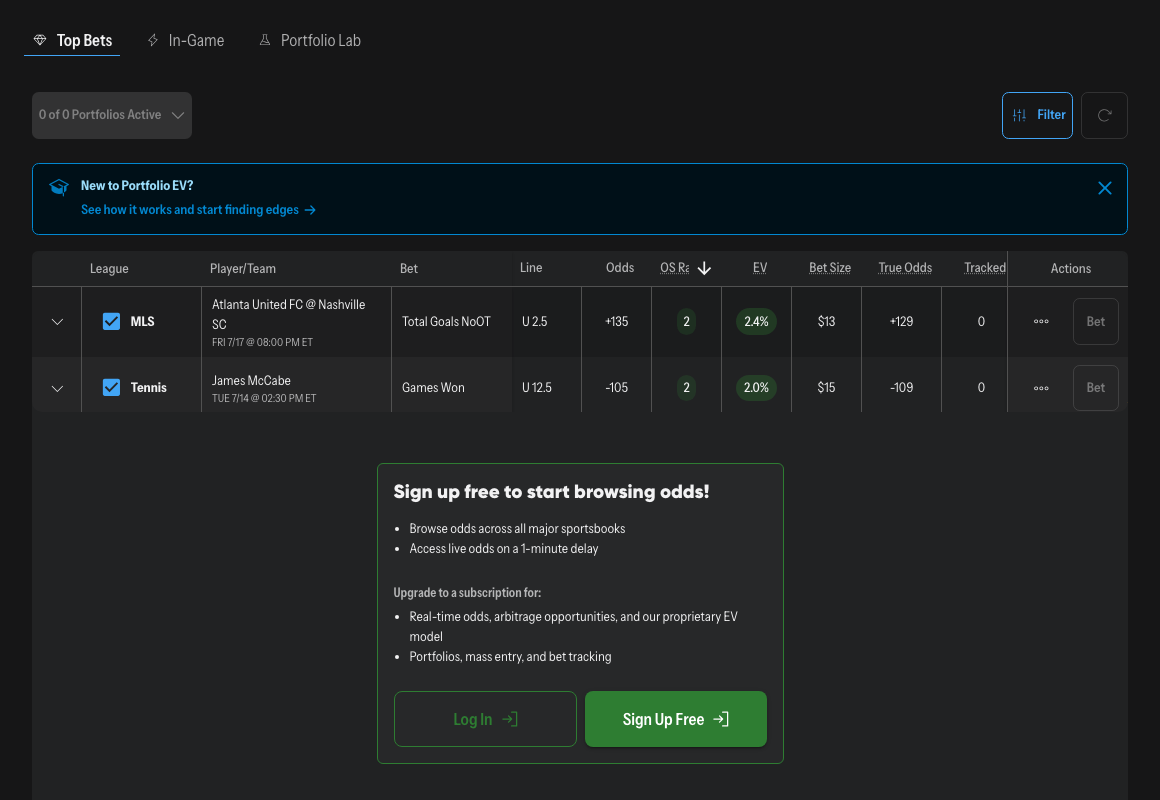
The OddsShopper +EV Screen.
Step 1: Sign Up and Find Your Way Around
Signing up takes a couple of minutes. Tap Log In / Sign Up in the top corner, enter your info, and the green button turns into a Deposit option (PayPal, card, and a few others). Sportsbooks make this part easy on purpose, so there's no reason to dwell on it. You'll need to be 21+ and in a state where betting is legal and regulated.
Once you're in, the layout is simple. Across the top you'll see Daily Fantasy, Sportsbook (where we're spending today), Casino (one honest warning: be careful in there), and a Marketplace. Your sports sit in the left rail. My Bets at the top holds everything live, upcoming, and already settled. The one orientation rule worth internalizing: stick to the sports you actually know. The endless menu of leagues and props is built for the book, not for you.
Step 2: How to Place a Bet on DraftKings
Placing a bet is the same three taps every time: pick the market, tap the price, and it drops into your bet slip on the right. Enter your stake, and the slip shows your potential payout before you confirm. Nothing is wagered until you hit the button, so you can build a slip, look at the price, and back out if the number isn't good enough. That pause before you confirm is where most of your edge lives. Before you take it, ask one question: is this the best available price on this exact bet? More on that below.
Step 3: Read the Three Core Bets (Spread, Moneyline, Total)
Pull up a game (say, 76ers vs. Grizzlies) and you'll see three numbers. Here's what each one means in plain terms.
The spread. Sixers -4 means they're favored by four. Bet them and they have to win by more than four (five or 50, it doesn't matter). Take the Grizzlies +4 and they can lose by up to three, or win outright, and you cash. Land exactly on four and it's a push: your stake comes back, the bet is voided. Spreads are usually priced -110 on both sides, which means you bet $110 to win $100 (you get $210 back, your $100 in winnings plus your $110 stake). Sometimes you'll see -115 on one side and -105 on the other.
The moneyline. Here you're just picking the winner, and the price sets the payout. Sixers -170 means you bet $170 to win $100. Grizzlies +145 means you bet $100 to win $145. That's the whole language of odds: a minus number is what you stake to win $100; a plus number is what $100 wins you. If converting those prices to win probabilities is still fuzzy, our how to read betting odds guide walks through it.
The total. The combined-score line, say 228.5. The over needs 229 or more; the under needs 228 or fewer. You can also bet a single team's total, for example the Grizzlies over 112.5 at -115, where again the price tells the story (-115 means $115 to win $100).
Build one habit right now: don't just look at the line, look at the odds. A team total at -155 is a very different bet from one at -110, even when the number on the screen looks identical. And the same line can carry a better price at another book, which is the whole idea behind finding +EV bets.
Step 4: Props, and Why the Price Matters Even More
Player props work like totals, but the odds swing hard from bet to bet. James Harden over 5.5 rebounds at -155 means you risk $155 to win $100; the under at +125 wins you $125 on $100. Same player, same line, very different prices on each side. The common beginner mistake is loving the number without checking the price, then wondering why a steady diet of -155 favorites never gets ahead.
A reality check the book is counting on you to skip: when a prop looks too good to be true, the book is almost never the one who's wrong. These sportsbooks know what they're doing. Stick to the basics early, and treat any line that feels free as a reason to slow down, not speed up.
Step 5: Shop the Number Against the Market
Here's the difference between a beginner who bleeds out and one who slowly builds. Every bet you make on DraftKings has a true price, the fair number a sharp market would set. DraftKings sets its own number around that, and so does every other book. When DraftKings is offering a worse price than the market, you're handing back money on a bet you'd make anyway.
Take a concrete case. DraftKings has the Grizzlies moneyline at +145. You go to bet it, but another regulated book has the same Grizzlies moneyline at +160. Identical bet, better payout: $100 returns $160 instead of $145. Take the worse one and you've donated the difference for no reason. Do that across a season and it adds up to real money. You never want to be the person who wins the bet but only got the short price when a better one was sitting right there.
OddsShopper does this for you automatically. Its line shopping and odds comparison feed scans 100+ regulated sportsbooks and, for any bet, shows you which book has the best number and how that price compares to the true, market-implied odds. You're not just finding the highest payout; the Portfolio EV view confirms the bet is +EV, priced in your favor versus the fair number, before you ever tap confirm. You can open the OddsShopper NBA live odds screen and see the moneyline, spread, and total for every game lined up book by book. A beginner who shops every number is playing a different game than one betting blind on a single app.
New to OddsShopper?It scans 100+ sportsbooks in seconds and flags the bets priced in your favor, so you can confirm DraftKings is giving you a fair number before you bet (and find a better one when it isn't). You can try it free for 7 days, and code SMARTBET20 takes 20% off OS Pro or OS Core if you subscribe.
Step 6: Bankroll Discipline Keeps You in the Game
You can pick good numbers and still go broke if you bet recklessly, because even a winning bettor loses plenty of bets in the short run. A few rules keep the variance from ending your account:
- Only stake what you can comfortably lose. Your bankroll is money set aside for betting, not the rent. A common starting point is risking a small, fixed fraction of it per bet (think low single-digit percentages), so no single result can wreck you.
- Size to the edge, not the excitement. Put more behind the bets where the price is most clearly in your favor and less behind longshots and high-variance plays. Don't fire the same $100 at a +500 longshot and a -150 favorite.
- Never chase a loss. Doubling your stake to "win it back" is how a bad night becomes a bad month.
That's the whole point of discipline: it gives a real edge enough time to show up. For a deeper plan, see our bankroll management for betting guide.
For more on this, see Sports Betting Strategy: How to Bet Smarter.
Step 7: Promos, Same-Game Parlays, and the Odds-Boost Trap
Sportsbooks hand out genuine value, and you should claim the real stuff:
- Weekly rewards. Loyalty points and a weekly reward chest accrue as you wager and can convert to site credit. Claiming them takes two seconds; make it a habit, because sometimes it's actual credit.
- Honest odds boosts. A straightforward "100% boost on any NBA game tonight" doubles your price. Those are good; take them when the underlying bet is one you'd make anyway.
- Same-game parlays: fun, but handle with care. The book prices the correlation between the legs into the payout, so most SGPs pay you worse than the true odds of the combination. They're only worth it on the rare occasion the book has mispriced that correlation. Books love SGP volume for a reason.
Now the trap. Sportsbooks serve up slick pre-made odds boosts that look like a gift. Some are. Many are quietly negative-EV: the boosted price is dressed up to look generous while still sitting on the wrong side of the math. The boost hides whether the bet actually works.
OddsShopper's Odds Boost Evaluator is built for exactly this. You plug in the boost, and it shows the fair odds, the expected win rate, and the expected ROI of the boosted price, color-coded so you can read it in a second. Here's how it reads, using the example from the video. Take a pre-made boost stacking three legs: Joel Embiid over 32.5 points, Jayson Tatum over 29.5, and Luka Dončić over 29.5. Boosted to +700, the evaluator returns a roughly -1.28% ROI: red, a losing bet. Push the same three legs to +800, and it flips to about +11% ROI: green, now a play worth considering. Identical legs; the only thing that decides whether it's a gift or a trap is the price, and pre-made boosts are often set just shy of where they'd actually clear +EV.
A boost, on its own, never makes a bad bet good. It adds value, but a boost on a still-losing price is still a losing bet. Run it, and only take the green ones.
A Note on Cash Out
You'll sometimes see a cash out offer, before a game or in-game, to take a smaller settled amount instead of letting the bet ride. Be skeptical. The book offers cash out when it benefits the book, and the price has extra hold baked in. Cashing a live bet you're on pace to lose just to "get $10 back" is usually the wrong move. It's a legitimate tool when you want out of a position, but reflexively cashing out every time you get nervous slowly drains your bankroll.
The One Thing to Remember
DraftKings is easy to bet on and easy to lose on, and the gap between the two is mostly about which prices you take. Bet the sports you know, read the odds and not just the line, size your bankroll so a cold streak can't end you, skip the boosts the math doesn't support, and shop every number against the market so you're betting +EV instead of blind. Do that and the math finally gets room to work in your favor instead of theirs. It's 21+ and legal only where regulated, so bet responsibly.
Want to bet smarter on DraftKings without doing the math by hand? OddsShopper scans 100+ sportsbooks and shows you the best number on any bet plus whether it's actually priced in your favor. Try it free for 7 days, then code SMARTBET20 is 20% off OS Pro or OS Core, less than a coffee a day to stop leaving the better number on the table.
Frequently Asked Questions
How do I bet on DraftKings as a beginner? Sign up and deposit, choose a sport you understand from the left rail, then read the three core markets: the spread (win by more than the number), the moneyline (pick the winner, the price sets the payout), and the total (over or under the combined score). Build your bet slip, check the price, and confirm. Mind the odds on every bet, size your bankroll, and shop the number before you tap.
How do I read DraftKings odds? A minus number is what you stake to win $100 (-170 means $170 to win $100). A plus number is what $100 wins you (+145 means $100 wins $145). Spreads and totals usually sit around -110 per side, while props vary a lot, so always check the price, not just the line.
Are DraftKings odds boosts worth it? Sometimes. A simple boost like 100% on a game you already like is good value. But pre-made odds boosts are often negative-EV, dressed up to look better than the math supports. Run any boost through an odds boost evaluator to see its real expected ROI, and take only the ones that come back positive.
Are same-game parlays a good bet on DraftKings? Usually not. The book prices the correlation between the legs into the payout, so most same-game parlays pay worse than the true odds of the combination. They're only worth it when the book has mispriced that correlation, which is hard to spot. Straight bets and small +EV parlays are the safer beginner path.
What's the smartest habit for a beginner on DraftKings? Shop the number. Every bet has a fair, market-implied price, and DraftKings won't always have the best one. Comparing the same bet across books (OddsShopper does it across 100+ in seconds) means you only bet when the price is in your favor, which is the difference between betting +EV and betting blind.
*DraftKings is easy to bet on and easy to lose on. The gap is mostly which prices you take. OddsShopper scans 100+ regulated sportsbooks, surfaces the best number on any bet, and tells you whether it's actually +EV against the fair odds, plus an Odds Boost Evaluator so pre-made boosts can't fool you. Try it free for 7 days; code SMARTBET20 is 20% off OS Pro or OS Core after that.
More on this: NFL Win Totals 2026: Kalshi Vs DraftKings Vs FanDuel · Kalshi Vs DraftKings: Exchange Or Sportsbook, Which Prices Your Bet Better? · How To Bet NBA On DraftKings: A Beginner's Guide · DraftKings Vs FanDuel: Which Sportsbook Wins? · How To Bet Baseball On DraftKings: 3 Markets Explained