The highest-rated prop on the board is usually not the one that belongs on your ticket. That sounds backwards until you watch a four-leg NBA same game parlay come together and the single best bet on the entire board never makes the cut. Learning how to build a same game parlay starts with one shift in how you look at a screen full of NBA player props: you're not hunting for the best bet, you're hunting for the best game.
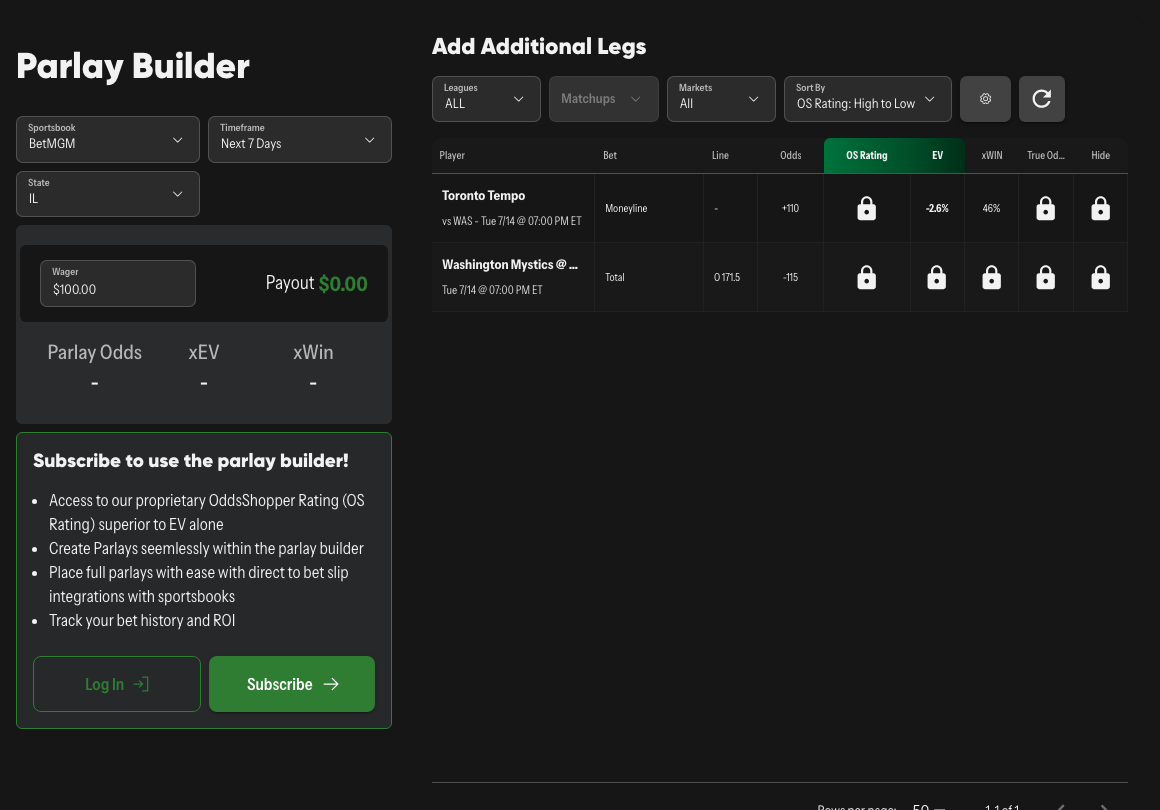 The OddsShopper Parlay Builder — every leg graded live (EV, xWin, true odds) before you lock a ticket. Open the live board.
Building it on DraftKings or FanDuel instead?The free DraftKings Parlay Simulator and FanDuel Parlay Simulator on Stokastic.com price the same parlay from 10,000 Sims next to that book's odds.
Watch The Video
OddsShopper betting analyst Eytan Shander builds a four-leg NBA same game parlay from scratch here, screen by screen. Everything below follows the same process.
One note before we start: the walkthrough runs on an archived NBA board from a past season, so read the player names as an illustration rather than tonight's card. The method is what transfers, and it transfers to every board since.
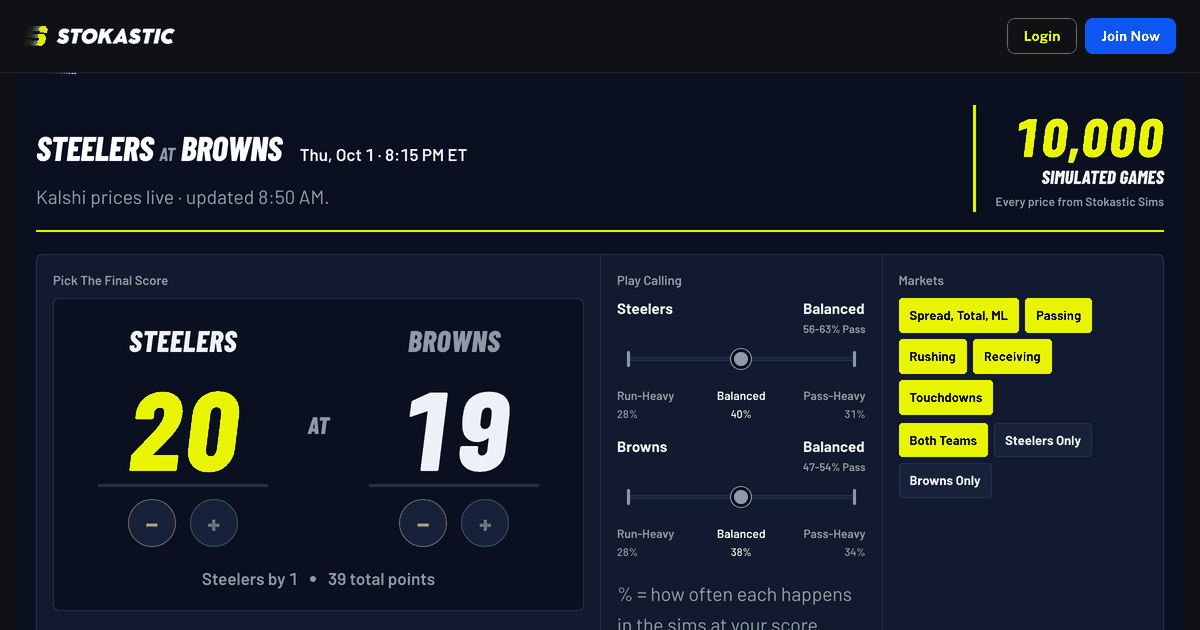 Betting it on Kalshi? Price the combo first. The Kalshi Parlay Simulator prices any combo against 10,000 simulated games of this week's game, next to the price on Kalshi.
Sort By Expected Win, Because Every Leg Has To Hit
Before you touch a bet slip, set the board up so it can tell you something. Open the NBA player props screen, filter to the state you're betting in, and sort by expected win from largest to smallest.
Expected win, shortened to xWin, is our projections' estimate of how often a prop actually cashes. Sorting by it is a deliberate choice, and it's a choice you make because you're building a parlay. Firing a single prop is a different job: there you'd sort by return on investment and hunt the biggest edge, since one standalone bet can carry a modest win rate as long as the price is long enough to pay for it.
A parlay forgives nothing. One miss voids the entire ticket, so what you want is the legs likeliest to hit, and xWin ranks precisely that. Sorted from largest to smallest, the tool surfaces the props our projections trust most, instead of leaving you to eyeball a wall of numbers.
New to prop betting? Our guide to player props betting covers the market types first. For the math on why a price and a probability aren't the same thing, start with implied probability.
New to OddsShopper?It scans 100+ sportsbooks and rates every NBA player prop by how often our projections say it should cash, so you can see which legs are worth combining before you build anything. Try OddsShopper Pro free for 7 days, and code SGPBUILD20 takes 20% off your first payment if you subscribe.
Why The Best Bet On The Board Is Often The Wrong Anchor
Sorted by xWin, the top prop on that night's board was Joel Embiid's rebounds against the Hornets, clearing the next prop in the list by nine points of expected win. A gap that wide practically begs you to make Embiid the anchor and build around him.
So the walkthrough tests that instinct. Searching the Sixers and Hornets game turns up a second strong prop, and then the list thins out. Two good legs, and nothing behind them.
Here's the constraint a same game parlay puts on you that an ordinary parlay doesn't: every leg has to come from one game. A phenomenal prop in a game with no supporting cast is a phenomenal straight bet, and it can't be an SGP by itself. The board was pointing at the right bet in the wrong game, so the walkthrough moves on without Embiid.
Let The Game Pick Your Same Game Parlay
Scanning further down the sorted list, three separate props above a 70% xWin rating all landed in the same place: Pistons versus Wizards. A fourth from that game sat just underneath.
That's the signal. Not one great leg, but a cluster. On a fuller NBA schedule this happens because a single game's pace, matchup, and minutes tend to lift several props at once, and the tool's sort makes the cluster visible instead of leaving you to guess. You don't choose the game. The density of qualifying legs chooses it for you.
Once the game picks itself, the only question left is which four legs deserve the ticket.
The Real Edge: Projection Versus The Posted Line
This is where an SGP stops being a lottery ticket. Every prop in the tool shows the sportsbook's line next to the projection, so you're never betting on a vibe. You're betting on a measurable gap.
| Player | The Prop | Projection (In The Walkthrough) | xWin |
|---|---|---|---|
| Saddiq Bey | Over 4.5 rebounds | 6 rebounds | 70%+ |
| Spencer Dinwiddie | Over 3.5 rebounds | 5 rebounds | 70%+ |
| Isaiah Stewart | 1+ assist | Yes | 74% |
| Kyle Kuzma | Over 6.5 rebounds | 8 rebounds | ~70% |
Kuzma is the row we keep coming back to, and notice he's last on that list. He was the fourth leg found, hovering just under the other three rather than leading them. Look at what the book is asking, though. It wants 6.5 rebounds, which means the leg cashes at 7, and the projection says 8. Kuzma can lose a full rebound off his projection and you still collect. He earns the place in this ticket that the higher-rated Embiid prop never could, because he had somewhere to live.
The Stewart leg works differently and rewards a closer look. Strip it down and there's no over or under involved at all. You're answering a yes-or-no question: does Stewart record a single assist? Our projections put that at 74%, the strongest of the four, and the sportsbook simply lists it as 1+.
Worked Example: Pricing The Four-Leg NBA SGP
Take those four legs to the book, build them into one same game parlay, and the ticket comes back at +550. A $50 bet returns $325 in total, which is $275 of profit on top of your stake.
The video stops at the payout. Run the numbers yourself and the ticket gets a lot more interesting, because now you can ask whether +550 is a good price rather than just a big one.
- What The Price Implies, Before Removing The Vig: roughly 15.4%. For any plus-money line, divide 100 by the odds plus 100, so +550 gives you 100 ÷ 650.
- What Our Projections Imply: the Stewart assist at 74%, and the three rebound legs at roughly 70% each. Multiplied together as though they were independent, that lands near 25%.
Ten percentage points separate those two numbers, and that gap is the reason to look twice at this ticket. Resist the urge to call it an edge, though, because the naive 25% assumes the four legs are independent, and legs inside one game never are.
Correlation pulls in both directions here, which is what makes it interesting. Some forces push the ticket's true chance up: a fast pace and a brick-heavy shooting night inflate every rebound prop on the floor at once. Other forces push it down: players chasing the same rebound are, to a degree, taking it from one another. Which force dominates on any given night is not obvious, and the sportsbook has already priced its own opinion about it into that +550, right alongside the vig.
The honest readthe naive 25% isn't a number you can trust in either direction, which is exactly why you demand real cushion on every single leg rather than betting the arithmetic.
You get there by using projections to choose the legs instead of letting a pre-built slip choose them for you. For the full mechanics of why books tax correlated legs, our same game parlay strategy guide breaks down why an identical SGP can pay wildly different prices at different books.
Should You Move The Line? The Slider Trade-Off
Some books let you push a prop's line up or down and reprice the leg, and the temptation with a projection in hand is obvious. Kuzma projects for 8 rebounds and sits listed at 6.5. Why not slide him to 7.5 and collect the longer price?
Because a projection is a central estimate rather than a floor. Shifting the line to 7.5 throws away most of the cushion that made the leg attractive in the first place, and it does that on every leg at once if you get greedy. In the walkthrough, Shander tries exactly this on Dinwiddie, pushing him from 3.5 rebounds up to 4.5, then says out loud that the move is aggressive. When he reads the finished ticket back, Dinwiddie is at the posted 3.5 and Kuzma is still at 6.5.
The slider cuts both directions, which is the part people forget. Pull a line down instead, surrender some price, and you buy yourself a materially safer leg. On a four-leg SGP where one miss voids everything, that trade is worth more than it looks.
Shop The Same SGP Before You Fire
One last step, and skipping it leaves real value on the table. The exact same four legs will not price the same everywhere. DraftKings 🎁 and FanDuel 🎁 each apply their own correlation adjustment, so an identical SGP can come back at meaningfully different numbers depending on where you build it.
Line shopping a straight bet is easy. Line shopping a four-leg SGP by hand across a half-dozen books is tedious enough that most bettors quietly stop doing it, which is precisely why the odds comparison tools exist. Our parlay calculator guide walks through how to confirm what a ticket is actually paying you. Do that, then take the best number available to you.
FAQ
How do you build a same game parlay? Sort a game's player props by expected win, find a single game with three or more legs clearing your threshold, compare each projection to the sportsbook's posted line, and combine only the legs where the projection clears the line with room to spare.
How many legs should a same game parlay have? The walkthrough above uses four, which is a reasonable ceiling for most bettors. Every additional leg multiplies the ways your ticket can die while the book takes another bite out of the correlation.
Why does my same game parlay pay less than its legs multiplied together? Because the legs come from one game, they're correlated, and sportsbooks price that correlation in rather than simply multiplying the odds. An SGP pays less than its own legs multiplied together would suggest. Our parlay betting guide covers it in depth.
Can you make money betting same game parlays? No version of parlay betting exists without real risk, and most SGPs are priced in the book's favor. The bettors who do best with them only fire when the projections clear the posted lines, and they shop the ticket for the best price. Our guide to finding +EV bets covers the method.
Do I need OddsShopper Pro to build a same game parlay? No. The odds screen and the NBA props board are free to use every day, and the walkthrough above is built on the free tool. OddsShopper Pro is the upgrade for bettors who want the full picture across every book and the rest of the +EV toolkit.
The Bottom Line: Let The Game Pick The Ticket
Go back to Joel Embiid for a second. He was the best prop on the board by nine points of expected win, and he never made the ticket, because a same game parlay rewards something other than identifying the single strongest bet. The ticket wins when one game has several things go right at once.
That reframe is the whole method, and it collapses to five steps:
- Sort by expected win, because every leg in a parlay has to hit. Save the ROI sort for straight bets.
- Find the game where the qualifying legs cluster, rather than the game with the loudest single name.
- Check every projection against its posted line and demand real cushion.
- Leave the sliders alone unless you're buying safety with them.
- Shop the finished ticket like a straight bet, because it deserves the same care.
Work through those, and the parlay stops being a lottery ticket you bought on a feeling. It becomes the one thing a good bet is supposed to be: a considered opinion, priced.
Build your next NBA same game parlay on real numbers.OddsShopper rates every NBA player prop by expected win and shows our projection next to the book's line, so the legs worth combining are visible before you build. Start free for 7 days, then use code SGPBUILD20 for 20% off your first payment.
Bet only where it is legal in your state, and only with money you can afford to lose. If gambling stops being fun, call 1-800-GAMBLER.
Tools for thisKalshi combo builder on Kalshi, or the Polymarket Combo Simulator for Polymarket's book.
More on this: How Are Same Game Parlay Odds Calculated? 9 SGPs, 9 Underpays · Broncos vs 49ers Same Game Parlay: Bo Nix Under 250 · Cardinals vs Giants Same Game Parlay: Skattebo Under 80 · Chargers vs Seahawks Same Game Parlay: Darnold Stays Quiet · NFL Game Simulator: The 13% Parlay That Hits 26% of the Time