Every NFL season, the same instinct kicks in. One team is coming off a bye with two full weeks to heal and game-plan. The other is dragging into a Thursday night on four days of rest after a cross-country flight. So you back the rested team and fade the tired one, and it feels like the obvious side.
It usually isn't. Rest and travel are real, physical facts, but betting them is a game of what the number already knows. The most intuitive rest angles in football are also the most heavily priced, and the money that is left sits in the spots nobody's instinct points to. This guide sorts the rest and travel angles into what's dead, what's still alive, and how to actually bet the live ones without paying the market to teach you a lesson.
TL;DR: What Actually Pays In NFL Rest Betting
- The Obvious Rest Plays Are Dead. Backing the home favorite off a bye and fading the tired name are the first spots the market prices, so the edge is already gone.
- The Quiet Versions Still Pay At The Margins. The road favorite off a bye and the road team on a true short week are the live angles, because they run against public instinct.
- Only Bet What You Can Explain In One Sentence. A rest edge or a body-clock disadvantage has a mechanism; an "8-2 on Thursdays" trend is a coincidence.
- The Number Is The Whole Game. Win the key number (3 and 7), shop every book on the live odds screen to get the best price, and confirm it's +EV before you fire.
Here's the same read at a glance:
| Rest / Travel Angle | Status | Why |
|---|---|---|
| Back The Home Favorite Off A Bye | Dead | Most public, most shaded; the edge is priced out |
| Road Favorite Off A Bye | Alive (marginal) | Public underrates road teams, so it's not inflated |
| Fade The Road Team On A True Short Week | Alive | Fatigue, travel, and short prep stack at once |
| Thursday Mini-Bye (9–10 Days Next) | Faint tailwind | Worth a sliver; a tiebreaker, never the bet |
| West Coast Team At 1Pm ET | Alive | A real body-clock disadvantage you can explain |
| "Team Is 8-2 ATS On Thursdays" | Dead | A trend with no mechanism is a coincidence |
The row that surprises people is the road favorite off a bye. The instinct is to hammer the home team with the rest, but that's the side the whole market piles onto, which is exactly why the quieter road version is the one still worth a look.
Why Rest Looks Like An Edge And Mostly Isn't
Start with the mechanism, because a betting angle is only worth anything if there's a reason behind it. A team off a bye gets two things: fresh legs and, more importantly, an extra week of practice, film, and self-scouting. That combination really does help. The catch is that everyone knows it helps, including the people who make the number.
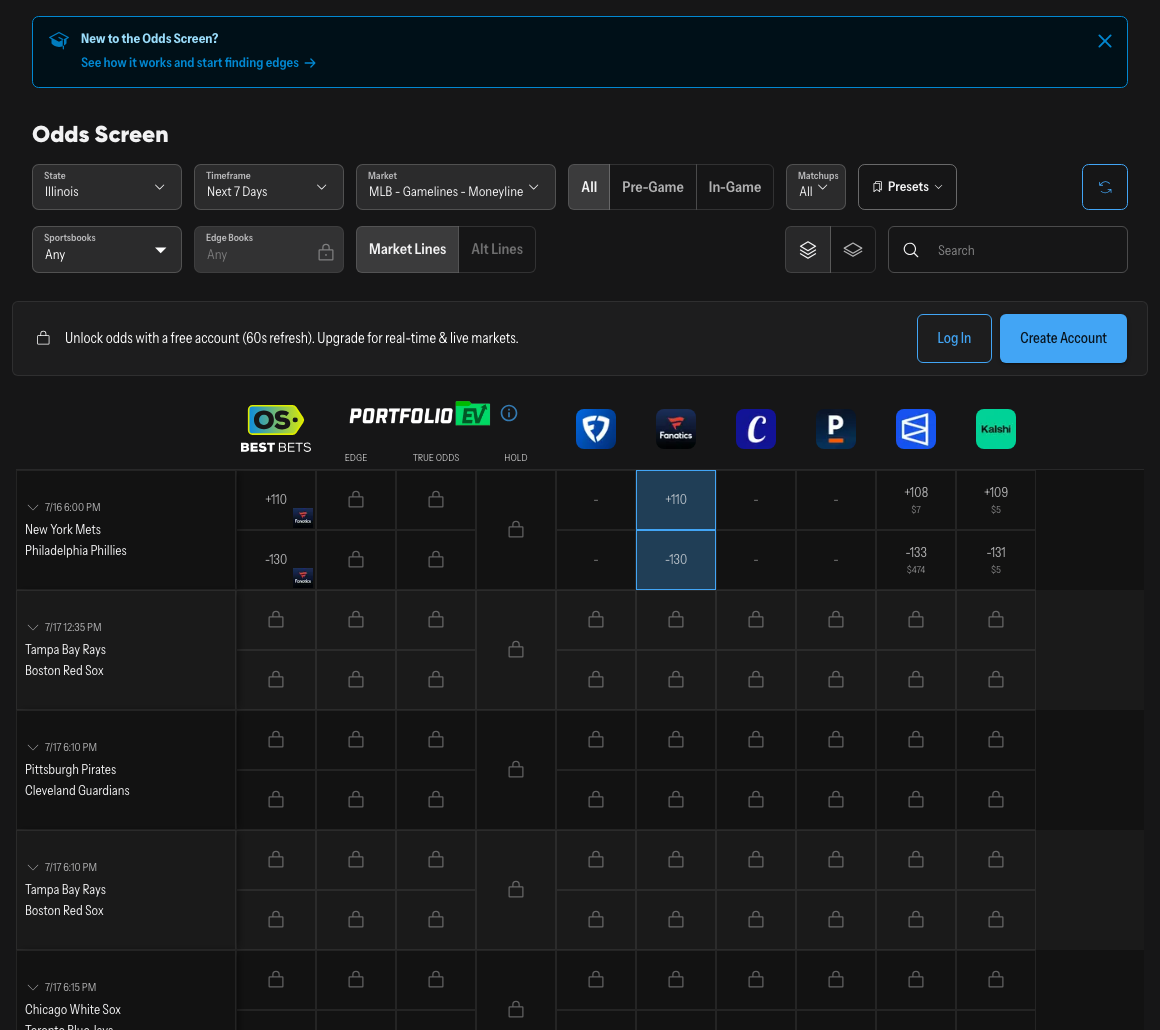
The OddsShopper Odds Screen.
Here's the part that changed the math. Years ago, when NFL bye weeks were spread differently across the calendar, the rest edge was worth real points on the spread. Then the schedule structure shifted and, more decisively, the market caught up. Years of results have since shrunk the modern bye-week edge to something close to negligible against the number. And the honest read is the least romantic one: what little survives is mostly the extra preparation time, not the extra rest. Hold onto that distinction. It's the thread that runs through every live angle below.
So when you look at a rested favorite and think "they should be even stronger than this line," stop and ask who else saw the same thing. The oddsmakers bumped that number days ago. Betting a rested team because they're rested is usually a bet on a fact the market already digested. Put plainly: whatever you're thinking is probably already in the line. If the concept of a bet being priced in your favor is new, our positive EV betting guide is the foundation this whole approach is built on.
The odds screen is where you check that instinct against reality. Before you talk yourself into a rest angle, it's worth comparing what every major sportsbook has hung on the game, because a spot the whole market agrees on is a spot with no edge left in it.
The Bye Week: Dead As A Blanket Play, Alive At The Margins
Blindly backing bye-week favorites is one of the oldest tired angles in football, and it stopped paying a long time ago. Teams sitting at home off a bye, laying points, are exactly the kind of "obvious" side the public loves and the book shades toward. Buying that story at a shaded price is how you slowly hand back your bankroll.
But there is one bye-week spot that still gets my attention, and it's the least intuitive one: the road favorite coming off a bye. That side runs against public instinct, because bettors reflexively downgrade any road team, so the market doesn't inflate it the way it inflates the home rested favorite. It's not a machine that prints money, and it's noisy enough that you still need the rest of your read, and the right price, to line up. The edge only exists if the number hasn't already swallowed the story. But it's a live spot precisely because it's the version of the rest story the public won't tell itself.
Notice what's actually driving it. It isn't fresh legs. The driver is the same thing we flagged up top: preparation. A road favorite good enough to be favored and handed an extra week to scheme is exploiting prep and coaching, not recovery. The rest is the packaging. The prep is the product.
Short Weeks And Thursday Night: Where The Live Edges Live
If the bye is mostly priced, the opposite pole is where the differential gets extreme enough that the market underreacts, and that pole is the short week. The angle isn't rest by itself. It's the gap in rest between the two teams, and the biggest gaps in football show up around Thursday Night Football.
Two directions matter, and they point opposite ways:
- The Road Team On A True Short Week Is The Side To Press. A team crossing the country to play on four days' rest, especially later in the season when the bodies are already beaten up, stacks fatigue, travel, and a compressed prep window all at once. This is the "tired team" instinct, except the edge is in the road version, and it's grounded in a mechanism you can actually name rather than a hunch. It still has to be confirmed against the number, but the direction has a real reason behind it.
- The Thursday Mini-Bye Is Context, Not An Edge To Build On. A team that plays on Thursday then gets nine or ten days before its next game is enjoying a mini-bye, and that extra rest going forward is an even fainter version of the bye effect. It's a tiebreaker on a side you already like, never the reason you're betting.
The one I keep coming back to is the road-team-on-short-rest fade, because it's the rare rest angle where the mechanism, the direction, and the market's blind spot all agree. The public sees a marquee Thursday game and bets the over and the name-brand team; the value is in fading that tired road side, not in riding the marquee name.
New to OddsShopper?It compares live odds across every major sportsbook and flags the bets priced in your favor, so you can see whether a short-week or bye spot is actually +EV or just a story the market already told itself. You can try OS Pro free for 7 days, and code RESTEDGE20 takes 20% off your first month of OS Pro or OS Core if you subscribe: Start your free trial.
Travel And Body-Clock Spots: Separate The Mechanism From The Myth
Travel is where rest betting gets the murkiest, so run every spot through one filter: is there a real physical mechanism, or just a pattern on a spreadsheet?
The spot with an actual mechanism is the body clock. A West Coast team flying east for a 1pm ET kickoff is, by its own internal clock, playing at 10am, and human bodies simply aren't at peak that early. That's a real, repeatable disadvantage rooted in physiology, which is why it's one of the few travel angles worth respecting. Its cousin is the grind spot: a team playing its third game in a compressed 10-day window, or piling a long flight on top of a short week, is fighting accumulated fatigue rather than a single bad night.
Then there's the noise that dresses up as an edge. Say a team is 8-2 against the spread on the road in prime time over three years. That's not an angle. There's no mechanism connecting a Sunday-night kickoff to a cover, so it's just a shape you found in a small sample after the fact — the same trap we break down in our guide to primetime NFL betting. This is the honest test that separates the live from the dead: rest advantage explains itself, and a body-clock disadvantage explains itself, but a day-of-week record explains nothing. If you can't say why in one sentence that a skeptic would accept, you don't have an edge. You have a coincidence you got attached to.
How To Actually Bet A Live Rest Edge
Say you've found a spot that passes the test: a road team dragging into a short week against a rested opponent, and your read on the matchup agrees. Finding the side is only half of it. In the NFL, how you bet the spread decides whether a real edge survives contact with the vig. Want a running head start? Our free expert picks today already flag the short-week and rest spots our team likes each week.
The game is built around key numbers. Because so many NFL games are decided by a field goal or a touchdown, the most common margins of victory are 3 and 7, with 6 and 10 a tier below them — roughly one in four NFL games lands on a 3 or a 7. Getting your number on the right side of one of them is worth more than almost any other half-point in sports. Not every half-point carries the same weight, and it helps to see which ones actually move the needle:
| Half-Point Move | Crosses a key number? | Worth paying for? |
|---|---|---|
| +2.5 → +3 (Or -3 → -2.5) | Yes — the 3 | Yes, at cheap juice |
| +6.5 → +7 (Or -7 → -6.5) | Yes — the 7 | Yes, at cheap juice |
| +5.5 → +6 | Partly — 6 is secondary | Situational |
| -8 → -7.5 | No — 7.5 isn't a margin | No, it's a trap |
| -10 → -9.5 | No | No |
The row that matters most is the top one. Say your read is to fade the tired road team getting points. If DraftKings has them at +2.5 but FanDuel or BetMGM hangs +3, that extra half-point pushes you across the single most important number on the board, and over a season that gap is enormous. If you're still building the fundamentals of reading a number, our guide to how to bet on sports covers the basics this section assumes.
That's also the one time buying a half-point makes sense: only when it crosses a key number, and only at cheap juice. Paying up to move a spread from -8 to -7.5 buys you almost nothing, because 7.5 isn't a common margin, and the book rakes those alternate numbers hard. Crossing 3 or 7 is the exception worth paying for. Everything else is a trap dressed as protection. The same logic is why NFL teasers are built to move standard spreads down through the 3 and up through the 7 — it's the key-number principle applied six points at a time.
Timing matters too, and rest spots have a rhythm. Sharp money tends to come in early in the week before the number firms up, while public money piles onto favorites and overs as kickoff nears. So if you love a rested favorite, the earlier number is usually the better one, before that public money inflates it. On the tired road underdog, waiting can hand you a slightly fatter number as the favorite gets bet up.
The one-line rule of thumbbet the rested favorite early, bet the tired road dog late, and never fire either without first crossing a 3 or a 7 at the best price on the board.
There's a way to check whether your timing is actually working, and it's the number every long-term bettor lives by: closing line value (CLV). If you grab the tired road dog at +3 and the line closes at +2.5, you beat the close — you got a better number than the market's final, sharpest price, and that's the real scoreboard whether the bet wins or loses. Rest angles are a CLV machine when you catch them early, because you're pricing in the fatigue before the public does.
This is where the odds screen and the +EV tools earn their keep. The tool surfaces every book's number side by side, so the spread you can find at 3 instead of 2.5, or at 7 instead of 7.5, isn't left to luck — and that difference across a full season is the difference between a small winner and a small loser. Checking a de-vigged, no-vig fair price against what every book is offering tells you whether the rest angle you like is actually priced in your favor or just priced.
Want the edge without the manual work?OddsShopper's live odds screen lines up every major sportsbook side by side so you can grab the right side of a key number in seconds, and its +EV tools strip out the vig to show you whether a rest or travel spot is truly a good price. Try OS Pro free for 7 days, then use code RESTEDGE20 for 20% off your first month of OS Pro or OS Core: Start your free trial.
Frequently Asked Questions
Is betting NFL teams off a bye week still profitable? Not as a blanket rule. Backing bye-week favorites was a real edge a long time ago, but the market has priced it out, and most of what survives is the extra preparation time rather than the rest. The one spot still worth a look is the road favorite off a bye, which the public underrates because bettors reflexively downgrade road teams.
How much is a rest advantage actually worth in the NFL? Far less than it feels like. A full bye is worth a fraction of a point on today's spread, and a Thursday mini-bye is worth roughly half of that. Because the number is so small and the oddsmakers already know it, rest should be a tiebreaker on a side you already like, not the whole reason for a bet.
What's the best rest-related NFL betting angle? The road team on a true short week, especially later in the season, is the most defensible fade among Thursday and other short-week spots. It combines fatigue, travel, and a compressed prep window all at once, each a disadvantage you can point to, and it runs against the public's habit of betting the marquee name. Confirm it against the price before you bet it.
Should I fade West Coast teams playing early East Coast games? It's a real spot because it has a real mechanism: a 1pm ET kickoff is a 10am body-clock start for a West Coast team, and bodies aren't at peak that early. Respect it, but treat it as one input, not an automatic bet, and always check the price first.
Why do day-of-week or "primetime record" trends fail? Because they have no mechanism. A rest edge or a body-clock disadvantage explains itself; a team being 8-2 on Thursdays does not. Trends without a causal reason are usually small-sample coincidences, and betting them is chasing a shape rather than an edge.
The Bottom Line On Rest And Travel
Rest and travel are real, but as a betting input they're a tiebreaker, not a thesis. The intuitive plays, backing the rested favorite and fading the tired name, are the ones the market prices first, and that's exactly why they stopped paying. The value lives in the spots the public won't talk itself into: the road team on a short week, the road favorite off a bye, the West Coast body clock at 1pm ET. And every one of them survives for the same reason we flagged at the start. It's about preparation and physiology you can explain in a sentence, not fresh legs the whole world already accounted for.
Find the spot that passes the "why" test, bet it through the right key number at the best available price, and let the small, repeatable edges compound. That's the honest version of rest advantage betting, and it's the only version that lasts.
More on this: NFL Home-Field Advantage In 2026: What It's Worth · NFL 2026 on Kalshi: Every Board We Track · NFL Coach Of The Year Odds: Kalshi Fades A Two-Time Winner · NFL Picks Hub: Week 1 Odds, Win Totals, Props · NFL Win Totals 2026: Kalshi Vs DraftKings Vs FanDuel