Every summer, college football win totals are one of the season-long markets serious bettors attack hardest, and Texas is one of the first numbers they circle. The sportsbooks have hung the Longhorns at 9.5 wins for 2026 and shaded the price toward the under, which is the market quietly telling you it expects a stumble somewhere in this schedule. That number is not an accident, and it is not a knock on Texas's talent. It is a read on one of the sport's toughest schedules during the SEC's first nine-game conference season. This piece does not hand you a side. Texas's win total is a real two-way market, so what follows is the framework: why the number sits where it does, the schedule that caps it, the honest case for the over, the honest case for the under, and the exact thresholds where the bet changes.
In Summary: The Quick Read
- The Market: the Texas Longhorns 2026 season win total is 9.5 wins, juiced to the under, a futures bet on how many regular-season games Texas wins. Texas and Georgia sit tied atop the SEC at 9.5.
- Why 9.5: 2026 is the SEC's first nine-game conference schedule. The extra league game is why no SEC team cracked a double-digit win total this year, Texas included, despite the talent.
- The Over Case: quarterback continuity, a settled coaching staff under Steve Sarkisian, elite recruiting depth, and a realistic path to 10 wins if Texas holds serve.
- The Under Case: the market's own lean. A nine-game SEC gauntlet plus an Ohio State non-conference test makes three losses somewhere the base expectation, and three losses are all it takes to cash the under.
- The Swing Factor: the quarterback room. Confirm who is QB1 before you bet. A win total is a dated wager, and the roster you back in July is not guaranteed to be the roster that takes the field.
Where The Number Sits And Why It Is 9.5
Start with the number itself, because a win total is really a bundle of individual game prices rolled into one line, and where the books set that line decides how you play it. Texas sits at 9.5 wins with the vig shaded to the under. That juice matters as much as the number: the books are not just saying "we think Texas wins about nine or ten," they are charging you more to take the under than the over, which is the market's own soft lean toward the down side.
The reason the ceiling is 9.5 rather than 10.5 is structural, not a referendum on the roster. 2026 is the first year of the SEC's nine-game conference schedule, and that one extra league game pushed every SEC number down. In the current market, no SEC team sits above 9.5, and Texas and Georgia share the top of the league there, which tells you the market sees Texas as roughly a co-favorite in the SEC while still expecting the schedule to bite.
Here is what the number asks of each side:
| Posted Total | The over needs | The under needs |
|---|---|---|
| 9.5 Wins | 10+ wins | 9 or fewer wins |
Ten wins in a twelve-game regular season means dropping no more than two, in the SEC, in its most demanding standard schedule format yet. That is the entire bet in one sentence. (New to season-long markets? Our futures bet explainer covers how these prices are built and settled.)
The Schedule Read: Sort The Games First
Before you weigh talent, count the schedule, because the win total is a schedule bet wearing a roster costume. The method our college football win totals work uses is simple: split the games into three buckets.
- The Cushion: Texas State and UTSA are the non-conference games where the talent gap should do the work. Bank those.
- The Marquee Non-Conference Test: Ohio State comes to Austin in Week 2, and it is not a cushion game. Treat it as a coin-flip-caliber matchup that lives in the same tier as the toughest league games. It is the correction most casual previews get wrong when they wave at "easy non-conference wins."
- The Games That Decide The Number: the nine-game SEC schedule, headlined by the Red River rivalry against Oklahoma at the neutral site in Dallas, plus four true road trips — at Tennessee, Missouri, LSU, and Texas A&M. That bucket, four SEC road games and the Oklahoma neutral-site game, is where the over and under actually live.
Run that exercise honestly and the shape of the bet is clear. Texas does not need to win every hard game to reach 10. It needs to protect the games it is favored in and split the toss-ups. The overs that bust usually die on upsets in games the team was favored in, not in the true coin flips: the over needs Texas to steal at least one marquee game and avoid more than a stumble or two where it is clearly favored. That distinction is the whole discipline of win-total betting.
Returning Production And Coaching
Three roster facts carry the most weight on a Texas number, and the order they matter in is not up for debate.
Quarterback first, by a mile. The QB is the line in college football. Texas's over case rests on the assumption the market is pricing: continuity at the position with Arch Manning, a high-pedigree passer entering his second season as the starter rather than an unknown taking over a new job. Quarterback certainty is exactly the edge most contenders lack in any given summer. The flip side is a hard rule: this is a dated wager. Confirm QB1 on the depth chart at the moment you bet, because if the room turns over between now and kickoff, the certainty that props up the over goes with it.
Coaching continuity, second. Steve Sarkisian is not a new hire installing a new system. Program stability at the top is a quiet over-supporting factor that returning-starter counts never capture, because scheme carryover and a settled staff shorten the distance between talent and wins.
The trenches, third and most volatile. Pass protection decides college football games disproportionately, and the offensive line is where a portal-era roster is most exposed. A veteran, continuous line is an over signal; a line rebuilt through the transfer portal is the standing fade until it proves it can protect. This is the unit to check hardest before you commit, and it is the most common reason a talented team's over quietly dies.
The Case For The Over
The foundation is the easy part: quarterback continuity, coaching stability, and recruiting depth that reloads rather than rebuilds. When your backups were national top-100 recruits, "inexperience" usually means unproven, not untalented, and a program at Texas's recruiting level keeps the two-deep stocked through normal roster turnover. Add the cushion games against Texas State and UTSA, and the path to double digits is real: it asks Texas to win those two, hold Ohio State to a coin flip it can win at home, and go roughly 7-2 or better through a nine-game SEC round it is favored in more often than not.
That is an attainable line for a co-favorite in the conference. Backing the over is fundamentally a bet that a Playoff-caliber roster protects the games it should win and steals one of the marquee ones. The realistic edge here is the price: shop for a friendlier number on the over than the shaded 9.5. A book hanging Texas as low as 8.5 would materially lower the bar — uncommon for a team tied atop the conference, but worth a fresh price check, since the over would then need only nine wins.
The Case For The Under
Now the honest other side, and it is the side the market itself is leaning. The under is a bet on three forces working against 10 wins.
First, the nine-game SEC schedule. This is the reason the whole conference tops out at 9.5, and it is the single biggest input. An extra league game replaces a potential cushion win with another real test, and it does that for a Texas team that already plays Ohio State out of conference. Second, three losses is all it takes. To cash the under, Texas simply has to drop three of its 12 games, and a schedule with Ohio State, the Red River rivalry, and a full nine-game SEC round makes three losses the base expectation, not the disaster scenario. Third, the price already reflects this. The books juiced the 9.5 to the under, so the market is on this side, and fading a shaded number means you need a real edge, not just a hunch that Texas is good.
Add it up and the under's thesis is clean: you are not betting against Texas being talented. You are betting that 10 wins, dropping no more than two, is a lot to ask in the toughest standard schedule format the SEC has run.
The Key Thresholds That Flip The Bet
This is where line shopping stops being generic advice and becomes real money. On a Texas-class win total, small differences swing the whole bet.
- 9.5 Is The Live Number, and because 2026 capped the SEC at 9.5, you are unlikely to find a book hanging Texas at 10.5. That makes the price, not the number, your main shopping target: the under carries the vig here, so if you want it, take the book with the least-expensive under, the one closest to even money.
- 8.5 Is The Number The Over Side Dreams About. It is uncommon for a co-favorite sitting at the conference ceiling, but if any book drifts Texas to 8.5, the over only needs nine wins, a far easier bar than ten, and that is worth hunting for.
- On the over side, you are on the plus-money end of a shaded market, so shop for the book paying the fattest price on the over before you take it.
The practical takeaway is the one our seasonal handicapping repeats every summer: never bet a win total off the first line you see. The gap between the best and worst price on the same side is not a rounding error on a bet like this. It is the edge. Compare every book before you lock anything in, and use a tool like Portfolio EV to check whether the price is actually in your favor rather than just the side you like.
The Market Read: How This Class Of Number Behaves
The Texas number will not sit still, and knowing how it moves keeps you from paying the tourist price. Expect the biggest swing around the Ohio State game on September 12: if books keep offering adjusted in-season win totals after kickoff, that result should be the first major repricing point — a Texas win firms the over, a loss can drift the live number to something friendlier later in the year. And when the schedule is this heavy, the market leans to the down side, which is exactly what has happened here: the vig is shaded to the under on Texas at 9.5. Read the hold on your side against the true price, not the two-way average, because on a lopsided market the two-way number hides where the juice actually sits. Futures limits are lower than main-line game limits, which is why sharp season-long bettors often buy better by waiting for a dip: an early Texas loss can push the live over to a friendlier number later in the year, and a ticket you already hold can be paired with that better price. Finally, treat the whole thing as the dated wager it is. Your money is tied up for months, the roster can change under you, and that opportunity cost is part of the bet's real price. (For the general mechanics of how these season-long markets move, our NFL win totals guide walks through the same structure in a market with more coverage.)
How To Actually Shop The Texas Win Total
We do not hand you a side on this one, and that is by design: a claimed lean on Texas is a named analyst's call, not a house verdict. What OddsShopper gives you is the two things that actually move your bottom line on a bet like this. First, the best price: the live odds screen — shop the number across every major book lines up FanDuel, DraftKings, BetMGM, and the rest on one screen, so the tool surfaces the least-expensive under when the market is shaded, and if anyone drifts to 8.5 you find it before it moves. Second, an honest read on the price: Portfolio EV and our de-vig tools flag when a win-total number is actually positive expected value rather than just the prettiest-looking line. Pair that with the framework above and the Texas over/under stops being a guess and starts being a priced decision.
New to OddsShopper?It scans every major sportsbook and shows you, in one place, which book offers the best price on a bet like the Texas win total, so you are less likely to leave value on the table when the price is shaded. You can try it free for 7 days, and code LONGHORNS20 takes 20% off OS Pro or OS Core if you subscribe. Start your free trial
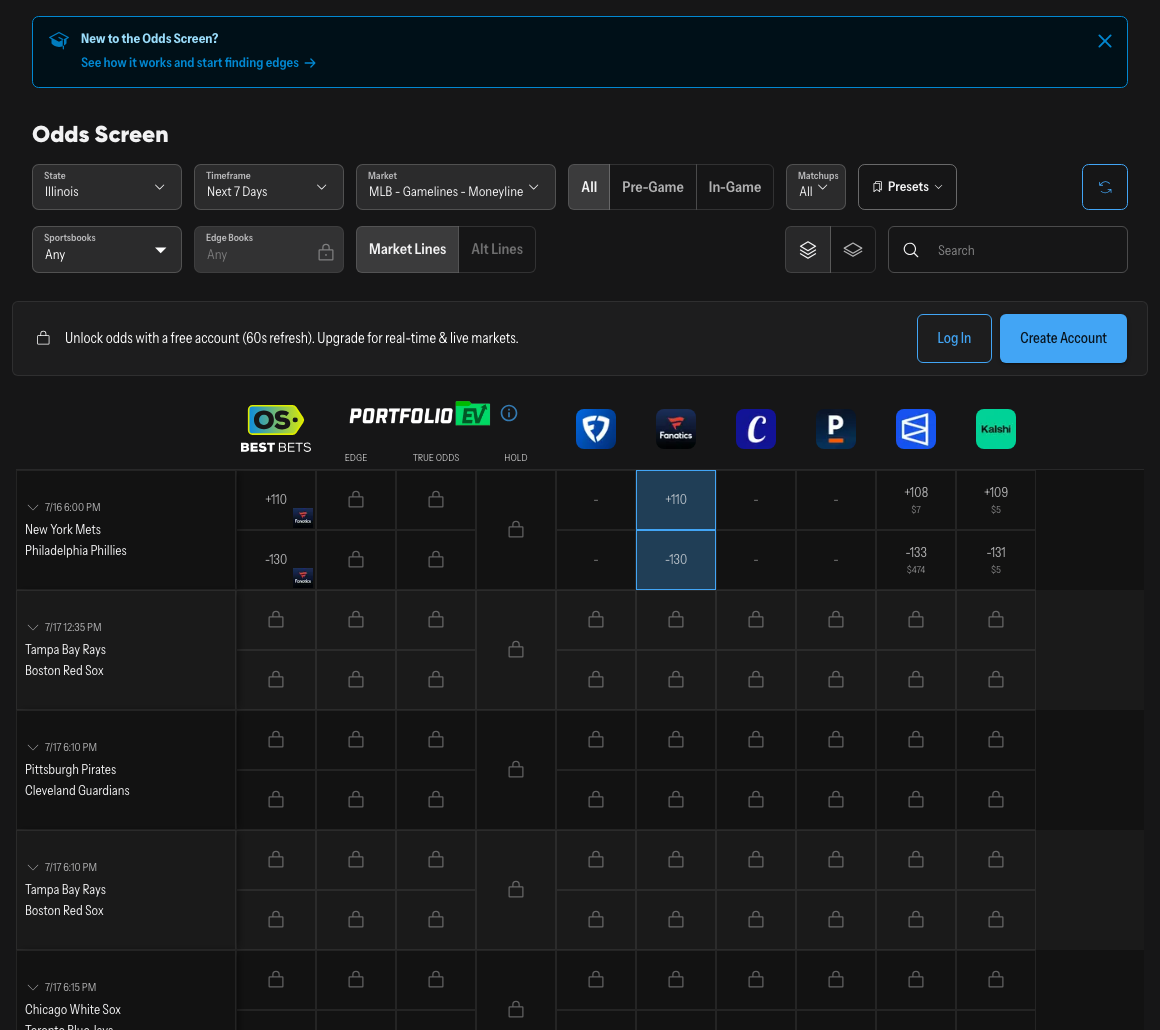 The OddsShopper live odds screen — every book's price on one board, refreshed in real time. Open the live board.
The Bottom Line
Texas at 9.5 is a number built by the schedule, not by any doubt about the roster. The over is a bet that a Playoff-caliber Longhorns team wins the games it is favored in and steals one of the marquee ones to reach 10; the under, which the market is quietly pricing as the lean, is a bet that a nine-game SEC schedule plus Ohio State takes its usual toll and costs Texas three games somewhere. Which side is right depends on the price you can find and how you read that schedule. Shop the number and the juice across every sportsbook, confirm the quarterback room before you commit, and let the schedule, not the logo, decide the bet.
Whichever side you land on, the price is where the bet is won or lost. OddsShopper lines up every major book on one screen and flags where the value actually sits, so you are not guessing which number is best. Start with a 7-day OS Pro free trial, and code LONGHORNS20 takes 20% off OS Pro or OS Core.
More on this: Cowboys Win Total 2026: Last In Defense, Priced To Contend · Giants Win Total 2026: A 4-13 Team Priced For 7.5 Wins · Patriots Win Total: The Books Agree On The Number. The Machines Don't · An Insurance Agent Made History Once In South Texas · Chiefs Win Total Odds: Lindy Vs. The Machine On 11+ Wins