Cowboys win total odds after Week 2: The 10-win contract that traded at 53.5¢ on September 8 sits at 44¢ bid, 45¢ ask. Dallas lost 28-20 at the Giants, beat Washington 37-20, and the ladder gave back most of what traders had built since April. The market now carries 9.1 expected Dallas wins, down from 9.67 on September 8. Nine AI models that priced this ladder blind on September 8 put the season at 8.88. Every rung from six wins up was above the panel then; the widest gap in the middle of the board, 11.9 cents on 10 wins, is now three, and nine wins is a coin flip either way, 59.5¢ against the panel's 58.5%.
Prices as of Wednesday, September 23, 2026, 7:31 a.m. ET, Kalshi bids and asks before fees. The panel numbers are from its September 8 run.
| Cowboys win at least | Kalshi now | September 8 | Panel |
|---|---|---|---|
| 8 games | 71¢ bid, 73¢ ask | 75¢ | 71.5% |
| 9 games | 59¢ bid, 60¢ ask | 66.5¢ | 58.5% |
| 10 games | 44¢ bid, 45¢ ask | 53.5¢ | 41.6% |
| 11 games | 30¢ bid, 32¢ ask | 38.5¢ | 26% |
| 13 games | 9¢ bid, 13¢ ask | 18¢ | 7.5% |
New to this kind of market? Our guide to betting NFL futures on Kalshi walks through how a season-long contract actually pays, and our Dallas Cowboys win total over/under page carries the sportsbook side of the same number.
Stay ahead of the markets.
Daily insights and expert picks on Kalshi, Polymarket, and what's moving markets.
Free forever. Unsubscribe anytime.
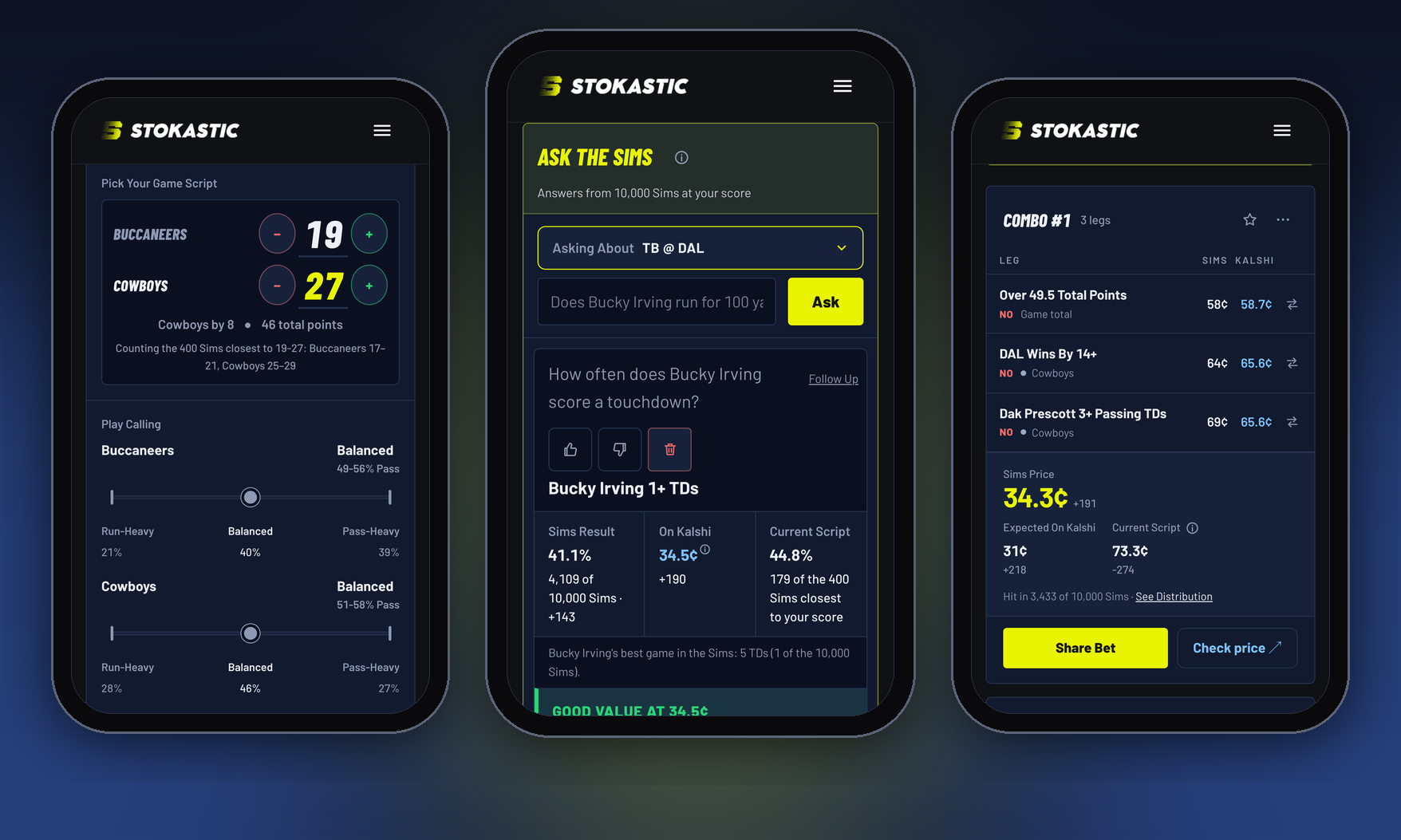 Price the combo before you buy it. The Kalshi Combo Simulator plays Buccaneers at Cowboys 10,000 times and prices any combo you build next to the price on Kalshi, on your phone, free, no login.
Hottest Prediction Markets Right Now
- 2028 Democratic presidential nominee · $213M traded
- 2027 Pro Football Champion · $84M traded
- Pro Baseball Champion · $68M traded
- 2028 U.S. Presidential Election winner? · $65M traded
- 2028 Republican presidential nominee · $64M traded
- Fed decision in Sep 2026? · $38M traded
Every market above links to our full AI model verdict; browse them all on the OddsShopper prediction markets hub, and see how every settled call actually scored on the full graded scoreboard.
What A 1-1 Start Did To The Ladder
The Week 1 loss did the damage and the Week 2 win barely touched it. Dallas carried 9.0 expected wins into Tuesday's board after beating Washington, and 9.1 on Wednesday's, a tenth of a win for a 17-point home win. The ladder now crosses 50 cents at 9.63 wins; on September 8 it crossed above 10.
The rung that moved most is the one this page was built around. Ten wins fell nine cents, from a 53.5¢ midpoint to 44.5¢, and the quote is one cent wide, so that is where the money agrees. The top of the ladder went with it. Fourteen wins fell from 13.5¢ to 5¢, 13 wins from 18¢ to 11¢, 15 wins from 6.5¢ to 3¢. The panel's whole argument on September 8 was that the market had priced a fat upper tail on a team whose median season was nine wins. Two games in, the tail is gone and the median is still nine.
The team that beat Dallas has since been marked down harder than Dallas was. The Giants lost 28-6 at the Rams in Week 2 and their ladder lost 1.4 expected wins, from 7.6 to 6.2, the biggest cut in the league on the Wednesday board. The Week 1 loss cost Dallas a win of expected value against a team the market no longer rates.
The Board
Each row is a separate yes-or-no contract that pays if Dallas finishes the regular season with at least that many wins; ties and playoff games do not count. The panel column is the September 8 median of nine models.
| Cowboys win at least | Bid | Ask | Mid | Panel (Sept 8) |
|---|---|---|---|---|
| 1 game | settled yes | 100¢ | ||
| 2 games | 95¢ | 100¢ | 97.5¢ | |
| 3 games | 95¢ | 100¢ | 97.5¢ | |
| 4 games | 95¢ | 100¢ | 97.5¢ | |
| 5 games | 93¢ | 100¢ | 96.5¢ | 94.8% |
| 6 games | 88¢ | 91¢ | 89.5¢ | 90% |
| 7 games | 83¢ | 84¢ | 83.5¢ | 82% |
| 8 games | 71¢ | 73¢ | 72¢ | 71.5% |
| 9 games | 59¢ | 60¢ | 59.5¢ | 58.5% |
| 10 games | 44¢ | 45¢ | 44.5¢ | 41.6% |
| 11 games | 30¢ | 32¢ | 31¢ | 26% |
| 12 games | 18¢ | 22¢ | 20¢ | 15% |
| 13 games | 9¢ | 13¢ | 11¢ | 7.5% |
| 14 games | 0¢ | 10¢ | 5¢ | 3.2% |
| 15 games | 0¢ | 6¢ | 3¢ | 1% |
| 16 games | 0¢ | 3¢ | 1.5¢ | |
| 17 games | settled no | 0¢ |
The panel numbers on this page are estimates, not predictions of fact and not financial advice. Every number in this piece gets graded in public once the market settles, on the full graded scoreboard.
Add the bids and the market implies at least 8.80 wins; add the asks and it implies at most 9.39. The panel's 8.88 sits inside that band. On September 8 it sat almost a full win below the market's 9.67. Seven, nine and 10 wins are each one cent wide, which is where the ladder is actually being traded; from 14 wins up there is no bid at all.
More from the same panel: all 32 NFL win totals · Giants win total 2026, Dallas's Week 1 and Week 17 opponent · Patriots win total 2026.
Every Seat's Number
Nine models priced the ladder on September 8 without seeing a price, then read each other's reasoning anonymously and revised or held. Eight came back with a second-round ladder; the ninth dropped out between rounds, so its first-round numbers stand. These are the on-record numbers and they do not move with the market.
| Model | 8+ | 9+ | 10+ | 11+ | 13+ | Median wins | Wins from the rebuild |
|---|---|---|---|---|---|---|---|
| Fable | 70% | 56% | 40% | 26% | 7.5% | 9 | +1.5 |
| Opus | 71.5% | 58.5% | 43% | 29% | 9% | 9 | +1.3 |
| Sonnet | 66% | 51% | 35% | 21.5% | 5.3% | 9 | +1.3 |
| ChatGPT | 75.3% | 59.8% | 41.6% | 25.1% | 6.3% | 9 | +1.3 |
| Gemini | 76% | 64% | 48% | 32% | 9% | 9 | +1.3 |
| Grok | 73% | 58.5% | 45% | 30% | 8% | 9 | +1.8 |
| Kimi | 59% | 48% | 38% | 25% | 7.5% | 9 | +1.5 |
| GLM | 63% | 50% | 37% | 22% | 4.5% | 9 | +2 |
| DeepSeek | 74% | 60% | 45% | 30% | 9% | 9 | +1.5 |
| Panel median | 71.5% | 58.5% | 41.6% | 26% | 7.5% | 9 | |
| Kalshi, Sept 8 | 75¢ | 66.5¢ | 53.5¢ | 38.5¢ | 18¢ | ||
| Kalshi, Sept 23 | 72¢ | 59.5¢ | 44.5¢ | 31¢ | 11¢ |
Every seat on this panel is graded against real market settlements. Records to date: Gemini 87% on 7,680 graded calls · Grok 85% on 6,396 graded calls · Kimi 86% on 3,836 graded calls · GLM 84% on 3,557 graded calls · DeepSeek 84% on 3,630 graded calls. Recomputed daily; the full scoreboard is public.
All nine seats put the median Dallas season at exactly nine wins, and that was the finding on September 8: panel and market agreed on the middle of this team and disagreed on how much room was above it. On 10 wins the market has now traded through Gemini at 48%, then Grok and DeepSeek at 45%, and sits between them and Opus at 43%. Only Fable, Sonnet, Kimi and GLM are still under the price on that rung, and the widest of those gaps is Sonnet at 9.5 cents.
Where The Panel Changed Its Mind
The second round produced one collective correction, on Micah Parsons. Two seats had built first-round numbers on the idea that Dallas had just lost its best pass rusher; Parsons played 14 games for Green Bay in 2025, so his absence was already inside the 7-9-1. Five seats pointed at the same error, Gemini took the correction and moved further than anyone, and Opus moved the other way for the reason the market has since come around to:
Opus"I had shaded the 6/10 class from 60% to 46% but never charged Dallas for being rank 32 rather than merely bottom-three. That worst-defense list lands on a 7.4 pace again and again, and its only offense-rich member, 2015 New Orleans, repeated at 7-9. So 10+ goes 46 to 43."
Opus's 43% on 10 wins was 10.5 cents under the market on September 8. It is a cent and a half under it now.
What Still Matters After Two Games
The 2025 Cowboys scored 471 points, seventh in the NFL, allowed 511, most in the league, and finished 7-9-1. The offense came back whole: Dak Prescott, George Pickens, CeeDee Lamb, Jake Ferguson and Javonte Williams. The defense was rebuilt from outside, with Rashan Gary from Green Bay (7.5 sacks in 2025), Von Miller from Washington (nine), safety Jalen Thompson from Arizona (95 tackles) and corner Cobie Durant from the Rams (three interceptions), plus a full season of Quinnen Williams after seven games in Dallas last year. The cost on the other side of the ball was left guard Tyler Smith, on injured reserve with a torn thumb ligament since the week before the opener on a four-game minimum; Week 5 against Tampa Bay is the earliest he can return and Week 6 at Green Bay is the realistic window.
The market spent five months betting that a good offense stapled to a terrible defense is a fixable problem. Since 2010, teams that finished top-10 in scoring and bottom-three in points allowed reached a 10-win pace the next year six times in 10; the whole worst-defense list, without that condition, is three of 15. Opus's point was that Dallas belongs to the second list as much as the first, and after two games the price is closer to Opus than to the list of six.
Week 3: Ravens And Cowboys In Rio
The NFL Rio Game is Sunday, September 27, at 4:25 p.m. ET at Maracanã Stadium, with Dallas the designated home team on a neutral field. The price to win is 37¢ bid, 38¢ ask for Dallas, down from 42¢ on Tuesday, and 61¢ bid, 62¢ ask for Baltimore. Baltimore to win by more than 2.5 points sits at 57¢ bid, 58¢ ask; by more than 3.5 it is 47¢ bid, 48¢ ask. Dallas to win by more than 1.5 is 35¢ bid, 36¢ ask. On the total, 52.5 is the coin flip, with the over at 50¢ bid, 51¢ ask.
Baltimore is also 1-1, a 41-23 win at Indianapolis and a 24-17 home loss to New Orleans, and its ladder carries 10.8 expected wins, unchanged since Tuesday.
At 1-1 with 15 games left, 10 Dallas wins needs nine of them. Win Sunday and it needs eight of the last 14, and the 10-win contract heads back toward 50 cents. Lose and it needs nine of 14 with Houston on the road the following week, and the rung heads toward the panel's 41.6% and under it. A Dallas win is priced at 37.5¢, so the win moves this ladder more than the loss would.
What Moves The Ladder Next
- The October road stretch. Houston on October 4, Green Bay on October 18, Philadelphia on October 26; those three went a combined 32-18-1 last season. Go 2-1 there and the 11-win rung climbs back toward its September price. Go 0-3 and the ceiling is gone by Halloween.
- Tyler Smith's return. On schedule around the Green Bay trip, the offense's floor is intact. Into November, and the 8-and-9-win mass thickens.
- Takeaways. Twelve in 17 games was the 2025 number, 30th in the league, and most of the panel's improvement rested on it correcting. The Week 5 Tampa Bay game was the checkpoint the panel named.
Settlement Timeline
| Date | What happens |
|---|---|
| Sunday, September 27, 2026 | Week 3 vs. Baltimore in Rio, Dallas 37¢ bid, 38¢ ask to win |
| Sunday, October 4, 2026 | Week 4 at Houston, the first of three October road games |
| Thursday, October 8, 2026 | Week 5 vs. Tampa Bay, Tyler Smith's earliest return on the four-game minimum |
| Sunday, October 18, 2026 | Week 6 at Green Bay, the realistic Smith return and Micah Parsons on the other side |
| Monday, October 26, 2026 | Week 7 at Philadelphia |
| Monday, January 18, 2027 | Settlement of every KXNFLWINS-27DAL contract on regular-season wins only; ties do not count |
A 10th Dallas win in December settles the 10-win contract early. This board is re-scored when the story moves, as of September 23, 2026.
The Bottom Line
Traders spent five months pricing the Cowboys as a team that fixed itself, and two games took most of that back: 9.67 expected wins to 9.1, the 10-win rung from 53.5¢ to 44.5¢, the 14-win rung from 13.5¢ to 5¢. The panel never moved. Its 8.88 now sits inside the market's own bid-ask band, and its 41.6% on 10 wins is three cents from the price. Nine wins is the number both sides have agreed on since September 8, and the next hard test of it is Lamar Jackson in Rio on Sunday.
The panel's calls are on the record for all 32 win totals.
Kalshi is a CFTC-regulated event exchange. Availability varies by state, as of September 2026. Nothing here is betting advice.
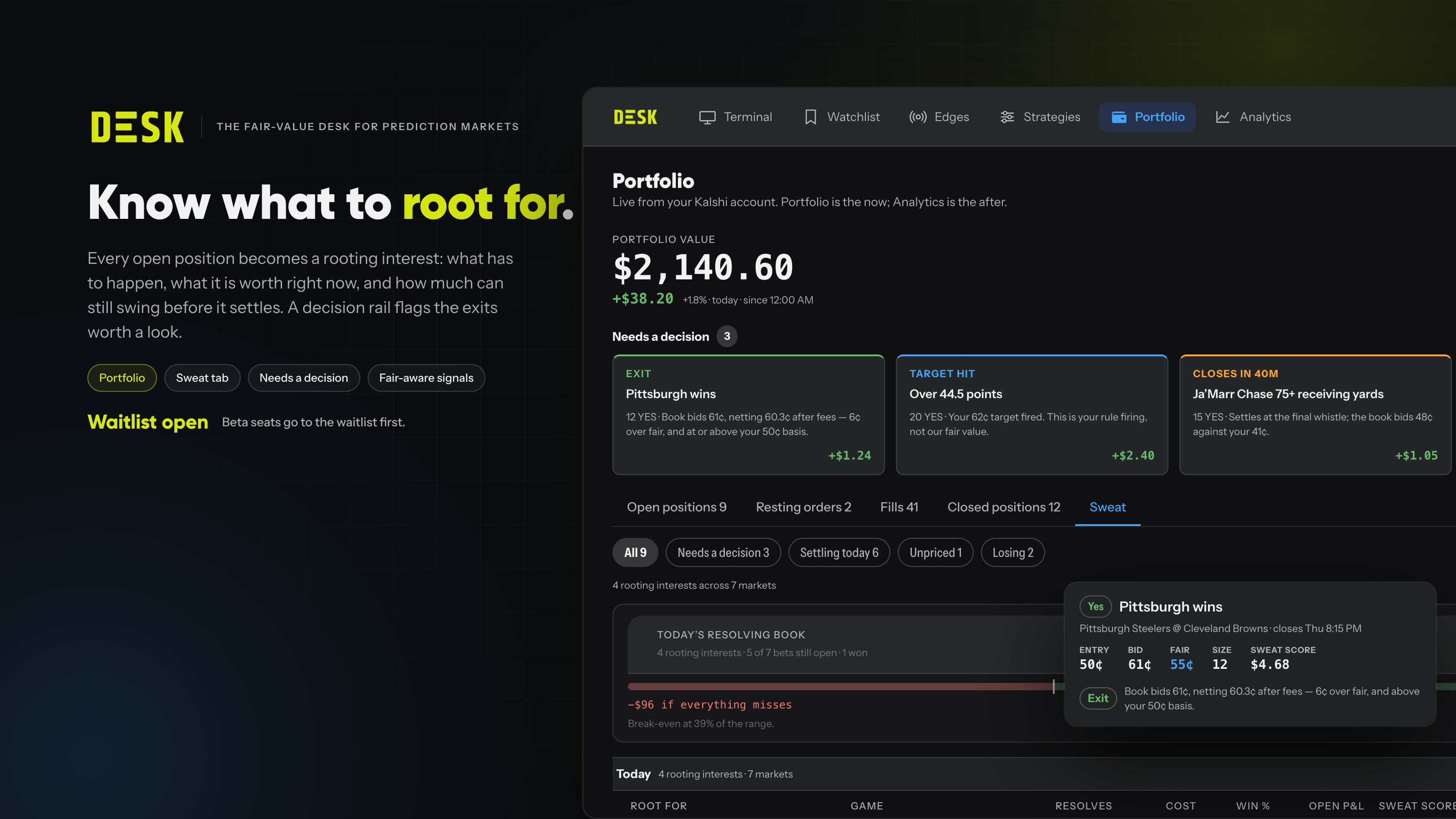
More on this: Browns Win Total 2026: The Panic Lasted One Week · Cardinals Win Total 2026: The Ladder Kept The Chargers Win · Dolphins Win Total 2026: Even Harsher After Two Losses · Steelers Win Total 2026: One Loss Rewrote The Ladder · Giants Win Total 2026: The Buying Lasted One Week