Week 1 of the 2026 college football season is complete, and the Kalshi College Football Playoff Qualifiers board spent the last 40 hours of it doing two different things. While games were on, it graded them the way Sunday's edition of this page said it would, by how a team won rather than whether it did. Notre Dame beat Wisconsin 41-13 at Lambeau Field and went from sharing the top of the board at 77 bid, 81 ask to owning it alone at 83/84. Ole Miss beat Louisville 41-38 in Nashville and gained two cents. SMU won 27-24 at Florida St. on Labor Day night and gained four. While games were not on, which was most of Monday, the board argued with itself about a team that had already played. LSU's contract had already climbed 20 cents across the opening weekend. Since Sunday morning it has been sold into the 40s five separate times, deepest 13 minutes before Sunday's kickoffs and again at breakfast on Monday, and each time bought back, the last leg running all Monday afternoon and into the night. It sits at 58 bid, 61 ask. The round trip was 16 cents wide and netted two and a half, and every contract of it traded around an 837,500-contract August position that never moved. That is the college football playoff odds story after one full week of 2026: the market has now watched all 50 teams play at least once, it has repriced almost every row at least a little, and the one it cannot stop trading is the one the nine-model panel, frozen since September 2, missed by the most. Every contract is re-fetched below, the LSU tape is read by the clock, and the piece closes on Saturday night in Austin, the first game on the calendar that hands one of the market's top eight its first loss.
The Quick Answer
Kalshi's College Football Playoff Qualifiers board has now priced a complete Week 1, and as of 1:53 AM ET on September 8, 2026, Notre Dame stands alone at the top at 83 bid, 84 ask, with Miami (FL) at 76/80, Georgia at 73/77 and Ohio St. at 73/76. LSU is 58/61 after trading between 45 and 61 since Sunday morning, and the nine-model panel scored on September 2 without prices is now 35.5 points under the market on it, the widest split on the board. Ole Miss, the panel's favorite disagreement, won a shootout, gained two cents, and moved inside the market's 12 by bid because Alabama drifted out. The full 50-team table with the move since Sunday, the LSU tape by the clock, the rows that won and fell anyway, and what Saturday's Texas-Ohio St. game settles are all below.
- The Market's 12, By Bid: Notre Dame, Miami (FL), Georgia, Ohio St., Indiana, Oregon, Texas, Texas Tech, LSU, Oklahoma, Texas A&M, then Ole Miss (36/38) and USC (36/37) tied at 36 bid for the last seat. Alabama (35/38) is the first row outside, after sitting in a three-way tie for the last two seats on Sunday morning.
- The Panel's 12, By Number, Unchanged Since September 2: Ohio St., Georgia, Oregon, Notre Dame, Indiana, Miami (FL), Texas, Texas Tech, Ole Miss, Texas A&M, Alabama, Oklahoma. The panel still holds Alabama, which the market has now nudged to the first row outside its 12, and still holds Ole Miss where the market holds LSU.
- Widest Splits Below The Market: LSU (58/61 against 24%), Florida (25/29 against 3%), Notre Dame (83/84 against 65%), Miami (FL) (76/80 against 60%), South Carolina (18/25 against 5%), Virginia Tech (12/16 against 1%). Pittsburgh's 9/28 would rank sixth by midpoint, but at 19 cents wide it is not a price.
- Widest Splits Above The Market: James Madison (3/8 against 28%), Ole Miss (36/38 against 48%), Michigan (13/15 against 24%), Clemson (4/12 against 16%), Texas A&M (37/40 against 46%).
Stay ahead of the markets.
Daily insights and expert picks on Kalshi, Polymarket, and what's moving markets.
Free forever. Unsubscribe anytime.
The Market At A Glance
| Venue | Kalshi, a CFTC-regulated event-contract exchange, 18+, with broad, state-specific availability under federal oversight |
| The Event | "College Football Playoff Qualifiers" (Kalshi event KXNCAAFPLAYOFF-26), 50 separate yes/no team contracts |
| The Contract | Every team's rule reads the same but for the name. Verbatim, on the Ohio St. contract: "If Ohio St. is one of the teams to qualify for the College Football Playoffs, then the market resolves to Yes" |
| Timing | Expected expiration December 15, 2026, with the book able to stay open to December 29. The field itself is announced on Selection Day, Sunday December 6 |
| The Shape | As of 1:53 AM ET, September 8, 2026: all 50 contracts carry both a bid and an ask; about 1.78 million contracts have traded on the event lifetime, about 23,300 in the last 24 hours, and about 1.50 million are open, all counted in dollars of contract face value, one dollar per contract, the way Kalshi displays them |
| Prices Below As Of | 1:53 AM ET, September 8, 2026, quoted as bid and ask. Every Week 1 game is final, and every one of the 50 teams has now played at least once; Illinois, Georgia Tech, Utah and Missouri opened on Thursday, September 3, and did not play over the weekend |
One sentence on why the numbers below do not sum to 100: 12 teams qualify, each contract settles on its own, so a coherent board of 50 sums to roughly 1,200%, and the panel's 50 numbers sum to 1,112% because some of the 12 will come from teams with no contract here. What changed between Sunday morning and now is that the book tightened while it repriced. The 50 bids sum to 1,192% and the 50 asks to 1,401%, a 209-point band against 271 on Sunday morning and 187 on September 2, and 14 contracts carry a spread of 5 cents or wider, down from 15. The sellers who stepped away on Sunday morning came back once they had seen the scores, which is what a weekend of games does to a preseason board. The worst rows are still not prices: Pittsburgh is 9 bid, 28 ask, and Vanderbilt is 6/23, and every "move" entry below that comes from a row that wide should be read as the ask stepping in or away, not as a trade.
These are model estimates, not predictions of fact and not financial advice. Nothing on this page is a recommendation to enter any position.
The Board: All 50 Teams, Repriced
Prices as of September 8, 2026, at 1:53 AM ET. The panel blend is the middle number of nine independent model estimates, each produced on September 2 without sight of any price and not re-run since. Sep 6 is Sunday morning's midpoint at 10:14 AM ET, the stamp on the last edition of this page. Move is today's midpoint minus that. Split is the panel blend minus today's midpoint, in points. A split is a disagreement between two ways of reading the same season, not a claim that either side is right, and the panel's disagreements now include a full week of games it never saw.
| Team | Conf. | Bid / Ask | Sep 6 | Move | Panel | Split |
|---|---|---|---|---|---|---|
| Notre Dame | Ind. | 83 / 84 | 79¢ | +4.5 | 65% | −18.5 |
| Miami (FL) | ACC | 76 / 80 | 73¢ | +5 | 60% | −18 |
| Georgia | SEC | 73 / 77 | 77.5¢ | −2.5 | 72% | −3 |
| Ohio St. | Big Ten | 73 / 76 | 79¢ | −4.5 | 78% | +3.5 |
| Indiana | Big Ten | 71 / 73 | 71.5¢ | +0.5 | 65% | −7 |
| Oregon | Big Ten | 67 / 72 | 68¢ | +1.5 | 72% | +2.5 |
| Texas | SEC | 65 / 69 | 68.5¢ | −1.5 | 57% | −10 |
| Texas Tech | Big 12 | 60 / 62 | 68.5¢ | −7.5 | 52% | −9 |
| LSU | SEC | 58 / 61 | 57¢ | +2.5 | 24% | −35.5 |
| Oklahoma | SEC | 40 / 42 | 45.5¢ | −4.5 | 38% | −3 |
| Texas A&M | SEC | 37 / 40 | 38.5¢ | even | 46% | +7.5 |
| Ole Miss | SEC | 36 / 38 | 35¢ | +2 | 48% | +11 |
| USC | Big Ten | 36 / 37 | 37.5¢ | −1 | 26% | −10.5 |
| Alabama | SEC | 35 / 38 | 40.5¢ | −4 | 40% | +3.5 |
| BYU | Big 12 | 34 / 35 | 27.5¢ | +7 | 25% | −9.5 |
| Penn St. | Big Ten | 30 / 35 | 30.5¢ | +2 | 31% | −1.5 |
| SMU | ACC | 27 / 29 | 24¢ | +4 | 22% | −6 |
| Florida | SEC | 25 / 29 | 25.5¢ | +1.5 | 3% | −24 |
| Utah | Big 12 | 25 / 29 | 23.5¢ | +3.5 | 29% | +2 |
| Tennessee | SEC | 23 / 29 | 24¢ | +2 | 20% | −6 |
| South Carolina | SEC | 18 / 25 | 21¢ | +0.5 | 5% | −16.5 |
| Louisville | ACC | 17 / 21 | 21.5¢ | −2.5 | 13% | −6 |
| Kansas St. | Big 12 | 16 / 19 | 22.5¢ | −5 | 6% | −11.5 |
| Washington | Big Ten | 14 / 19 | 20¢ | −3.5 | 19% | +2.5 |
| Iowa | Big Ten | 14 / 16 | 26¢ | −11 | 17% | +2 |
| Virginia | ACC | 14 / 16 | 15.5¢ | −0.5 | 6% | −9 |
| Missouri | SEC | 13 / 16 | 11.5¢ | +3 | 12% | −2.5 |
| Houston | Big 12 | 13 / 16 | 14¢ | +0.5 | 6% | −8.5 |
| Michigan | Big Ten | 13 / 15 | 14.5¢ | −0.5 | 24% | +10 |
| Virginia Tech | ACC | 12 / 16 | 14.5¢ | −0.5 | 1% | −13 |
| Auburn | SEC | 11 / 17 | 13.5¢ | +0.5 | 4% | −10 |
| Pittsburgh | ACC | 9 / 28 | 12¢ | +6.5 | 4% | −14.5 |
| Vanderbilt | SEC | 6 / 23 | 13¢ | +1.5 | 12% | −2.5 |
| Illinois | Big Ten | 6 / 8 | 6.5¢ | +0.5 | 7% | even |
| Clemson | ACC | 4 / 12 | 10.5¢ | −2.5 | 16% | +8 |
| North Carolina St. | ACC | 4 / 8 | 6¢ | even | 2% | −4 |
| Florida St. | ACC | 4 / 7 | 6¢ | −0.5 | 3% | −2.5 |
| Arizona St. | Big 12 | 3 / 10 | 11.5¢ | −5 | 7% | +0.5 |
| James Madison | Sun Belt | 3 / 8 | 23¢ | −17.5 | 28% | +22.5 |
| California | ACC | 3 / 8 | 3.5¢ | +2 | 2% | −3.5 |
| Arizona | Big 12 | 3 / 7 | 5¢ | even | 9% | +4 |
| TCU | Big 12 | 3 / 6 | 5¢ | −0.5 | 4% | −0.5 |
| Georgia Tech | ACC | 2 / 12 | 5¢ | +2 | 6% | −1 |
| Baylor | Big 12 | 2 / 7 | 4.5¢ | even | 2% | −2.5 |
| Tulane | American | 2 / 5 | 3.5¢ | even | 10% | +6.5 |
| Miami (OH) | MAC | 2 / 5 | 1.5¢ | +2 | 2% | −1.5 |
| Oklahoma St. | Big 12 | 2 / 4 | 1.5¢ | +1.5 | 0% | −3 |
| North Texas | American | 2 / 4 | 3¢ | even | 8% | +5 |
| Kentucky | SEC | 2 / 4 | 10.5¢ | −7.5 | 2% | −1 |
| Arkansas | SEC | 1 / 4 | 2.5¢ | even | 2% | −0.5 |
Every seat on this panel is graded against real market settlements — records to date: Claude Fable 89% on 2,350 graded calls · Claude Opus 89% on 2,489 graded calls · Claude Sonnet 87% on 2,466 graded calls · ChatGPT 86% on 9,181 graded calls · Gemini 87% on 7,885 graded calls · Grok 85% on 6,542 graded calls · GLM 84% on 3,617 graded calls · Kimi 86% on 3,908 graded calls · DeepSeek 84% on 3,696 graded calls. Recomputed daily; the full scoreboard is public.
The row to read first is still LSU, because the split is now 35.5 points, wider than Sunday's 33 and wider than any number this page has carried. Nothing about the team changed between the two readings. LSU did not play. What changed is that the market spent 40 hours deciding where a 41-point win over Clemson should trade, sold it as low as 45 and bought it as high as 61 in the process, and ended up two and a half cents above where it started. The panel, which had LSU at 24% on a 7-6 team with a quarterback arriving rather than a season already banked, stayed at 24 because it is not allowed to move. A 35.5-point split is not nine models telling you LSU is overpriced. It is nine models that have not seen Sam Leavitt play yet, which is exactly why we do not re-run a 50-market panel every Sunday: a number that moves after every Saturday is a number that never gets graded.
Every number in this piece gets graded in public once the market settles, and you can read the running results on the full graded scoreboard. That record also carries the honest caveat this page has to state plainly: across thousands of settled contracts the market has been the better forecaster more often than the panel has. Treat a split as context and as a question worth asking, never as a signal to act on.
More live boards from the same panel: the national championship board is the same 50 teams asked a much harder question, and this morning Notre Dame and Ohio St. share the top of it at 13¢ ask, with Texas, LSU and Indiana all at 11¢; the Heisman board is the same panel's read on the individual award; our weekly Kalshi college football hub scores the game-by-game boards these 50 season contracts get repriced against; and the same panel's week-by-week game board prices every ranked matchup on the slate. The Stokastic edition of this playoff board reads the same 50 contracts for the DFS side of the house. Prices fetched September 8, 2026.
Hottest Prediction Markets Right Now
- 2028 Democratic presidential nominee · $210M traded
- 2027 Pro Football Champion · $78M traded
- Pro Baseball Champion · $65M traded
- 2028 U.S. Presidential Election winner? · $64M traded
- 2028 Republican presidential nominee · $62M traded
- Bitcoin price at the end of 2026 · $34M traded
Every market above links to our full AI model verdict; browse them all on the OddsShopper prediction markets hub, and see how every settled call actually scored on the full graded scoreboard.
LSU: Sold To 45, Bought Back To 61, Around 837,500 Contracts That Never Moved
Here is the promise from the top of the page. LSU's qualifier contract now shows 888,577 contracts of lifetime volume, and 837,500 of them, about 94%, are still the single fill from August 13 at 3:05 PM ET, one buyer taking Yes at 41¢. That fill is why LSU shows 871,318 open contracts, more than the other 49 rows combined, and it has not traded since. Everything that happened to the price between Sunday morning and Tuesday morning happened around it: 279 fills for 5,241 contracts, 2,023 of them on Sunday, 2,976 on Monday and about 240 in the first hour of Tuesday, which is about six-tenths of one percent of the open interest deciding what the other 99.4% is worth.
Read Sunday by the clock. At 10:14 AM the row was 56 bid, 58 ask. In the 11 o'clock hour sellers took it from 58 down to 48 and 50, 186 seller-side contracts out of about 240 traded in the hour. Buyers came back through the early afternoon and paid 59 for 131 contracts at 1:33 PM and 60 for 181 at 2:17 PM, Sunday's high. At 6:18 PM a seller hit 53 and 54. Then at 7:17:24 PM, 13 minutes before Notre Dame and Ole Miss kicked off, one seller put 221 contracts through in a single second from 51 down to 45, the lowest print on the row since a seller swept it to 43 while Saturday night's game was still being played. Nineteen minutes later buyers were paying 51 to 56 again, and by 9:13 PM, with Notre Dame pulling away at Lambeau, it printed 57. Sunday's last print, 57, was a cent above its first, and the whole 15-cent range in between belonged to fewer than 2,100 contracts.
Monday was the same argument at larger size. At 12:32:44 AM one buyer swept 840 contracts at 57 and 58, and the 662 that went off at 58 in a single fill are the largest single fill on the row since Sunday morning and the third-largest on the board, behind a 938-contract print on Miami (OH) at 5¢ and Kansas St.'s 739 at 46. Twenty-six minutes later, at 12:58 AM, a seller put 406 contracts through from 55 down to 50. Sellers had the morning: 85 contracts went off from 49 down to 47 at 8:38 AM, Monday's low and the number the day's move gets measured from. From 11:03 AM the buyers took over, and the 11 o'clock hour ran from 51 up to 57 on about 660 contracts, 192 of them at 52 at 11:03 and 137 at 57 at 11:14, the hour in which the day's move was made. The 8 o'clock hour that night added 56 to 59 on 169 contracts. Between 12:09 and 12:48 AM on Tuesday buyers paid 58 to 61 for about 240 contracts, 83 of them at 61, and the last print before we fetched was a seller at 58 at 1:01 AM. Fifty-eight bid, 61 ask is where that leaves it: the midpoint is 59.5, up two and a half cents from Sunday morning and 22.5 from September 2, and the round trip to get there ran 16 cents wide on a row with nothing on its schedule until Louisiana Tech visits Baton Rouge on Saturday at 7:30 PM ET as a 35.5-point underdog on the game line.
Nobody learned anything about LSU between Sunday morning and Tuesday morning. There was no game, no injury, no depth chart. What moved was the price other people were willing to pay for the same 51-10, and on a row where 94% of the volume is one idle position, the price is set by whoever shows up. Sunday's sellers showed up before the night games and Monday's buyers showed up after lunch, and that is the whole explanation. The national championship board, which repriced LSU on 600,000 contracts on Saturday night, did not repeat the argument: LSU's title contract sits at 10 bid, 11 ask, exactly where Sunday morning's edition left it, with Notre Dame and Ohio St. sharing the top of that board at 12/13 and Texas and Indiana alongside LSU at 10/11. The title board decided on Saturday and stayed decided. The qualifier board, with a fraction of the volume and a much bigger idle block, has spent two days re-deciding.
The panel's 24% is the number this page owes you honestly. The nine seats ran from 16 to 30 on LSU, one of the widest disagreements in the market's top ten, and the highest of them is now 29.5 points under the market. That is the row the September 2 panel will be graded hardest on, and it is also the row where the panel's method was most exposed from the start: it was scored on ratings, schedules and returning production, and Sam Leavitt's 113 rushing yards and 230 passing in a 644-yard night are exactly the kind of evidence it was not built to see. We are not re-scoring it. We are writing down what the market did around it and letting December sort out who was right.
Notre Dame Took The Top Alone. Ohio St. Gave It Up Without Playing.
Notre Dame had not taken a snap when Sunday's edition went out, and its contract had drifted from 83.5¢ on September 2 to 77 bid, 81 ask with no football to explain it. Then it beat Wisconsin 41-13 at Lambeau Field, a Shamrock Series game with Notre Dame the designated home team, and the row did three things in order. At 1:04 PM, six and a half hours before kickoff, a seller hit 67 for 94 contracts, the low of the whole stretch. At 8:02:51 PM, 32 minutes after the kick, a seller put about 820 contracts through in a single second from 77 down to 68, 500 of them at 71, the biggest fill on the row since Sunday morning, and the row absorbed it: by 10:18 PM buyers were paying 86, and at 12:17 AM Monday 185 contracts went off at 86 and 87. On Monday at 12:55 PM a seller put about 475 through from 83 down to 78, and the row settled at 83 bid, 84 ask, up 4.5 by midpoint and alone at the top for the first time since September 2. Sunday's page said a 40-point win would give the market a reason to revisit Friday's 86¢ buyer. The Irish won by 28 and the market revisited anyway: that buyer got the price back for a few hours overnight and then watched the row sold below it. The panel's 65% is now 18.5 points under the market, the third-widest split under the market after LSU and Florida.
Ohio St. is the row that gave up the top, and it did so without playing. It beat Ball State 56-3 on Saturday and shared the lead at 77/81 on Sunday morning; it is 73 bid, 76 ask on Tuesday morning after a Monday in which a buyer paid 77 for 124 contracts at 7:23 AM, a seller hit 75 for 115 at 11:44 AM, buyers paid 77 for 100 contracts each at 2:57 and 3:04 PM, the last size went off at 76 at 10:48 PM, and 15 contracts printed at 75 a half hour later. Down 4.5 on a day with no game is not a verdict on Ohio St. It is the market taking a little off both sides of Saturday night, because Ohio St. plays at Texas at 7:30 PM ET, Texas a 1.5-point favorite on the game line, and Texas fell too, from 66/71 to 65/69. The two rows summed to 147.5 on Sunday morning and 141.5 now. One of them wakes up on Sunday with a loss, and the panel, which has Ohio St. at 78 and Texas at 57, is back above the market on Ohio St. for the first time since September 2. The Texas split, 10 points, is the panel's standing claim that the losses are coming from Austin.
There is a smaller story inside Monday's tape that is worth a paragraph, because it explains three of the day's fallers at once. Between 6:02:26 and 6:03:41 AM ET on Monday, a stretch of 75 seconds, buyers lifted the asks on three rows: about 230 Alabama contracts from 39 up to 45, about 395 Texas contracts from 71 up to 77, and about 375 Texas Tech contracts from 69 up to 72, the highs of the stretch on all three. By Tuesday morning every one of those rows was lower than it had been on Sunday morning: Alabama 35/38 from 37/44, Texas 65/69 from 66/71, Texas Tech 60/62 from 68/69. Whoever paid the 6 AM asks on Labor Day is, so far, the clearest loser on the board this week, and Texas Tech and Alabama, two of the three rows they lifted, are among the four biggest fallers in the market's top 15.
Miami (FL) is the counterexample, and the biggest riser among the market's top ten. It beat Stanford 45-6 on Friday night, sat at 72/74 on Sunday morning, and then between 12:23 and 12:31 AM on Monday buyers took about 1,370 contracts in two sweeps from 75 up to 83, the most concentrated buying on any row in the market's top ten. It is 76 bid, 80 ask now, up 5 by midpoint, with the panel at 60, an 18-point split that is the fourth-widest under the market. Nine seats clustered between 55 and 62 on Miami, and the market's 78¢ midpoint now sits 16 to 23 cents above every one of them. Miami hosts Florida A&M on Thursday at 8 PM ET as a 55.5-point favorite, which is not a test of anything.
Michigan: Buyers At 15, With Oklahoma Coming Saturday
Michigan is 13 bid, 15 ask, half a cent off Sunday morning by midpoint, and the row has traded 3,085 contracts since, third-most on the board. Every large fill was a buyer. Six hundred 29 contracts took 15¢ at 10:21 AM Sunday, 337 took 14 at 8:52 AM Monday, 212 took 14 at 11:03 AM, 193 and 214 took 14 and 15 at 10:23 and 10:37 PM, and 378 took 15 at 12:12 AM Tuesday. Somebody has spent two days accumulating Michigan at the panel's side of the argument, and the sellers have kept meeting them at the same two numbers, which is why a row with real two-way volume has a two-cent spread and has not moved.
It gets its test at noon ET on Saturday, when Oklahoma visits Ann Arbor as a 5.5-point favorite on the game line. Oklahoma's own row went the other way: 45/46 on Sunday morning to 40 bid, 42 ask, down 4.5, with sellers hitting 41 for 77 contracts at 10:47 PM Monday. On Sunday the market sat 7.5 points above the panel's 38 on Oklahoma; it now sits 3 above, and on Michigan it sits 10 below the panel's 24. Saturday grades both rows at once. An Oklahoma win as a road favorite confirms the 41 and buries the 15. A Michigan win, seven days after the Hail Mary, would be the first time this season the board had to reprice a team upward for a result rather than a margin, and it would hand the panel its best row of the month.
The Rows That Won And Fell Anyway, And The Rows That Lost
The Michigan rule from Sunday's edition, that a win the market did not like is repriced as a loss of information, kept working through Monday, and it worked hardest on the rows that had drifted up on wide asks over the weekend.
Texas Tech (60/62, panel 52%). Beat Abilene Christian 33-10 on Saturday, sat at 68/69 on Sunday morning, and is down 7.5 by midpoint, the biggest fall among the market's top ten. The 6:03 AM buyer paid 72 for 301 contracts; by 10:47 PM on Monday sellers were hitting 53 to 58. The panel's 52% was 16.5 points under the market on Sunday and is 9 under now. A 23-point win over Abilene Christian is the shape of result the rule was built for.
Kansas St. (16/19, panel 6%). Beat Nicholls 71-3 and sat 15/30 on Sunday morning. At 9:35:41 PM Sunday one buyer swept about 1,140 contracts from 24 up to 46 in a single second, 739 of them at 46, which are the only prints above 30 on the row since Sunday morning and were the ask leaving, not a price. Monday's sellers took it from 22 to 16, and 16/19 is a real two-way market for the first time since September 2. Down 5 by midpoint, toward a panel that now sits 11.5 under it.
Iowa (14/16, panel 17%). Shut out Northern Illinois 40-0, showed a 14.5-cent gain on Sunday morning at 19 bid, 33 ask, and has given all of it back: sellers hit 12 for 94 contracts at 10:54 PM Monday, and the row is 14/16, down 11 by midpoint. That is the largest fall on the board among rows with a real spread, and it puts the panel's 17% two points above the market. Iowa hosts Iowa St. on Saturday at 7:30 PM ET as a 14.5-point favorite.
Washington (14/19, panel 19%). Beat Washington St. 24-10 on Sunday afternoon and fell from 18/22 to 14/19, down 3.5, on 133 contracts, the thinnest tape of any row that played since Sunday's edition except Ole Miss. A rivalry win nobody traded is a row the market has not decided to care about yet, and a bid moving four cents on that little volume is one side of the book thinning, not a verdict. The panel is 2.5 above it.
Then the rows whose teams lost: two since Sunday's edition, two the weekend had already settled, and one that won by a point and was priced like a loss.
Louisville (17/21, panel 13%). Lost 41-38 to Ole Miss at Nissan Stadium in Nashville. The row was 20/23 pre-game; at 11:08 PM Sunday a seller hit a 7¢ bid for 33 contracts, because the book had emptied out under it after the final, and by 2:18 PM Monday a buyer was paying 22 and 23 for 241 contracts. It settled at 17/21, down 2.5. The panel's 13% was one of its wider ACC fades and is now six under the market rather than 8.5.
Florida St. (4/7, panel 3%). Lost 27-24 to SMU at home on Monday night. A buyer paid 10 for 79 contracts at 11:54 AM before the game; a seller hit 7 for 20 at 11:25 PM after it. Down half a cent by midpoint, because the row was already 4/8.
Clemson (4/12, panel 16%). The loser of the LSU game was 10/11 on Sunday morning. At 12:34:47 PM Monday one seller put 684 contracts through from 7 down to 4, the biggest fill on the row, and it is 4 bid, 12 ask now. The panel's 16% sits 8 points above a midpoint that is mostly ask. Nine seats scored Clemson on last season's ledger; the market has priced this season's.
Oklahoma St. (2/4, panel 0%), which lost at Tulsa on Saturday, drifted from 1/2 to 2/4 ahead of Oregon's visit at noon Saturday, and Auburn (11/17), which lost four cents on Sunday for a one-point win over Baylor, held there on Monday. The rule cuts once.
What Week 1 Settled, And What The Wide Rows Are Hiding
Sunday's edition said the Louisville-Ole Miss game was the one to stay up for, because the two rows argued with each other: the panel's biggest SEC upgrade against its biggest ACC fade. Ole Miss won 41-38, and here is what the market did with it: 11 fills, 113 contracts, and a move from 34/36 to 36 bid, 38 ask. A buyer paid 43 and 44 for 22 contracts at 1:01 AM Monday, buyers paid 38 for 61 contracts at 9:10 PM, sellers hit 35 and 36 at 10:58 PM, and that was all the size. A 41-38 win by the panel's favorite disagreement traded about one twenty-sixth of what LSU's idle Monday did. Two cents was still enough to move Ole Miss inside the market's 12 by bid, tied with USC at 36, because Alabama's ask came in from 44 to 38 and its bid slipped from 37 to 35 on a Monday when buyers took 415 contracts at 38 at 12:24 PM and sellers kept meeting them lower. The panel's 48% on Ole Miss is 11 above the market; its 40% on Alabama is now 3.5 above a market that has dropped the Tide to the first row outside the 12. Ole Miss moved toward the panel; Alabama moved through it, from 40.5 to 36.5 by midpoint against a panel 40.
SMU is the row where a game and a wide book met, and it is worth reading because it shows what the tape looks like when the ask finally gets hit. The row was 20 bid, 28 ask on Sunday morning. Between 7:12 and 7:16 PM on Monday, roughly 15 minutes before kickoff in Tallahassee, buyers took about 1,320 contracts at 28 and 29¢, most of them at 29 and 467 of them in one fill at 7:16 PM, the largest pre-game buying on the row this week. SMU won 27-24. At 12:12 AM Tuesday a seller hit 22 for 175 contracts, and then at 12:39:11 AM one buyer swept about 1,135 contracts from 26 up to 41, 212 of them at 37 and 110 at the 41 high, and the row settled at 27 bid, 29 ask. Up 4 by midpoint and 7 on the bid, with the spread cut from 8 cents to 2. The panel had SMU at 22%, and the split is 6.
Then the rows that show a move and did not have one. Kentucky's 2/4 contract printed 33¢ for 31 contracts at 7:11 PM Monday, a buyer lifting an ask 29 cents above the bid, and the table shows the row down 7.5 only because Sunday's ask was 19. James Madison went from 2 bid, 44 ask to 3/8 without a single trade: the seller who wanted 44 on Sunday morning now wants 8, and the panel's 28%, its biggest non-power upgrade, finally has a midpoint to be measured against and sits 22.5 points above it. Pittsburgh is 9/28 after 217 contracts printed from 28 down to 16. Vanderbilt is 6/23, Arizona St. 3/10, and Georgia Tech, which lost 14-13 to Colorado on Thursday night, is 2/12. Fourteen rows are 5 cents wide or worse on Tuesday morning, one fewer than Sunday, and the honest reading is unchanged: on those rows the sellers have an opinion and the buyers have not shown up to test it. If you want the game-level version of any number on this page, the live odds screen carries every college football game line across every major book, and it is where you shop the number before you form a view of the season contract it feeds.
Where The Panel Stands After Week 1
On Sunday morning this page counted 24 contracts that had moved 3 cents or more since September 2, nine of them toward the panel's number and 15 away, and called the first weekend a clear loss for a panel that was never shown a margin. The 40 hours since were closer. Seventeen contracts moved 3 cents or more by midpoint between Sunday morning and Tuesday morning. Seven moved toward the panel: Texas Tech, Oklahoma, Utah, Kansas St., Iowa, Arizona St. and Kentucky. Ten moved away: Notre Dame, Miami (FL), Ohio St., Alabama, BYU, SMU, Washington, Missouri, Pittsburgh and James Madison. Strip out the rows 5 cents wide or worse, where the midpoint is a fiction, and it is 13 tight rows, six toward and seven away.
The pattern is the mirror image of the weekend's. The market moved away from the panel on the rows where a team's ceiling showed on the field, Notre Dame's 41-13, Miami's 45-6, BYU's 63-7, SMU's win in Tallahassee, and it walked back toward the panel on the rows where a margin disappointed or a wide ask got tested, Texas Tech, Kansas St., Iowa, Oklahoma. Ohio St. and Alabama are the two exceptions worth naming: both fell through the panel's number on days they did not play, so the market overshot the panel rather than approached it, and both get a real game on Saturday. What the panel was built to be right about is December, and its September 2 numbers stay on this page unchanged until there is enough season to grade them against.
The two rows where it is most exposed did not get any less so. Florida is 25/29 against a panel 3%, a 24-point split, wider than Sunday's 22.5. South Carolina is 18/25 against 5%, and at 12:44 AM Tuesday a buyer paid 23 to 28 for about 430 contracts on it, the row's biggest fill of the week. Those are the two SEC rows where the nine seats were most unanimous and the market most disagreed, and neither plays anyone this week who could settle it; Florida hosts Campbell on Saturday and South Carolina hosts Towson.
The Week 2 Games That Grade This Board
Week 1 was mostly a margin test against overmatched opponents. Week 2 has real games between rows on this board, and the prices above are the last read before them. Kickoffs are Eastern, and every point spread quoted is the game line as it stood at the time of this fetch.
| Kickoff (ET) | Game | Contracts on this board | What it tests |
|---|---|---|---|
| 8:00 PM, Fri Sep 11 | Missouri at Kansas | Missouri 13 / 16, panel 12% | Missouri beat Arkansas-Pine Bluff 54-14 on Thursday and is a 5.5-point road favorite here; the row gained 3 cents since Sunday without playing |
| 12:00 PM, Sat Sep 12 | Oklahoma at Michigan | Oklahoma 40 / 42, panel 38%; Michigan 13 / 15, panel 24% | The first game between two rows the panel and market read in opposite directions. Oklahoma is a 5.5-point favorite |
| 12:00 PM, Sat Sep 12 | Arizona St. at Texas A&M | Texas A&M 37 / 40, panel 46%; Arizona St. 3 / 10, panel 7% | Texas A&M is a 14.5-point favorite, and the panel sits 7.5 above the market on it, one of its biggest upgrades inside the 12. Arizona St. is a row too wide to read |
| 12:00 PM, Sat Sep 12 | Oregon at Oklahoma St. | Oregon 67 / 72, panel 72% | Oregon fell 7.5 cents between September 2 and Sunday for a seven-point win over Boise St. and has recovered 1.5 since; a 22.5-point favorite, and the market wants a margin |
| 3:30 PM, Sat Sep 12 | Alabama at Kentucky | Alabama 35 / 38, panel 40% | The row that just fell out of the market's 12, on the road as a 10.5-point favorite |
| 3:30 PM, Sat Sep 12 | Arizona at BYU | BYU 34 / 35, panel 25% | The week's biggest riser at +7 meets its first Big 12 opponent as a 7.5-point favorite |
| 3:30 PM, Sat Sep 12 | Duke at Illinois | Illinois 6 / 8, panel 7% | Illinois beat UAB 42-23 on Thursday and is a 6-point favorite here |
| 7:00 PM, Sat Sep 12 | Tennessee at Georgia Tech | Tennessee 23 / 29, panel 20%; Georgia Tech 2 / 12, panel 6% | Georgia Tech lost 14-13 to Colorado on Thursday; Tennessee is a 12.5-point favorite |
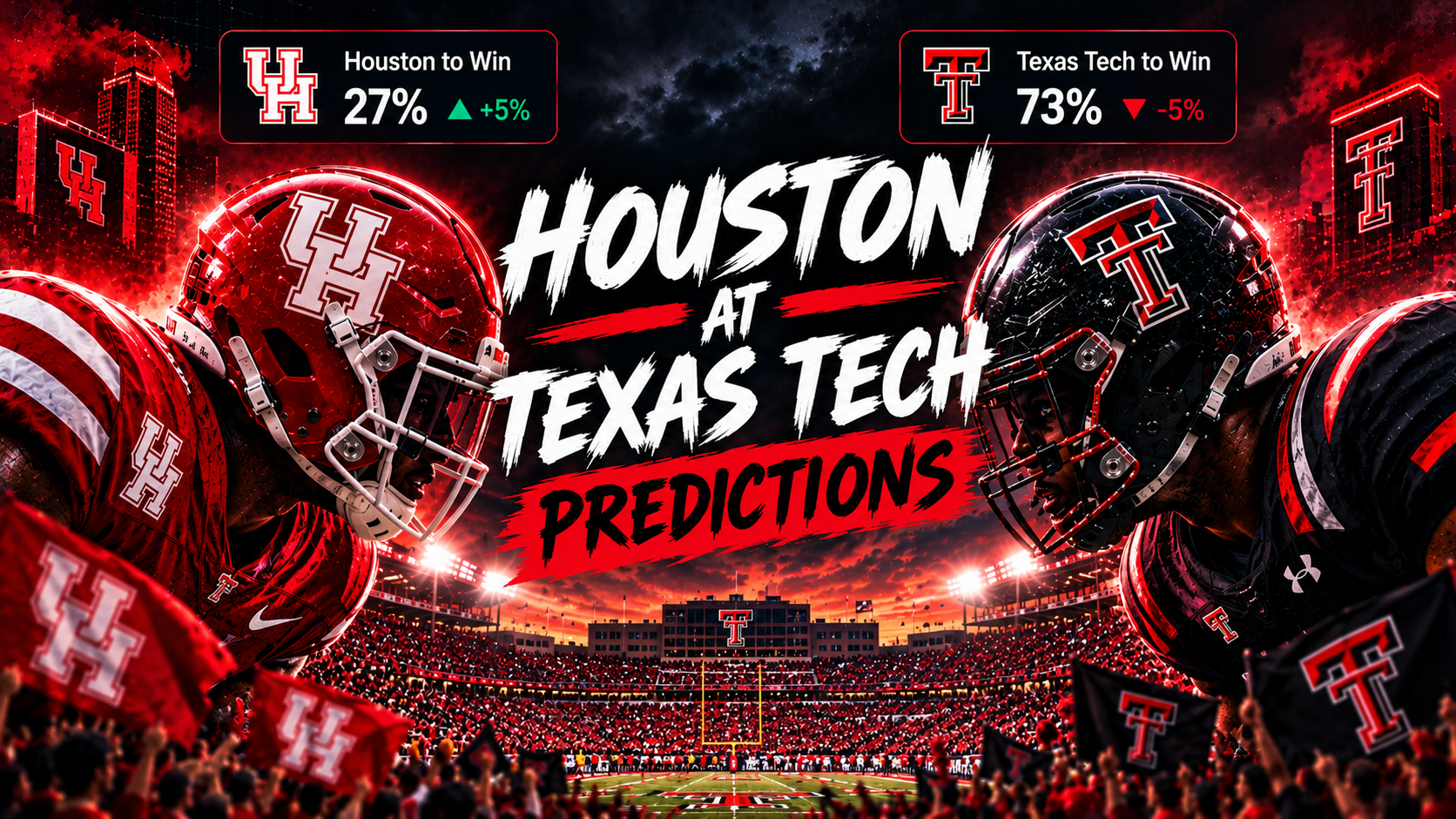
| 7:30 PM, Sat Sep 12 | Ohio St. at Texas | Ohio St. 73 / 76, panel 78%; Texas 65 / 69, panel 57% | Texas is a 1.5-point favorite. One of the market's top eight takes its first loss |
| 7:30 PM, Sat Sep 12 | Iowa St. at Iowa | Iowa 14 / 16, panel 17% | Iowa is a 14.5-point favorite after giving back the whole 40-0 bounce |
| 7:30 PM, Sat Sep 12 | Texas Tech at Oregon St. | Texas Tech 60 / 62, panel 52% | A 26.5-point favorite that just lost 7.5 cents for winning by 23 |
| 10:15 PM, Sat Sep 12 | Arkansas at Utah | Utah 25 / 29, panel 29%; Arkansas 1 / 4, panel 2% | Utah beat Idaho 66-14 on Thursday; a 12.5-point favorite, and the panel is 2 above the market |
The one I keep coming back to is the noon game in Ann Arbor, because Michigan is the row where someone has spent two days buying at the panel's side of the argument, and Saturday is the first time that trade gets marked against a result rather than a replay review. Texas-Ohio St. is the bigger game, but the market and the panel agree on the order of those two rows and disagree only on the distance; Saturday night narrows a gap. Oklahoma-Michigan can flip one.
What Would Change The Panel's Mind
This page re-scores when the story moves. Four things would move it, each of them a dated, checkable event rather than a feeling.
- The first College Football Playoff selection committee ranking, Tuesday November 3. This is the first time the actual selection body puts names in order, and it is the input the entire non-power seat now turns on, because that bid goes to the highest-ranked team rather than to a champion. A James Madison inside the committee's top 25 pushes its number up hard; a James Madison omitted while South Florida or Boise State appears pushes it toward a market that has just settled at 3 bid, 8 ask.
- A starting quarterback lost at Notre Dame, Ohio St. or Georgia. The panel was given no injury or depth-chart data at all, and the card said so explicitly, so every number in the high 70s at the top of this board assumes the quarterback who started in Week 1 is still starting in November. LSU showed what one quarterback is worth on this board in the other direction, and the two days since have shown what the market does to that row with nothing new to price. A season-ending injury to the starter at any of the three would be a bigger single-event repricing than anything that has happened this season, and the panel's 65 to 78 would be the numbers left holding the bag.
- The first loss by a team inside the market's 12. Nobody in the market's top ten has lost yet, and Saturday night in Austin ends that: Ohio St. at 73/76 and Texas at 65/69 cannot both wake up unbeaten on Sunday. The four automatic bids mean a conference title is worth more than a ranking, so a first loss does not eliminate a team that can still win its league, but the bid on the morning after is the first number that grades the panel's Texas split. If Texas loses and holds above 57, the panel was simply wrong about Texas. If Ohio St. loses and holds above 70, the panel's 78 was a ceiling the market never believed.
- A ruling on the non-power bid itself. Front Office Sports reported in February that the non-power commissioners "may discuss whether to change the bid back to the top-ranked conference champion", and that "They'll need approval from the Power 4 for any format changes." As of the August 11 rules summary, no reversal has taken effect. If one did, every non-power number on this board would need rebuilding.
Settlement timeline
| Date | What happens |
|---|---|
| September 8, 2026 | First in-season AP Top 25, released Tuesday afternoon after the Labor Day Monday game |
| November 3, 2026 | First College Football Playoff selection committee ranking |
| November 10, 17 And 24, 2026 | Subsequent committee rankings, then December 1 |
| December 5, 2026 | Conference championship games decide the four automatic power bids |
| December 6, 2026 | Selection Day: the twelve-team field is announced |
| December 15, 2026 | Expected expiration on the Kalshi contracts, with the book able to stay open to December 29 |
Prices and panel numbers on this page carry the date they were taken, and the page is re-scored when one of the four triggers above fires.
Every Seat's Number
The top 20 contracts by today's bid, in the order of the board above, with all nine seats shown as they stood after the September 2 revision round. The market column is today's midpoint. A wide row is a genuinely open question, not a rounding artifact. Utah enters the top 20 this edition and Louisville leaves it.
| Team | Market | Fable | Opus | Sonnet | ChatGPT | Gemini | Grok | GLM | Kimi | DeepSeek |
|---|---|---|---|---|---|---|---|---|---|---|
| Notre Dame | 83.5¢ | 65 | 62 | 68 | 60 | 68 | 67 | 65 | 70 | 62 |
| Miami (FL) | 78¢ | 60 | 58 | 62 | 55 | 62 | 61 | 60 | 57 | 58 |
| Georgia | 75¢ | 72 | 70 | 78 | 67 | 75 | 75 | 75 | 70 | 72 |
| Ohio St. | 74.5¢ | 78 | 72 | 80 | 72 | 80 | 80 | 75 | 74 | 78 |
| Indiana | 72¢ | 66 | 62 | 64 | 64 | 70 | 70 | 65 | 64 | 68 |
| Oregon | 69.5¢ | 72 | 69 | 76 | 69 | 76 | 76 | 70 | 68 | 74 |
| Texas | 67¢ | 55 | 57 | 68 | 52 | 58 | 58 | 60 | 56 | 52 |
| Texas Tech | 61¢ | 52 | 48 | 46 | 52 | 55 | 54 | 50 | 52 | 50 |
| LSU | 59.5¢ | 24 | 24 | 30 | 20 | 16 | 19 | 30 | 25 | 22 |
| Oklahoma | 41¢ | 38 | 44 | 42 | 38 | 25 | 36 | 20 | 38 | 36 |
| Texas A&M | 38.5¢ | 48 | 50 | 52 | 43 | 38 | 47 | 35 | 45 | 46 |
| Ole Miss | 37¢ | 45 | 51 | 50 | 42 | 45 | 48 | 50 | 48 | 48 |
| USC | 36.5¢ | 28 | 27 | 20 | 28 | 26 | 26 | 25 | 22 | 24 |
| Alabama | 36.5¢ | 40 | 45 | 35 | 38 | 34 | 40 | 45 | 42 | 38 |
| BYU | 34.5¢ | 30 | 20 | 20 | 29 | 19 | 26 | 25 | 30 | 24 |
| Penn St. | 32.5¢ | 30 | 31 | 23 | 35 | 52 | 30 | 45 | 40 | 26 |
| SMU | 28¢ | 24 | 16 | 22 | 25 | 32 | 24 | 15 | 18 | 20 |
| Florida | 27¢ | 4 | 5 | 5 | 5 | 2 | 2 | 3 | 2 | 2 |
| Utah | 27¢ | 29 | 27 | 28 | 31 | 36 | 35 | 15 | 30 | 24 |
| Tennessee | 26¢ | 20 | 20 | 15 | 23 | 23 | 18 | 20 | 19 | 18 |
Read that table the way the seats wrote it. On LSU the highest number any of the nine produced was 30, and the market is at 59.5; that is not one seat missing, it is the whole method missing the same thing, and the thing it missed played on Saturday and has been re-argued on the tape ever since. On Miami (FL), every seat sits between 55 and 62 against a 78¢ market, the tightest cluster of any row in the market's top ten with a split that wide, which means nine models agreed on the number and the market disagreed with all of them at once. And on Ohio St., the seats span 72 to 80 and the market, at 74.5, has walked back toward the middle of that range after sitting near its top edge on Sunday, four days before the game that will tell us which end of it was right.
More on this: College Football Championship Odds: The Champ Nobody Wants · Kalshi College Football Picks This Week: Every Board, Scored · Heisman Trophy Odds 2026: All 29 Names, Scored · How To Bet College Football On Kalshi: Markets & Value · NFL Playoff Odds 2026: Why Kalshi Doubts the Eagles
The Season Will Grade US
On Sunday morning this page said the board did not grade wins, it graded how you won. Two days later that still holds, and the week added a second rule: on the days with no games, the board grades nothing and trades anyway. All 50 teams have now played at least once, every Week 1 result is final, and the most-traded row since Sunday is the one team that had nothing to do. LSU ran 45 to 61 and back to 58/61 while the position that makes up 94% of its volume sat exactly where it has sat since August 13.
It is also why we score this board instead of leaving it to the exchange. Kalshi runs the venue, and a venue's content has to stay neutral about its own prices; an exchange telling you its LSU contract just round-tripped 16 cents on 5,000 contracts around an 837,500-contract position would be telling one of its own customers something about their book. We are not the venue. We have a byline, a panel with a public graded record, a rule that every number is dated, and a free expert picks page for readers who want a game-level view rather than a season one. For transparency: Stokastic trades prediction markets, including on Kalshi, and we have no affiliate or commercial relationship with Kalshi.
Fifty contracts, 12 berths, one August buyer at 41¢ who has now watched the row trade as high as 63 and as low as 36 around him without moving, a Notre Dame that stands alone at the top for the first time, and a Saturday night in Austin that hands a top-eight row its first loss.
Kalshi event contracts are CFTC-regulated derivatives traded on a designated contract market, not sportsbook wagers, and they can lose their full value. 18+, with broad, state-specific availability under federal oversight. Stokastic trades these markets and holds positions in them; we have no affiliate or commercial relationship with Kalshi. Everything above is a model estimate and market description, not trading advice.
Prices on this page are Kalshi's book. If you also trade on Polymarket, code OS4 gets new users a $50 trading bonus on a $10 deposit — affiliate link; terms as stated by Polymarket; 18+, availability varies by state.