Congress built a hard deadline into one of the intelligence community's most heavily used surveillance authorities, and this Kalshi market asks whether a full two-year FISA Section 702 reauthorization becomes law before 2027 arrives. Here is the catch: not every FISA action Congress might take would count.
TL;DR
- The Market: Kalshi's YES trades around 18¢, or roughly 18% implied probability that a clean two-year reauthorization of FISA Title VII (including Section 702) becomes law before Jan 1, 2027.
- The AI Read: an equal-weight blend of seven models lands at 28%, about 10 points above the market. The models see the two-year fix as slightly less of a longshot than traders do, but both still make NO the favorite.
- Why It's SO Narrow: the contract pays only for the exact two-year product signed into law. A short stopgap, a five-year deal, or a lapse-then-fix-in-2027 all settle NO.
- The Tell To Watch: a short-term patch surfacing first. That is the single clearest signal this resolves NO.
- How To Use It: read the 18¢ price as a near no-vig probability, compare it to your own estimate, and treat the model blend as one more opinion, not a green light.
Stay ahead of the markets.
Daily insights and expert picks on Kalshi, Polymarket, and what's moving markets.
Free forever. Unsubscribe anytime.
The Market
| Venue | Kalshi — a CFTC-regulated exchange |
| Ticker | KXBILLS-FISA |
| The Contract | Resolves per the market's official settlement rules: Will legislation that reauthorizes FISA Title VII, including Section 702, for two years become law before Jan 1, 2027? |
| Closes | On resolution; scheduled settlement January 1, 2027 |
| Current YES Price | 18¢ ≈ 18% implied (snapshot as of July 21, 2026 — confirm the live price on Kalshi before trading) |
Verify it yourself: the live market and price sit on Kalshi's bills-become-law markets, and the current legislative status of Section 702 is tracked on the Brennan Center's 2026 Section 702 resource page. As of this writing the authority has lapsed after its April 2026 sunset and short-term extensions, and no replacement has been signed — the exact backdrop this market is pricing.
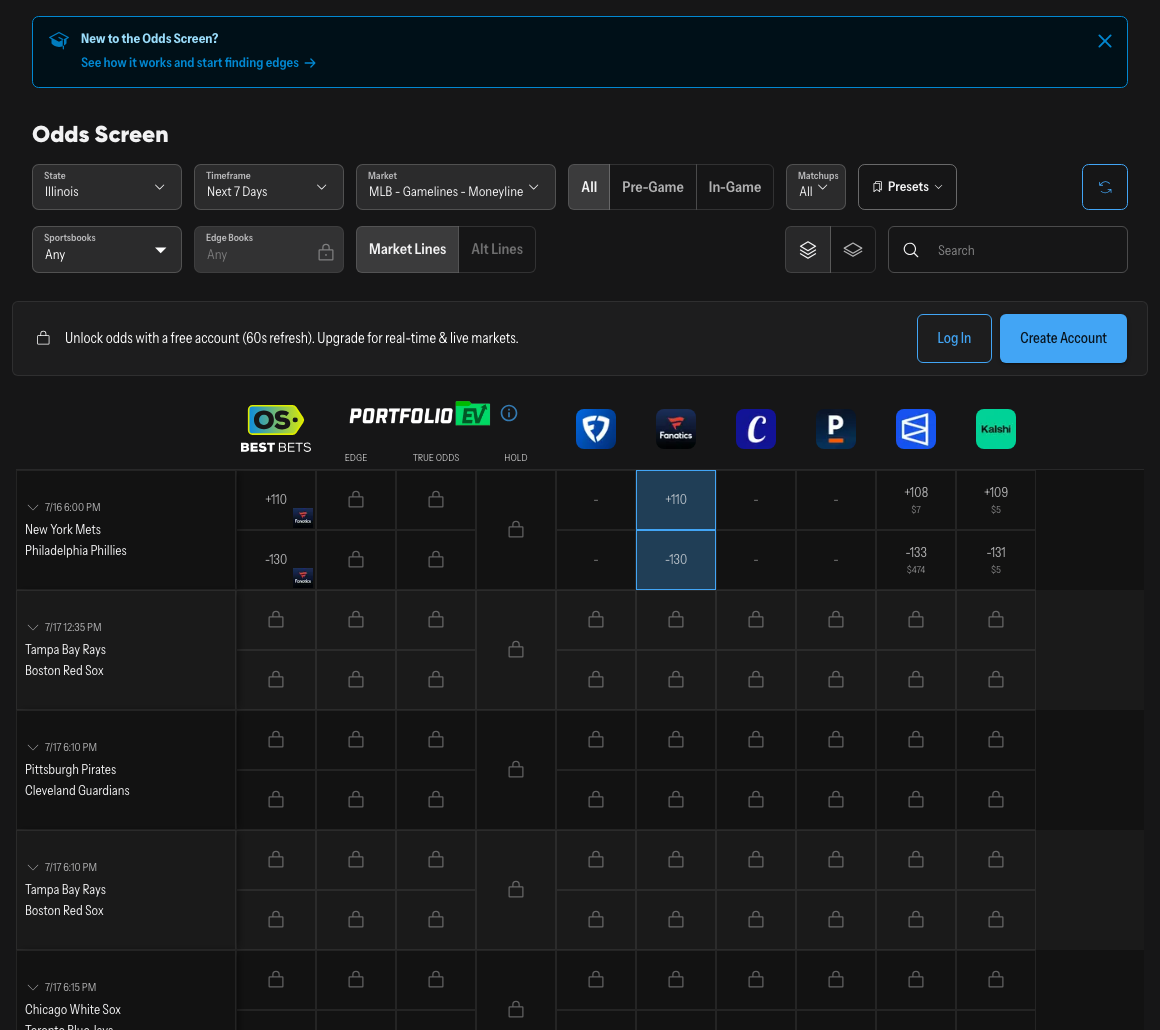
The OddsShopper Odds Screen.
The Bull Case (Why YES)
Start with the template. The last full reauthorization, passed in April 2024, ran exactly two years, so a matching two-year renewal is the deal Congress already knows how to cut. Every Section 702 sunset fight since the authority was created has ended the same way: the program kept going in some form. The calendar helps too. December is must-pass season, and FISA language has ridden those vehicles before; the late-2023 short-term extension traveled inside the annual defense bill. A post-midterm lame-duck session is historically when stalled national-security items clear, because members take hard votes with the election behind them. Add steady, bipartisan pressure from the intelligence committees, which treat this authority as a top legislative priority whenever it nears expiration, and the path to a signed two-year bill before New Year's is well worn.
The Bear Case (Why NO)
This market does not pay for Congress doing something. It pays for one specific product: a two-year reauthorization of Title VII, including Section 702, signed into law before January 1. Congress's revealed preference under deadline pressure is the punt, a short extension stapled to a must-pass bill, and a punt would leave this settling NO. The floor fight is real, too: the last reauthorization nearly died over a warrant-requirement amendment that failed on a tie vote, and that cross-party privacy coalition has not gone anywhere. The forcing function is also weaker than it looks, since court-approved certifications issued before a sunset can keep collection running for months after the statute lapses. Midterm-year floor time is scarce, appropriations and the defense bill eat the fall, and buying time is always cheaper than settling the fight.
What The Market Is Pricing
YES trades around 18 cents, so the market itself prices this as less than a one-in-five shot, and the shape of that price is instructive. Traders are not saying the surveillance authority dies; they are saying the specific two-year version probably does not get signed within the next five-plus months. The market settles January 1, 2027, and per the market's settlement rules, what counts is the described legislation actually becoming law before that date, not a stopgap and not a promise. The realistic path to YES runs through a December must-pass vehicle carrying a full two-year title, the same route FISA provisions have taken before. Watch three things: whether leadership marries FISA to the defense bill, whether any warrant fight gets resolved in committee rather than on the floor, and whether a short patch surfaces first. A patch is the tell that this settles NO. The same December-vehicle logic drives our $250 bill verdict, a sibling market that lives or dies on the lame-duck calendar too, and if reading exchange prices is new to you, our Kalshi odds guide covers the cents-to-probability conversion.
Model Verdicts
Market: 18¢ · AI blend: 28%, the models sit 10 points above the market.
| Model | YES | Why |
|---|---|---|
| ChatGPT | 21% | Section 702 can continue temporarily under pre-expiration certifications, reducing pressure for Congress to overcome surveillance-reform disputes and enact an exact two-year renewal in 2026. |
| Gemini Flash | 75% | Bipartisan support for FISA Section 702's reauthorization, despite reform debates, makes its passage likely. |
| Gemini Pro | 18% | The 18% market price reflects the low likelihood of another exact two-year reauthorization, as Congress typically prefers longer-term extensions or short-term stopgaps rather than repeating the 2024 compromise. |
| Grok 4.5 | 20% | Post-April 2026 expiration amid deep partisan splits on warrants and reforms makes a clean two-year reauth unlikely by year-end. |
| DeepSeek V4 | 15% | Section 702 expired in April 2026; midterm gridlock and deep partisan divides make a two-year reauthorization unlikely, with only a lame-duck session offering a narrow window. |
| Kimi K3 | 22% | Congress always eventually reauthorizes 702, but existing certifications run ~a year past sunset, making spring 2027 the true deadline and reducing urgency to act by December. |
| GLM 5.2 | 22% | Section 702 expires April 2026, forcing congressional action, but the specific two-year duration requirement significantly narrows the outcome space. |
| Blended Verdict | 28% | equal-weight mean of all seven model estimates |
Every seat on this panel is graded against real market settlements — records to date: GPT 83% on 1,693 graded calls · Gemini 85% on 1,718 graded calls · Grok 79% on 1,529 graded calls · DeepSeek 80% on 1,877 graded calls · Kimi 84% on 1,863 graded calls · GLM 80% on 1,874 graded calls. Recomputed daily; the full scoreboard is public.
The models span a 60-point range on this one.
Model estimates generated 2026-07-21 00:07 UTC. Models are frequently wrong; the market price reflects real traders' money.
Why The Models Disagree
Six of seven models converge near 15-22% by independently reasoning about the same specific facts: Section 702's authority lapsed in April 2026; the market demands an exact two-year term (not a longer or short stopgap extension, which most consider more likely); and 2026 is a gridlocked midterm year. Gemini Flash (75%) never engages with the exact-duration resolution criterion at all, instead applying a generic 'FISA always gets reauthorized eventually' base rate. Gemini Pro further stands apart by explicitly anchoring its 18% to the market price itself rather than independent legislative analysis.
- High Outlier (75%), Gemini Flash. Treats this as a generic 'will Section 702 survive' question and leans on the historical base rate that Congress always eventually reauthorizes, without addressing the narrow exact-two-year resolution requirement.
- Mid Camp (20-22%) — ChatGPT (GPT-5.6), GLM 5.2, Kimi K3, Grok 4.5. Reauthorization is likely eventually, but hitting the specific 'two years, before Jan 1 2027' target is a narrow window given election-year gridlock and competing extension-length options.
- Low Camp (15-18%) — Gemini Pro, DeepSeek V4. As of July 2026 no replacement has passed since the April lapse, and a midterm-year Congress is unlikely to strike a clean two-year deal before year-end; Gemini Pro also defers heavily to the market's own 18-cent price.
The AI read: The mid/low camp's reasoning rests on more specific, checkable facts — the April 2026 Section 702 expiration, the 2024 two-year compromise as precedent for duration fights, and the 'exactly two years' resolution wording — while Gemini Flash's case never mentions the expiration date or the duration constraint at all, making it the least evidence-grounded outlier.
What settles it: A confirmed bipartisan two-year reauthorization framework attached to a lame-duck vehicle (e.g., the FY2027 NDAA) — or news that a different-duration extension already passed — would resolve the disagreement.
The Full Reasoning
ChatGPT (21%): The strongest factor is limited urgency: although Title VII’s statutory authorization expired in April 2026, certifications issued before expiration can generally remain effective for roughly another year, pushing the practical operational cliff into 2027. Congress therefore has less incentive to resolve the persistent dispute over warrant requirements for searches involving Americans before year-end. Historically, Congress usually preserves Section 702, often through deadline-driven compromise or attachment to must-pass legislation, so eventual reauthorization is considerably more likely than permanent lapse. However, this market requires enactment before January 1 and apparently an exact two-year reauthorization; Congress could instead pass a temporary extension, choose a different duration, or defer action until the 2027 deadline. The lame-duck NDAA or appropriations process provides a plausible route, but election-year polarization and crowded calendars lower its probability. I am uncertain about post-April 2026 committee activity, negotiations, and whether existing bill text satisfies the settlement language. The single development that would most raise my estimate is announcement of a bipartisan bicameral two-year compromise scheduled for votes as part of must-pass year-end legislation.
Gemini Flash (75%): The strongest driver is the historical precedent of FISA Title VII, including Section 702, being reauthorized multiple times, indicating its perceived importance by national security agencies and a significant portion of Congress. While there have been debates and calls for reform, particularly regarding US person queries, these have historically led to amendments rather than outright expiration. The base rate for reauthorization of such critical intelligence tools is high, even if the specific two-year term is new. The current political climate suggests that national security concerns will likely outweigh calls for radical changes that would prevent reauthorization. I am most uncertain about the specific form of any amendments that might be attached, and whether these could become sticking points that delay passage past the deadline. The one piece of news that would most change my estimate would be a definitive statement from key congressional leaders (e.g., Speaker of the House, Senate Majority Leader) indicating a firm intention to let Section 702 expire without reauthorization.
Gemini Pro (18%): My estimate is heavily guided by the current market price of 18 cents. FISA Section 702 was reauthorized in April 2024 for two years, setting up another expiration in April 2026. Because my knowledge is limited to early 2025, I am uncertain about the exact legislative developments that occurred in early 2026. However, the low market probability strongly implies that an exact two-year reauthorization is not the expected outcome for the 2026 cycle. Historically, Congress prefers longer reauthorizations (such as the five-year extensions seen in 2012 and 2018) to avoid frequent contentious debates, or they use very short-term stopgap extensions (weeks or months) during negotiations. The two-year extension in 2024 was a specific political compromise to push the debate past the 2024 elections. Repeating an exact two-year extension is a narrow target, making it less likely than other durations. The most significant uncertainty is whether Congress already passed a different extension in April 2026 or if negotiations are currently ongoing. The one piece of news that would most change my estimate is learning the current status of the April 2026 FISA expiration and the specific durations being proposed in any pending bills.
Grok 4.5 (20%): Primary driver is entrenched polarization: privacy hawks in both parties demand warrants for US-person queries while intelligence committees resist, repeating 2024's near-failure that produced only a short two-year deal. Secondary is the narrow 'exactly two years' criterion; longer or stopgap extensions are more probable vehicles and would resolve NO. Base rate favors eventual reauthorization (every prior sunset has been extended), yet timing slips and short-term CRs dominate recent cycles, especially in a midterm year. Most uncertain is whether any temporary extension already exists or if leadership has a vehicle teed up for lame-duck. The single most pivotal news would be a bipartisan House-Senate framework explicitly locking a 24-month term.
DeepSeek V4 (15%): Key drivers, in order: (1) Section 702's two-year reauthorization from April 2024 expired in April 2026, and as of July 2026 no replacement has passed, signaling legislative failure. (2) 2026 is a midterm election year, historically unfavorable for controversial surveillance bills; lawmakers avoid votes that could be used against them. (3) The 2024 reauthorization barely passed after intense debate, revealing deep splits within both parties over privacy and national security. (4) The only plausible path is a lame-duck session after the November elections, but even then, a two-year bill faces high hurdles given likely post-election recriminations. Base rate: FISA authorities have rarely lapsed permanently, but short-term extensions are more common than multi-year reauthorizations during divided government. I'm most uncertain about whether a bipartisan deal can be struck in the lame duck; the 18% market price suggests some traders see that as possible. The single piece of news that would most change my estimate: a public announcement of a bipartisan, bicameral agreement on a two-year reauthorization framework.
[Editor's note: this model's premise is wrong — Section 702 did not lapse in April 2026; short-term extensions carried the authority until it lapsed around June 15, 2026. The verdict stands as published and will be graded as such.]
Kimi K3 (22%): Key drivers in order: (1) The April 2026 sunset was soft — FISA transition procedures let existing certifications run roughly a year, so Congress's real deadline is spring 2027; the 2018 precedent shows it will legislate after a lapse, pushing action past Jan 1. (2) Midterm-year calendar leaves few legislative days; the December NDAA/lame-duck session is the only realistic vehicle. (3) Base rates favor eventual reauthorization (2012, 2018, 2024 — three for three), and a roughly two-year sunset was the 2024 compromise, so that duration is plausible again; executive and intelligence-committee support is strong. (4) But warrant-requirement demands from privacy-hawk Republicans and Democrats have repeatedly derailed votes, and Democrats may resist expanding Trump-administration surveillance powers. My biggest uncertainty is what happened between early 2026 and today — whether a short-term extension already passed (which would explain the 18-cent price) or the authority lapsed entirely. The single most decision-relevant news: whether leadership commits Section 702 language to the FY2027 NDAA conference report.
GLM 5.2 (22%): Key drivers: (1) Current Section 702 authorization expires April 2026, creating strong pressure for reauthorization before the deadline. (2) The question requires specifically a TWO-YEAR reauthorization—Congress could pass a different duration (e.g., 5-year, 1-year extension), which would resolve NO. (3) The 2024 reauthorization set a two-year precedent, making two years plausible but not locked in. (4) 2026 is a midterm election year, which could complicate passage of controversial surveillance legislation. (5) Historical base rate: FISA reauthorizations usually get done but often after short-term extensions and with varying durations. (6) Political gridlock or reform demands could delay passage past the deadline or into 2027. I am most uncertain about whether Congress will settle on exactly two years versus another duration, and whether partisan dynamics will allow timely passage. The single piece of news that would most change my estimate: reports of congressional leadership agreeing on a specific reauthorization duration, especially if they signal two years or a different term.
Reading An 18¢ Price The Way A Sharp Bettor Would
A prediction-market price is not a vibe; it is a probability with a dollar sign in front of it. YES at 18¢ is the market's shorthand for "about an 18% chance," the same implied-probability math you would run to de-vig a two-way sportsbook line. What sharp bettors like about a venue such as Kalshi is that the price sits close to no-vig. You are not paying the 4-5% hold a book bakes into a two-way market, so 18¢ is a cleaner read on true probability than a lopsided moneyline would be. If you have never turned a market price into a percentage before, our primer on how prediction markets work walks through it step by step.
The bettor's move from there is the same one you would make on any number: compare the price to your own estimate, and only act when they diverge. The on-topic tool for that here is OddsShopper's EV calculator, which turns any price-plus-estimate into an expected-value number in one step — feed it the 18¢ price and your own probability and it does the arithmetic below for you. The same reflex carries over to sports: on a game line you would also shop the number across books first, the habit OddsShopper's live odds screen is built for (pictured above on an MLB market). A prediction market like Kalshi already collapses that shopping step into one near-no-vig price, so here the estimate is the whole job. And before you trade any political or event market, confirm it is available where you live — we keep a running guide to whether prediction markets are legal in your state.
The one number I keep coming back tois the 10-point gap between the 28% model blend and the 18% market price. If the models are right, YES is modestly underpriced. If the traders are right, and real money usually is, the models are anchoring on "702 always gets renewed" and skating past the exact-two-years fine print. That gap, not the headline question, is the actual bet.
A Worked Example: Turning 18¢ Into An Expected-Value Read
Say you buy the model blend and set fair value at 28%. Here is the napkin math a bettor runs before risking a dollar:
| Input | Value |
|---|---|
| YES Price | 18¢ (risk 18¢ to win 82¢) |
| Your Estimated Fair Probability | 28% |
| Break-Even Probability | 18% |
| Expected Value Per Contract | (0.28 × $0.82) − (0.72 × $0.18) = +$0.10 |
On those inputs, every YES contract carries about a dime of theoretical edge: positive, but thin, and entirely dependent on trusting a model blend over the market. Flip the estimate: side with the traders at 18% and the EV is exactly zero, and any Kalshi fees drag it negative from there. That is the read. The edge only exists if you believe seven AI models over a real-money market, and those models openly disagree by 60 points on this very question. I would not fire on a 10-cent theoretical edge built on that foundation. But running the number instead of trading the headline is the whole discipline, and it is exactly what the 18¢ price is inviting you to do.
More on this: NFL Defensive Player of the Year Odds: The Full 2026 Field · Why Kurt Alme (R) Will Win the Montana Senate Race · Greenland Acquisition Odds: Will The US Take Any Part? · Why Ashley Moody (R) Will Win the Florida Senate Primary · Why Chris Pappas (D) Will Win the NH Senate Primary