We have covered Underdog on the daily fantasy sports side for years: best ball draft rooms in July, NFL pick'em slips in November, NBA and MLB projections in between. So when IG Group announced on July 30, 2026 that it had agreed to buy the company for up to roughly $1.3 billion, my first instinct was to file it as a fantasy story.
It isn't one. Read IG's own announcement and the shape of the IG Group Underdog acquisition is unmistakable: a London-listed trading company agreed to pay close to a billion dollars up front, most of it in its own stock, for several million American sports fans already trained to take fast, short-duration risk on their phones, and now moving that habit onto federally regulated event contracts. IG says it is buying the license stack, and it is. But a license can be bought, as Underdog itself proved in March. A converted audience cannot, and one number in the announcement separates the two.
The Quick Answer
IG Group agreed on July 30, 2026 to acquire Underdog for up to about $1.3 billion: roughly $1.1 billion of upfront enterprise value plus an earnout of up to about $200 million. Nothing has closed yet. IG expects completion in late 2026 or early 2027, subject to US regulatory approvals and Hart-Scott-Rodino antitrust clearance. The board's case is that the deal will more than double IG's US revenues and increase its US monthly active customers more than tenfold, and the reason it is worth that is the DFS customer base converting to prediction markets faster than anyone outside the company realized. The number that shows it, and what it means for your best ball bankroll and the Kalshi versus Robinhood versus Underdog venue race, is below.
What IG Actually Bought
Every figure below is IG's own, subject to customary adjustments.
| Deal Component | Amount |
|---|---|
| Total Consideration | Up to $1.3 billion (completion expected late 2026 or early 2027) |
| Upfront Enterprise Value | $1.1 billion, or 2.4x Underdog's net revenue for the 12 months to June 30, 2026 |
| Upfront Equity Value At Completion | $963 million |
| New IG Shares Issued | 24.1 million, roughly 6.8% of enlarged share capital and 60% of the upfront equity value |
| Cash At Completion | $380 million |
| Underdog Debt Repaid | $160 million |
| Earnout To Underdog Shareholders | Up to $200 million, tied to 2026 net gaming revenue targets and positive 2026 EBITDA |
| Management Incentive Plan (Separate) | Capped at $850 million, self-funded; the maximum payout requires EBITDA of at least $400 million in 2028 and $700 million in 2029 |
The row worth staring at is the multiple: 2.4x net revenue, which for a business IG calls one of the fastest-growing in its category is not a euphoric price. Underdog's net revenue was about $466 million in the 12 months to June 30, 2026, up 21% year over year, and it only turned EBITDA-positive in the first quarter of 2026 after three straight years of losses. IG is not buying the profit and loss statement. It is buying more than 11 million registered accounts, more than five million depositing customers and roughly one million monthly actives, attached to what IG calls the second-largest DFS operator by revenue behind PrizePicks.
The Number That Explains The Price
Here is the line I promised. IG's announcement puts it at 54% of Handle in the first half of 2026, and defines handle as the total amount staked by customers. So this is a share of dollars, not a share of people, and "reached" means the product got there during H1, not that it averaged 54% across the six months.
Underdog launched prediction markets in September 2025 as a limited offering, with contracts listed on a third-party exchange, later migrating to Kalshi. Inside that window, event contracts went from nothing to more than half of every dollar staked in the app, ahead of the daily fantasy product the company was built on. That is not a new vertical bolted onto a fantasy business. It is a fantasy business becoming a prediction-market business in real time, on the same app, wallet, identity check and brand.
IG's own phrasing is that Underdog "migrated its pre-converted customer base onto prediction-market rails with no friction." The 54% is what that sentence costs to say: customers repriced their own product faster than the company could have marketed the change. A funded competitor can acquire pieces of the license stack, as Underdog did with its designated contract market and clearing organization in March 2026. What no competitor can acquire is a book of customers who have already made the switch.
Worked Example: The Same LeBron Pick, Two Products
IG's announcement spells out why the fantasy version is the constrained one. Under DFS rules, a pick'em entry has to reference multiple athletes across multiple teams: IG's illustration is a customer taking LeBron James over 27.5 points in an NBA game and Patrick Mahomes over 275.5 passing yards in an NFL game, in one entry. You cannot isolate the LeBron number, often the only leg you have a real opinion about.
On a CFTC-regulated exchange that constraint disappears. One contract on one outcome is the default unit, the price is quoted as a probability, and each contract settles Yes or No: it pays $1 if the event happens and $0 if it doesn't. That framework, per IG, is deliverable in around 50 states under a single federal regime, in place of the state-by-state DFS framework.
Now do the arithmetic. A two-leg pick'em entry paying 3x needs both legs to hit, so break-even per leg is the square root of one-third: about 57.7%. You have to be right about LeBron and Mahomes at nearly 58% each just to tread water, and you pay that toll on a leg you may have no opinion about. On an exchange, the same LeBron view is one contract with one break-even printed on it: a contract at 55 cents needs 55%, with no second leg subsidising the house.
Combinations do not disappear, since Underdog's stack still supports parlay-style entries. The change is that the single position becomes available at all, which is where expected value math for DFS players stops being theoretical.
What It Means If You Play DFS Or Best Ball
Three things follow, and the first is uncomfortable.
The pick'em format is a funnel, not a destination, and the funnel runs further than most coverage noticed. IG's stated case is a "coherent customer funnel" running from sports and prediction markets into active trading and derivatives on financial markets, scaled through tastytrade in the US. Event contracts are not the end of that road either. Underdog will keep the fantasy lights on because that is where customers enter, but the roadmap dollars follow the 54%.
Best ball is the piece I would not write off, because it is the fantasy format closest to a market structure already: a portfolio of correlated season-long outcomes you assemble once and hold. IG explicitly calls out a patented format combining DFS and prediction-market mechanics in a single position, and Underdog now owns the exchange to list it on. If a fantasy-native contract gets built anywhere in the next two years, this is the company with both the reason and the license stack to build it.
And your bankroll is what is being competed for, which is context rather than a warning: IG puts Underdog's upfront equity at roughly $963 million, and more than five million depositing customers are the central asset behind that number. Expect the products aimed at you to get more attention, and the offers to get louder. If you have drafted best ball all summer and never priced a single-outcome contract, our primer for DFS players and the sports prediction markets hub are the honest starting points.
What It Means If You Trade Prediction Markets
The venue race just changed shape. By IG's own internal estimate, covering September 1, 2025 through June 30, 2026 and counting prediction markets and DFS combination trades together, Underdog is the third-largest US venue by regulated notional volume flow, behind Kalshi and Robinhood. On July 18, 2026 it launched its own exchange, and says it became the first sports company to hold the full CFTC license stack: futures commission merchant, designated contract market and derivatives clearing organization. Once the deal closes, number three will have a London-listed trading group's balance sheet behind it.
That matters more than the ranking suggests. Robinhood's sports contracts have been distributed against Kalshi's order book, so where that still holds, Kalshi and Robinhood are one price wearing two logos. Underdog running its own exchange is the venue that actually adds a second book to sports, and a second book is also a second pool of flow: Underdog's is DFS-native and recreational, exactly the kind of order flow that leaves prices sitting away from the sharper book. That is when liquidity is worth checking venue by venue. Read Kalshi and Polymarket side by side rather than defaulting to one, track how prediction-market prices compare to sportsbook numbers on the same games, and hold us to the same standard on our publicly graded model-verdict scoreboard.
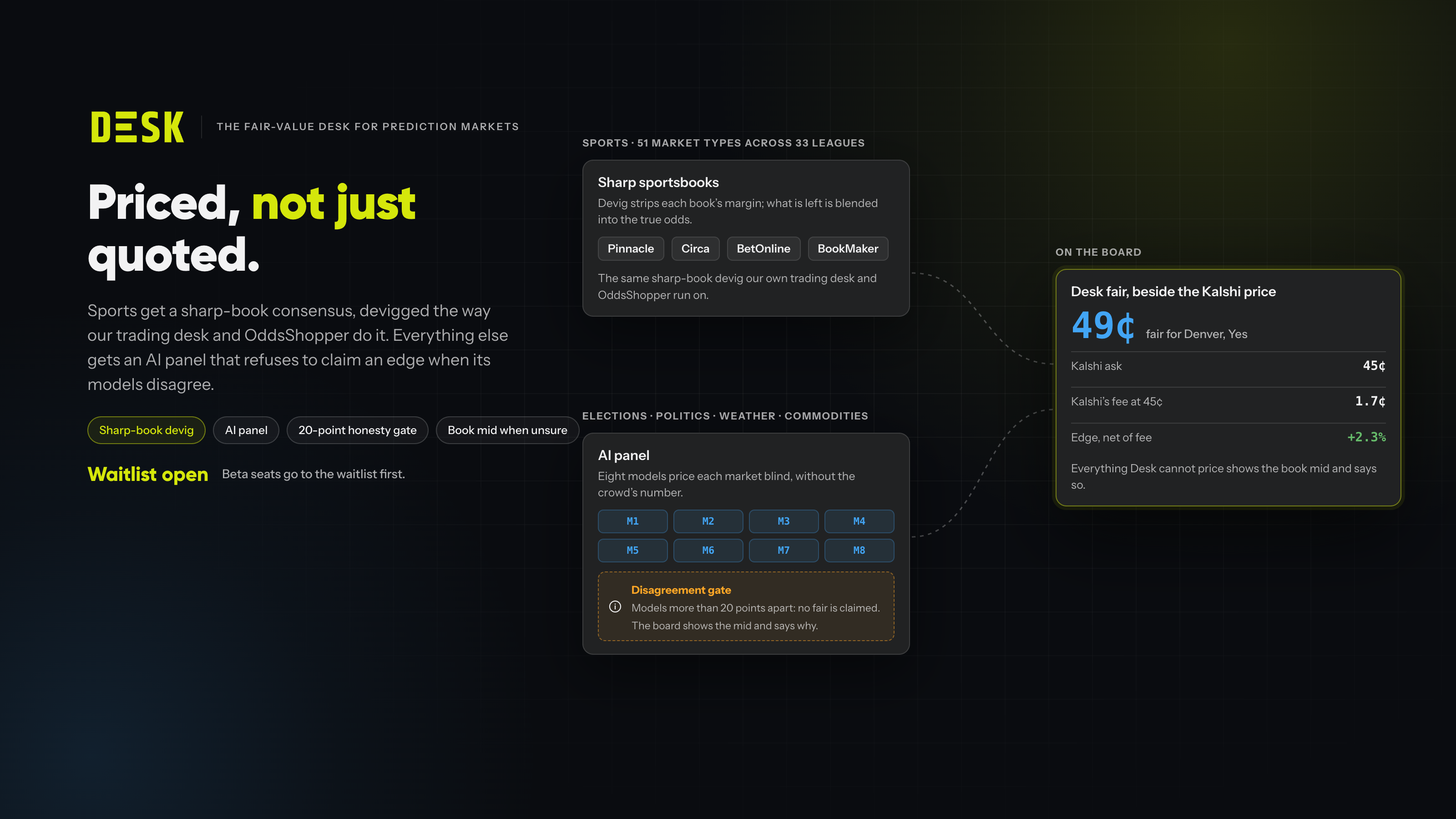
The sequence I run does not change, it just gets more valuable with a third book. Strip the vig out of the sportsbook price to get a no-vig probability, compare that to the contract price on each venue, then subtract the friction that venue charges you: the fee, the bid-ask spread you have to cross, and the settlement timing that decides how long your money sits there. Size only where the gap survives all three, because a two-point edge does not survive a three-point spread. Shop the same outcome across every major sportsbook on the live odds screen first, and see the free expert picks for how our analysts read the same board.
The Part That Could Still Go Wrong
I would be writing this badly if I left out the arguments against it.
The market did not love the deal. IG's shares fell about 8.5% when the acquisition was announced, per market coverage on the day, and the company paused its buybacks the same day, expecting to resume in 2027. Shareholders who had bought a regulated trading business are being asked to own a fantasy sports operator, and a chunk of them repriced it accordingly.
The second argument is regulatory, and it sits under the whole category rather than this deal. Senators Adam Schiff and John Curtis introduced the bipartisan Prediction Markets Are Gambling Act (S. 4160) in March 2026, which would amend the Commodity Exchange Act to bar CFTC-registered entities from listing sports and casino-style event contracts. It has not passed, and forecasting Congress is not my job. But the case for paying $1.3 billion rests on federal preemption holding, and that question is open, alongside the state fights in our prediction market legality guide. Underdog co-founder and CEO Jeremy Levine's own framing is the tell: the company has "proven we can build the best products no matter how the regulatory landscape shifts."
The third argument is in IG's footnotes. CEO Breon Corcoran holds a personal investment of roughly 0.34% of Underdog's fully diluted share capital, acquired in March 2021 and January 2023, before he became IG's CEO in December 2023. He disclosed it, the board approved his involvement in negotiating the deal, and he recused himself from its formal approval: the correct process in the correct place. It is also a buyer's CEO with a personal stake in the seller and a relationship with its founder going back to the Paddy Power Betfair years, worth knowing when you weigh how hard the price was negotiated.
Where I Land
This deal is a receipt, not a forecast. IG did not bet that DFS players would migrate to prediction markets; it watched event contracts reach 54% of Underdog's handle inside the first half of 2026, and agreed to pay 2.4x revenue to own the pipe those dollars were moving through.
For years the argument about prediction markets versus sports betting has been about legality, or whether the contracts are "really" gambling. This transaction skips that fight and answers a different question: where is the money going. A trading company just committed close to a billion dollars, most of it its own equity, behind its answer, and the fantasy app in your pocket is the road it plans to use. Whether that is smart is a 2029 question. Whether it changes what you get offered this NFL season is not.
Sources
- IG Group, Acquisition of Underdog, regulatory announcement, July 30, 2026 (all deal terms and Underdog financials).
- Underdog, Underdog Launches Prediction Markets on its own Exchange, July 18, 2026.
- US Senate, Curtis, Schiff Introduce Bipartisan Legislation to Ban Sports Prediction Market Contracts, March 2026 (Prediction Markets Are Gambling Act, S. 4160).
- Investing.com, "IG Group stock tumbles on $1.3 billion Underdog acquisition," July 2026 — the source for the 8.5% share-price move. The buyback pause is confirmed in IG's own announcement above.
Prices on this page are Kalshi's book. If you also trade on Polymarket, code OS4 gets new users a $50 trading bonus on a $10 deposit — affiliate link; terms as stated by Polymarket; 18+, availability varies by state.
More on this: UEFA Nations League Odds: Spain And England In One Group · Underdog Predict Review 2026: How The Fantasy Giant's Prediction Market · Greenland Acquisition Odds: Will The US Take Any Part?