Slate: Sunday, Aug 16 · Updated Aug 16, 9:55 a.m. ET · Prices as of August 16, 2026, 8:41 a.m. ET
Every day this page grades the AI panel's last batch of calls in public, names the widest market-vs-model disagreement on the day's sheet, and lists what settles before the close. This morning's sheet splits into two piles that could not be less alike. One pile is boards that moved because something physically happened: a leaderboard filled in, a tennis match started, a review got posted. The other pile is boards where nothing happened at all and the price is still miles from our panel's number, because the argument is not about the world, it is about what a word in the contract means. Knowing which pile you are looking at is the whole job today. The URL never changes, so bookmark it.
Jump to: The Morning Grade · Pick of the Day · The Gap · Biggest Swings · Resolves Today · New Listings · Full Scoreboard
The Quick Answer
Tom Kim's contract to finish top 20 at the FedEx St. Jude Championship opened this window at 16¢, took 37 points in the single hour stamped 11 a.m. ET Saturday, and prints 80¢ now, the largest move on today's sheet. Behind it, a movie-score contract that opened this window at 33¢ is at 96¢, a pair of tennis contracts crossed each other in the hour stamped 7 a.m. ET, and there is no Pick of the Day, because nothing settling inside 48 hours carries a panel read wide enough to qualify. The most interesting number on the sheet is a 54-point gap on an Apple contract, and I am going to spend the gap section arguing that our own panel is on the wrong side of it. The reason why is a lesson worth more than the gap.
These are model estimates, not predictions of fact and not financial advice. Kalshi is a CFTC-regulated event-contract exchange, open to users 18+ in eligible states, and availability varies by state.
Free: The Weekly PM Market Brief — the AI panel's graded record, the week's biggest market-vs-model gaps, and what's spiking next. One email, Sundays. Sign up in the box at the end of this article.
The Morning Grade
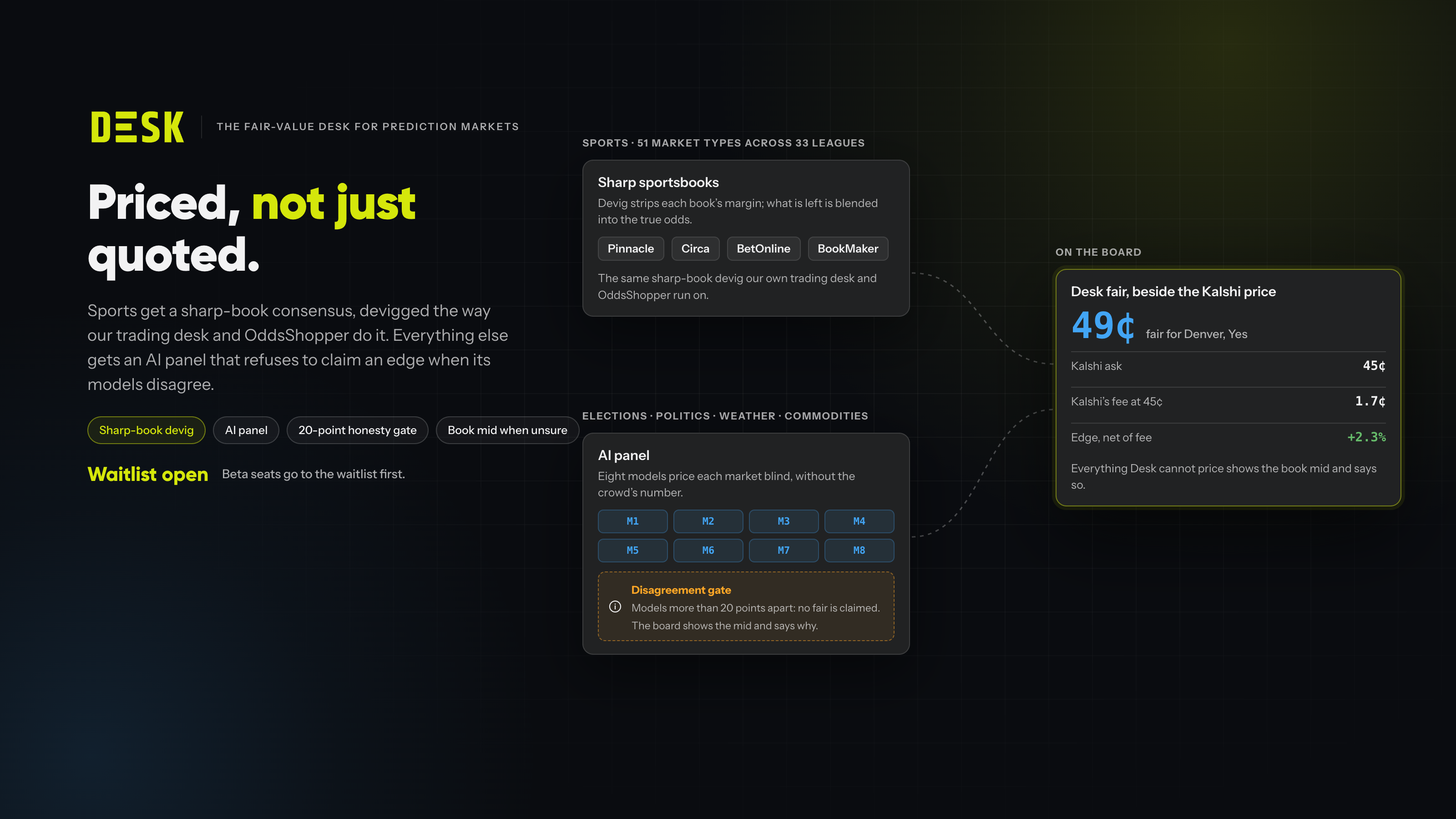
The panel is a bank of AI models (Claude Fable, Claude Opus, Claude Sonnet, GPT, Gemini, Grok, Kimi, GLM, and DeepSeek) that each put a probability on Kalshi markets without seeing the price. Every call is graded here against the real settlement.
No new grades landed overnight, and none landed Thursday, Friday or Saturday either. The last book to settle and score is still Wednesday's, so the honest version of the day record this morning is that there isn't one.
Positions are graded as one theoretical contract per call, bought on the panel's side at the ask; a Kalshi contract pays $1.00 at settlement, so a 76¢ favorite risks 76¢ to win 24¢ while a 24¢ underdog risks 24¢ to win 76¢.
| Ledger | Calls | Avg price | Staked | P&L | ROI |
|---|---|---|---|---|---|
| Latest Graded Day (Wed, Aug 12) | 69 | 78¢ | $53.54 | −$1.54 | −2.9% |
| Full 17-Day Window | 1,406 | 76¢ | $1,069.57 | −$0.57 | −0.05% |
Read the average-price column before you read the P&L column, because it explains the whole table. At 76¢ across fourteen hundred calls this is a heavy-favorite book, and a heavy-favorite book wins the large majority of its calls by construction. That is exactly why no win count appears here: it would look terrific and mean nothing. Seventeen days of work for a net loss of fifty-seven cents on $1,069.57 staked is the real answer, which is flat, and the profitable-day streak is zero.
The Wednesday row is the sharper one: 69 graded calls, $53.54 staked, $1.54 gone. The number every reader of this page should carry around is the one in the middle column. Break-even on a 78¢ contract is 78%, so a book buying at that average has to be right nearly four times in five just to hold serve, and being right most of the time is not the same thing as being right often enough.
Return by seat is the more useful cut, and it has not moved since Wednesday either, for the obvious reason that nothing has been graded.
| Seat | Graded calls | Staked | ROI |
|---|---|---|---|
| Claude Sonnet | 295 | $202.70 | +6.07% |
| Claude Fable | 299 | $204.22 | +5.77% |
| Claude Opus | 297 | $205.25 | +2.80% |
| Kimi | 1,324 | $992.14 | +0.99% |
| Grok | 2,007 | $1,538.71 | +0.93% |
| DeepSeek | 1,356 | $984.74 | +0.74% |
| GLM | 1,350 | $999.87 | +0.71% |
| Gemini | 2,177 | $1,683.30 | −1.32% |
| GPT | 2,783 | $2,112.11 | −2.23% |
The row I keep coming back to is GPT's. It is the largest book on the board at 2,783 graded calls and $2,112.11 staked, and it is also the worst performer at −2.23%. The three seats above 2% all sit on books under 300 calls. That ordering is what a sample-size artifact looks like from the inside, and it is why this table gets published with the call counts attached rather than as a leaderboard. Ask again in a thousand calls.
Almost nothing is marked against the panel this morning, because eleven of the twelve boards on the gap screen were polled at 8:12 a.m. ET today and have not had time to drift. Two have moved since they were asked. The smaller one is the Apple before-2027 rung, two points further from the panel than at ask. The larger one is the only sports contract on the screen: Jacob Misiorowski to win the National League Cy Young, polled on August 5 at 79.5¢ against a blended read of 43.1%, now trading at a mid of 87¢. That is 7.5 points of drift in eleven days, all of it away from the panel, on a board that has traded $372,858 with a two-cent quote. Seven seats priced it between 30.9% and 50%, so the blend is not one outlier dragging the rest down. It settles at the end of December and nothing about it is realized until then.
This day record is the calibration farm rather than a picks record. It grades whatever settles fast, which is why a 69-call day can carry $53.54 of stake and a picks sheet never would; the complete history is public on the Model Verdict Scoreboard.
Pick Of The Day
No call today, and the reason is a calendar problem rather than a shrug. The flagship needs a market settling inside 48 hours where the panel disagrees with the price, The sheet ranked thirty divergences this morning and surfaced the twelve widest, and those twelve fail the first half of that test without exception. Three NVIDIA rungs, four OpenAI Astra rungs and two GPT-6 rungs all carry expiry stamps in November, December or January. The two Apple rungs are stamped January 1. The one sports board left, the Cy Young contract, is stamped December 31. The flagship test ran on those twelve, which is the widest slice the sheet publishes.
Meanwhile the boards that actually settle before dinner tonight, a baseball slate, a soccer card, a full tennis card and the 5 p.m. crypto candles, were never polled, so there is no panel number to hold their prices up against. That is the structural shape of a Sunday in mid-August: the fast half of the exchange is a sports slate, and the half our panel has been working is a set of winter futures. The next board that settles quickly, splits the panel, and has not started yet gets the flagship treatment.
The Gap
Apple to release the iPhone 18 before 2027 — Market: 12¢. Panel: 66.0%.
Fifty-four points, on a book that has traded $662,034 with a one-cent quote and eight seats spread from 55% to 90%. On the three structural checks this page always runs, spread first, volume second, seat cluster third, it passes all three. It is the widest disagreement on the sheet quoted a penny wide with six figures of flow behind it. NVIDIA posts a bigger raw number further down, on a book nobody has traded.
And I think it is our number that is wrong, not the market's.
Here is the check that flips it. Our full model verdict on this exact contract, dated August 3, reports a five-model run of the panel blending to 13% before October and 20% before 2027, against a Kalshi market of 10¢ and 19¢ on the same two rungs. Panel and market were within a few points of each other on both. This morning an eight-seat run priced those two rungs at 53.8% and 66.0%, while the market moved the other way, down to 6¢ and 12¢. Nothing on our sheet says Apple did anything in the thirteen days between. What changed is which phone the seats think the contract is about.
DeepSeek, filing the highest read on both rungs at 85% and 90%, says it out loud: "Pegatron confirmed Pro lineup on track for September; 'iPhone 18' likely includes Pro models, so Oct 1 rung is high confidence." That is a claim about the September Pro launch being on schedule, which nobody disputes. But the contract's own rule text reads "If Apple Inc. releases iPhone 18 to the public before Jan 1, 2027, then the market resolves to Yes," and our verdict page reports that Kalshi runs the Pro as a separate market, which is the entire reason that page exists. A seat that prices the Pro launch onto the standard-model ladder is not disagreeing with the market about Apple. It is answering a different question.
So read the 54 points as a scope error rather than an opportunity, and take the general lesson instead: on any release-date ladder, read the resolution text before you read the gap. The number is only as good as the noun.
Which is a useful lens for the rest of this morning's screen, because every other gap on it is the same species of fight.
| Board | Market | Panel | Gap | Spread | Volume |
|---|---|---|---|---|---|
| Apple iPhone 18, Before 2027 | 12¢ | 66.0% | +54.0 pts | 1¢ | $662,034 |
| Apple iPhone 18, Before October | 6¢ | 53.8% | +47.8 pts | 1¢ | $871,755 |
| OpenAI GPT-6, Before 2027 | 78¢ | 18.6% | −59.4 pts | 6¢ | $37,162 |
| OpenAI GPT-6, Before Nov 1 | 50¢ | 9.1% | −40.9 pts | 4¢ | $73,244 |
| OpenAI Astra, Before Oct 1 | 72¢ | 25.1% | −46.9 pts | 3¢ | $9,863 |
| NVIDIA Vera Rubin, Before 2027 | 86¢ | 13.5% | −72.5 pts | 7¢ | $0 |
The GPT-6 rows are the ones worth sitting with, because there the panel's scope argument is the one I would keep. The market prices a model called GPT-6 or higher arriving before 2027 at 78¢; the panel says 18.6% across eight seats that range from 10% to 26%. DeepSeek's note is the cleanest statement of the case on the whole sheet: "No GPT-6 name signal; Astra branding likely displaces numeric naming. Contract pays on literal name, not capability." That is precisely the reasoning the iPhone rows needed and did not get. Same panel, same morning, opposite discipline, and it is only visible if you read the notes column next to the gap column.
Astra is the other side of the same coin, and Kimi carries the high read there at 45% on the October 16 rung, arguing the disclosure came with "an unusually broad same-training-run clause" so that "any rebranded public derivative pays." Notice that Kimi's clause argument and DeepSeek's naming argument cannot both be the dominant effect. One says the wording is loose enough that almost anything settles Yes; the other says the wording is literal enough that a better model under a different name settles No. The market has picked a side: 72¢ on Astra before October and 78¢ on a GPT-6 name before 2027 says traders think both ship. If you only take one thing from this section, take the habit of finding that contradiction inside a panel before you trust its blend.
The bottom row is on the table as a warning, not a candidate. NVIDIA's Vera Rubin ladder posts the single widest raw gap on the sheet at 72.5 points, plus two more inside the top four, on books that have traded $0.00, $3.00 and $176.71 in their lifetimes behind six- and seven-cent quotes. A gap measured against the midpoint of a market nobody has traded is a gap against an imaginary number. Structure first, always: the Apple rows clear all three checks and are still wrong for a different reason, and these clear none of them.
More live boards from the same panel: the full launch ladder lives on tech release date odds, where the GPT-6 rung quotes 78¢ · the standard-model argument is unpacked at iPhone 18 release date odds, whose before-2027 rung is 12¢ this morning · and the politics side is on Senate control 2026 and Fed September 2026.
Biggest Swings
Everything above moved zero points overnight, which is what a definition fight looks like on a tape. This is the other pile.
| Market | Path | Big hop (ET) | Expiry stamp (ET) |
|---|---|---|---|
| Tom Kim To Finish Top 20, St. Jude | 16¢ → 80¢ | Sat 11 a.m., +37 pts | Aug 29, 8 p.m. |
| The End Of Oak Street Above 84 Tomatometer | 33¢ → 96¢ | Sat 11 a.m., +15 pts | Mon, 10 a.m. |
| The End Of Oak Street Above 85 Tomatometer | 5¢ → 35¢ | Sat 3 p.m., +19 pts | Mon, 10 a.m. |
| Varvara Panshina, W75 Kursumlijska Banja R32 | 41¢ → 76¢ | Today 7 a.m., +22 pts | Today, 11 a.m. |
| Yelyzaveta Kotliar, W35 Bydgoszcz Final | 55¢ → 85¢ | Today 6 a.m., +14 pts | Today, 10 a.m. |
| Shedeur Sanders, Cleveland Week 1 Starter | 24¢ → 15¢ | Sat 11 p.m., +14 pts | Sep 15, 10 a.m. |
Read the Path column as the whole 25-hour window and the Big hop column as the largest single hour inside it, which is why a hop can point the opposite way from the session.
Start with the golf, because it is the largest move on the sheet and also the quietest. Tom Kim's top-20 contract went 16¢, 15¢, 23¢, then 60¢ in the hour stamped 11 a.m. ET Saturday, then 82¢. Since that spike it has printed inside a six-cent band for twenty straight hours, 78¢ to 83¢, and it sits at 80¢ this morning. The board has traded $1,534,884 lifetime with $217,324 of that in the last day. Our sheet flags no volume concentration and no linked story on it, so I am not going to attach a reason I cannot source. The structural read is the one worth having: a top-20 finish is a position contract rather than a winner contract, which means live scoring moves it far harder than it moves an outright, and once the field has sorted itself the same property makes it go still. Sixty-four points and then twenty flat hours is one board doing both halves of that in a day.
The movie board did the opposite thing, and it gets sharper the closer you line the rungs up. The End of Oak Street runs a Tomatometer ladder, and three of its rungs are living in different worlds this morning. The above-84 contract ran 33¢ to 96¢ across the window and quotes 94/96¢. The above-85 contract, one single point higher, ran 5¢ to 35¢ over the same hours and quotes 30/34¢. Underneath both, the above-80 rung sits at 99/100¢, which is the market saying that argument is over. Read those three together: one point of Tomatometer separates a 94/96¢ quote from a 30/34¢ quote, and all three settle at the same instant tomorrow morning. That single point is where the entire remaining uncertainty on this title now lives.
The tennis pairs are the tidiest demonstration of a rule this page keeps coming back to: correlated boards that move in the same hour are reading one event. Varvara Panshina went 41¢ to 76¢ while Xinran Sun went 58¢ to 28¢, both taking their biggest hour in the hour stamped 7 a.m. ET, both stamped to expire at 11 a.m. Yelyzaveta Kotliar went 55¢ to 85¢ while Daria Kuczer went 35¢ to 14¢, both hopping in the hour stamped 6 a.m., both stamped 10 a.m. Two sides of one contract crossing inside the same sixty minutes is not information arriving, it is a match being played. There is nothing to trade in that and nothing to explain about it.
Which brings me to the one row on the table that is not a leaderboard and not a definition fight. Shedeur Sanders to be Cleveland's Week 1 starting quarterback sat between 11¢ and 18¢ through Saturday evening, spiked to 26¢ in the hour stamped 11 p.m. ET, and was back to 14¢ an hour later. It has printed 15¢ or 16¢ ever since. The board has traded $247,341 lifetime and only $12,690 of it in the last day, and our sheet flags no volume concentration and no story attached to the hop. A 14-point move that fully retraces inside two hours, overnight, on a book doing five percent of its lifetime volume that day, is the shape of thin-market noise rather than news. Anyone reading that spike as a pro football roster signal was reading thin-market noise rather than a sourced report. Its expiry stamp is September 15, so there are four more weeks for something real to happen to it.
The tell to take from this morning: two boards on one question that move in the same hour are reading an event. Two boards on one question that sit 60 points apart with neither one moving are reading a rulebook. The first kind is usually over by the time you see it. The second kind is where reading the rule text does the most work.
Resolves Today
Fifty-three contracts on our sheet carry a settlement stamp inside the next day. Here is the marquee slice, with yes-side bid and ask as of the 8:41 a.m. ET price stamp. Every time below is the contract's expiry stamp, not a first pitch, a kickoff or a final whistle.
| Market | Category | Expiry stamp (ET) | Price | What decides it |
|---|---|---|---|---|
| Manchester City To Advance Past Arsenal | Soccer | 4:00 p.m. | 53/54¢ | Advancing and lifting the Community Shield, so a shootout counts |
| Arsenal And Manchester City Both To Score | Soccer | 2:00 p.m. | 57/58¢ | Both teams scoring in 90 minutes plus stoppage |
| Real Madrid To Beat Schalke | Soccer | 2:00 p.m. | 74/75¢ | 90 minutes plus stoppage, no extra time or penalties |
| Villarreal To Beat Santander | Soccer | 2:00 p.m. | 47/48¢ | 90 minutes plus stoppage, La Liga fixture |
| Tampa Bay To Beat Baltimore | Baseball | 3:15 p.m. | 57/58¢ | Game result |
| Boston To Beat Pittsburgh | Baseball | 4:35 p.m. | 53/54¢ | Game result |
| Bitcoin Above $63,249.99 At 5 P.m. | Crypto | 5:05 p.m. | 12/13¢ | The 60-second BRTI average, not a spot tick |
| Milwaukee At Los Angeles, First-Inning Run | Baseball | 7:10 p.m. | 46/47¢ | Either team scoring in the first |
| The End Of Oak Street Above 85 Tomatometer | Entertainment | Mon 10:00 a.m. | 30/34¢ | The score showing at 10 a.m. ET Monday |
| Donald Trump To Attend UFC 330 | Other | 10:00 a.m. | no bid / 1¢ | Whether he attended UFC 330 |
The last row is the biggest book on this table by a distance, $658,909 traded, and it is also the only one where the price has already told you the answer. No bid against a one-cent ask means the market has settled the question in its own head and is waiting for the clock. Compare that to the two soccer rows immediately above it, priced 74/75¢ and 47/48¢ with hours to run, and you have the difference between a contract that is live and a contract that is merely listed.
The soccer rows are where the rule text does the most work today, and the Community Shield final is the cleanest demonstration on the sheet. Two contracts on one match, and they do not settle on the same football. Manchester City to advance resolves on advancing past Arsenal and lifting the cup, so a shootout counts. Both teams to score resolves on 90 minutes plus stoppage, so a shootout does not. Same fixture, same afternoon, one contract reading the trophy and the other reading the clock, priced 53/54¢ and 57/58¢ on $99,269 and $91,010. The Real Madrid and Villarreal rows carry that same 90-minutes-plus-stoppage wording, and on the Real Madrid row it is a club friendly, where an exhibition that ends level pays the draw side no matter what happens in a shootout afterward.
Not in the table above: the New York and Toronto total at 4:37 p.m., the Washington and New York spread at 4:40 p.m., the Philadelphia and Minnesota total at 5:10 p.m., the Seattle and Houston total at 10:20 p.m., the two Ethereum rungs at 5:05 p.m., and a tennis card that has been settling all morning. The table is the marquee slice, not the full settlement calendar.
What else to watch: four mention boards whose events air today do not appear in the table above, because today's sheet gives them no settlement stamp at all. They are the most interesting boards on the sheet anyway, though at those sizes they are small money next to a day's sports books. The board on what Todd Blanche says during Fox News Sunday has 14 contracts and $46,091 traded, with "Democrat" at 51/54¢ and "Election" at 22/25¢. The board on Hakeem Jeffries during Meet the Press has 14 contracts and $26,383, with "Trump / President" at 86/87¢, affordability language at 80/84¢, "Supreme Court" at 63/68¢ and "Oil / Gas / Gasoline" at 59/62¢. The Ro Khanna board on the same program has 12 contracts and $11,455, where "Billionaire" is a coin flip at 51/52¢ while "AI / Artificial Intelligence" is 4/9¢. A fourth board, on Tom Homan during Fox News: One Nation with Brian Kilmeade, carries 13 contracts and $10,042.
Two things about that Jeffries board repay attention. The affordability contract at 80/84¢ is the market saying a word is close to certain to be said, which is a very different kind of forecast from a game result, and the four-cent spread is it admitting it cannot be sure. And the Jeffries board carries an "Event does not qualify" contract at 0/1¢, which pays if the appearance never happens in a form the rules recognize. At 0/1¢ it is the cheapest contract on that board.
The Fine Print: The Tomatometer Settles On A Reading, Not A Score
Look again at the rule on the movie rungs: "If The End of Oak Street has a Tomatometer score of above 85 on Aug 17, 2026 at 10:00 AM ET, then the market resolves to Yes." That criterion is a photograph, not a verdict. It does not ask where the score lands, it asks what the number reads at one instant tomorrow morning, and a score sitting a fraction above or below the line at 9:59 can cross it on a single review posting late Sunday night. There is no adjustment afterward.
Two details compound it. The word is "above," not "at or above," so a score of exactly 85 pays No on the 85 rung and exactly 84 pays No on the 84 rung. And the rungs all settle at the same instant, which is why the 30/34¢ on the 85 rung and the 94/96¢ on the 84 rung are pricing one reading rather than two different futures. That is also the general lesson for this whole class: a contract that settles on a published number settles on the number as published at a stated moment, and the moment is doing at least as much work as the number.
New Listings
Five of the roughly two dozen boards that opened in the last day, rated on structure rather than on a view about the outcome.
- Taylor Fritz To Beat Michelsen, ATP Cincinnati Round Of 64, 62/63¢. Worth A Look. Opened 11:05 a.m. ET Saturday, penny wide on $78,193 of flow, stamped 2 p.m. today. A penny quote on five figures inside a day of listing is the best-structured new board on this sheet, and 62¢ is a real opinion rather than a formality.
- Baltimore And Tampa Bay To Score More Than 7.5 Runs, 52/53¢. Worth A Look. $82,669 traded, penny wide, stamped 3:15 p.m. A total that finds the coin flip on its own and stays there is a market somebody has argued with on both sides.
- Miami's High Temperature To Land At 95 Or 96 Degrees, 25/28¢. Worth A Look. $17,564 on a three-cent quote, settling Monday afternoon. This is a band contract rather than a threshold, so it can lose in both directions, and 25¢ is the market pricing a two-degree window out of a whole distribution. Read the price as a width question, not a hot-or-cold question.
- Los Angeles's High Temperature To Exceed 82 Degrees, No Bid / 1¢. Skip. $91,093 has traded on a contract nobody will bid for, which makes it the highest-volume near-zero listing on the sheet. There is nothing structurally wrong with it and nothing to do with it.
- Ethereum Above $1,849.99 At 5 P.m., 95/97¢. Skip. $28,342 on a two-cent quote. You cross to buy at 97¢, and 97¢ buys you three, on a five-hour view of a crypto price. The strike is far enough below the market that the contract has already done its thinking.
The baseball listings are the ones worth sitting with, because of what is missing from them. Every new baseball board that opened yesterday is a game-level contract, five totals and three spreads, and not one player prop among them. The only MLB prop rungs anywhere on today's sheet are the two Ryan Weathers strikeout lines on the New York and Toronto game, 5+ at 54/55¢ on $3,200 of flow and 8+ at 12/13¢ on $2,957. That is the whole player layer on the exchange today, on four-figure books. If the player layer is the one you actually want on a Sunday slate, the live home run prop odds screen prices it across every major sportsbook at once, and holding those numbers against each other is the same line-shopping habit that makes an exchange board readable in the first place.
Kalshi Picks Today FAQ
Why Is There No Pick Of The Day This Edition?
The flagship needs a market settling inside 48 hours where the panel disagrees with the price, and nothing on this sheet does both. Every one of the twelve widest rows the sheet surfaces is a winter future stamped for November, December or January, and the boards settling today were never polled. The Pick of the Day section above lists the stamps.
Why Does This Page Argue With Its Own Panel?
Because the panel is a measured instrument, not an oracle, and the measurement is published above. When a seat's written reasoning contradicts the contract's rule text, as it does on the Apple rungs this morning, saying so is more useful than reprinting the blend. The ledger will keep score either way.
What to watch between now and tonight's close: the 5:05 p.m. Bitcoin rung at 12/13¢ is the cleanest live test of the candle-versus-book habit above, because it reprices continuously right up to its stamp. The Tomatometer pair is the one to check tomorrow at 10 a.m., when a single overnight review can decide the upper rung. And the four mention boards are worth a look the moment the programs end, because that is when their prices stop moving, whatever their contracts say about expiry.
The Full Verdict Boards
Today's gap screen is almost entirely a technology screen, which is unusual, and the standing boards behind it are worth reading in full: tech release date odds carries the whole launch ladder that the GPT-6 and Astra rungs come from, and iPhone 18 release date odds is the page whose scope argument the panel appears to have lost track of this morning.
The politics boards did nothing overnight, and the sports side is one contract: the Cy Young board discussed in the Morning Grade sits off the standing coverage on Senate control 2026, South Carolina Senate 2026 and Fed September 2026. The Bitcoin rung settling at 5:05 p.m. tonight has a long-range sibling on the end-of-2026 board, where the timeframe is long enough for a forecast to mean something, and the 15-minute markets board is the opposite extreme. Outside today's sheet, the standing boards are 2026 Ballon d'Or and 2028 Democratic nominee.
How To Read These Prices
A Kalshi price is the market's probability in cents, so a contract at 80¢ is the crowd saying roughly an 80% chance. The complication most explainers skip is that a board carries two prices at once, and this morning's sheet shows the gap between them cleanly on the movie rungs. The above-85 contract's last hourly candle printed 35¢. The live order book reads 30 bid, 34 ask. Both numbers are honest: the candle is where the board last traded, the book is where you could actually do something about it, and when the two disagree, believe the book.
That distinction is also why every gap in this edition is quoted with its spread attached. A panel probability is a clean number with no bid and no ask behind it, so holding it against the midpoint of a seven-cent quote on a book that has traded three dollars, as the NVIDIA rungs invite you to do, compares a real number to an imaginary one. And as the Apple rows show, passing all three structural checks still is not enough on its own: the last check is always the rule text. The mechanics, fees, and what happens at settlement are covered in how to bet sports on Kalshi and how Kalshi settlement works.
Hottest Prediction Markets Right Now
- 2028 Democratic presidential nominee · $181M traded
- FedEx St. Jude Championship Winner · $92M traded
- 2027 Pro Football Champion · $63M traded
- 2028 U.S. Presidential Election winner? · $60M traded
- 2028 Republican presidential nominee · $57M traded
- Pro Baseball Champion · $54M traded
Every market above links to our full AI model verdict; browse them all on the OddsShopper prediction markets hub, and see how every settled call actually scored on the full graded scoreboard.
How this page works. The prices above were pulled from Kalshi's public API at 8:41 a.m. ET on August 16, 2026; the grades come from our public verdict ledger, where every AI-panel call is stored with its ask-time price and graded against the real settlement. These are model estimates, not predictions of fact and not financial advice. Kalshi is a CFTC-regulated event-contract exchange, open to users 18+ in eligible states, and availability varies by state. Event contracts involve risk.